Sports
Pace, swerve, angle – the art of the ‘olimpico’, football’s (usually) rare phenomenon


Oscar Wilde once famously wrote that “to concede one goal direct from a corner is a misfortune, to concede two in eight days looks like carelessness.”
The thoughts of Oscar, noted corner-kick scholar, may have been rushing through the heads of anyone associated with Manchester United recently after they allowed not one but two ‘olimpicos’ — which, if you’re not familiar with the term, means scoring directly from a corner — in just over a week, in two different competitions.
The first came from Son Heung-min in that madcap Carabao Cup quarter-final against Tottenham, his corner sailing over second-choice keeper Altay Bayindir and into the net. The second saw Matheus Cunha flummox Andre Onana, with the help of some judiciously positioned Wolves defenders, in the Premier League on Boxing Day.
The olimpico is a relatively rare phenomenon. You tend not to get more than one a season, if that, so United managing to let two in over such a short period of time is fairly extraordinary. Although given their problems with defending set pieces and their general existential crisis, if you were going to predict which team this would happen to, it would probably be them.
The instinct is to write these goals off as flukes, misdirected crosses that rely on goalkeeping errors to go in, not genuine attempts to score by the corner taker. How can the attacker possibly mean it when they can’t see the goal?
That’s certainly true of some. However, many of them exist in a sort of grey area, where there’s intent from the corner taker and the attacking team, and the aim is ultimately reached, if perhaps not through entirely conventional means.
Former Blackburn Rovers winger Morten Gamst Pedersen, still playing aged 43 back in his native Norway, has made scoring olimpicos something of a signature move in the latter days of his career. He scored three of them in one season a few years ago, and claims he once scored five in one game, in his youth.
Pedersen celebrates a Premier League goal for Blackburn in 2005 (Paul Mcfegan/Sportsphoto/Allstar via Getty Images)
His contention is that even if the taker isn’t always ‘shooting’ per se, a goal is the ultimate conclusion of a well-struck corner anyway.
“If the ball can go straight in, it’s like a perfect free kick,” he tells The Athletic. “You’re aiming for the far corner, and loads of things can happen, the goalkeeper can get distracted. If it would go in anyway with nobody there, it’s a good corner.
“You see with what Arsenal have been doing this season: loads of the corners they’ve been scoring from, if nobody touched it, the ball would have gone straight in anyway.
“It’s about creating those situations as close to the goal line as possible. Anything can happen.”
This is a sentiment echoed by another olimpico specialist, the former Wycombe Wanderers full-back Joe Jacobson. He scored two in one game (as part of a hat-trick of set pieces) against Lincoln in 2019, and a number of others over his career.
Here it is!
One of the most incredible hat-tricks you’ll see. pic.twitter.com/N7jbaWsD9T
— Wycombe Wanderers (@wwfcofficial) September 9, 2019
“I don’t think I ever set out thinking, ‘I’m gonna hit it in the top corner’,” Jacobson says, “but there’d be plenty of times when the coach would tell me, ‘Get it on target, as if it’s a shot’, so that if someone gets a nick or anything it can go in.
“I think inswinging corners went out of fashion for a while — there were a lot of studies showing that if you do outswingers, then defensive headers don’t go as far. Now all of a sudden Arsenal have kind of made inswingers popular again.”
On some occasions though, the taker is definitely trying to shoot.
Megan Rapinoe famously scored directly from a corner at the Tokyo Olympics in 2021, having done so nine years earlier in London. The first instance might not have been entirely intentional, but the second was. According to her, at least.
“I meant this one,” she told the media after that game against Australia in Tokyo. “I actually said it to Vlatko (Andonovski) and our assistant coach Laura Harvey yesterday. They were saying ‘Put it here, this is where we want to go, this is kind of the game plan,’ and I was like ‘Well, I might just shoot it.’”
Pedersen’s became so frequent and clear that his colleagues adjusted their movements accordingly.
“At one stage one my team-mate, who played centre-half, asked me before I took the corner, ‘Morten, are you going to shoot?’ I said yes, so he just stayed back on the halfway line.”
Pedersen would practise corners as if he was trying to score, even if most of the time someone would intervene before it got to the net. “When I played for Tromso at the beginning of my career, I would put a basketball hoop and board in front of the goal, and aim for that,” he says.
From a layman’s perspective, it seems that the secret to a dangerous inswinging corner is to get as much swerve on the ball as possible, so the taker must adjust the way they strike the ball accordingly. But Jacobson suggests that, while swerve is a factor, pace and delivery angle is much more important.
“You see loads of times where it’s a nice curly ball into the box and the keeper just plucks it out of the air. But when there’s pace on the ball and it doesn’t get too high, it doesn’t go too far above his eyeline, then I think it’s really difficult for the keeper to come and claim anything.”
Jacobson instead relied on the angle of his run-up to create just the right amount of curl, thus allowing him to concentrate on striking the ball as cleanly and as powerfully as possible.
“As with free kicks, I’d always stand at a right angle to where I wanted to hit the ball and where I wanted it to end up. I tried to hit over the top of the ball, a bit like topspin in tennis, and so it wouldn’t curl miles out and then curl back in.
“I’d over hit a lot and I’d under hit a lot, but when I got them right, the angle meant that I wouldn’t worry about where the ball would end up directionally. I knew that if I ran up at that right angle, the ball would end up in an area where I’d want it to end up.”
From a goalkeeper’s perspective, it’s pretty embarrassing for one of these to go in. But sometimes, when the penalty area is crowded and the taker gets the kick just right, there isn’t a huge amount you can do.
“They’re tricky because you have a lot of guys around you,” says Matt Pyzdrowski, the former goalkeeper and The Athletic’s resident expert. “The tendency for goalkeepers is to first go forward — your instinct tells you that you want to go forward to attack the ball, and get it at its highest point, so you get it before any of the attackers.

Bayindir initially moves forward… (Sky Sports)
… before trying to retreat and getting caught under the ball (Sky Sports)
“As a goalkeeper you want to resist that tendency to be a little bit more patient and I think the goal that Tottenham scored (against United), it’s very clear that the keeper bites very early. There’s a player who runs in front of him and he’s almost more concerned about the player in front of him. He takes a couple of steps forward and then realises the ball’s going over his head.
“Any time the ball goes over your head as a goalkeeper, it’s quite tough to retreat. I think it takes his attention away from the ball enough that he just misses it entirely.”
In Onana’s case, for the goal Cunha scored, the United keeper had attackers in front and behind him, making it extremely difficult for him to move anywhere. In that case, the finger of blame arguably points more at his defenders.
“Each goalkeeper is different,” says Pzydrowski, “but when I played I wanted the defender to be on the outside of the attacker so they can push the player into the goal, so it takes away that space. In this case, the defender (Manuel Ugarte) just doesn’t do a good enough job and he basically pushes the attacker into Onana.”

Onana, surrounded by Wolves players, is also beaten from a corner (Jack Thomas – WWFC/Wolves via Getty Images)
Teams train for these scenarios, but like anything, it’s difficult to recreate the unpredictability and intensity. Might these goals partly be the result of when teams practise corners? Pyzdrowski thinks it could be a factor.
“It was always the day before a game (that we would practise corners) where the intensity is lower. And any time that the intensity is lower in training, there’s just a natural tendency for the player to relax a little bit too much.”
When you watch any olimpico, the instinct is to assume that the ones that go in at the far post are intentional, and the ones that sneak in at the near post are lucky. But the truth might be exactly the opposite.
A perfect example is the game when Jacobson scored directly from two corners. The first snuck in at the near post, the second curled higher into the far.
“The second one obviously looks a lot nicer, but it was probably a bit too high for the near post, and it flew in,” he says.
“Wycombe’s assistant manager Richard Dobson, who was in charge of set pieces, always said try and whip it in the near post head high, because an attacker will get there, and if he doesn’t he’ll cause some chaos behind. It’s really difficult for a keeper to read it if there are players running across the ball.”
Pyzdrowski confirms that. “Where I always felt insecure was when I knew teams were trying to whip the ball in towards the near post,” he says. “Because you want to go forward and attack it, other players might get in the way and that’s where you’re a little bit more vulnerable.”
With more and more teams following Arsenal’s lead and whipping those vicious inswinging corners into the six-yard box, it may not be the last time this season that we see an olimpico.
And while they might look like flukes, there is often a little more to them than that.
(Photos: Getty Images; design: Will Tullos)



Sports
Pirates star pitcher makes unfortunate history after being taken out in middle of perfect game bid

NEWYou can now listen to Fox News articles!
Jared Jones was flirting with Major League Baseball history on Wednesday night — he got it, but it was not what he originally envisioned.
The Pittsburgh Pirates pitcher retired the first 18 batters he faced, but he was taken out in the middle of his perfect game bid after six innings.
Now, the Pirates certainly have their reasons — the 24-year-old Jones hasn’t thrown more than 81 pitches in eight starts since returning May 20 after missing all of last season while undergoing ulnar collateral ligament internal brace surgery on May 21, 2025. He was yanked with 77 pitches and likely would have needed more than 100 pitches to record the 25th perfect game in MLB history.
Jared Jones of the Pittsburgh Pirates pitches during the first inning against the Atlanta Braves at PNC Park on July 8, 2026, in Pittsburgh, Pennsylvania. (Photo by Joe Sargent/Getty Images)
However, Jones left the game after getting zero run support, so when the Atlanta Braves tacked on three runs late for a 3-0 victory, Jones instead found himself in the wrong chapter of the history books.
According to Opta Stats, Jones became the first pitcher in the modern era (since 1920) to pitch at least six perfect innings and not record a win.
“It does suck. Something’s cool coming on, but I’m on what? My eighth start off of surgery? I completely understand it, and it is what it is,” Jones told reporters after the game.
Pittsburgh Pirates starting pitcher Jared Jones (17) makes his way to the field to warm up before pitching against the Atlanta Braves at PNC Park. (Charles LeClaire/Imagn Images)
JUSTIN VERLANDER ANNOUNCES HE WILL RETIRE AFTER THIS SEASON: ‘I’VE REALIZED THAT TIME HAS COME’
Jones said he didn’t entertain attempting to complete the perfect game.
“Not with the pitch count,” he said. “Not really ever expecting to go nine right now, so that was never in my head.”
Joey Bart, traded to the Braves from the Pirates on June 18, followed a double by Mike Yastrzemski with a 422-foot, two-run homer to left-center field off a slider from Dennis Santana. Drake Baldwin added an RBI single to center in the ninth for good measure.
It was the second time in less than a week that a pitcher was taken out of the game with a perfect bid through six innings — the Miami Marlins took Eury Perez out after seven innings in which he had 92 pitches. Perez, too, is in the midst of returning from injury and has surprisingly found himself right in the postseason mix.
He was pulled for Lake Bachar to start the eighth, and the Marlins allowed eight runs to the Athletics in the final two innings, but held on to win 9-8.
Jared Jones (17) of the Pittsburgh Pirates delivers a pitch during a MLB game against the Cincinnati Reds on June 27, 2026, at PNC Park in Pittsburgh, Pennsylvania. (Joe Robbins/Icon Sportswire via Getty Images)
CLICK HERE TO DOWNLOAD THE FOX NEWS APP
The Pirates are 4.0 games out of the final wild card spot, which is held by the Marlins.
The Associated Press contributed to this report.
Follow Fox News Digital’s sports coverage on X, and subscribe to the Fox News Sports Huddle newsletter.
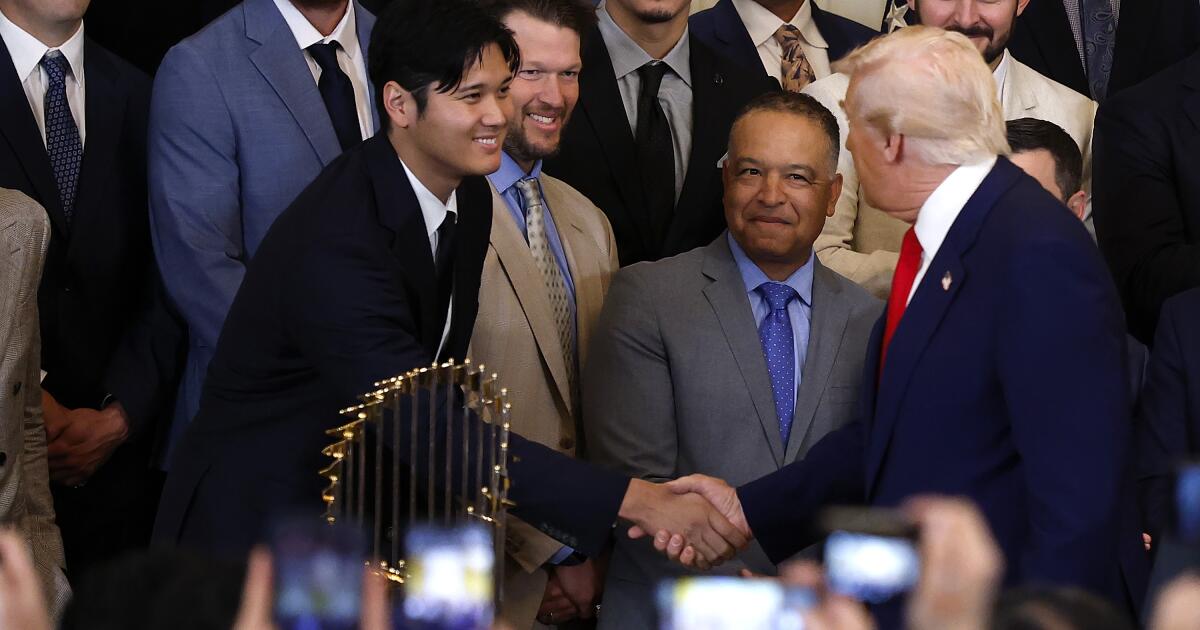
WASHINGTON — The Dodgers are scheduled to visit the White House on July 23 to celebrate their latest World Series title.
“President Trump is excited to welcome the Los Angeles Dodgers BACK to the White House to celebrate their World Series championship!,” White House spokesperson Taylor Rogers said in a statement to The Times.
The date falls on a scheduled off day in the middle of a nine-game East Coast road trip for the Dodgers. The team will play three games in Philadelphia against the Phillies July 20-22 before ending the trip with a three-game series against the New York Mets July 24 to 26.
The visit continues a tradition from the Dodgers’ two previous World Series championships. They were hosted by President Biden in 2021 and President Trump in April 2025.
After the Dodgers claimed their second consecutive World Series title with a dramatic Game 7 victory over the Toronto Blue Jays, a visit to the White House was planned, but it wasn’t until Thursday that a date was officially booked and confirmed.
Questions swirled around whether players would decline the visit this year after it did not happen during a scheduled visit to Washington in April.
Kiké Hernández said in 2018 he was unsure he would have gone had the Dodgers won the World Series the previous year. Mookie Betts said he was undecided and needed to talk it over with his family when last year’s visit was announced. After winning his first World Series with the Boston Red Sox in 2018, Betts skipped their trip to the White House the following year during Trump’s first term.
Both players, along with every returning member of the 2024 team who was with the team during its road trip, participated in the visit. The only notable absence was first baseman Freddie Freeman, who remained in Los Angeles to nurse an ankle injury.
Manager Dave Roberts, who indicated in comments to The Times in 2019 he might not go to the White House if Trump was president, also participated in last year’s ceremony.
Asked at the Dodgers’ fan festival in January about the possibility of returning to the White House, Roberts told The Times’ Bill Shaikin: “For me, I stand by: I’m a baseball manager. That’s my job.”
“I was raised — by a man who served our country for 30 years — to respect the highest office in our country,” Roberts said. “For me, it doesn’t matter who is in the office, I’m going to go to the White House. I’ve never tried to be political. … For me, I am going to continue to try to do what tradition says and not try to make political statements, because I am not a politician.”
Clayton Kershaw, who retired after last season but was on Team USA for this year’s World Baseball Classic, told The Times in the spring that he was aware Dodgers fans are split over whether the team should visit the White House again this year, but he said he is looking forward to it.
“I went when President Biden was in office. I’m going to go when President Trump is in office,” Kershaw said. “To me, it’s just about getting to go to the White House. You don’t get that opportunity every day, so I’m excited to go.”
Times deputy sports editor Ed Guzman contributed to this report.

NEWYou can now listen to Fox News articles!
All eyes were on Caitlin Clark on Wednesday night as she made her anticipated return from injury in a road matchup in Los Angeles.
But instead of a triumphant comeback, the Fever spent the entire night chasing the Sparks as Clark’s rough return fueled a 106-92 rout.
The superstar never found a groove, looking completely out of sync in her return from a back injury.
STEPHANIE WHITE GIVES CAITLIN CLARK STATUS UPDATE AHEAD OF FEVER-SPARKS, BUT HER NEXT MOVE RAISES QUESTIONS
Caitlin Clark huddles with teammates as the Indiana Fever battle the Sparks. (Photo by Katelyn Mulcahy/Getty Images) ((Photo by Katelyn Mulcahy/Getty Images))
Much of that disjointed performance falls squarely on head coach Stephanie White, who kept Clark on a ridiculously tight leash by limiting her to just 16 minutes. The stop-and-go approach could have sabotaged any chance for the phenom to establish a rhythm.
Clark finished with just 9 points, 4 rebounds and 3 assists. Her minus-16 plus-minus told the story.
The Los Angeles Sparks were severely shorthanded, taking the floor without stars Kelsey Plum and Cameron Brink.
MERCURY’S NOW-DELETED SOCIAL MEDIA POST MOCKING CAITLIN CLARK DRAWS SCRUTINY AFTER STAR’S INJURY
Yet while a depleted Sparks roster played to win, Indiana spent the night over-managing its biggest asset.
With Clark on a minutes restriction and Aliyah Boston out of the lineup, Kelsey Mitchell was forced to shoulder the entire offensive burden.
Mitchell did her part, pouring in 29 points while shooting 5-of-9 from beyond the arc.
Caitlin Clark orchestrates the Fever offense as Indiana battles the Los Angeles Sparks in primetime action. (Photo by Katelyn Mulcahy/Getty Images) ((Photo by Katelyn Mulcahy/Getty Images))
But one hot hand couldn’t stop an efficient LA squad.
The Sparks shot 45% from three-point range, going 9-of-20 from deep to cruise to the 106-92 victory.
White’s next move is to sit Clark against the Mercury on Thursday while Boston returns.
CLICK HERE TO DOWNLOAD THE FOX NEWS APP
After Wednesday’s loss to a shorthanded Sparks team, it’s fair to question whether Indiana’s cautious approach is working. The Fever dropped to 12-9.
Caitlin Clark and Dearica Hamby face off as Fever and Sparks battle at Crypto.com Arena in Los Angeles. (Photo by Tyler Ross/NBAE via Getty Images) ((Photo by Tyler Ross/NBAE via Getty Images))
Send us your thoughts: alejandro.avila@outkick.com / Follow along on X: @alejandroaveela
-

 Missouri2 minutes ago
Missouri realtors hold statewide rally to vote no on Amendments 4 & 5
-

 Montana5 minutes ago
District court judge blocks new Montana GOP bylaws – WTOP News
-

 Nebraska10 minutes ago
Nebraska ag experts say early detection for livestock parasites, illnesses will be important during summer show season
-

 Nevada17 minutes ago
Local artists on Northern Nevada stages, now through Labor Day weekend
-

 New Hampshire20 minutes ago
Trans athletes drop lawsuit to gain access to girls’ sports in New Hampshire after SCOTUS ruling
-

 New Jersey25 minutes ago
Family describes frantic moments delivering baby on the NJ Turnpike
-

 New Mexico32 minutes ago
Hidden gem in Cloudcroft, New Mexico has best BBQ in US
-

 North Carolina35 minutes ago
North Carolina Airport Looks to Expand Commercial Service | AirlineGeeks.com

