Sports
MLB commissioner Rob Manfred reflects on decade spent putting ‘my mark on the game’


NEW YORK — The passage of time is an unavoidable conversation these days for Rob Manfred, the 66-year-old commissioner of Major League Baseball. Sitting in a conference room at his Manhattan office this month, he scurried out mid-sentence to retrieve a piece of paper, a small square with ruled interlocking lines and a dot in the middle called an Amsler grid.
“So, when you’re older,” he said on his return, “your eye doctor will probably give you one of these.”
In August, sensing an issue with his right eye, Manfred looked at the grid and saw only black on one side. The next day he was in surgery to repair a detached retina. His doctor told him he was lucky: Twenty years ago, he might have permanently lost sight in the eye.
Manfred talks about the ordeal now mostly as an inconvenience. For weeks, he had to spend much of his days lying down. It’s not an optimal position to run a league that last year reached record revenues of $12.1 billion. The recovery also came with a doctor’s orders not to fly, which very nearly kept Manfred from one of the sport’s holiest days, the first game of the World Series. But vision in his eye has much improved since his surgery, and the league he oversees is at its healthiest point during a tenure that he says will end four years from now.
Saturday marked 10 years on the job for Manfred. He is the fifth of the sport’s 10 commissioners to reach that point.
Manfred has been commissioner for a decade. (Rob Tringali / MLB via Getty Images)
Manfred’s first eight years on the job were full of quarrels: with players and their union, with minor league owners and towns, with reporters. When speaking publicly, and particularly when defending his decisions, he used to react aggressively, a vestige of his days as a labor lawyer. But as he enters his second decade in office, something unexpected has happened. For a year and a half now, he has been visibly calmer. He says time and experience have something to do with this, yes. And some media training, too. But success has also played a role. The commissioner has grown more at ease as he’s started to see the fruits of his signature achievement: the pitch clock.
The clock had once been unthinkable in baseball. But since the measure was introduced two years ago, it has forced pitchers to work faster, speeding up games that had grown to be a drag. Someday, Manfred might even be remembered as “the pitch-clock commissioner.” It easily could have been an unflattering epithet, except attendance has grown in consecutive seasons for the first time in more than a decade.
“I had come to the conclusion in my own mind that whatever change you make, there’s going to be people who call it heresy, so you can’t make decisions based on that,” Manfred said. “What we really did need was something that was firm and prescriptive and had durability. And the clock seemed like the only thing I could come up with.”
Manfred will never go down as the most popular of the sport’s leaders. But regardless of approval ratings, he has been a relentless agent of change, with a body of work that now raises an entirely different question: In the history of the sport, might Manfred be its most consequential commissioner?
“I don’t think it’s hyperbole,” said Steve Greenberg of Allen & Company, the son of Hall of Famer Hank Greenberg, and a friend and advisor to Manfred. “It’s more than the pitch clock. It’s all of those rule changes, the perception that the game has sort of been reinvigorated, the focus on bigger, broader, national and international sponsorship and media relationships, and just the changing nature of media.”
“The degree of difficulty of this job has increased exponentially in the last 30 years from what it was.”
The commissioner’s fingerprints are all over the modern game. He brought the designated hitter to the National League and he put a runner on base in extra innings. The physical bases are larger. He has reshaped the business of baseball as well, most notably in the minor leagues. In 2021, Manfred threw 40 farm teams out of the traditional affiliate system, an overhaul he powered through while fans and politicians screamed he was harming the game’s long-term future, and even small-town America itself.
But it is rare that fans care more about an initiative away from the field than on it, leaving the clock to loom uniquely large. In magnitude, its arrival is often compared with the 1973 introduction of the designated hitter in the American League, though one expert prefers a comparison to the introduction of the foul strike at the turn of the 20th century.
“The pitch clock returned the game to its ancient roots and rhythms,” said John Thorn, who in his role as the league’s official historian works for Manfred. “Ordinarily, the entrance of the machine spells the end of art, but in this case it restored baseball from a flabby parody of the old game to something that, strangely, resembled it.”
The average time of game during the clock’s first year in 2023 dropped by 24 minutes from the year before, to 2 hours, 40 minutes. When four more minutes fell off this past year, baseball had its fastest season in 40 years.
Manfred still has plenty of problems to work through in the sport. He didn’t provide a firm opinion on his place in history. But to some, like Atlanta Braves chairman Terry McGuirk, the comparison isn’t particularly close because Manfred tackled a far more complex job than even his immediate predecessor, Bud Selig, whose accomplishments as commissioner include the introduction of revenue sharing and the development of technology pioneer MLB.com.
“Bud did a great job,” said McGuirk, who like Greenberg is a friend to Manfred. “I don’t think it’s even close with what you’re trying to run here. This is an amazingly complicated machine, modern-day baseball, compared to what it was in the 90s.”

Selig served as MLB commissioner from July 1998-January 2015. (Susan Farley / AFP via Getty Images)
Selig is 90 and teaching at the University of Wisconsin. He was commissioner for 22 years, with Manfred serving him as a loyal lieutenant during that tenure. One of Selig’s powers was corralling a group of owners who preferred to disagree with one another. Yet, nothing he did on the field was quite as profound as the clock, which Manfred and others believe is the most important undertaking of his career.
“When I took over — with Rob, by the way — there hadn’t been change in 50 years, right?” Selig said. “There’s always a fair amount of controversy surrounding every commissioner. But how do I think he’s done? Look, I am partial. He worked with me and for me for 25, almost 30 years. I think he’s done fine.
“It was very difficult when I took over in ‘92, very difficult. The sport hadn’t changed anything, it had a terrible relationship with the union. It was really a generation or two behind where it should have been. But Rob today, the job is very complicated and very difficult.
“Is it more so than the early ‘90s? Well, I guess what I’d say to you, I’ll let historians determine that.”
For an executive who has affected so much change, Manfred wound up running baseball almost by accident. His ambition was not to become a CEO, nor did he set out to work in sports. Twice as a young lawyer, in fact, Manfred turned down a full-time job with baseball. He thought he would become a partner at a law firm and ride off.
The reasons Manfred started down this path are rooted in the small upstate city of Rome, N.Y.
Labor relations, the push and pull of unions and management groups, was part of the fabric of life in Rome, a factory town once known as the “Copper City.” And even as a kid, he loved a good debate. Manfred said he doesn’t have a single memory of his parents arguing, but well before he went on to Harvard Law, “I was an argumentative child,” he laughed. “There is no doubt about it.”
Manfred’s father ran a unionized production facility, Revere Copper and Brass, that “had terrible labor relations.” His mother saw things from the other side as part of a teacher’s union that had its share of work stoppages.
All three colleges Manfred applied to had labor programs. He picked a Washington, D.C. law firm that specialized in the field, Morgan, Lewis and Bockius. MLB happened to be a client. So Manfred started doing work as outside counsel in 1988. He was assigned to the task by a man who’d become a father figure, Chuck O’Connor, his boss at the time and a former MLB lead negotiator.
Manfred turned down one opportunity to join MLB full-time in the early 1990s — he had just made partner — and another after the 1994-95 strike. When he relented and went in-house in 1998, he did so with the caveat he did not have to relocate to New York from D.C. He quickly decided that was a mistake and moved.
Before becoming commissioner, Manfred’s most high-profile work came on the sport’s various steroids scandals. But he was also steadily assigned tasks that broadened his scope. One day when he was in the Dominican Republic, he got a call from then-commissioner Selig with the charge of negotiating a deal with Comcast over the distribution of MLB Network.
“Well, I’m happy to do that, but I don’t know anything about anything,” Manfred told his boss of TV carriage negotiations.
To get the lay of the land, Selig advised Manfred to call McGuirk, who is a veteran media executive. That process played itself over again and again but with different tutors. Through the bankruptcy of Dodgers owner Frank McCourt, a messy legal affair, Manfred learned more about the governance side of the game.
“From the beginning, Rob and I not only hit it off, but are like-minded on many subjects,” Selig said. “As any chief executive will tell you, you develop confidence in somebody after they’ve successfully done other things right.”

Manfred and Selig worked closely together over two decades. (Steve Ruark / Associated Press)
Multiple times, Selig said he intended to retire then delayed and delayed again. But to this day, Manfred says he never thought Selig was preparing him for the top job.
“People underestimate how clever Bud is,” Manfred said. “I never had the sense that I was being groomed. I swear to you — maybe you say, ‘You’re a dope when you look back and you look at the things he asked me to do,’ you could say, ‘How could you have missed that?’
“We literally have never talked about it. I really don’t think even the day he decided he was going to step aside and appointed the (search) committee, I don’t think he’d made his mind up that he was going to be supportive of me.”
Selig called that a “fair statement,” noting he wanted to let the committee do its work.
“When one says, ‘Well, was he being groomed?’ Well, it turned out that his experience was a help to him and to us,” Selig said. “It’s also true that he and I never talked about it. It was more action, it was more the things that we did, why we did ‘em, and how we did ‘em. So if you said, ‘Who has that kind of experience?’ He had it.”
Manfred said he always stuck to what he called the best piece of advice his father gave: Don’t worry about the next job, because if you do your current job well, the next will take care of itself.
“I never thought about being the commissioner,” Manfred said, “and I never did one damn thing that was purposely designed to position myself to be commissioner.”
Five years ago, the sport Manfred oversaw was stuck on a carousel of scandal and discontent. The Houston Astros created an uproar by cheating, and Manfred threw more fuel on the fire when he referred to the championship trophy as a “piece of metal.” Owners and players then fought over the game’s economics during a pandemic, which foreshadowed the 2021-22 lockout. Manfred at one point even crossed over into a national political drama. In 2021, he moved the All-Star Game out of Atlanta at a time when Georgia’s voting laws were under scrutiny.
And just as minor leaguers started publicly lambasting the league over low wages, Manfred was about to embark on an initiative that arguably has contributed most to the image that some hold of the commissioner as a ruthless suit.
Manfred undertook a sweeping reduction of the traditional affiliate farm system that he had long described as “chaos.” The overhaul stripped 40 cities of their affiliated teams and triggered a wave of reaction from fans and politicians who howled that he was harming the game’s long-term future — and perhaps even the small-town America of which Manfred himself is a product.
“People never want to give you the benefit of doubt when you want to change,” Manfred said. “Their immediate reaction is, ‘Oh, my God, it’s going to be worse.’”
Years later, he called the effort “an unallied success,” in part because most of those markets still have some form of baseball, even if not affiliated with a big league club. He also pointed toward improved facilities for players and, for the remaining teams, a new, more stable system that has triggered more investment from private equity.
“We took care of every small town,” Manfred said. “The fact of the matter is that the reason the outcry died down is that for even the most affected towns, they ended up better off than they were before we undertook the change.”
Many have disagreed over time, but the clamor isn’t what it once was. The change is done.
The sport still faces large problems. Pitching injuries are rampant. Diversity across the game remains an evergreen sore point, as do local television blackouts. The game’s relationship to betting remains controversial. And while the clock solved one aesthetic woe, the high number of strikeouts still frustrates many a fan.
Perhaps no group detests Manfred more than A’s fans, who blame him for allowing the team to leave Oakland.

Manfred has aroused the ire of A’s fans. (Brandon Vallance / Getty Images)
Yet despite all of it, baseball overall has been less frenzied with controversy than it once was. Many of the issues that plagued the midpoint of Manfred’s tenure have reached some kind of resolution, or simmered.
The A’s indeed fled Oakland, heading to Sacramento for at least three seasons before a planned move to Las Vegas. Minor leaguers successfully unionized. This week, Carlos Beltrán, a ringleader of the Astros’ cheating, fell less than 20 votes shy of induction into the Hall of Fame.
And, this year, Atlanta hosts the All-Star Game.
“I do feel like we’re in a better spot,” Manfred said.
Besides the clock, Manfred believes a discussion of his impact should look at two undertakings in his tenure: no missed games because of a labor issue, and no missed broadcasts despite upheaval in the media industry.
“This is a sleeper,” he said, “and I don’t think people understand how significant it was: our ability to withstand the change in the media environment without ever having a game not broadcast.”
In 2023, amidst cord-cutting and the bankruptcy of a major sports broadcasting company, Diamond Sports Group, the San Diego Padres and Arizona Diamondbacks both were left without a regional sports network to carry them — in the middle of a season. But the commissioner’s office had prepared by essentially turning itself into a regional sports network.
This year, MLB plans to broadcast five teams, and the future of local TV distribution is perhaps Manfred’s greatest ongoing challenge.
“We had no local media,” Manfred said. “We had nothing. “In a really short period of time, we managed to get it up and running in a way that kept the game in front of fans.”
The other issue is Manfred’s bottom-line record in labor negotiations. Since baseball’s devastating 1994-95 strike, he has overseen every collective bargaining agreement negotiation for the owners. On his watch, MLB has not missed a game due to a work stoppage. Things got hairy in 2021-22 when players demanded a slew of changes, but a full 162-game slate was still scheduled and played.
Said Manfred: “Every round of bargaining that you go (through) that you don’t lose a game is a really significant accomplishment.”
His likely final go-round might be the biggest test yet.
A lockout almost certainly looms in 2026. Precisely how long it lasts will shape how Manfred’s tenure as commissioner is remembered.
The curiosity is whether the owners once again pursue a salary cap, the same issue that brought the sport to a halt in the devastating 1994-95 strike. How aggressively Manfred and the owners pursue a cap, then, could well affect Manfred’s legacy. “The cap commissioner,” or “the lockout commissioner,” are monikers still in play.
Franchise values have always risen in baseball, and ensuring that trend continues is Manfred’s responsibility. Steve Greenberg has represented a slew of MLB teams when they’re put for sale, including the Minnesota Twins at present. He contends that baseball’s lack of a cap lowers franchise values compared to those of other major sports.
“The perception around baseball is that without a salary cap, its values will lag behind, at least behind the NFL and the NBA, and that’s been the case,” Greenberg said. “We’ll see what happens in Rob’s final negotiation.”
In arguing that the game’s economic system needs change, Greenberg referenced the disparity between lower payroll clubs and higher payroll franchises. “That’s not a healthy situation,” he said. The topic has been top-of-mind within the sport all offseason with the Los Angeles Dodgers flexing their financial muscle. McGuirk himself avoided the word “cap,” though he advocated a desire for “new thinking.”
“One foot in front of the other doesn’t really work anymore,” McGuirk said. “Rob is, I think, committed to that kind of new thinking. I think his command of what the 30 owners want, I think, is very accurate. … There’s very high expectations of maybe fixing some problems.”
Tony Clark, the head of the Major League Baseball Players Association, has said the players will never agree to a cap.
Ultimately, Manfred has not said what route he will go, other than a general desire to improve labor relations and “leave for the next guy a situation in which we have better alignment with the players in terms of pulling together in order to make the game as good as we can make it.”
“And I mean that as broad as it sounds,” Manfred said. “I’m not suggesting any particular solution.”
Despite Manfred’s stated desire for détente, Clark said what ultimately matters are the choices that the commissioner makes.
“Players understand the difference between words and actions. Words are easy, actions are meaningful,” Clark said in a statement. “As we negotiate our next agreement with the commissioner’s office, it will be the actions that matter.”
But one action looks virtually certain. Manfred said an offseason lockout, as there was in 2021-22, should be considered the new norm.

MLB seems headed for another lockout after the current CBA expires in 2026. (James Black / Icon Sportswire via Getty Images)
“In a bizarre way, it’s actually a positive,” he said. “There is leverage associated with an offseason lockout and the process of collective bargaining under the NLRA works based on leverage. The great thing about offseason lockouts is the leverage that exists gets applied between the bargaining parties.”
Clark disagreed.
“Players know from first-hand experience that a lockout is neither routine nor positive,” Clark said. “It’s a weapon, plain and simple, implemented to pressure players and their families by taking away a player’s ability to work.”
Manfred drew a distinction. Compared to an in-season work stoppage, he said the offseason variety is “like using a .22 (caliber firearm), as opposed to a shotgun or a nuclear weapon.”
That it’s a difficult task to manage baseball’s 30 owners is well understood. “They don’t have to do what I say necessarily,” Manfred said. Less known is how he actually does it, a skill that will once again be tested as the next lockout looms and the commissioner works to accomplish the rest of his agenda before stepping aside.
“Thirty years ago, it was more about personal relationships, me putting my hand on your shoulder and saying, ‘I need you on this one,’” Manfred said. “That’s not how you get guys now. You got to convince them you’re right.”
When he was running for commissioner, Manfred delivered a speech that relied heavily on something MLB had done little of previously: fan research. A consistent theme was the customer’s desire for more athleticism and action.
“Which, no kidding — really, right?” Manfred said. “But you can lose sight of that. And it does get back to, how do you develop a consensus, how do you manage the owners? I think we learned from the very beginning that that kind of quantitative data was different than what they had seen for a long time.”
Near the top of Manfred’s agenda before he exits is an ambitious plan for his office to take over local broadcasting rights. He wants control so that he can sell more national television packages to streaming companies. Baseball’s national TV deals expire in 2028, and that’s when MLB wants to cash in as the NBA did last year with media deals valued at a combined $77 billion.
“Maybe that’s an 11-year deal from ’29 to ’40. And, you know, maybe that’s a $100 billion deal,” said McGuirk, once Turner Broadcasting System’s CEO. “These are really big, big, big boxcar bets that he’s looking at for setting the future of baseball, long after he’s gone. And I think he’s doing all of the right things.”
But such an overhaul requires corollary changes to the sport’s revenue sharing, which means a big political problem among owners, whose TV rights greatly differ in worth. It also adds a layer of the potential fight with the players’ union in 2026, because players have a say in revenue sharing. Notably, in the age of Shohei Ohtani, selling content packages for big money isn’t just a domestic ambition.
“Our reach has been damaged by the RSNs in recent years,” Manfred said. “We have an untapped asset in terms of our Japanese, Korean, Taiwan market that streamers will be really, really interested in.”
Manfred also wants to settle MLB’s two next expansion markets before he leaves, though his confidence level in getting that done changes from day to day. It depends largely on what happens with the Tampa Bay Rays, who are in limbo following millions in damage to their stadium caused by Hurricane Milton in October.
When the time comes to choose Manfred’s successor, baseball’s owners will have a fundamental decision to make. Because the future of local media is so uncertain, and because the business has grown so large, it’s possible some will desire a commissioner of a different cloth. Perhaps the owners will seek out a top-flight media executive to lead the sport. But Manfred believes the candidate’s vocation is the wrong central question.
“The variable that you ought to look at is inside versus outside,” he said, referring to whether the next commissioner is an internal or external hire. “If you got the best executive in the world, dropped him in that office Day 1 with no indoctrination, he’d fail miserably, is my view.”
Not every official in baseball is convinced Manfred will actually leave in January 2029, or that he wants to leave. As one baseball executive asked rhetorically: How else could he make $25 million a year?
Manfred, however, points to his seven grandchildren, and a desire to see the world for fun, rather than work. Asked if he would stay if owners made that request of him, he said he is “pretty set.”
“I’ve had a job since I was 14, and I really do believe that in a leadership role, there’s a window where you put your mark on the game, the business, whatever it is,” Manfred said. “And I think at the end of this term, good, bad or indifferent, I will have had my opportunity to put my mark on the game. And it’s time for somebody with a fresh vision to take the game over.”
(Top photo: Rob Tringali / MLB Photos via Getty Images)



NEWYou can now listen to Fox News articles!
All eyes were on Caitlin Clark on Wednesday night as she made her anticipated return from injury in a road matchup in Los Angeles.
But instead of a triumphant comeback, the Fever spent the entire night chasing the Sparks as Clark’s rough return fueled a 106-92 rout.
The superstar never found a groove, looking completely out of sync in her return from a back injury.
STEPHANIE WHITE GIVES CAITLIN CLARK STATUS UPDATE AHEAD OF FEVER-SPARKS, BUT HER NEXT MOVE RAISES QUESTIONS
Caitlin Clark huddles with teammates as the Indiana Fever battle the Sparks. (Photo by Katelyn Mulcahy/Getty Images) ((Photo by Katelyn Mulcahy/Getty Images))
Much of that disjointed performance falls squarely on head coach Stephanie White, who kept Clark on a ridiculously tight leash by limiting her to just 16 minutes. The stop-and-go approach could have sabotaged any chance for the phenom to establish a rhythm.
Clark finished with just 9 points, 4 rebounds and 3 assists. Her minus-16 plus-minus told the story.
The Los Angeles Sparks were severely shorthanded, taking the floor without stars Kelsey Plum and Cameron Brink.
MERCURY’S NOW-DELETED SOCIAL MEDIA POST MOCKING CAITLIN CLARK DRAWS SCRUTINY AFTER STAR’S INJURY
Yet while a depleted Sparks roster played to win, Indiana spent the night over-managing its biggest asset.
With Clark on a minutes restriction and Aliyah Boston out of the lineup, Kelsey Mitchell was forced to shoulder the entire offensive burden.
Mitchell did her part, pouring in 29 points while shooting 5-of-9 from beyond the arc.
Caitlin Clark orchestrates the Fever offense as Indiana battles the Los Angeles Sparks in primetime action. (Photo by Katelyn Mulcahy/Getty Images) ((Photo by Katelyn Mulcahy/Getty Images))
But one hot hand couldn’t stop an efficient LA squad.
The Sparks shot 45% from three-point range, going 9-of-20 from deep to cruise to the 106-92 victory.
White’s next move is to sit Clark against the Mercury on Thursday while Boston returns.
CLICK HERE TO DOWNLOAD THE FOX NEWS APP
After Wednesday’s loss to a shorthanded Sparks team, it’s fair to question whether Indiana’s cautious approach is working. The Fever dropped to 12-9.
Caitlin Clark and Dearica Hamby face off as Fever and Sparks battle at Crypto.com Arena in Los Angeles. (Photo by Tyler Ross/NBAE via Getty Images) ((Photo by Tyler Ross/NBAE via Getty Images))
Send us your thoughts: alejandro.avila@outkick.com / Follow along on X: @alejandroaveela
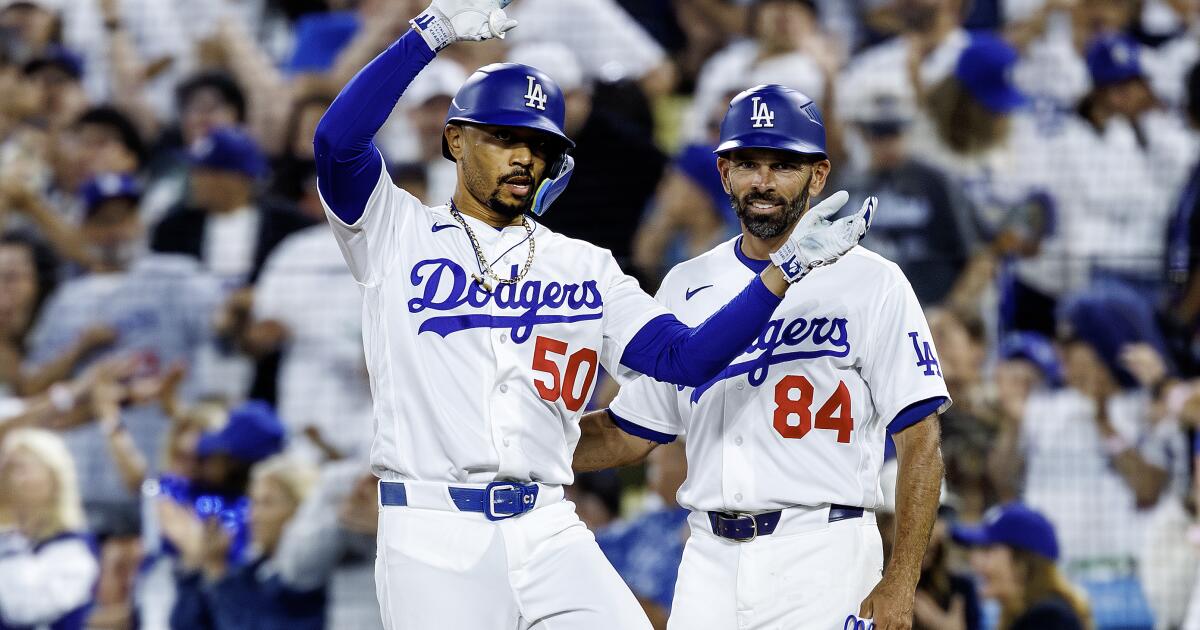
Mookie Betts’ first hit this series against the Rockies couldn’t have come at a more opportune time. With the crack of the ball against his bat, Tommy Edman scored from third, giving the Dodgers the lead.
And as Betts reached first, he pointed to Freddie Freeman, whose single put Edman in scoring position. It had taken a team effort to overcome another middling start from Roki Sasaki, and Betts, who had little to show before his game-winning hit, took the chance to highlight the joint contribution in the Dodgers’ 4-3 rubber-match win over Colorado (38-56).
“It feels great,” Betts said of his nine-pitch battle. “Helping the boys win, that’s really all it is. We play the game to win, and coming through in a big moment is kind of what, when you’re a kid, playing in the backyard, getting that hit is what you always strive to do, and fortunately, I was able to do it.”
Given a three-run lead in the first inning, brought to the Dodgers by a wild pitch and Kyle Tucker’s two-run, line-drive single to left field, Sasaki seemed set up for success.
Still, he gave away the lead as quickly as it came. In the second inning, he left a fastball too far over the plate, and third baseman Kyle Karros drove the ball over the left-center wall. The slider he dealt two batters later to second baseman Edouard Julien also crossed the zone too far over the plate, and Julien rounded the bases with another homer. In the third, a sacrifice fly by Mickey Moniak evened the scored, 3-3.
Sasaki’s troubles this season have been hard to pin down since his last win on May 23, as Sasaki tries to claw back the triple-digit velocity that’s escaped him as of late.
Against the Rockies, his fastball topped out at 99.1 miles per hour before steadily dropping to 98. He had managed five strikeouts in his six innings when manager Dave Roberts replaced him with Jack Dreyer, though the three earned runs couldn’t be ignored.
But Roberts also acknowledged the possibility that the pitcher had been tipping his pitches, possibly since he was playing in Japan, and Sasaki has tried to address it after a three-inning, six-run start last week. Even if he had fully self-corrected, his control issues remain. In the third inning, he walked the tying runner, Brett Sullivan.
“I’ve been working on a lot of things like the tipping stuff,” Sasaki said through interpreter Kensuke Okubo. “Also, I need to make quality pitches.”
Sasaki regained some of his confidence in the fourth when he worked out of a two-base jam with two strikeouts and a flyball to right, something that didn’t go unnoticed by Roberts.
“You can see the demeanor walking off the mound, the confidence,” Roberts said. “For me, it was more of let him end on a high note, feeling good about his outing, and then go from there.”
The Dodgers’ problems were compounded by Alex Call wasting the team’s two challenges in his at-bat in the first inning when the team had already taken the lead. And maybe it would’ve been excusable if Call had driven in the runners on first and second, but instead he ended the inning on a strikeout, stranding both. Roberts called the situation an “outlier” and didn’t feel as though he needed to have a conversation with Call regarding the situation.
After the three-run first, the Dodgers (61-33) remained hitless until Max Muncy laced a double down the right-field line in the sixth, though to little avail. As the innings ticked forward, Colorado’s chances seemed to increase. The Rockies hold the best league batting average (.297) in the eighth and ninth innings (the Dodgers are fourth with .268). And the Dodgers relievers, within the same constraints, have a 3.83 ERA — not bad, but not in the top 10 either.
Third baseman Max Muncy can’t get his glove on a line-drive double by Kyle Karros in the fourth inning.
(Gina Ferazzi/Los Angeles Times)
So when Alex Vesia struggled against the Rockies in the eighth inning and Muncy suffered a throwing error, Colorado seemed in position to score with the bases loaded and one out. Vesia struck out TJ Rumfield and Edgardo Henriquez (4-0), his replacement, retired Karros on a fly ball to right.
After Betts’ single allowed the Dodgers to take the lead, Tanner Scott (13) shut down the Rockies with back-to-back strikeouts, avoiding the team’s eighth series loss of the season.
“Didn’t feel great,” Roberts said. “Fortunately, we won a series, but that’s not the kind of way you want to do it.”
Sports
Justin Verlander announces he will retire after this season: ‘I’ve realized that time has come’

NEWYou can now listen to Fox News articles!
One of the greatest pitchers in the history of baseball will be hanging up his cleats after this season.
Three-time Cy Young Award winner Justin Verlander announced on Wednesday that the 2026 season will be his last.
Amid an injury-riddled season with the Detroit Tigers, Verlander decided it’s time to go.
Detroit Tigers pitcher Justin Verlander watches from the dugout during a game against the Chicago White Sox at Comerica Park in Detroit June 21, 2026. (David Rodriguez-Munoz/USA Today Network via Imagn Images)
“This season has challenged me in ways I haven’t experienced before, both physically and mentally. I’ve always believed that as long as I could compete at the level I expect of myself, I’d keep playing. I never wanted to retire because of a milestone, a number, or a date on the calendar. I wanted the game to tell me when it was time. Over the last several months, I’ve realized that time has come,” Verlander said in a social media post.
“While I’m fully committed to giving my team everything I have for the rest of this season, I’ve decided this will be my last. It’s fitting that I get to finish where it all started – with the Detroit Tigers, the organization that drafted me and gave me my first opportunity.”
Verlander inked a one-year deal with the Tigers, with whom he spent his first 12½ seasons before being traded to the Houston Astros, in the offseason. In Houston, he returned to dominance, winning both of his World Series titles and two of his Cy Young Awards.
“Baseball has given me more than I could have imagined. It taught me discipline, resilience, and the value of continuing to adapt and evolve. I’ve been fortunate to play with and against incredible players, for outstanding organizations, and compete in-front of fans who deeply appreciate the game,” Verlander added in his announcement.
Justin Verlander of the Houston Astros celebrates after the Astros defeated the Philadelphia Phillies in Game 6 of the 2022 World Series at Minute Maid Park Nov. 5, 2022, in Houston, Texas. (Mary DeCicco/MLB Photos via Getty Images)
PHILLIES STAR SAYS ‘BS RULE’ IS KEEPING HIM FROM BEING NAMED ALL-STAR IN FRONT OF HOME CROWD
“To every teammate, coach, player, clubhouse attendant, and fan who has been part of this journey – thank you. It’s been a privilege to share the field with you. To my family, especially my wife Kate, thank you for standing beside me through every season, every rehab, and every high and low. I couldn’t have done this without you. It’s time for the next chapter. But first, I’m excited to finish this season the only way I know how – with everything I’ve got.”
Verlander is the active leader with 3,554 strikeouts, which is good for eighth all-time. He needs 21 to surpass Don Sutton and 87 to pass Tom Seaver.
The 43-year-old made his MLB debut in 2005 and won the American League Rookie of the Year Award the following season in what was just a small glimpse of what was to come.
Verlander was a Cy Young Award finalist on four other occasions, consistently near the top of the leaderboard in just about every pitching stat. MLB Commissioner Rob Manfred gave Verlander a legend’s exemption to this year’s Midsummer Classic, making him a 10-time All-Star.
One could argue that Verlander should have at least one more Cy Young Award on his mantle, but he is on the fast track to Cooperstown and very much in the conversation to join Mariano Rivera as the only player unanimously elected to the Hall of Fame.
Verlander’s best season came in 2022, when he pitched to a career-best 1.75 ERA along with a 0.829 WHIP. However, that came after he missed the entire 2021 season due to Tommy John surgery for an injury he suffered after pitching just one inning in the abbreviated 2020 season.
Houston Astros starting pitcher Justin Verlander throws against the Boston Red Sox during the first inning Aug. 22, 2023, in Houston. (AP Photo/Michael Wyke)
CLICK HERE TO DOWNLOAD THE FOX NEWS APP
He won his first Cy Young Award in 2011, when he was also awarded the MVP Award, and his second in 2019. Verlander’s 11 seasons between his first and final Cy Young Awards are the second-most behind Roger Clemens, who had 18 seasons between his first and seventh.
Verlander led the majors in innings and WHIP four times while recording the most strikeouts in three seasons.
Follow Fox News Digital’s sports coverage on X, and subscribe to the Fox News Sports Huddle newsletter.
-

 Louisiana4 minutes ago
Norman C. Francis library naming honors Lafayette education legacy
-

 Maine11 minutes ago
Live updates: U.S. and Iran escalate attacks; jockeying starts in Maine after Graham Platner drops Senate bid
-

 Maryland14 minutes ago
How the Baltimore-style hot dog tells a uniquely Maryland story
-

 Michigan19 minutes ago
Michigan immigration advocates react after Supreme Court ruling on Temporary Protected Status
-

 Massachusetts26 minutes ago
Is new construction right for you? There are benefits to buying a brand-new home in Massachusetts.
-

 Minnesota29 minutes ago
Where to watch Cleveland Guardians vs Minnesota Twins: TV channel, start time, streaming for July 9
-

 Mississippi34 minutes ago
Where Ace Reese, Mississippi State signees appear in latest MLB mock drafts
-

 Missouri41 minutes ago
Missouri Farm Bureau to host agritourism conference in Hermann | Fulton Sun

