Sports
Meet the former Vikings and Packers visionary known as the grandfather of NFL analytics


Editor’s note: This article is part of The Changemakers series, focusing on the behind-the-scenes executives and people fueling the future growth of their sports.
LAKE ELMO, Minn. — When he retired from the Green Bay Packers, finally ready to leave the job that surpassed his wildest dreams, Mike Eayrs plucked folders from file cabinets and tried to figure out what he could actually take.
So many of the documents inside these folders were proprietary. Hundreds of printed spreadsheets, color-coded with highlighter yellows and electric greens, harboring the most detailed information you could possibly find about the NFL teams we all watch and love.
For decades, one of Eayrs’ many duties was creating these game-day cheat sheets for coaches. The laminated sheets of paper contained countless data points about every opposing coach: the play calls they preferred in certain situations, how their game plan would shift depending on the score and how quickly they’d typically unveil their plan during a game.
Walking away from his role as the Packers’ director of research and development nine years ago, Eayrs did not need any of these relics. Though he might be interested in a keepsake or two. Eventually, he grabbed one particular file, one he had compiled ahead of Super Bowl XLV, the Packers’ victory over the Pittsburgh Steelers.
“This is it,” Eayrs says, sliding it over.
Now 73, he is sitting at the kitchen counter in his home about 30 miles from Minneapolis. It’s a quaint spot. He lives here with his wife, Mary Jo. Their three children are out of the house now and have families of their own, so they have time to spend Sunday afternoons in August like this, relaxing and hosting a curious visitor.
Nothing about the appearance of Eayrs’ home hints at his former life as an NFL visionary, a man who is viewed by many as the grandfather of NFL analytics and referred to in hushed tones as the secret weapon in the Packers’ rivalry with the Minnesota Vikings. There are paintings on the family’s walls, no pictures memorializing Eayrs’ time on NFL sidelines. His wispy white hair and staccato voice make him rightfully seem like a blend of an engaging statistics teacher and an uplifting coach.
But then he scans through his keepsake and starts talking about the 2011 Steelers. How defensive coordinator Dick LeBeau played Cover 3 on 91 percent of their snaps in base personnel, and how the Packers used this tidbit of information to their advantage. The data is complex and contextualized, compiled to support the Packers’ coaches in making in-game decisions.
That’s how Eayrs viewed his role, first with the Vikings, then with their enemies to the east — as decision support. He did not set out to work in what is now widely known as “analytics.” In fact, when Eayrs stumbled into all of this in the 1980s, there was really no such thing as sports analytics. Why he was hired in the first place, how his job evolved over time and how he adapted to the changes are lessons about data science and quantitative analysis, a subset of NFL front offices that has become increasingly more prevalent.
“Mike was a lone ranger,” says former NFL coach Brian Billick, who won a Super Bowl as coach of the Baltimore Ravens. “He was theorizing some of the stuff we talk about now 40 years ago. He was so far ahead of the curve. He was brilliant.”
Mike Eayrs, wife Mary Jo and their family following the Packers’ victory in Super Bowl XLV. (Courtesy of the Eayrs family)
Before they built a sleek practice facility in the Twin Cities, the Vikings held training camp in Mankato at the local college. After practice, the Vikings coaches often crossed paths with the Minnesota State coaches. Once, in the early 1980s, the college’s head coach suggested some of the Vikings coaches sit down with one of his assistants, Mike Eayrs.
Soon after, Vikings assistants Les Steckel and Floyd Reese cast a shadow in the doorway of Eayrs’ office. They asked if they could talk, and Eayrs nodded nervously. They told him what they’d heard, that Eayrs had been studying regression lines and standard deviation charts relating to football.
Pulling up chairs across from Eayrs’ desk, one of them said: “Show us some of the things you got.”
Eayrs sifted through some papers, wondering where to start. He began as simply as possible. He explained that Minnesota State had gone 3-7 the year before and that he had watched the film of all 10 games, trying to identify patterns in the wins and losses.
“The thing that emerged right away was ball security,” Eayrs told them. “We threw interceptions and fumbled the ball.”
Steckel and Reese didn’t see this as much of a revelation. Even then, coaches knew turnover margin correlated with wins and losses.
So Eayrs took a different approach. Wanting to make the conversation more interactive, rather than acting like a know-it-all math person speaking to two experienced football people, Eayrs asked, “Do you know how long the average possession is?”
Reese, a defensive coach, replied, “You get a lot of three-and-outs.”
Steckel, the offensive coach, interjected, “But there’s a lot of 10-play drives, too.”
“In a way, both of you are right,” Eayrs said. “The mean number of plays in a drive is 5.8. (Nearly 40 years later in 2024, the average number of plays per drive is 5.71.) I’m the offensive play caller. I tell myself every time we take the field, I’ve got to have a plan in my mind of how we’re going to get from where we’re starting to scoring position in six plays or less.”
“Why do you do that?” Steckel responded.
In an instant, the coaches had gone from skeptical to curious. Maybe the most interesting aspect of their earnest interest was the fact that Eayrs was talking like a coach. It was as if his being a play caller earned him immediate credibility.
“If you look at the three games we won,” Eayrs said, “what happened was, somewhere in that possession, we had a long gain. Your goal as a play caller is to empower your men to set the circumstances up to get the big gain.”
In a nonintuitive way, he was explaining the impact of explosive plays on wins and losses.
Eayrs then asked them how much their play calling changed depending on the score of the game. Did they account for score differential when scouting their opponent’s tendencies?
Steckel and Reese looked at one another before shaking their heads: “No.”
“You’re missing one of the most important variables of the game,” Eayrs said. “The score has a distinct relationship with strategy.”
This back-and-forth continued for over an hour until Steckel and Reese realized they were about to miss practice. They asked Eayrs if he would show up at the high-rise dormitory on campus later that night. Eayrs ultimately did, and when he got there, another handful of Vikings coaches had come to meet him. They asked thoughtful questions that got Eayrs thinking about additional studies he could do. He left inspired.
Over the next few years, Eayrs compiled data packets and sent them to NFL teams. Legendary Dallas Cowboys executive Gil Brandt called him to ask about the information. Lou Holtz, then the head coach at the University of Minnesota, invited him to a meeting and asked, “What are you trying to do with this?” Eayrs told him he hoped to establish a consultant business so he could take his family on a nice vacation. “You keep producing these tables with numbers,” Holtz said, “and before you’re done, you’ll take your family on the greatest vacation you’ve ever known.”
A couple of years later, in June 1985, the Vikings did the inevitable. At the urging of the coaching staff, they hired a man who had neither played nor coached in the NFL. To do what exactly? At the time, Eayrs didn’t fully know.
What is an explosive play? @jasonjwilde‘s 2001 profile of former director of research Mike Eayrs revealed Green Bay counted:
• Passes over 16 yards
• Runs over 12 yardsMore: https://t.co/NU8haSIl4d pic.twitter.com/XRgN7TNW90
— The Power Sweep (@ThePowerSweep) January 23, 2019
Growing up, friends peppered Brian Eayrs: What does your dad do for the Vikings?
Brian would be lifting books out of his locker, and he’d hear the questions from classmates.
Is he a coach?
“Kind of,” Brian would say.
Is he a statistics guy?
“Kind of,” Brian would say.
What do you mean … kind of?
“He’s a statistics assistant for the coaches,” Brian would say, then leave it at that.
Eayrs’ job evolved over time. In 1985, his first season with the Vikings, the defensive staff was developing a new package. The coaches argued constantly, but a consensus formed around the information Eayrs presented: If teams were running a toss sweep more than any other play, why not design the package around limiting the toss sweep?
In general, legendary Vikings coach Bud Grant despised data. Eayrs initially printed packets of information and placed them on Grant’s wooden desk. Grant rarely acknowledged Eayrs’ insights in the early days, so Eayrs dipped into his own backstory, to what had intrigued him about football data in the first place.
When he was hired at Minnesota State in Mankato, Eayrs was asked to teach a class nobody else wanted to teach: statistics. The subject bored students some and the professors more. Eayrs thought he’d be a better fit for a leadership course or some psychological field relating to problem-solving. But he didn’t have a choice. From the outset, he vowed to find a textbook that did not read like rocket science, one that would allow the students to apply the subject to something fun like sports.
The class was segmented into groups, and each later presented its findings. One group studying the NFL discovered that the standard deviation curve was abnormally high in the middle with two long tails at the end. According to Eayrs, that meant there were 26 similarly talented teams clustered in the middle, and there were three outliers on both ends of the spectrum.
“What I used to tell the coaching staff in our meetings was, ‘You can be an optimist, or you can be a pessimist,’” Eayrs says. “Basically, if you’re an optimist, we’re sitting in this room, and we only have to figure out how to make eight to 10 crucial plays at the right time, and we’re going to be in the playoffs. And if you’re a pessimist, we are eight to 10 plays away from the abyss. The difference in that middle spectrum of teams really boils down to who can do the right thing at the right time.”
While the early studies shaped Eayrs’ perspective of the NFL, it also helped him connect with Grant. The simpler the information he could disseminate to Grant and the more he could align it with Grant’s coaching priorities, the more he believed Grant would listen. So he exchanged tables and charts for quick bullet points and, soon after, Grant started to knock more frequently on his door.
“Have you got a minute?” Grant would ask.
“What was I going to say to Bud Grant? No?” Eayrs says now.
Once, Grant sat across from Eayrs’ desk and said, “You know, we put an awful lot of work into practice. But I don’t really think we’re practicing as efficiently as we could. Is there anything you can think of that would help us?”
Eayrs thought silently.“We could start to record more information,” he suggested.
“Good idea,” Grant said, then stood and exited.
His mind racing, Eayrs wondered: How? And what? How would they measure practice, and what should they measure? He sketched out some ideas, utilizing a spreadsheet he’d already created for game day as a foundational resource. At the time, play-by-play data had not yet been automated. So, Eayrs decided he and a handful of assistants would jot down the plays called during practice, the defensive fronts used, the coverages deployed and the results of the play.
Almost a decade later, when Billick was hired as the Vikings’ offensive coordinator, he asked Eayrs to use a stopwatch to track the time between a snap and throw. By then, Brian Eayrs was a teenager, visiting the Vikings’ facility and burying himself in a dark room with his father while they charted practice reps together. Brian watched coaches enter the room and ask his father questions, then he listened to his father’s deliberate responses. It was almost as if Eayrs was having to convince the coaches to use his information.
But many of them did. And when they did, Brian was paying attention from section 131 at the Metrodome, wearing purple and grateful to be so close to his childhood team.

Mike and Brian Eayrs. (Courtesy of the Eayrs family)
In 2001, the Vikings hosted the Packers at the Metrodome, but that night, Brian was not sitting in section 131. He had been sequestered in an end zone section surrounded by green and gold.
“That was the most eerie game of my life,” he says. “It was very strange.”
His father had made a change. After 16 seasons with the Vikings, Green Bay hired him away. Head coach Mike Sherman wanted someone who could gather, organize and filter information and help the Packers make better in-game and off-field decisions. Sherman said most folks within the NFL during the early 2000s knew how far ahead of the curve Eayrs and the Vikings were.
“So,” Sherman says, “we stole him away.”
Sherman remained the head coach until 2005. Mike McCarthy was hired a year later and not only kept Eayrs on, but also asked him, specifically after Green Bay’s 6-10 season in 2008, to bury himself in business strategy. Why? To find out if there were any approaches they could take and adapt to help the football side of the organization evolve.
Eayrs identified two relevant examples. The first was a study produced by the now-defunct Bemis Company, which transformed its strategy to offer more autonomy to its employees in the factory. The second was a report from Southwest Airlines explaining that its customer service was enhanced by providing gate attendants the ability to issue refunds to passengers. After months of research and planning, Eayrs presented his findings to McCarthy and the Packers staff.
Essentially, he believed the more the players on the field controlled the decision-making, the better off Green Bay would be. He even referenced an old Grant line, saying that decision-makers should come from the middle of the field. Offensively, quarterback Aaron Rodgers developed hand signals. Defensively, linebacker A.J. Hawk designed quick word association methods of changing the call from one to another.
“We never told the players about Bemis or Southwest Airlines,” Eayrs says. “They never knew the backstory.”
So much of Eayrs’ work was like this — unknown and never written about, but resoundingly impactful.
Mike Eayrs Green Bays Director of Research and Development spent 16 years with Vikings the last 12 with Packers.Gives GB huge inside edge.
— Larry Fitzgerald Sr. (@FitzBeatSr) December 3, 2012
Once, Eayrs applied a standard deviation curve to a 16-game NFL season and found that 10 to 12 games go like the staffers think they will, and there are two games on opposite ends of the spectrum that wind up as outliers due to injuries, turnovers or a flipped game script. He calls the negative games “Twilight Zone” games where “you’re going to see the train coming down the tracks,” Eayrs says, “and you’re going to try to do everything you can to divert it. You can’t.”
Another time, he used decades of practice data to answer the question of which drill most correlates with game results. The answer shocked him: seven-on-seven.
Eayrs’ curiosity could have kept him going forever. Even after he retired in 2015, Pro Football Focus hired him as an analyst to help the company make use of its swaths of automated data. Holtz would be happy to know that Eayrs’ family has taken numerous trips in the last decade.
You might not be surprised to find out that Brian’s kids are now getting the questions he once did: Is your dad a coach? Or is he a statistician?
Brian joined former Seattle Seahawks head coach Pete Carroll’s staff in 2013 and is currently helping first-year head coach Mike Macdonald. Data is more accessible now than it was when his father did the job, and Brian’s coding ability only multiplies what’s possible. Still, Brian believes that the core of what he and other analytics staffers across the league can offer is not like Jonah Hill in “Moneyball,” but more like the real-life Mike Eayrs. He was a man without answers who spent his entire work life trying to find them.
The Changemakers series is part of a partnership with Acura.
The Athletic maintains full editorial independence. Partners have no control over or input into the reporting or editing process and do not review stories before publication.
(Top photo: Charlie Riedel / Associated Press)



NEWYou can now listen to Fox News articles!
In just his second season at the helm, Curt Cignetti led Indiana to its first national championship.
During the Hoosiers’ title run, Cignetti became known for his demanding coaching style. Indiana opened spring practice Thursday, and incoming transfer wide receiver Nick Marsh got a crash course in what it means to play for Cignetti.
Marsh, who transferred from Michigan State, arrived at practice in gold cleats. After noting Marsh’s productive two-year stint in East Lansing, Cignetti pivoted to the wideout’s footwear.
Nick Marsh (6) of the Michigan State Spartans runs the ball up the field during the first quarter of a game against the Maryland Terrapins at Ford Field Nov. 29, 2025, in Detroit. (Mike Mulholland/Getty Images)
“I didn’t love those gold shoes he came out in today,” Cignetti said. “He learned what getting your a– ripped is all about. I don’t know if that happened to him very often at Michigan State. That was before practice started.”
INDIANA’S CURT CIGNETTI SHUTS DOWN NFL COACHING SPECULATION: ‘I’VE ALWAYS BEEN MORE OF A COLLEGE FOOTBALL GUY’
Marsh totaled 1,311 receiving yards and nine touchdowns at Michigan State. TCU quarterback Josh Hoover also headlines Indiana’s transfer additions.
An Indiana Hoosiers helmet during a game against the Ball State Cardinals at Lucas Oil Stadium Aug. 31, 2019, in Indianapolis. (Michael Hickey/Getty Images)
Cignetti added that the coaching staff has “more work to do with this group than the first two teams,” noting the group is still learning more about players the team will likely rely on next season.
Indiana Hoosiers head coach Curt Cignetti during the second quarter against the Miami Hurricanes in the 2026 College Football Playoff national championship at Hard Rock Stadium Jan. 19, 2026, in Miami Gardens, Fla. (Alex Slitz/Getty Images)
Indiana went 16-0 en route to a thrilling win over Miami in the College Football Playoff national championship in January.
Cignetti framed his callout of Marsh’s cleats as an early message about expectations.
“That was a wake-up call,” Cignetti said of the receiver’s pre-practice cleats. “But he’s really worked hard, done a great job for us.”
Follow Fox News Digital’s sports coverage on X, and subscribe to the Fox News Sports Huddle newsletter.
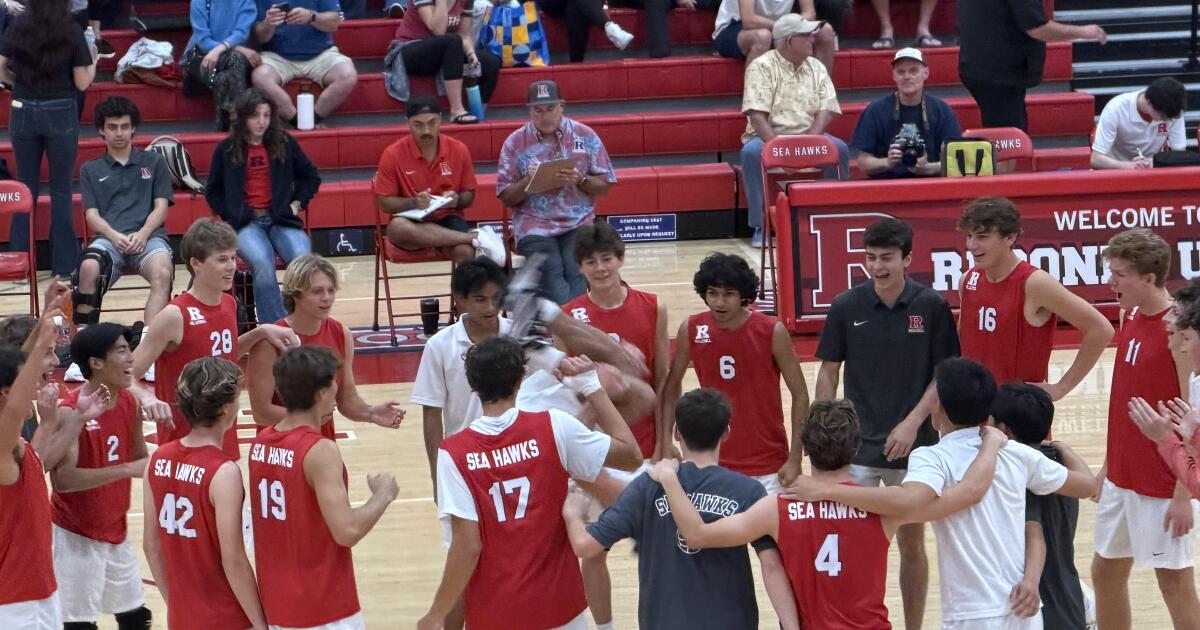
Redondo Union didn’t care that Mira Costa’s volleyball team was ranked No. 1 in California. This was their South Bay rival coming to their gym Thursday night, and anything can happen when a team digs deep and doesn’t fear losing.
The Sea Hawks (14-2) were aggressive from the outset and came away with a 27-25, 21-25, 25-22, 21-25, 15-13 victory.
“Chemistry,” setter Tommy Spalding said about the Sea Hawks’ triumph. He’s one of three players headed to MIT, and all three had big matches.
At one point on back-to-back plays, Carter Mirabal had a block and Vaughan Flaherty followed with a kill off an assist from Spalding. Chemistry.
JR Boice, a Long Beach State commit, was delivering kills, and Cash Essert’s serving and all-around play kept Mira Costa’s Mateo Fuerbringer looking frustrated. The Sea Hawks’ focus was on Fuerbringer, who came alive in the fifth set with six kills, but Redondo was able to come back from an 11-9 deficit.
It was only Mira Costa’s second loss in 25 matches. Redondo Union took over first place in the Bay League.
Baseball
Orange Lutheran 3, Jacksonville (Fla.) Trinity Christian 2: The Lancers advanced to the semifinals of the National High School Invitational in Cary, N.C., behind a walk-off single in the eighth inning by Andrew Felizzari. Brady Murrietta had tied the score with a squeeze bunt in the bottom of the seventh. CJ Weinstein had two doubles for the Lancers.
Venice (Fla.) 12, Harvard-Westlake 0: The Wolverines were limited to three hits at the National High School Invitational in Cary, N.C.
Casteel (Queen Creek, Ariz.) 3, St. John Bosco 2: The Braves suffered their first defeat in North Carolina. Jack Champlin threw five innings and also had two RBIs.
Chatsworth 6, Taft 3: Tony Del Rio Nava threw six innings and had two RBIs in the West Valley League win.
Granada Hills 4, El Camino Real 3: A two-run single by Nicholas Penaranda in the seventh inning keyed a three-run inning for the Highlanders in their West Valley League upset. JJ Saffie had three hits for ECR.
Cleveland 4, Birmingham 3: The Cavaliers pushed across a run in the top of the 10th inning to break a 3-3 tie in the West Valley League win. Joshua Pearlstein finished with three hits, including a home run.
Sun Valley Poly 4, San Fernando 2: Fabian Bravo gave up four hits in 6 2/3 innings for the Parrots, who are tied with Sylmar for first place in the Valley Mission League. Ray Pelayo struck out eight for San Fernando.
Verdugo Hills 15, Kennedy 1: Cutlor Fannon had two doubles and four RBIs in the five-inning win. Anthony Velasquez added two singles and four RBIs.
Westlake 9, Agoura 4: Jaxson Neckien hit a three-run home run to power the Warriors.
Thousand Oaks 7, Calabasas 5: Gavin Berigan, Jeff Adams and Cru Hopkins each had two hits for the Lancers.
Oaks Christian 11, Newbury Park 2: Dane Disney contributed three hits in the Marmonte League win. Carson Sheffer had two doubles and three RBIs.
Santa Monica 12, Simi Valley 4: Ryan Breslo and Johnny Recendez had two RBIs and a triple for Santa Monica. Ravi Chernack had three RBIs.
Dana Hills 7, Corona Santiago 0: Gavin Giese finished with eight strikeouts over six innings and gave up one hit for Dana Hills.
Softball
Sherman Oaks Notre Dame 10, Sierra Canyon 0: Kelsey Luderer contributed three hits and two RBIs while freshman Ainsley Jenkins threw five scoreless innings.
Chaminade 15, Louisville 2: Norah Pettersen had two hits and four RBIs.
Carson 10, San Pedro 0: Atiana Rodriguez finished with three hits, including a double and triple, and three RBIs.
Huntington Beach 6, El Modena 2: Willow Kellen had three hits for the Oilers.
Murrieta Mesa 15, Chaparral 0: It’s a 16-0 start for the Rams. Tatum Wolff hit two home runs.

NEWYou can now listen to Fox News articles!
The fiancée of Buffalo Sabres star Rasmus Dahlin received a roaring welcome home in her first appearance of the season Wednesday night, months after undergoing a lifesaving transplant after she suffered heart failure during a vacation in France.
Carolina Matovac, 25, was shown on the jumbotron during Wednesday’s game against the Boston Bruins. Fans cheered as she waved, and Dahlin, who was also shown on the screen in a split, cracked a smile at the crowd’s reaction.
Carolina Matovac and Rasmus Dahlin of the Buffalo Sabres pose on the red carpet at the Metro Toronto Convention Centre in Toronto, Ontario, Canada, Feb. 1, 2024. (Nicole Osborne/NHLI via Getty Images)
“Welcome home to Carolina Matovac, the fiancée of our captain Rasmus Dahlin,” the arena announcer said. “She is back with us, attending her first game of the season. The Sabrehood loves you, Carolina.”
In an open letter to fans in September, Dahlin shared that Matovac had been feeling ill for several days during their trip, which led to her experiencing “major heart failure.”
“Fortunately, she received CPR on multiple occasions, and up to a couple of hours at a time to keep her alive, which ultimately saved her life. Without her receiving lifesaving CPR, the result would have been unimaginable. It is hard to even think about the worst-case scenario,” he wrote at the time.
Rasmus Dahlin (of the Buffalo Sabres prepares for a faceoff during a game against the New York Rangers at KeyBank Center in Buffalo, N.Y., Oct. 9, 2025. (Bill Wippert/NHLI via Getty Images)
Matovac remained on life support for weeks before receiving the transplant in France.
JACOB WINTERTON, FORMER OHL PLAYER AND BROTHER OF NHL’S RYAN WINTERTON, DEAD AT 25 AFTER CANCER BATTLE
In January, Matovac revealed she was pregnant when her heart failed, adding that her unborn child was the reason she went to the hospital initially.
“You will always hold a special place in our hearts as our first baby, even though we never had the chance to meet. Our love for you is endless,” she wrote in a post on Instagram on what was supposed to be her due date.
“Though you didn’t get to experience this world, you played a vital role in ensuring that I could continue to be a part of it.”
Buffalo Sabres defenseman Rasmus Dahlin follows the puck in the first period against the Ottawa Senators at the Canadian Tire Centre in Ottawa, Ontario, Canada, on April 1, 2025. (Marc DesRosiers/Imagn Images)
CLICK HERE TO DOWNLOAD THE FOX NEWS APP
Despite taking some time to be with Matovac as she recovered in their native Sweden, Dahlin is second on the team with 65 points, and the Sabres are on the cusp of ending an NHL-record 14-season playoff drought.
The Associated Press contributed to this report.
Follow Fox News Digital’s sports coverage on X, and subscribe to the Fox News Sports Huddle newsletter.

Oklahoma City Comets preliminary 2026 roster

Merkley Announces Additional Oregon Town Halls April 2-4

Pennsylvania-born indie rockers Tigers Jaw return with new album release

A new safety role at Rhode Island College comes into sharper focus after Brown shooting – The Boston Globe

NFL Draft Injury Analysis: Jalon Kilgore, S – South Carolina

Florida High School Football Rankings: Top 25 teams – Oct. 21

How old is Bo Nix? What to know about Oregon quarterback ahead of 2024 NFL Draft

Cleary's 21 help Le Moyne down Central Connecticut State 69-64 in OT

99th annual Pony Swim held in Virginia

Indiana Members Credit Union announced as new anchor tenant at Bottleworks District

Video: Will ICE Change Under Its New Leader?

DHS shutdown breakthrough comes at cost for Republicans as funding fights nears end

Rubio joins crucial G7 talks as Iran war set to dominate second day

A surprise resignation could open the door for an independent to win a Montana Senate seat

Video: Savannah Guthrie Says She Believes Her Mother Was Taken for Ransom
-

 Detroit, MI1 week ago
Drummer Brian Pastoria, longtime Detroit music advocate, dies at 68
-

 Science1 week ago
How a Melting Glacier in Antarctica Could Affect Tens of Millions Around the Globe
-

 Movie Reviews1 week ago
‘Youth’ Twitter review: Ken Karunaas impresses audiences; Suraj Venjaramoodu adds charm; music wins praise | – The Times of India
-
 Science1 week ago
I had to man up and get a mammogram
-

 Sports6 days ago
IOC addresses execution of 19-year-old Iranian wrestler Saleh Mohammadi
-

 New Mexico5 days ago
Clovis shooting leaves one dead, four injured
-
 Business1 week ago
Disney’s new CEO says his focus is on storytelling and creativity
-

 Texas1 week ago
How to buy Houston vs. Texas A&M 2026 March Madness tickets