Sports
Lee Fitting was ESPN’s ‘golden boy’ — then his alleged misconduct ‘finally caught up to him’


The memo from Norby Williamson, one of ESPN’s top executives, was short and direct: Lee Fitting, a senior vice president of production who had been at ESPN for more than 25 years, was “no longer with the company” and ESPN would be “finalizing a new production structure” for the shows he oversaw.
The timing of Fitting’s dismissal — the memo was sent on Aug. 21, 2023, about a week before the start of the college football season — amplified the shockwaves felt through ESPN’s headquarters in Bristol, Conn. Since 2004, Fitting oversaw “College GameDay,” and his leadership cemented the program into the cultural zeitgeist, catapulted the popularity of on-air personalities like Chris Fowler and Kirk Herbstreit, and turned the show into a revenue and ratings winner.
As the show rose, so did Fitting’s profile within ESPN. In addition to “College GameDay,” he eventually oversaw all college and NFL properties, giving him the power to make and break careers, and he was expected to one day succeed Williamson as head of the network’s programming. When he was escorted out of the building by security, some at ESPN’s headquarters groused at what they perceived as indecorous treatment. For all he’d accomplished, Lee Fitting deserved better.
There was, in contrast, a subset of current and former ESPN employees who reacted differently. “I can’t believe it took this long,” said one woman.
She and others had watched Fitting rise within ESPN despite, according to them, making comments objectifying women, criticizing their physical appearance and making crude jokes, some sexual in nature, in the workplace. This went on unchecked for years, according to the scores of current and former ESPN employees interviewed by The Athletic, who requested anonymity to speak freely because they still work in sports media. It had a devastating effect on numerous women who believed they had to endure or go along with his conduct to stay employed or ascend at ESPN. Many women in sports media quietly shared their interactions and concerns about Fitting with each other. Some left ESPN in part because of their experience with him.
But in 2023, a complaint regarding Fitting was made with ESPN’s human resources department, prompting officials at ESPN to question a group of employees, including some prominent female staffers. A short time later Fitting, then 48, was done at ESPN. “It finally caught up to him,” said one of the women questioned.
Fitting, via a spokesperson, denied some of the allegations made against him while choosing not to address others. He declined to comment on the broader characterization of him as someone who mistreated women during his tenure at ESPN or why he was let go by the network.
Fitting’s ouster is among the most significant examples of ESPN’s ongoing reckoning with its past. Since chairman Jimmy Pitaro came from parent company Disney in 2018, there have been significant changes. A less publicized part of that transformation has been a behind-the-scenes effort to clean up the boys’ club ethos that long permeated the company. In the last two years, ESPN has removed at least four male employees — three in elevated positions — who were accused of wrongdoing toward women and/or subordinates.
ESPN declined to discuss Fitting’s dismissal, citing the company’s policy to not discuss personnel matters. Williamson, who is no longer at ESPN, also declined to comment. In a statement, the network said: “ESPN is dedicated to maintaining the most inclusive, respectful and comfortable work environment for everyone. Our people are the most valuable resource at ESPN, and we ensure our commitment by providing year-round guidance, including extensive support and training. On top of that, we clearly communicate workplace expectations for all, while emphasizing care, sensitivity and accessibility in response to any employee needs.”
In its early years, ESPN’s culture was openly hostile toward female employees. Women were ogled and subject to aggressive overtures and male employees offered female co-workers advancement in exchange for sexual favors. It was not unusual for office monitors to show the Playboy Channel.
In James Andrew Miller and Tom Shales’ 2011 oral history of ESPN, “Those Guys Have All the Fun,” they describe the company’s atmosphere in its early years (it was founded in 1979) as “a wild wellspring of sexual misconduct.”
It wasn’t until the late 1980s that someone drew attention to the problem. On-air personality Karie Ross spoke up about what she felt was rampant sexual harassment at a meeting of at least 200 employees. “I decided the only way to get my point across was to stand up in front of the whole place,” she said in the book. Afterward, Ross felt marginalized and left the company.
Former president Steve Bornstein blamed the widespread misogyny, in part, on ESPN’s location in Bristol. “It’s one hundred miles from real civilization, and you got the kind of testosterone, jock mentality, frat house approach that’s pretty much a recipe for stupid decisions being made,” he said in “Those Guys Have All the Fun.”
By 1996, when Fitting landed a job in ESPN’s production assistant pool, the company remained a problematic place for women, according to several who worked there at the time. The “frat house approach” persisted.
Fitting, a fraternity member while he attended James Madison University, graduated from ESPN’s production assistant program and became an associate producer on “College GameDay” in 2000 and was promoted to feature producer two years later. In the spring of 2004, he impressed his boss, Mark Gross, with a pitch for how he’d run the show. Fitting was put on smaller live shows that summer to hone his skills, and by that fall, at age 29, he was sitting in “College GameDay’s” lead chair.
The show, which began in 1987 as an in-studio production (it didn’t go on the road until 1993), was already popular. The casting of Fowler, the unflappable host; Herbstreit, the former college quarterback; and Lee Corso, the ex-coach-turned-charming-goofball, had already resonated. Fitting launched it into a different stratosphere. He made the show feel younger, fresher and unpredictable.
During a visit to Ole Miss in 2014, everyone on set wore custom bow ties. Katy Perry, at the apex of her pop stardom and decked out in a pink mohair sweater and matching space buns, arrived with a state trooper detail carrying a tray of drinks. The segment culminated with her tossing corn dogs at the camera, shucking off Lee Corso’s mascot helmet and leading the crowd in the “Hotty Toddy” chant.
“The number one rule to producing good television is not to be scared,” Fitting said in the keynote conversation at the 2017 SVG College Sports Summit in Atlanta. “You’ve got to be willing to take risks and you have to be willing not to worry about what your boss or bosses say when you take those risks.”
Fitting also excelled at aspects of the job, such as hobnobbing with college coaches on the golf course or socializing with executives from the show’s corporate sponsors over drinks. “Lee is a gregarious, social, friendly guy. If we brought advertisers around, Lee knew how to shake hands, and he was skilled at that,” said John Skipper, ESPN’s president from 2012-17. He added: “Lee clearly made the show better and made the show extraordinarily entertaining and extraordinarily popular. He was a golden boy.”
And he was extremely popular with many male executives at ESPN. Fitting was assured; he was good at golf (a valuable currency in the ESPN ecosystem; multiple executives belonged to the same golf club as Fitting). People see the on-air talent at ESPN and assume it is a company of confident operators. But as one longtime employee framed it: ESPN is actually a “kingdom of dorks,” and Fitting was a cool kid with a gravitational pull. Some of the most powerful men at the company liked being in his orbit.
The show’s success and Fitting’s popularity afforded him great latitude. If he wanted a baby bison on the set during a show in Fargo, N.D., someone rounded up a baby bison. His sway over the show’s budget and personnel decisions and ability to expand its reach was unmatched by others running ESPN programs. And as one of the few shows not centered in Bristol, there was less oversight by the bosses back at HQ.
In an oral history of the show published by The Ringer, “SportsCenter” host Scott Van Pelt said about “College GameDay”: “They’re their own kind of country, so to speak — favored-nation status.”
The cast got special catering, security, transportation and more. Staffers who moved from elsewhere at ESPN to “College GameDay” went from boxed lunches to takeout from the Capital Grille. “It was steak, not sandwiches,” said one person who worked on the show. “It was almost piggish.”
Said one employee: “The common theme is — there are no rules. It’s ‘GameDay’ rules.”
A fan holds up a sign of Lee Fitting. (Courtesy of ESPN)
Many women who worked on “College GameDay” and under Fitting elsewhere at ESPN — The Athletic spoke to more than 20, including six who participated in the network’s 2023 investigation into Fitting — said that the workplace culture under Fitting featured boorish behavior and offensive remarks, many of them sexual in nature.
Around 2012, some ESPN employees were watching the NCAA’s men’s basketball tournament from a conference room in Bristol when Fitting allegedly commented on a woman (who was not present and didn’t work at ESPN) and her ability to “open her throat” to down a beer, then joked that the woman would be good at performing fellatio, according to one person present. (The Athletic also spoke to a former ESPN employee who the person present told about the alleged comment.) Fitting, via his spokesperson, said this incident never happened.
In a production meeting around 2014, no chairs were available for a woman on staff. Fitting patted his lap and said to her: “I’ve got a seat right here for you,” according to one person in the room and another person who was told about the remark from another individual present. Fitting denied this allegation. One female ESPN employee said that Fitting sent her a text message around 2018 that read: “You look hot.” She showed the text to a producer, who recalled the woman’s hand shaking as she showed the producer the message.
On more than one occasion, he jokingly asked a female staffer for her hotel room number and also routinely joked about performing bed checks, according to “College GameDay” employees. Fitting denied those allegations. He also allegedly bragged about his and his wife’s robust sex life, according to multiple sources.
When he saw a woman in an outfit he liked, he’d let her know, sometimes in ways women and other employees found crude and/or humiliating. He once loudly exclaimed “Goddamn!” when a woman appeared on set in a skirt he liked. These types of comments were so frequent that one female “College GameDay” employee developed a strategy to blunt his behavior. Whenever he would say or do something inappropriate, she would open up a notebook and mimic writing something down. When Fitting would ask what she was doing, she’d respond: “Just jotting this down for the book.”
Boozy dinners near college campuses were common, followed by visits to a local bar, and Fitting was a frequent late-night texter.
In a 2015 Harrisonburg, Va., Daily News-Record profile, Fitting bragged about his partying days as a JMU fraternity member, and some “College GameDay” employees felt that side of him never truly graduated. “It was a frat boy sense of atmosphere all the time,” one former show employee said. In “The System,” a book by Armen Keteyian and Jeff Benedict, Fitting mused about bringing the show to The Grove at Ole Miss, remarking: “Ah, sundresses and alcoholic beverages.”
Many women who worked on “College GameDay” and under Fitting elsewhere at ESPN said they felt pressured to go out for drinks and tolerate the inappropriate remarks, worried that if they did not present as members of the boys’ club they’d be ostracized. Sometimes, before or after saying something crude or sexist, Fitting would use a phrase — “It’s OK, she’s one of the guys” — to justify why his remark was permissible, sources said. When one female employee left the show, Fitting dismissed her as “no fun” in front of a group of employees, according to one person present.
Some women who appeared on-camera were told by Fitting how to style their hair, how much makeup to wear, what outfits he approved of or did not like. He sometimes referenced aspects of their body that he advised them to conceal.
One woman said that one day, when she and Fitting were working in different locations, he had seen her on an in-house feed and texted her that he liked her hair in a ponytail. She brushed off the comment, but he texted again: “Put your hair up in a ponytail.” The woman replied that she had already been in hair and makeup for the day, to which she said Fitting responded: “Put your hair up in a ponytail before I do it for you.” (Fitting denied saying that he would put her hair up if she did not.)
Another woman said Fitting, in addition to commenting on her makeup and wardrobe, told her she should refrain from laughing on air because he found her laugh annoying. (The Athletic spoke with a person she later told about that exchange.)
“You already have these things in the back of your mind. And then when somebody doesn’t think you can advance in your career because you don’t check a box, that awareness can become an insecurity,” one woman said.
Fitting, via his spokesperson, said it was his job to provide feedback to male and female on-air talent regarding their appearance and on-air delivery.
Fitting commented so frequently on how women looked that judging women in that way became engrained in how he operated the show. In the production truck, he would direct people to scan the crowd for “hot” women who could be shown on the broadcast, according to multiple people who worked with him. In 2012, “College GameDay” was in South Bend, Ind., for an October game between Notre Dame and Stanford. Fitting had an issue with the crowd shot behind the studio set: The Notre Dame cheerleaders in the shot were not attractive enough. They were no Oregon cheerleaders, he remarked. (Fitting had a particular fondness for the Oregon cheerleaders, multiple people said, citing comments he made about them that spanned years). As Fitting ordered the Irish cheerleaders cut from the shot, no one batted an eye.
In 2016, Fitting was promoted to vice president and given oversight of all college football and basketball studio and remote production. It gave him even more influence over the ESPN star-making machine.
One ESPN employee said that around 2017 she asked Fitting if she could meet with him in New York to discuss work opportunities. She said that he then asked via text whether he should get a hotel room for the night, which she interpreted as him asking if he should get a room for the two of them. She decided to drop the matter and the meeting never happened. Fitting, via his spokesperson, said that the woman misinterpreted his question; he was asking if he should reserve a conference room at the hotel.
Another ESPN employee said she asked to meet with Fitting to discuss career opportunities on three occasions. Each time he asked her to meet with him for drinks, she said. She declined, as she said other women at ESPN told her not to meet with Fitting alone outside of work. Said another female staffer: “Women had warned each other to be conscious of interactions with him.” Fitting said through his spokesperson that it was common for him to get drinks with men and women as part of his job.
During Fitting’s rise, ESPN took action against some men accused of misconduct. In 2006, Sean Salisbury was suspended for showing pictures of his genitals to co-workers at a bar; his contract was not renewed when it expired in 2008. In 2009, Steve Phillips was fired for having an affair with a production assistant. One connection between those two cases: The wrongdoing was reported on by media outlets.
Around the time of the Phillips affair, ESPN also let two vice presidents go after the consensual relationship they were in — which had been earlier disclosed to higher-ups — was reported on. Within the company, that move was considered unnecessary and reactionary, evidence that the company was reeling.
Williamson called a meeting of people in leadership, and the message he delivered was that the company “wasn’t putting up with any of this,” said one attendee. But most of the alleged wrongdoing by Fitting shared with The Athletic occurred after that meeting. And despite Williamson’s message, many women at ESPN still believed that if they raised the alarm about Fitting’s behavior it would cost them their careers.
“It’s survival,” said one woman.
The person present when Fitting allegedly made the joke about the woman being good at fellatio rebuked him at the time because a young female staff member was also present. “If I laughed along to that, I’m teaching them it’s OK,” the person said. But that individual did not raise the matter to HR or anyone else because, that person said, Fitting was far from the only man at ESPN who acted that way and that person doubted that reporting him would change anything.
The woman he allegedly sent the text message to that read “You look hot” concluded that escalating the issue was too fraught. Her producer understood her predicament: “Lee Fitting has more power and juice than you, so if you say something, you put your job and livelihood in jeopardy.”
The woman who said Fitting texted her asking if he should get a hotel room for their meeting in New York disclosed that interaction to a male executive at ESPN. However, she decided not to report the matter to HR and asked the male executive to keep her disclosure quiet. (That executive corroborated her account.)
“I was trying so hard to keep the job and get more opportunities,” said the woman. “You get blackballed if you say anything. Are they gonna keep me or Lee Fitting?”
There have been significant changes at ESPN since the arrival of CEO and chairman Jimmy Pitaro from parent company Disney in 2018. (Kyle Grillot / Getty Images)
Skipper, during his run as ESPN’s president, championed diversity issues and the careers of many women at the network. But he was also running ESPN when much of the alleged wrongdoing by Fitting took place. Skipper said he was never made aware of any concerns or complaints about Fitting’s behavior when he was at ESPN.
“I did invite people and made it clear that if there were issues (with any employees), people could come to me and tell me. And they did (regarding others). On the other hand, I recognize how hard it is to go all the way to the top of the company and tell the president,” Skipper said.
Speaking generally about people coming forward, he added: “It is a hard thing to do. You’ve got to decide. I mean, if you’re exposed to something, maybe it is somebody who is going to decide what your bonus is next year. If it’s a colleague, you know, it’s wrong, but people still have the old ‘I’m not going to tell on anybody’ thing.’ And then, until a company establishes a track record of actually holding the people responsible, you always fear you’re basically going to get into the bad parts of being a whistleblower. Will these people resent you and (then) they’re unhappy?”
Skipper abruptly resigned in 2018 to seek substance abuse treatment in what he later said was a cocaine extortion plot, and Pitaro moved over from parent company Disney and became ESPN’s president. In 2020, he added the title of chairman — ESPN’s first who did not rise through its ranks in Bristol. According to multiple sources, Disney tried to insert Pitaro as Skipper’s No. 2 earlier, but Skipper rebuffed those efforts, protective of ESPN’s insular culture. But with Skipper gone, Pitaro had a clear field to force change.
He was quickly labeled a “boy scout” by some long-time ESPNers as he pushed the company’s internal business and culture to be more synergistic with Disney’s, to pull “Bristol closer to Burbank,” as one ESPN executive put it. He transformed the human resources department. Longtime chief Paul Richardson departed in 2021 and senior vice presidents Sonia Coleman and Judy Agay arrived from Disney.
Among the changes they made: Preseason meetings with shows during which members of the human resources group that handles complaints address show staff and emphasize creating a welcoming work environment and outline resources to help address problems. A member of that staff also visits each show during the season and reiterates those messages. The company also created an executive women’s forum with an open line to company leadership to address issues.
“It usually takes a lot to get fired by ESPN,” Miller and Shales wrote in “Those Guys Have All the Fun.” But as those changes took hold, and with Pitaro empowering the new leaders in human resources, that was no longer true.
Rob King, a senior executive who oversaw “SportsCenter,” ESPN.com and special projects during his tenure and had been with the company for almost two decades, was fired in March 2023 amidst harassment allegations. When contacted, he referred The Athletic to a statement he posted on his personal social media account shortly after the news surfaced: “The time is right for me to leave the company. I’m looking forward to spending more time with my family and friends, and wish the company continued success.”
SportsCenter anchor Max McGee was let go in February 2024 after the company received a complaint about him from a female employee, according to ESPN sources. McGee said he had been advised not to comment and referred questions to a spokesperson, who did not respond to multiple requests seeking further comment. In November, a “SportsCenter” producer was let go after being accused of inappropriate behavior toward subordinates.
The first sign of trouble for Fitting came in 2023 when ESPN learned that “College GameDay” was integrally involved in a scheme that involved sending falsified submissions to The National Academy of Television Arts & Sciences, which operates the Emmys, and led to “College GameDay” receiving more than 30 statuettes that it didn’t earn.
That scheme, made public by The Athletic, led to Fitting being banned from future Emmy participation, according to multiple sources. Then, in July 2023, an HR official contacted some employees who had worked with Fitting about a “confidential matter.” According to multiple sources, a complaint had been made against Fitting, prompting an HR inquiry.
The people who participated in the probe said they were asked questions such as: Did you ever feel pressure to drink or socialize? Did you ever feel like you had to engage in flirtatious behavior? Did you ever feel like you were passed over for an opportunity based on anything other than merit? Were inappropriate comments ever made about your appearance or your body? Were women ever pitted against each other in the workplace?
Those who participated in the probe said the questioning eventually focused on Fitting. Multiple people said they described to an HR official instances in which they believed Fitting engaged in inappropriate conduct and/or discriminated against women. Two current ESPN executives briefed about the result of the HR investigation said the findings gave the company little choice but to let Fitting go.
Fitting, through his spokesperson, declined to address why his employment was terminated by ESPN.
Some women who worked at ESPN were stunned that the company finally cut bait with Fitting. Others lamented the years of transgressions that went unseen or ignored. A few expressed relief that their careers might be allowed to flourish now without having to fake being “one of the guys.”
The significance of Fitting’s ouster was underscored when ESPN put Amanda Gifford, who joined the company in 2004 and came up through the radio side of the company, in charge of college football event production. Early on, Gifford met with women working on “College GameDay” to hear about their experiences and make clear that she was there for them if they had issues or concerns.
Fitting, meanwhile, was only out of work for a few months. In January 2024, he was hired at WWE, a company embroiled in a sexual assault and trafficking scandal allegedly involving founder Vince McMahon that has prompted a federal investigation. McMahon characterized the allegations as “baseless.”
WWE’s president is Nick Khan, who was previously a talent agent who represented a number of ESPN personalities.
Fitting produces “Monday Night Raw” and “Friday Night SmackDown,” and those broadcasts now more closely resemble “College GameDay.” At the time of Fitting’s hiring, Khan called him a “phenomenal leader”; Paul “Triple H” Levesque recently heralded him as a “game-changer.”
A WWE spokesperson said the company had no comment on the allegations against Fitting.
(Illustration: Meech Robinson / The Athletic. Photo: ESPN)



NEWYou can now listen to Fox News articles!
In just his second season at the helm, Curt Cignetti led Indiana to its first national championship.
During the Hoosiers’ title run, Cignetti became known for his demanding coaching style. Indiana opened spring practice Thursday, and incoming transfer wide receiver Nick Marsh got a crash course in what it means to play for Cignetti.
Marsh, who transferred from Michigan State, arrived at practice in gold cleats. After noting Marsh’s productive two-year stint in East Lansing, Cignetti pivoted to the wideout’s footwear.
Nick Marsh (6) of the Michigan State Spartans runs the ball up the field during the first quarter of a game against the Maryland Terrapins at Ford Field Nov. 29, 2025, in Detroit. (Mike Mulholland/Getty Images)
“I didn’t love those gold shoes he came out in today,” Cignetti said. “He learned what getting your a– ripped is all about. I don’t know if that happened to him very often at Michigan State. That was before practice started.”
INDIANA’S CURT CIGNETTI SHUTS DOWN NFL COACHING SPECULATION: ‘I’VE ALWAYS BEEN MORE OF A COLLEGE FOOTBALL GUY’
Marsh totaled 1,311 receiving yards and nine touchdowns at Michigan State. TCU quarterback Josh Hoover also headlines Indiana’s transfer additions.
An Indiana Hoosiers helmet during a game against the Ball State Cardinals at Lucas Oil Stadium Aug. 31, 2019, in Indianapolis. (Michael Hickey/Getty Images)
Cignetti added that the coaching staff has “more work to do with this group than the first two teams,” noting the group is still learning more about players the team will likely rely on next season.
Indiana Hoosiers head coach Curt Cignetti during the second quarter against the Miami Hurricanes in the 2026 College Football Playoff national championship at Hard Rock Stadium Jan. 19, 2026, in Miami Gardens, Fla. (Alex Slitz/Getty Images)
Indiana went 16-0 en route to a thrilling win over Miami in the College Football Playoff national championship in January.
Cignetti framed his callout of Marsh’s cleats as an early message about expectations.
“That was a wake-up call,” Cignetti said of the receiver’s pre-practice cleats. “But he’s really worked hard, done a great job for us.”
Follow Fox News Digital’s sports coverage on X, and subscribe to the Fox News Sports Huddle newsletter.
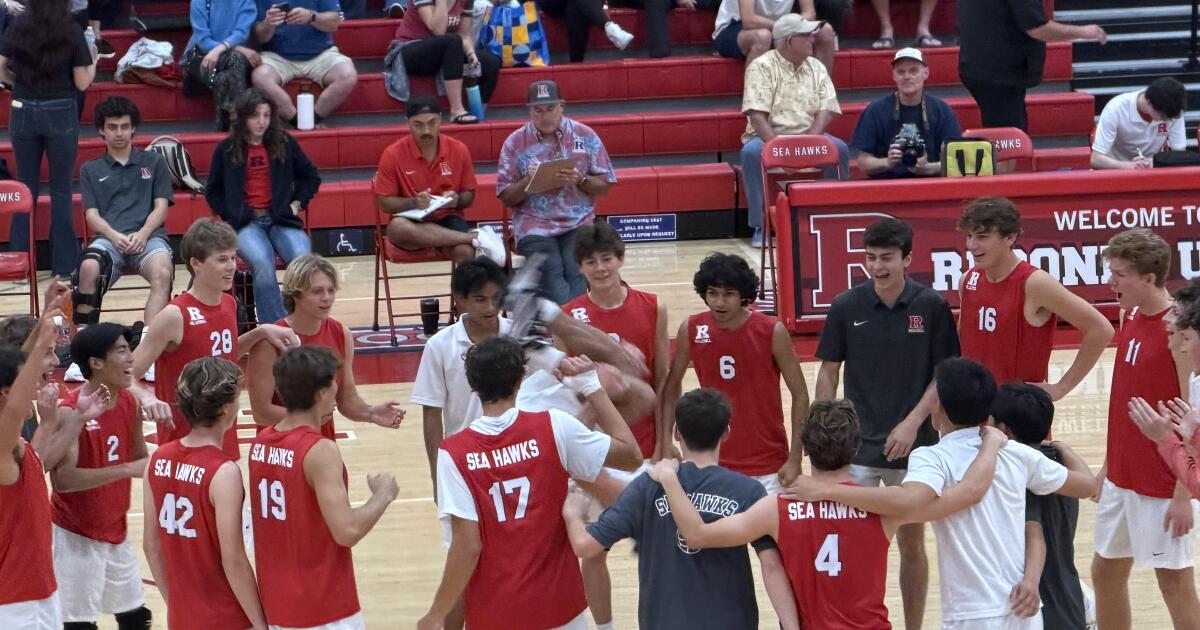
Redondo Union didn’t care that Mira Costa’s volleyball team was ranked No. 1 in California. This was their South Bay rival coming to their gym Thursday night, and anything can happen when a team digs deep and doesn’t fear losing.
The Sea Hawks (14-2) were aggressive from the outset and came away with a 27-25, 21-25, 25-22, 21-25, 15-13 victory.
“Chemistry,” setter Tommy Spalding said about the Sea Hawks’ triumph. He’s one of three players headed to MIT, and all three had big matches.
At one point on back-to-back plays, Carter Mirabal had a block and Vaughan Flaherty followed with a kill off an assist from Spalding. Chemistry.
JR Boice, a Long Beach State commit, was delivering kills, and Cash Essert’s serving and all-around play kept Mira Costa’s Mateo Fuerbringer looking frustrated. The Sea Hawks’ focus was on Fuerbringer, who came alive in the fifth set with six kills, but Redondo was able to come back from an 11-9 deficit.
It was only Mira Costa’s second loss in 25 matches. Redondo Union took over first place in the Bay League.
Baseball
Orange Lutheran 3, Jacksonville (Fla.) Trinity Christian 2: The Lancers advanced to the semifinals of the National High School Invitational in Cary, N.C., behind a walk-off single in the eighth inning by Andrew Felizzari. Brady Murrietta had tied the score with a squeeze bunt in the bottom of the seventh. CJ Weinstein had two doubles for the Lancers.
Venice (Fla.) 12, Harvard-Westlake 0: The Wolverines were limited to three hits at the National High School Invitational in Cary, N.C.
Casteel (Queen Creek, Ariz.) 3, St. John Bosco 2: The Braves suffered their first defeat in North Carolina. Jack Champlin threw five innings and also had two RBIs.
Chatsworth 6, Taft 3: Tony Del Rio Nava threw six innings and had two RBIs in the West Valley League win.
Granada Hills 4, El Camino Real 3: A two-run single by Nicholas Penaranda in the seventh inning keyed a three-run inning for the Highlanders in their West Valley League upset. JJ Saffie had three hits for ECR.
Cleveland 4, Birmingham 3: The Cavaliers pushed across a run in the top of the 10th inning to break a 3-3 tie in the West Valley League win. Joshua Pearlstein finished with three hits, including a home run.
Sun Valley Poly 4, San Fernando 2: Fabian Bravo gave up four hits in 6 2/3 innings for the Parrots, who are tied with Sylmar for first place in the Valley Mission League. Ray Pelayo struck out eight for San Fernando.
Verdugo Hills 15, Kennedy 1: Cutlor Fannon had two doubles and four RBIs in the five-inning win. Anthony Velasquez added two singles and four RBIs.
Westlake 9, Agoura 4: Jaxson Neckien hit a three-run home run to power the Warriors.
Thousand Oaks 7, Calabasas 5: Gavin Berigan, Jeff Adams and Cru Hopkins each had two hits for the Lancers.
Oaks Christian 11, Newbury Park 2: Dane Disney contributed three hits in the Marmonte League win. Carson Sheffer had two doubles and three RBIs.
Santa Monica 12, Simi Valley 4: Ryan Breslo and Johnny Recendez had two RBIs and a triple for Santa Monica. Ravi Chernack had three RBIs.
Dana Hills 7, Corona Santiago 0: Gavin Giese finished with eight strikeouts over six innings and gave up one hit for Dana Hills.
Softball
Sherman Oaks Notre Dame 10, Sierra Canyon 0: Kelsey Luderer contributed three hits and two RBIs while freshman Ainsley Jenkins threw five scoreless innings.
Chaminade 15, Louisville 2: Norah Pettersen had two hits and four RBIs.
Carson 10, San Pedro 0: Atiana Rodriguez finished with three hits, including a double and triple, and three RBIs.
Huntington Beach 6, El Modena 2: Willow Kellen had three hits for the Oilers.
Murrieta Mesa 15, Chaparral 0: It’s a 16-0 start for the Rams. Tatum Wolff hit two home runs.

NEWYou can now listen to Fox News articles!
The fiancée of Buffalo Sabres star Rasmus Dahlin received a roaring welcome home in her first appearance of the season Wednesday night, months after undergoing a lifesaving transplant after she suffered heart failure during a vacation in France.
Carolina Matovac, 25, was shown on the jumbotron during Wednesday’s game against the Boston Bruins. Fans cheered as she waved, and Dahlin, who was also shown on the screen in a split, cracked a smile at the crowd’s reaction.
Carolina Matovac and Rasmus Dahlin of the Buffalo Sabres pose on the red carpet at the Metro Toronto Convention Centre in Toronto, Ontario, Canada, Feb. 1, 2024. (Nicole Osborne/NHLI via Getty Images)
“Welcome home to Carolina Matovac, the fiancée of our captain Rasmus Dahlin,” the arena announcer said. “She is back with us, attending her first game of the season. The Sabrehood loves you, Carolina.”
In an open letter to fans in September, Dahlin shared that Matovac had been feeling ill for several days during their trip, which led to her experiencing “major heart failure.”
“Fortunately, she received CPR on multiple occasions, and up to a couple of hours at a time to keep her alive, which ultimately saved her life. Without her receiving lifesaving CPR, the result would have been unimaginable. It is hard to even think about the worst-case scenario,” he wrote at the time.
Rasmus Dahlin (of the Buffalo Sabres prepares for a faceoff during a game against the New York Rangers at KeyBank Center in Buffalo, N.Y., Oct. 9, 2025. (Bill Wippert/NHLI via Getty Images)
Matovac remained on life support for weeks before receiving the transplant in France.
JACOB WINTERTON, FORMER OHL PLAYER AND BROTHER OF NHL’S RYAN WINTERTON, DEAD AT 25 AFTER CANCER BATTLE
In January, Matovac revealed she was pregnant when her heart failed, adding that her unborn child was the reason she went to the hospital initially.
“You will always hold a special place in our hearts as our first baby, even though we never had the chance to meet. Our love for you is endless,” she wrote in a post on Instagram on what was supposed to be her due date.
“Though you didn’t get to experience this world, you played a vital role in ensuring that I could continue to be a part of it.”
Buffalo Sabres defenseman Rasmus Dahlin follows the puck in the first period against the Ottawa Senators at the Canadian Tire Centre in Ottawa, Ontario, Canada, on April 1, 2025. (Marc DesRosiers/Imagn Images)
CLICK HERE TO DOWNLOAD THE FOX NEWS APP
Despite taking some time to be with Matovac as she recovered in their native Sweden, Dahlin is second on the team with 65 points, and the Sabres are on the cusp of ending an NHL-record 14-season playoff drought.
The Associated Press contributed to this report.
Follow Fox News Digital’s sports coverage on X, and subscribe to the Fox News Sports Huddle newsletter.

Dementia risk signals could lie in simple blood pressure readings, researchers say

Indiana coach Cignetti sends message to star transfer with pre-practice dress code lesson

Drone food delivery launches in New Jersey

FKA twigs sues ex-boyfriend Shia LaBeouf over ‘unlawful’ NDA
LAPD chief backed cops who shot at author, Weezer bassist’s ex; commission overruled him

Florida High School Football Rankings: Top 25 teams – Oct. 21

How old is Bo Nix? What to know about Oregon quarterback ahead of 2024 NFL Draft

Cleary's 21 help Le Moyne down Central Connecticut State 69-64 in OT

99th annual Pony Swim held in Virginia

Indiana Members Credit Union announced as new anchor tenant at Bottleworks District

Rubio joins crucial G7 talks as Iran war set to dominate second day

A surprise resignation could open the door for an independent to win a Montana Senate seat

Video: Savannah Guthrie Says She Believes Her Mother Was Taken for Ransom

Stefanik grills University of Michigan leader on lack of audit after string of Chinese national arrests

Photos: More than one million displaced by Israel’s evacuations in Lebanon
-

 Detroit, MI1 week ago
Drummer Brian Pastoria, longtime Detroit music advocate, dies at 68
-

 Science1 week ago
How a Melting Glacier in Antarctica Could Affect Tens of Millions Around the Globe
-

 Movie Reviews1 week ago
‘Youth’ Twitter review: Ken Karunaas impresses audiences; Suraj Venjaramoodu adds charm; music wins praise | – The Times of India
-
 Science1 week ago
I had to man up and get a mammogram
-

 Sports6 days ago
IOC addresses execution of 19-year-old Iranian wrestler Saleh Mohammadi
-

 New Mexico4 days ago
Clovis shooting leaves one dead, four injured
-

 Texas7 days ago
How to buy Houston vs. Texas A&M 2026 March Madness tickets
-

 Tennessee3 days ago
Tennessee Police Investigating Alleged Assault Involving ‘Reacher’ Star Alan Ritchson