Sports
How Shai Gilgeous-Alexander forged his own path to the NBA MVP conversation


A formerly “puny” man could not find anyone tall enough to guard him.
A few years into his professional career, Shai Gilgeous-Alexander needed to add post-up drills to his summer routine. His trainers, far from the typical troop that surrounds an NBA superstar, couldn’t meet the criteria. Gilgeous-Alexander spends his summers in Hamilton, Ontario, near where he grew up. His morning workouts, which begin at 6 a.m., include a Team Canada assistant coach and six friends from high school.
The gang goes by the name of its text chat: “Sunrise Training.” But no regular sunrise trainer is bigger than 6 foot 2. Whatever the crew wanted to try with Gilgeous-Alexander on the low block, it couldn’t come close to replicating the MVP candidate’s NBA counterparts. They were determined to solve the problem.
The gymnasium where he and the sunrise trainers work contains three courts: one he and his friends were using that day, another empty one and one more where a 6-8 stranger, Stefan Borovac, was shooting around. Both he and Gilgeous-Alexander’s group finished around the same time. As Borovac headed to the door, passing the sunrise trainers on the way, Nate Mitchell, Gilgeous-Alexander’s summer coach and a coach with Team Canada for nearly a decade, wandered to this power-forward-sized figure.
“Can I grab you for a second?” Mitchell asked.
The sunrise trainers were about to acquire a new member.
Gilgeous-Alexander, with his unconventional training crew, has become an unconventional megastar. He is the best player on the 50-11 Oklahoma City Thunder, who are running away with the Western Conference’s top seed. He’s tracking to win his first scoring title, averaging 32.6 points and most recently dropping 51 Monday against the Houston Rockets, his fourth 50-point performance over the past seven weeks. With only a quarter of the season remaining, Las Vegas has him as the odds-on favorite to win his first MVP.
The 6-6 guard moves as if he’s beholden to directions on Waze. Sure, he arrives at expected destinations — in the post, from his cushy midrange or (now more than ever) while pulling up from 3-point land — but in his journey there, he will weave onto a dirt path no one else knew existed. He halts just when it seems he’s about to speed up, jolts when a defender succumbs to one of his dekes. That skill has taken him to the forefront of the MVP conversation.
His pacing is unlike anyone else’s. But then again, so is his preparation. And on that morning, before Gilgeous-Alexander had reached even All-Star status, he needed someone to match his skill — or, at least, his size and quirks.
Mitchell pointed to Canada’s greatest active player and explained the situation to Borovac, a former D-I baller at UMass-Lowell who grew up not far away from Gilgeous-Alexander. Mitchell saw Borovac sinking jumpers and dunking, an acceptable test of his athleticism. He asked if Borovac would join the next morning to guard the All-Star in post-up drills.
“I’d be happy to,” Borovac responded.
He returned the next day and fared well. Gilgeous-Alexander scored more often than not, but Borovac was competitive, enough so that the sunrise trainers invited him back the following morning. And the next one. And the next one. And the summer after that. And the subsequent summer, too.
Years later, Borovac remains a member of the team, the guy with a daily summertime task that might make Sisyphus quit. The sunrise trainers use more than just one player to guard Gilgeous-Alexander. His offseason strategy is to face live defenses with moving parts, a situation more replicable to the ones he sees in NBA action, instead of repeating the same drills on a loop. But when it comes to post-ups, Borovac is the brawn in Gilgeous-Alexander’s grill.
“Stef has the hardest job in the world,” Mitchell said.
Gilgeous-Alexander’s usual routine begins at 6 a.m., but this is a public gym, where camps enter some days only an hour later. On those mornings, the sunrise trainers arrive at 5 a.m., just so Gilgeous-Alexander can get his usual routine in before heading to strength training later and then returning to the gym in the afternoon for more shooting.
This is Gilgeous-Alexander’s life — and it has been for a while. Starting in eighth grade, he would arrive at his school’s gym at 6 a.m. daily to get shots up 2 1/2 hours before classes started.
A unique approach has taken him to the pinnacle of basketball. Most high school recruit rankings plopped him somewhere in the 30s before he headed to Kentucky in 2017. He wasn’t drafted until the end of the lottery the next year. The LA Clippers dealt him to the Thunder as part of the Paul George trade after only one pro season, when he showed promise, but when no one predicted he would become one of the NBA’s preeminent franchise centerpieces.
His in-season workouts are more routine than those summertime sessions, going through usual warmups with Oklahoma City’s coaches before games, practices or in open gyms. But the offseason is when Gilgeous-Alexander’s approach stands out, because no one of his level does it like him: with the same group of loyal friends who never sniffed the NBA and with a slew of live defenders at all times hustling until their hearts feel like they’ll give out just to gang up on a slithery scorer.
It’s no wonder that Gilgeous-Alexander’s game doesn’t look like anyone else’s.
“He’s ahead of his time,” Thunder coach Mark Daigneault said in a conversation with The Athletic. “Intuitively, he’s where the scientific research is, which is you wanna be making decisions. You want randomness in your workouts. You want variability. You want interweaving in the workout. He kinda does that naturally.”
And the science doesn’t end there.
From a young age, Gilgeous-Alexander understood he had to compensate for a once-slight frame. He estimates he was only 5-7 at 13 years old, though others who knew him then claim he was 5-6.
“I was puny,” he said in a recent interview with The Athletic. “I was like my mom’s height.”
In a tall man’s game, this presented issues. Gilgeous-Alexander’s first solution? Outwork everybody.
Gilgeous-Alexander’s former club coach, Dwayne Washington, was a teacher at St. Thomas More Catholic Secondary School, the first high school the future star attended. At only 13, he asked a favor of Washington: Could teachers open up the gym at 6 a.m. daily so he could conduct workouts before school?
“I was like, ‘Oh man, nobody ever asked that,’” said Washington, who remembered becoming emotional after receiving the request. “He’s very, very consistent and very disciplined, more than anybody I’ve ever met.”
Washington can’t recall Gilgeous-Alexander taking a morning off — from eighth grade through the end of high school. If he or another teacher were unable to unlock the doors on a particular day, Gilgeous-Alexander would go to the local YMCA instead, arriving there at 5 a.m.
This was just the start.
Washington, a native New Yorker who learned the game from watching local, herky-jerky guards such as Rod Strickland, was not just a basketball coach and physical education teacher; he also taught science. His goal with Gilgeous-Alexander, a bright student obsessed with the game, was to mesh his two areas of expertise.
“I’m a nerd,” Washington said. “That’s what it comes down to.”
The best way for Gilgeous-Alexander to compensate for his size was to fiddle with timing. Washington taught him about acceleration and deceleration, about how slowing down quickly could create as much space as speeding up just as fast.
He compared Gilgeous-Alexander to a car with four gears, telling his student never to rev to fourth gear, where he could too easily lose the wheel.
“You’re never gonna be faster than Allen Iverson,” Washington explained to him. “But what you can do is control your gears.”
He surmised an on-court formula for Gilgeous-Alexander: Go from third gear to first gear, then first gear to third gear, then ease down to second gear and then first again before ratcheting back up to second. Avoid shifts from second to third gear; that would be too predictable. As Washington advised Gilgeous-Alexander, even a rocket can’t throttle where it wants if the opponent knows where it’s going.
“I was always a quick learner,” Gilgeous-Alexander said. “So I always tried to soak things up and just get better as fast as I could and use them instinctually throughout the years.”
Washington directed Gilgeous-Alexander to move diligently enough that he could spin in a new direction, if necessary. His strides would have to remain short, already an elite skill of Gilgeous-Alexander. He’d implore the guard to count in his head as he maneuvered through gears — “one thousand one, one thousand two” — just to master the timing.
That was physics. Next was biology. They worked on breathing techniques.
“Most people wanna go, go, go,” Washington said.
But not Gilgeous-Alexander. Controlled breathing would keep the heart rate down. The calmer the player was, the more composed he could be shifting from third to first gear and back again to third.
Finally, geometry.
Washington believed too many players viewed a basketball court as a canvas for straight lines. A driver starts at point A and wants to dart to point B. But there are more options to consider.
He taught Gilgeous-Alexander about the strength of triangles. If a defender stopped him from fighting to point B, that would be just dandy, as long as Gilgeous-Alexander targeted a point C, too.
“Make them think they beat you to the spot and then you actually go the way you really wanna go,” Washington said. “So, sometimes you use their strength to your advantage. If they’re faster than you, let them be faster than you. If they stop you, let them. They got there first. But you never have to rush.”
Gilgeous-Alexander would bring notebooks to his workouts, writing down each drill Washington taught him, which became a tradition.
“I wasn’t gonna remember on the fly,” Gilgeous-Alexander said.
He jotted down drills from other coaches and began watching trainers and his favorite players on YouTube, taking notes about what he observed, then attempting to replicate them in the gym.
During his free time, he read the notebooks “like it was homework,” Washington remembered.
“What’s unique about him is he’s player-led. He’s not coach-led,” Daigneault said.
Only one man holds the secret to stopping Gilgeous-Alexander, and he won’t share it.
Lu Dort knows the leader of the Thunder well. A fellow Canadian, he began competing against Gilgeous-Alexander when he was 13. They have been teammates in Oklahoma City for six seasons. And Dort, an All-Defense candidate, insists he is the one person who can stop this otherwise untamable scorer. At least, this is what he tells Gilgeous-Alexander regularly, though his strategy will remain inside his brain.
“I can’t go into details like that,” Dort said during a one-on-one conversation when pressed for a hint. “I don’t know who’s gonna read this. … But yeah, he won’t get over his average (against me). I mean that, for real.”
Despite the length of their relationship, Dort didn’t realize the breadth of Gilgeous-Alexander’s basketball knowledge until his rookie year with the Thunder. The two lived together in a five-bedroom home just outside of Oklahoma City in 2019-20, then traveled to the NBA Bubble during the COVID-19 pandemic, when there was not much to do other than play or watch ball.
When they flipped on games, Gilgeous-Alexander would point out nuances on the court. A defender would get caught on his heels, and he would explain what move should follow. Another would help from the weak side, and he would mention the open passing lane and how to exploit it.
Dort’s favorite Gilgeous-Alexander move is the stepback jumper going left, which isn’t new. Gilgeous-Alexander already had that one perfected by the time he got to high school.
Gilgeous-Alexander is Dale Earnhardt, the NBA’s preeminent driver. He blisters to the hoop more than anyone else in the league. The Thunder score 119.8 points per 100 possessions directly off his drives, according to Second Spectrum, second only to Kevin Durant among NBA high-volume drivers.
He twirls defenders out of their shoes when he plants for the stepback special. His speed shows best while he’s slowing down.
“You’ll be watching it and be like, ‘Yeah, my knees can’t do that,” Thunder center Isaiah Hartenstein said.
The midrange stepback going left is another example of Gilgeous-Alexander, a right-handed shooter, doing things his way. When driving this season, he goes left 57 percent of the time. He looks comfortable enough veering that way that some defenses will actually scheme to force him to his strong hand.
This was not always the case.
“I was very right-hand dominant from until I was, like, 9 (years old),” Gilgeous-Alexander said.
Determined to change that, he began to build left-hand coordination. A 9-year-old Gilgeous-Alexander put himself through dribbling drills using only his left hand, layups only with his left and floaters only with his left.
“Sometimes I’d go to the gym and not touch the ball with my right hand,” he said.
By the time he was 12, he had grown more ambidextrous. He had the skill, just not the size.
Gilgeous-Alexander’s first growth spurt arrived from eighth to ninth grade, when he sprouted to 5-10. In 10th grade, he was 6-2. A year later, he reached 6-4, then finally 6-6.
He didn’t stand out on the national circuit until he was large enough for anyone to notice him. He tried out for Team Canada at 14, hoping to land on one of the junior teams, but he got cut. Gilgeous-Alexander fell short in the next two years. Eventually, at 17, he made the senior national team.
“I always thought I was better than I was,” he said.
Now, he keeps good company, the commander of Team Canada, though arguably not the top dog in his family. His mother, Charmaine Gilgeous, was an All-American at Alabama and a two-time Olympian in track and field. She still playfully jabs at her son for making twice as many Olympics as he has.
But she’s never drained a stepback over Jrue Holiday.
In the age of the 3-pointer, to no one’s surprise, Gilgeous-Alexander isn’t operating like other high-volume guards, many of whom chuck up long balls without a filter.
Only about a quarter of his shots come from deep, though he’s added more 3s to his game this season, hitting 37 percent of them. He’s never hoisted this many off the dribble.
He feasts from the short midrange, where he’s nailing more than 50 percent of his attempts, and gets to the basket and free-throw line often. Among players who finish an above-average number of their team’s possessions with a shot, a turnover or a drawn foul, he ranks fourth in the NBA in true-shooting percentage, an all-encompassing metric that accounts for the value of 2-pointers, 3s and free throws. He rarely turns it over, too.
Usually, the more usage increases, the more efficiency goes the other way. That’s not happening in Oklahoma, where Gilgeous-Alexander, ignored through adolescence, has forged his path to join basketball’s elite.
“It’s like LeBron (James) in his prime, Giannis (Antetokounmpo), the speed of (Ja) Morant, the speed and power of (Russell) Westbrook; he’s a great athlete, but he’s not an overpowering athlete, where those guys are,” Daigneault said. “And yet, he gets to the same places on the floor as they do. And to me, that says it all about the skill.”
(Illustration: Demetrius Robinson / The Athletic; Zach Beeker/NBAE via Getty Images)



Sports
Folarin Balogun admits that red-card reversal affected USA World Cup teammates: ‘A lot of outside noise’

NEWYou can now listen to Fox News articles!
The United States Men’s National Team had all the momentum when Folarin Balogun’s red card from the Round of 32 was suspended, giving him a chance to play in the Round of 16 — at least, that’s what American soccer fans thought.
The day before the USMNT’s Round of 16 game against Belgium, which Balogun was originally supposed to miss because of a red card in the previous game, FIFA ruled that he would be eligible.
The ruling added to what was already a huge controversy, as it was argued Balogun should not have been red-carded in the first place. Nonetheless, Balogun was active despite an appeal and strong reaction from Belgium.
United States forward Folarin Balogun kicks the ball against Bosnia and Herzegovina in the Round of 32 of the 2026 FIFA World Cup at Levi’s Stadium in Santa Clara, California. (David Gonzales)
However, it was hardly a needle-mover, as Belgium embarrassed the Stars and Stripes with a 4-1 win. If anything, the needle might have moved the wrong way, Balogun himself said.
“My initial reaction was I was happy to be back in the team, but when I kind of started to reflect, I knew it was going to cause a lot of controversy, and I could almost see within my teammates a bit of nerves, because it is something that is so unique,” Balogun told CBS on Tuesday.
“The closer we got to the game, I tried to just focus as best as I could, but it was difficult. A lot of outside noise and that’s hard to avoid.”
Balogun said the entire situation was “confusing,” as the team was initially practicing without him. But the team found out on the bus to practice that Balogun would be active.
“Everybody was screaming and shouting,” Balogun said.
BELGIUM MANAGER PRAISES CLASSY GESTURE BY FOLARIN BALOGUN AFTER RED CARD CONTROVERSY: ‘I REALLY LIKED THAT’
Folarin Balogun of the U.S. celebrates scoring their first goal during the FIFA World Cup 2026 Round of 32 match against Bosnia and Herzegovina in Santa Clara, California. (Phil Noble / Reuters via Imagn Images)
But that did not change the whirlwind of emotions, which may or may not have contributed to the loss.
“It’s more just being able to separate the emotion from the job at hand. We’re all professionals, so it’s not something I think was too difficult to be able to separate once we got over the initial announcement. You saw it was a difficult game against Belgium and that can kind of overshadow whether we were focused or not. From me being inside the camp and inside the setup, I know we had full concentration going into the game,” he said.
President Donald Trump admitted to calling FIFA President Gianni Infantino to ask for a review of the red card.
“All I did was, I asked for a review, because I didn’t think it was a foul,” Trump said. “And again, I’m good at this stuff. I didn’t think it was a foul. I thought it was two great athletes who crashed into each other and got entangled. That was not a guy punching somebody in the face or anything that would be different.
Team USA striker Folarin Balogun celebrates scoring a goal during the FIFA World Cup 2026 Round of 32 match against Bosnia and Herzegovina at Levi’s Stadium in Santa Clara, California. (Jamie Squire/Getty Images)
CLICK HERE TO DOWNLOAD THE FOX NEWS APP
“I think it’s a terrible… if they wouldn’t allow a top player, maybe the best, maybe among the best on the team, to play, I think it would have had a big stain. I relayed it. I didn’t tell him what to do. I don’t believe he made the decision. I think it was a committee that made the decision, and they made the right decision because, No. 1, it wasn’t a foul, and you want to see a game with your best players.”
Belgium was knocked out by Spain in the quarterfinals, and Spain will face France in the first semifinal match Tuesday in Atlanta.
Follow Fox News Digital’s sports coverage on X, and subscribe to the Fox News Sports Huddle newsletter.
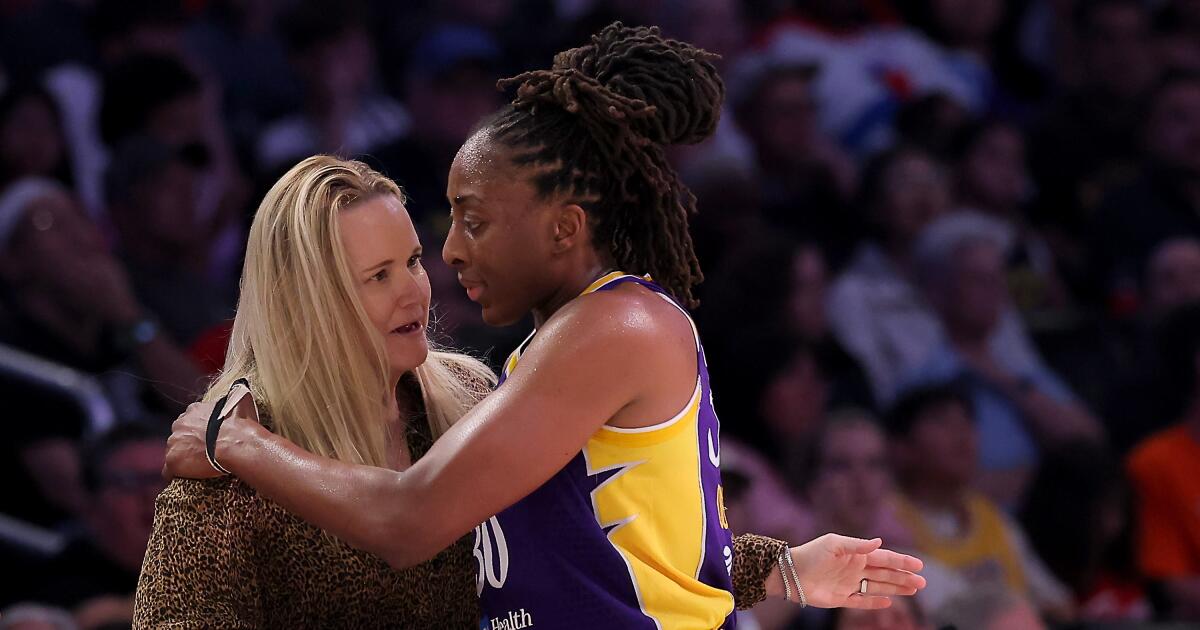
A day after general manager Raegan Pebley was fired, the Sparks were in Atlanta and seemingly still focused on trying to reach the playoffs this year.
The suggestion that Pebley’s removal was a sign that the team is performing poorly didn’t sit well with coach Lynne Roberts.
“I don’t think we underachieved last year and this year is still going,” Roberts said in Atlanta on Monday before the team’s loss to the Dream. “For where we want to get, that’s not where we want to be, but we tripled our win total in my first year — that’s not underachieving. We haven’t hit our stride, we’ve been injured all year. Hopefully we get [Kelsey Plum] and Cam [Brink] back. Our system is designed around KP. I’m not close to thinking we are underachieving.”
Pebley and the rest of the Sparks’ organization signaled a clear intention to compete this season, signing veterans Nneka Ogwumike and Erica Wheeler in the offseason, signing Dearica Hamby to a three-year deal and trading for Ariel Atkins.
The Sparks’ Rae Burrell protects the ball under pressure the Chicago Sky’s Natasha Cloud at Crypto.com Arena on July 10.
(Luiza Moraes / Getty Images)
They are still in the playoff race midway through the season, but have the second-worst defensive rating in the WNBA and sit a game below the postseason cutoff line.
They have competed without Plum, their top scorer, for 12 games and former No. 2 overall pick Brink during the past nine contests.
But even with their struggles, culminating in an 82-64 loss to Seattle on July 6, the Sparks responded well with consecutive home wins against Indiana and Chicago. After those games, Roberts seemed to think the team was moving in the right direction, but team owners made a major change.
The Sparks have a decision to make about how hard they want to push the rest of this season as the team flirts with missing the playoffs for a sixth consecutive season. With the trade deadline on Aug. 2, they could make some moves to improve this season or sell off their veteran assets and attempt to rebuild again.
The Sparks haven’t made the playoffs since 2020 and have made some controversial moves while trying to snap out of the slump.
In addition to the questionable trade of 2024 fourth overall pick Rickea Jackson to Chicago for veteran Atkins this offseason, Pebley traded the picks that would become Storm post duo Awa Fam and Dominique Malonga for Plum and Kia Nurse. In her sole season with the Sparks, Nurse averaged 7.6 points per game.
Pebley also traded the No. 8 pick in 2024 (that later was used to draft Alissa Pili) to Chicago for Julie Allemand and Li Yueru, then lost Allemand in the expansion draft. Yueru was sent to Seattle in the Plum trade and is now playing with Dallas. The Sparks’ 2025 first-round draft pick Sarah Ashlee Barker was left unprotected and went to Portland in the expansion draft.
The Sparks waived their top pick in this year’s draft, Ta’Niya Latson, after barely playing, and she has gone on to join Las Vegas. Sania Feagin, a 2025 first-round draft pick, was waived and signed with Portland.
Most of those moves, though, came after the Sparks lost the top spot in the 2025 draft lottery to Dallas, which selected Paige Bueckers with the No. 1 pick. Before the lottery result, it seemed like the Sparks — who went 8-32 in 2024 before that draft — were lining up for a youth movement led by Brink and Bueckers. A lineup of those three, a healthy Feagin, Barker and Allemand would be an entirely different kind of team.
Once that failed, they focused on adding veterans who could win now and have only managed modest improvement.
The Sparks have their next two first-round draft picks and four players still on rookie contracts after this season (Brink, Chance Gray, Kate Martin and Pili). Brink is their lone lottery pick left from their disappointing past six seasons. (Pili was a top-10 pick, but she has struggled to stay on a WNBA roster and just signed a player developmental contract with the Sparks this month.)
Pebley told The Times in an interview on Friday that she was open to making moves to compete at the deadline this year.

Players on the Sparks’ bench celebrate during a win over the Chicago Sky at Crypto.com Arena on July 10.
(Luiza Moraes / Getty Images)
“We are in a space where we are here to win,” she said. “This is a city that wants to win. We have an ownership that wants to win. You see what they’re doing with the Lakers. You see what they’ve done already with the Dodgers. … We have to always continue to invest in the roster. We have a responsibility to always listen and be aware of what’s out there.”
A league source not authorized to discuss trade conversations publicly told The Times that Pebley had been aggressive ahead of the deadline, and now teams are unsure what approach the Sparks will take moving forward.
“I found out when everybody else did,” Roberts said of Pebley’s firing. “It was a surprise. She’s a good friend of mine. I think the tone is set that we need to keep building and get the Sparks back to where they have been. That’s been the tone. Raegan did some great things for our org in that regard and improved a lot of things. That work can’t go undenied. It’s full-steam ahead and I’m focused on what I can do.”
It would be difficult to move some of their heftier contracts, especially since WNBA teams cannot take on more salary than their remaining cap space allows in a trade. Hamby, 32, is signed for two more years for more than $1 million per season. Atkins is also signed for two years at $1 million-plus and is having a career-worst offensive season, shooting 36.4% with 8.7 points per game.
Wheeler, 35, has another year left on her deal, but a $625,000 cap hit for a player who would be a backup point guard on most teams is a tough sell.
Plum and Ogwumike are on expiring deals, and the Sparks’ most valuable roster asset, Rae Burrell, is a restricted free agent, but one of the few young players left on the Sparks’ roster.
The Sparks have a limited $86,000 in cap space, too, so if they decide they want to buy at the deadline, they have to find a way to clear space.
They enter the trade deadline period in a difficult spot as a team in purgatory that just fired its general manager.
Yet what they decide to do in the next month might be the most clearest sign of their ambition and hope for the future.

NEWYou can now listen to Fox News articles!
ATLANTA — The FBI and Atlanta Police Department are getting ready for a massive security operation ahead of the World Cup semifinals between England and Argentina at Atlanta Stadium.
Both agencies have used drones to search for potential threats on the ground and in the sky. The FBI is enforcing the Federal Aviation Administration’s Temporary Flight Restrictions around the venue.
The FBI has confiscated more than 600 drones nationwide since the World Cup began. Special Agent in Charge of the FBI Atlanta Field Office Marlo Graham said 86 of those drones were seized in Atlanta.
Graham said the FBI uses a “mechanism” that allows agents to see unauthorized drones in restricted airspace. Agents then work to mitigate the threat posed by unknown drones.
“We’ve been able to safely land drones that have been unauthorized in the flight restricted area,” Graham said.
The FBI has confiscated more than 600 drones at World Cup events since the tournament started. (FBI Atlanta)
While the FBI treats every drone as a potential threat, Graham said the threat level can increase depending on the size of the drone and how close it gets to the stadium.
“Obviously, the closer to the venue, the larger the crowd. We are fortunate here in Atlanta that we have a closed dome stadium,” Graham said. “We don’t want the game to be impacted because a hobbyist couldn’t control their drone, and it lands right when one of our star players was getting ready to score a goal.”
EXCLUSIVE: FBI ADDS ALLEGED COVID FRAUDSTER TO MOST WANTED LIST
The Atlanta Police Department’s Drone Unit has helped the FBI track down people suspected of flying in restricted zones.
Sgt. Kindu Franklin said most of the people caught flying drones around World Cup venues are hobbyists with no intent to harm the crowd of soccer fans below.
“In some cases, they just recently bought a drone just for FIFA to get some of the cool footage that they want to put up on their social media,” Franklin said. “There are different ways that you can weaponize these drones. So, we’re operating in a proactive manner.”
The Atlanta Police Department’s drone mission at the World Cup focuses on surveillance. (FOX)
The Atlanta Police Department’s drone mission is focused on surveillance. Officers are looking for potential threats, traffic issues and people the FBI suspects are flying drones illegally.
“So, what we want to do is give our command staff a view that they can’t get from the ground,” Sgt. James Cunningham with APD’s Drone Unit said.
ARMED MAN ARRESTED AT US CAPITOL BARRICADE AS POLICE PROBE WHY HE DROVE ONTO RESTRICTED GROUNDS
Cunningham’s unit can launch drones remotely from handheld controllers. Other drones are launched from docking stations strategically placed across the city, and officers control them from the back of an SUV using a computer and a PlayStation controller.
The Atlanta Police Department launches some drones from docks strategically placed across the city. They are controlled by a computer and a PlayStation controller. (Fox News)
The drone docks are used year-round to help the police get an aerial view of emergency situations before officers arrive. The computer shows the drone pilot where all the police body cameras and vehicles are in the area, allowing them to communicate better with officers on the ground.
For the World Cup, the drone docks let the department have more eyes in the sky and respond to emergencies faster.
“It’s going to cut down time. We’re going to get there quick. And then you’re going to get an aerial perspective of what you can’t see on the ground,” Cunningham said.
The Atlanta Police Department launches some drones from docks to get more eyes in the sky and respond to emergencies faster. (Fox News)
Cunningham said the drone unit has completed more than 1,400 flights and logged more than 550 flight hours since the beginning of June.
“Some people haven’t even done that in years or haven’t even reached those numbers in the life of their drone unit,” Cunningham said.
“We train for the environment. We live here, so we know what to expect,” Anais Paredes, an APD drone pilot, said.
CLICK HERE TO DOWNLOAD THE FOX NEWS APP
The FBI is asking that hobbyist drone pilots know the Temporary Flight Restrictions in their area before taking off.
There is a one-mile restriction around World Cup stadiums on non-match days, and a three-mile restriction on game day.
-

 Los Angeles, Ca55 minutes ago
Stabbing at Chino Hills liquor store ends in attempted murder arrest
-

 Detroit, MI1 hour ago
A small group of citizens rally for mental health coverage in Detroit
-

 San Francisco, CA2 hours ago
1 dead, 2 missing after boat capsizes near Alcatraz in San Francisco Bay
-

 Dallas, TX2 hours ago
Death penalty off the table for man accused of beheading Dallas motel manager, prosecutors say
-

 Boston, MA2 hours ago
Chickadee, the popular Mediterranean restaurant in Seaport, is shutting down – The Boston Globe
-

 Denver, CO2 hours ago
Denver Nuggets 7-Year NBA Veteran Gets Honest On Peyton Watson
-

 Seattle, WA2 hours ago
Top 25 Seattle Seahawks Going into 2026 NFL Season: #17 Grey Zabel
-

 San Diego, CA2 hours ago
Tijuana earns spot in Little League World Series, hoping third time’s a charm

