Sports
Column: Baseball legend Willie Mays instrumental in California fight against housing discrimination

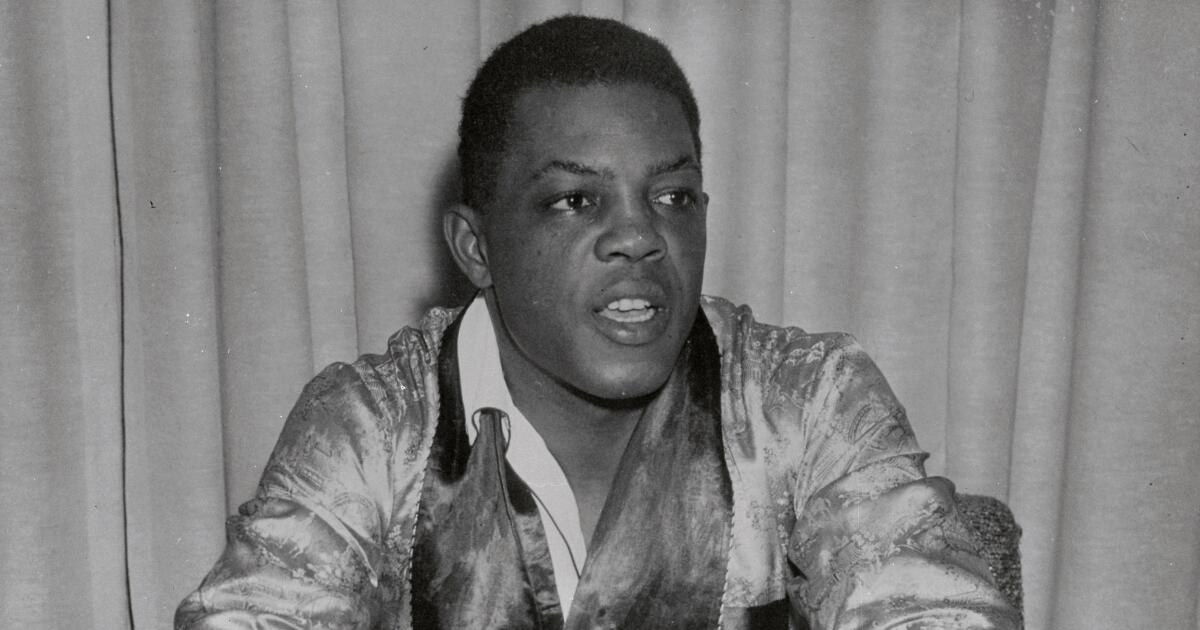
As a ballplayer, Willie Mays was arguably the greatest of all time — baseball’s GOAT. But he also starred in another endeavor — as an important California civil rights pioneer.
Mays never wanted to be an activist about anything off the baseball diamond. But the racism he encountered after moving to San Francisco stirred others to leap to his cause and ultimately helped motivate the city and state governments to outlaw housing discrimination.
His role began when Mays arrived in San Francisco from New York with the Giants baseball team in late 1957. Local folks in supposedly enlightened San Francisco welcomed the star outfielder by trying to bar him from a white neighborhood.
Mays downplayed it publicly, but his wife, Marghuerite Mays, spoke out to reporters: “Down in Alabama where we come from, you know your place. But up here, it’s all a lot of camouflage. They grin in your face and deceive you.”
Willie Mays receives the Presidential Medal of Freedom from President Obama at the White House in 2015.
(Evan Vucci / Associated Press)
Never mind that Mays was en route to the baseball Hall of Fame as the best all-around ballplayer in history. Didn’t matter. If a Black man was allowed to buy a home in a desirable neighborhood — adjoining tony St. Francis Wood in the Sunset District — nearby property values would tumble. At least that’s what white neighbors openly feared.
“I happen to have a few pieces of property in the area, and I stand to lose a lot if colored people move in,” a nearby home builder told reporters.
Yes, that was San Francisco — in fact, virtually all of California — until laws were passed in the 1960s to stop such discrimination. The change was aided significantly by Mays’ indirect help, according to another legendary Willie from San Francisco — former mayor and longtime state Assembly Speaker Willie Brown.
I called Brown, 90, after Mays died this week at age 93. Brown, a rare Black lawyer in late 1950s San Francisco, struck up an early friendship with Mays.
“He was a joy, frankly. A fun guy,” Brown says.
Brown credits the racial bias against Mays with galvanizing the city into adopting an ordinance forbidding housing discrimination.
“It started with Willie Mays,” Brown told me. “As a result of his being rejected, newspapers suddenly became aware of the racism in San Francisco.
“San Francisco wasn’t racist like other parts of the country. People smiled.”
Brown continued: “The fair housing law of San Francisco was passed because Mays got denied the right of housing. That escalated the need to change. He was the most dramatic example of how discrimination was practiced on people of color.”
In 1963, spurred by Gov. Pat Brown and Bay Area lawmakers, the state Legislature passed a bill outlawing racial discrimination in the sale and rental of housing. It needed all the support it could muster and generated the biggest, bitterest political brawl I’ve ever witnessed in Sacramento.
California voters overwhelmingly repealed the law the next year. But the repeal was declared unconstitutional by both the state and U.S. supreme courts.
Mays didn’t participate personally in that fight, but Brown certainly did.
A transplant from Jim Crow east Texas, Brown became a civil rights activist in San Francisco about the time Mays was arriving from New York. In fact, Brown was persistently snubbed by real estate agents when he tried to buy a house in 1961. He responded by leading a sit-in at a Realtor’s office.
The Mays incident occurred after he offered the asking price of $37,500 for a three-bedroom home in an upscale, tree-lined, all-white neighborhood. After he waited several days, his offer was turned down. The house remained on the market for the same price — but unavailable for the star ballplayer.
The San Francisco Chronicle got wind of the rejection and ran this banner at the top of Page 1: “WILLIE MAYS IS DENIED S.F. HOUSE–RACE ISSUE.” The headline on the story read: “Willie Mays is Refused S.F. House–Negro.”
“I didn’t figure I would have this much trouble trying to buy a place,” Mays told a TV reporter. “When I go looking for a house, I don’t worry about who’s living beside me.”
Unlike nervous white people of that era.
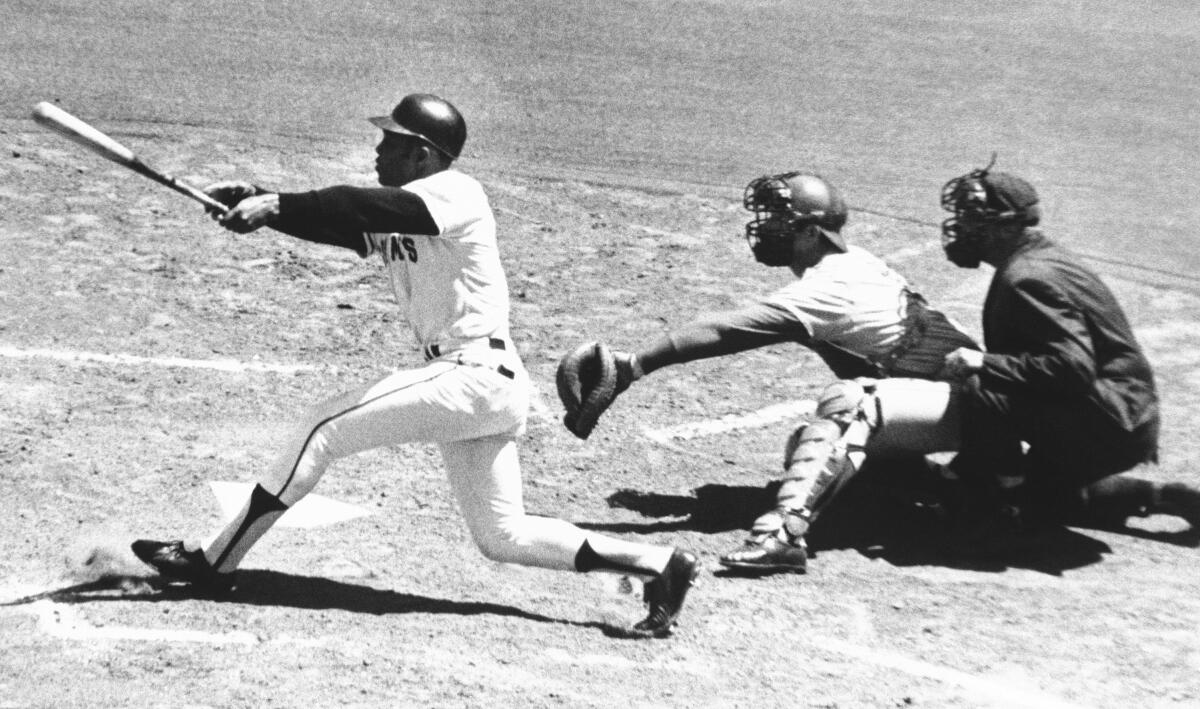
Mays gets the 3,000th hit of his career, a single to left, at Candlestick Park in San Francisco in 1970.
(Robert H. Houston / Associated Press)
San Francisco Mayor George Christopher — a moderate Republican, back when such a breed existed — offered to let Mays and his wife live temporarily at his home.
Ultimately, the homeowner backed down, despite being berated by neighbors. Mays moved in. And almost immediately someone threw a brick through a window.
Mays kept his mind on baseball and eventually became the pride of San Francisco.
As a bottom-tier sportswriter for United Press International, I was privileged to watch lots of Giants games at windy Candlestick Park in the early 1960s.
Mays’ statistics are phenomenal: a .301 career batting average, 660 home runs, 3,293 hits, 339 stolen bases, 12 Gold Glove awards in center field, 24 All-Star games.
In the 1961 All-Star Game at Candlestick that I helped cover, Mays doubled home the tying run in the 10th inning and then scored the winning run on a single by Pittsburgh’s Roberto Clemente as the National League edged the American League, 5-4.
But box scores and stats tell only part of the story of Mays’ greatness.
What I remember most about him was his playing with elation and exuberance — galloping around first base, always a threat to stretch a single into a double and a menace to steal second in any case. Full speed no matter the score. Cap flying.
In his long post-career, Mays provided a comfortable nostalgic link back to baseball’s exciting heyday — before blah analytics and emphasis on astronomical free agent salaries.
America can’t afford to lose such people. He didn’t hate. He brought cheer.
And — while there’s no stats on it — he assisted in beating housing discrimination.

Sports
Pirates star pitcher makes unfortunate history after being taken out in middle of perfect game bid

NEWYou can now listen to Fox News articles!
Jared Jones was flirting with Major League Baseball history on Wednesday night — he got it, but it was not what he originally envisioned.
The Pittsburgh Pirates pitcher retired the first 18 batters he faced, but he was taken out in the middle of his perfect game bid after six innings.
Now, the Pirates certainly have their reasons — the 24-year-old Jones hasn’t thrown more than 81 pitches in eight starts since returning May 20 after missing all of last season while undergoing ulnar collateral ligament internal brace surgery on May 21, 2025. He was yanked with 77 pitches and likely would have needed more than 100 pitches to record the 25th perfect game in MLB history.
Jared Jones of the Pittsburgh Pirates pitches during the first inning against the Atlanta Braves at PNC Park on July 8, 2026, in Pittsburgh, Pennsylvania. (Photo by Joe Sargent/Getty Images)
However, Jones left the game after getting zero run support, so when the Atlanta Braves tacked on three runs late for a 3-0 victory, Jones instead found himself in the wrong chapter of the history books.
According to Opta Stats, Jones became the first pitcher in the modern era (since 1920) to pitch at least six perfect innings and not record a win.
“It does suck. Something’s cool coming on, but I’m on what? My eighth start off of surgery? I completely understand it, and it is what it is,” Jones told reporters after the game.
Pittsburgh Pirates starting pitcher Jared Jones (17) makes his way to the field to warm up before pitching against the Atlanta Braves at PNC Park. (Charles LeClaire/Imagn Images)
JUSTIN VERLANDER ANNOUNCES HE WILL RETIRE AFTER THIS SEASON: ‘I’VE REALIZED THAT TIME HAS COME’
Jones said he didn’t entertain attempting to complete the perfect game.
“Not with the pitch count,” he said. “Not really ever expecting to go nine right now, so that was never in my head.”
Joey Bart, traded to the Braves from the Pirates on June 18, followed a double by Mike Yastrzemski with a 422-foot, two-run homer to left-center field off a slider from Dennis Santana. Drake Baldwin added an RBI single to center in the ninth for good measure.
It was the second time in less than a week that a pitcher was taken out of the game with a perfect bid through six innings — the Miami Marlins took Eury Perez out after seven innings in which he had 92 pitches. Perez, too, is in the midst of returning from injury and has surprisingly found himself right in the postseason mix.
He was pulled for Lake Bachar to start the eighth, and the Marlins allowed eight runs to the Athletics in the final two innings, but held on to win 9-8.
Jared Jones (17) of the Pittsburgh Pirates delivers a pitch during a MLB game against the Cincinnati Reds on June 27, 2026, at PNC Park in Pittsburgh, Pennsylvania. (Joe Robbins/Icon Sportswire via Getty Images)
CLICK HERE TO DOWNLOAD THE FOX NEWS APP
The Pirates are 4.0 games out of the final wild card spot, which is held by the Marlins.
The Associated Press contributed to this report.
Follow Fox News Digital’s sports coverage on X, and subscribe to the Fox News Sports Huddle newsletter.
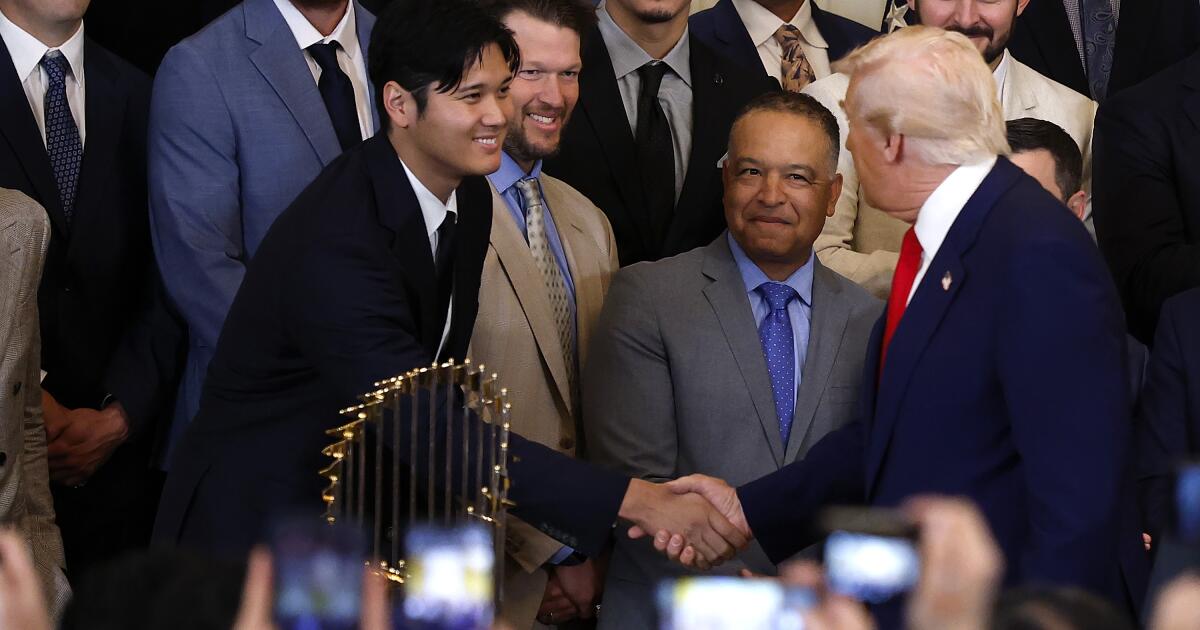
WASHINGTON — The Dodgers are scheduled to visit the White House on July 23 to celebrate their latest World Series title.
“President Trump is excited to welcome the Los Angeles Dodgers BACK to the White House to celebrate their World Series championship!,” White House spokesperson Taylor Rogers said in a statement to The Times.
The date falls on a scheduled off day in the middle of a nine-game East Coast road trip for the Dodgers. The team will play three games in Philadelphia against the Phillies July 20-22 before ending the trip with a three-game series against the New York Mets July 24 to 26.
The visit continues a tradition from the Dodgers’ two previous World Series championships. They were hosted by President Biden in 2021 and President Trump in April 2025.
After the Dodgers claimed their second consecutive World Series title with a dramatic Game 7 victory over the Toronto Blue Jays, a visit to the White House was planned, but it wasn’t until Thursday that a date was officially booked and confirmed.
Questions swirled around whether players would decline the visit this year after it did not happen during a scheduled visit to Washington in April.
Kiké Hernández said in 2018 he was unsure he would have gone had the Dodgers won the World Series the previous year. Mookie Betts said he was undecided and needed to talk it over with his family when last year’s visit was announced. After winning his first World Series with the Boston Red Sox in 2018, Betts skipped their trip to the White House the following year during Trump’s first term.
Both players, along with every returning member of the 2024 team who was with the team during its road trip, participated in the visit. The only notable absence was first baseman Freddie Freeman, who remained in Los Angeles to nurse an ankle injury.
Manager Dave Roberts, who indicated in comments to The Times in 2019 he might not go to the White House if Trump was president, also participated in last year’s ceremony.
Asked at the Dodgers’ fan festival in January about the possibility of returning to the White House, Roberts told The Times’ Bill Shaikin: “For me, I stand by: I’m a baseball manager. That’s my job.”
“I was raised — by a man who served our country for 30 years — to respect the highest office in our country,” Roberts said. “For me, it doesn’t matter who is in the office, I’m going to go to the White House. I’ve never tried to be political. … For me, I am going to continue to try to do what tradition says and not try to make political statements, because I am not a politician.”
Clayton Kershaw, who retired after last season but was on Team USA for this year’s World Baseball Classic, told The Times in the spring that he was aware Dodgers fans are split over whether the team should visit the White House again this year, but he said he is looking forward to it.
“I went when President Biden was in office. I’m going to go when President Trump is in office,” Kershaw said. “To me, it’s just about getting to go to the White House. You don’t get that opportunity every day, so I’m excited to go.”
Times deputy sports editor Ed Guzman contributed to this report.

NEWYou can now listen to Fox News articles!
All eyes were on Caitlin Clark on Wednesday night as she made her anticipated return from injury in a road matchup in Los Angeles.
But instead of a triumphant comeback, the Fever spent the entire night chasing the Sparks as Clark’s rough return fueled a 106-92 rout.
The superstar never found a groove, looking completely out of sync in her return from a back injury.
STEPHANIE WHITE GIVES CAITLIN CLARK STATUS UPDATE AHEAD OF FEVER-SPARKS, BUT HER NEXT MOVE RAISES QUESTIONS
Caitlin Clark huddles with teammates as the Indiana Fever battle the Sparks. (Photo by Katelyn Mulcahy/Getty Images) ((Photo by Katelyn Mulcahy/Getty Images))
Much of that disjointed performance falls squarely on head coach Stephanie White, who kept Clark on a ridiculously tight leash by limiting her to just 16 minutes. The stop-and-go approach could have sabotaged any chance for the phenom to establish a rhythm.
Clark finished with just 9 points, 4 rebounds and 3 assists. Her minus-16 plus-minus told the story.
The Los Angeles Sparks were severely shorthanded, taking the floor without stars Kelsey Plum and Cameron Brink.
MERCURY’S NOW-DELETED SOCIAL MEDIA POST MOCKING CAITLIN CLARK DRAWS SCRUTINY AFTER STAR’S INJURY
Yet while a depleted Sparks roster played to win, Indiana spent the night over-managing its biggest asset.
With Clark on a minutes restriction and Aliyah Boston out of the lineup, Kelsey Mitchell was forced to shoulder the entire offensive burden.
Mitchell did her part, pouring in 29 points while shooting 5-of-9 from beyond the arc.
Caitlin Clark orchestrates the Fever offense as Indiana battles the Los Angeles Sparks in primetime action. (Photo by Katelyn Mulcahy/Getty Images) ((Photo by Katelyn Mulcahy/Getty Images))
But one hot hand couldn’t stop an efficient LA squad.
The Sparks shot 45% from three-point range, going 9-of-20 from deep to cruise to the 106-92 victory.
White’s next move is to sit Clark against the Mercury on Thursday while Boston returns.
CLICK HERE TO DOWNLOAD THE FOX NEWS APP
After Wednesday’s loss to a shorthanded Sparks team, it’s fair to question whether Indiana’s cautious approach is working. The Fever dropped to 12-9.
Caitlin Clark and Dearica Hamby face off as Fever and Sparks battle at Crypto.com Arena in Los Angeles. (Photo by Tyler Ross/NBAE via Getty Images) ((Photo by Tyler Ross/NBAE via Getty Images))
Send us your thoughts: alejandro.avila@outkick.com / Follow along on X: @alejandroaveela
-

 Austin, TX2 minutes ago
Think tank says state education reforms have set up future of the ‘Texas Miracle’
-

 Alabama9 minutes ago
New Alabama women’s basketball coach Pauline Love credits late mentor for coaching career
-

 Alaska11 minutes ago
Fatal crash closes Glenn Highway southbound lanes near Eagle River
-

 Arizona16 minutes ago
Arizona Cardinals’ Jordan Burch takes lessons from rookie year
-

 Arkansas24 minutes ago
Dino Fest brings interactive experiences, lifelike dinosaurs and reptiles to Arkansas July
-

 California26 minutes ago
Southern California police vow to quash planned ‘takeover’ event following recent chaos
-

 Colorado32 minutes ago
Body found in western Colorado believed to have been eaten by bear
-

 Connecticut39 minutes ago
CBIA BizCast: Snapshot of Connecticut’s Economy » CBIA

