Sports
Christina Unkel interview: Team president, attorney, app creator and Euros breakout star


Follow live coverage of England vs Netherlands in the Euro 2024 semi-final today
The breakout star of this summer’s European Championship only played her first game on Monday.
ITV’s referee analyst Christina Unkel speaks to The Athletic before setting off for the media match against the BBC in Berlin. First, she will meet up with Jill Scott for a coffee — one of the players she booked in her former life as an elite referee is now a colleague — and on Wednesday she will be on hand for coverage of England’s semi-final against the Netherlands. She has worked on all of ITV’s matches during the tournament, plus their highlight shows.
It is a wonder she finds the time. Unkel is also the president of Tampa Bay Sun, a new team due to play in the inaugural USL Super League season starting in August, a founder of fitness apps and a litigation attorney. She is well known to U.S. viewers, having featured on Fox, CBS and Paramount Plus’s football coverage, but Euro 2024 has marked her UK breakthrough and she has garnered widespread acclaim for her calm authority.
The 37-year-old is whipsmart and her contributions have often made for the most compelling parts of ITV’s half-time and post-match coverage. Unkel is often challenged by pundits Gary Neville, Ian Wright, Roy Keane and Ange Postecoglou, who might keep abreast of football’s changing laws but still do not like all of them.
“That’s the whole point of why I did this in the first place,” she says. “I encourage them. Everyone’s like: ‘I feel like they’re beating up on you.’ Not at all! Ask me questions! If they’re struggling with those questions as professional footballers, the general population is struggling.
“If I just wanted to collect a paycheque and walk out, I probably would be cringing. But those are the opportunities I desire. Those are the conversations that IFAB (the International Football Association Board, the game’s lawmakers) might need to hear from the football community.
“They have such a high level of football understanding and sometimes they don’t even know — justifiably so — some of the nuances we have. You can take a look at the laws of the game, but the nuances or the application — what I call the case application — aren’t included.”
Unkel began her own refereeing career at the age of 10. She had been the kind of player to feel unjustifiably aggrieved with officials, to the extent that her coach told her she needed to be quiet or take a course and actually learn the rules. The treatment of referees was kinder when she was coming up — had it not been, she says, she is not sure she would have stayed in the game — and when faced with any kind of sexist invective about getting back in the kitchen, she would shrug it off with a wish that her detractors would come up with something more original.
Primarily, she was focused on becoming the kind of official she had yearned to encounter as a player.
“Being a female soccer player, people would be assigned to our games and either not take it seriously or think they’re not much of an issue,” she says. “For somebody to not care about our game — because it was a girls’ game — drove me nuts. We still deserved fair treatment and quality and care and concern. There are times you just remember a ref for how good of a job they did. I always wanted to be remembered for that.”
Unkel graduated from college to find there was little infrastructure for women’s professional soccer in the United States. Playing abroad was not an option when pay was still so poor. Officiating was the best way to stay involved — even if in the early days of her refereeing career the pay was so paltry she would actually lose money giving up her day job.
Her goal was to reach the point where she could referee sides such as the U.S. Women’s National Team. Those were the most thrilling games of her career “because of the environment that they were creating. I’m a referee and no one’s obviously going to come to see me except for my parents, but you were part of that tapestry in some way”.
Christina Unkel, pictured in 2014, during her on-field refereeing career (Stanley Chou – FIFA/FIFA via Getty Images)
She took her first television role before the 2019 Women’s World Cup, taking on 53 games for Fox Sports. She joined up a day before Fox announced their line-up. It meant giving up her role on the FIFA Panel and, having made that sacrifice, she was keen that her involvement amounted to more than just critiquing her former colleagues. That, she says, is why “this role is very taboo”, although the stigma is shifting.
“Not many people had done this role in the way I envisioned it, which was to educate the masses,” she says. “If the referee got a decision correct, break it down: here’s the play, here’s the law, here’s what should have been the answer. It’s very rare that officials get something incorrect just because it’s a pure misapplication of law. That’s easy to explain without destroying an official. My job is not to rate the referee; my job is to explain the laws.
“When I stepped into that role, it did ostracise some people. Some friends of mine didn’t agree.” They came around when she was picked up by CBS for their Champions League coverage in 2020 and they could see what she was trying to do. This tournament has underlined that it’s worthwhile work.
“It’s been a little enlightening to me to see so many people tearing down English referees but they’ve actually been some of the best-performing officials in this tournament,” Unkel explains. “To just enlighten people so they are making opinions, or decisions that are more fully educated, is really the goal.”
At ITV, she has the benefit of a full-time video operator to help her select clips for analysis; for domestic matches, she pulls up the best angle herself. The pair treat her secluded studio booth “as if I were stepping into a VAR room” and it helps that Unkel was part of the first cohort of referees trained in VAR in 2017, with Howard Webb as her instructor.
That boot camp involved sitting in video-operating booths with timers in the corner of the footage she was watching. “At 10 or 15 seconds, it goes from green to yellow, and then it goes to red at, like, 30. So it does feel like you’re in a spy movie about to blow up.” It was good preparation for the three to five seconds she has in-game to explain decisions. “Sometimes I have to break down something I’ve learned over 20 years. What are the one or two really important things you want people to walk away with so they can connect it very quickly without having taken all the referee courses I did?
“You know what kind of checks are being reviewed. ‘Here’s what I need to look at, and here’s what I need to break down.’ And as soon as I have that answer, I’m always like: ‘Let me in! Let me in!’ If they bring me in before I have the answer, I’m commentating while I’m looking for it: ‘The VAR is looking for this specific angle that’s going to be showing this.‘ I’m basically running the audience through the exact same mental protocol that’s happening in live time.”

Among the most divisive features of the tournament are the semi-automated offsides, facilitated by additional cameras and limb-tracking technology, which denied Belgium’s Romelu Lukaku three goals in his opening two matches.
“As a striker, I’m never going to be able to accept that kind of offside,” Wright said in the aftermath of Belgium’s 2-0 group-stage win over Romania. Unkel went on to outline how certain players might have to adjust their running style to stay within the law. Spurs manager Postecoglou has also been critical of laws now punishing what previously would have been ignored. “I don’t think that is why we brought in technology,” he has said.
“We’re just in this Goldilocks period of figuring out how we want to use our technology to better the game,” Unkel says now. “Everyone hates toenail offsides. Players hate it. Refs hate it. Fans hate it. Coaches hate it.
“We see these toenail offsides because of law and the technology that’s given: the semi-automated offsides and the lines that drop. In Major League Soccer, even to this day, they can’t afford those lines that drop. We have not had issues in Major League Soccer about toenail offsides because when you do VAR in Major League Soccer, if it is really close and you truly can’t tell, you leave it be. The goal stands. It remains that way and nobody is upset by it. They might have been off by a centimetre.
“Whereas here, we know they’re off by a centimetre. And that’s what really frustrates people. I kind of laugh and advocate for: competitors and competitions can save millions of dollars if they just get rid of the offside lines. The technology is really expensive. Importantly, (in punditry) now you get someone to be able to use the naked eye to say: does that make any sense? Would that be taken back or not? How close is that?”
The coverage has exposed a gap between expectations of the technology and how it has worked in practice. Unkel is keen to point out that each law change is deliberate and meticulous; debate at major European tournaments can accelerate changes to laws but, generally speaking, tweaks take a couple of years before they are signed off. They go through technical and practical advisory boards, directors for IFAB, FIFA representatives, players, coaches and confederations.
“When people are like, ‘I wasn’t expecting this,’ either you or somebody from your coaching staff needs to be focusing on this because it does affect how you might be setting up for games or understanding the implications,” says Unkel. “You can voice an opinion prior to application so that we have a better understanding of how it’s going to play in the game, and not do so after the fact.”
With Unkel on their case, they just might.
(Top photo: ITV)



NEWYou can now listen to Fox News articles!
All eyes were on Caitlin Clark on Wednesday night as she made her anticipated return from injury in a road matchup in Los Angeles.
But instead of a triumphant comeback, the Fever spent the entire night chasing the Sparks as Clark’s rough return fueled a 106-92 rout.
The superstar never found a groove, looking completely out of sync in her return from a back injury.
STEPHANIE WHITE GIVES CAITLIN CLARK STATUS UPDATE AHEAD OF FEVER-SPARKS, BUT HER NEXT MOVE RAISES QUESTIONS
Caitlin Clark huddles with teammates as the Indiana Fever battle the Sparks. (Photo by Katelyn Mulcahy/Getty Images) ((Photo by Katelyn Mulcahy/Getty Images))
Much of that disjointed performance falls squarely on head coach Stephanie White, who kept Clark on a ridiculously tight leash by limiting her to just 16 minutes. The stop-and-go approach could have sabotaged any chance for the phenom to establish a rhythm.
Clark finished with just 9 points, 4 rebounds and 3 assists. Her minus-16 plus-minus told the story.
The Los Angeles Sparks were severely shorthanded, taking the floor without stars Kelsey Plum and Cameron Brink.
MERCURY’S NOW-DELETED SOCIAL MEDIA POST MOCKING CAITLIN CLARK DRAWS SCRUTINY AFTER STAR’S INJURY
Yet while a depleted Sparks roster played to win, Indiana spent the night over-managing its biggest asset.
With Clark on a minutes restriction and Aliyah Boston out of the lineup, Kelsey Mitchell was forced to shoulder the entire offensive burden.
Mitchell did her part, pouring in 29 points while shooting 5-of-9 from beyond the arc.
Caitlin Clark orchestrates the Fever offense as Indiana battles the Los Angeles Sparks in primetime action. (Photo by Katelyn Mulcahy/Getty Images) ((Photo by Katelyn Mulcahy/Getty Images))
But one hot hand couldn’t stop an efficient LA squad.
The Sparks shot 45% from three-point range, going 9-of-20 from deep to cruise to the 106-92 victory.
White’s next move is to sit Clark against the Mercury on Thursday while Boston returns.
CLICK HERE TO DOWNLOAD THE FOX NEWS APP
After Wednesday’s loss to a shorthanded Sparks team, it’s fair to question whether Indiana’s cautious approach is working. The Fever dropped to 12-9.
Caitlin Clark and Dearica Hamby face off as Fever and Sparks battle at Crypto.com Arena in Los Angeles. (Photo by Tyler Ross/NBAE via Getty Images) ((Photo by Tyler Ross/NBAE via Getty Images))
Send us your thoughts: alejandro.avila@outkick.com / Follow along on X: @alejandroaveela
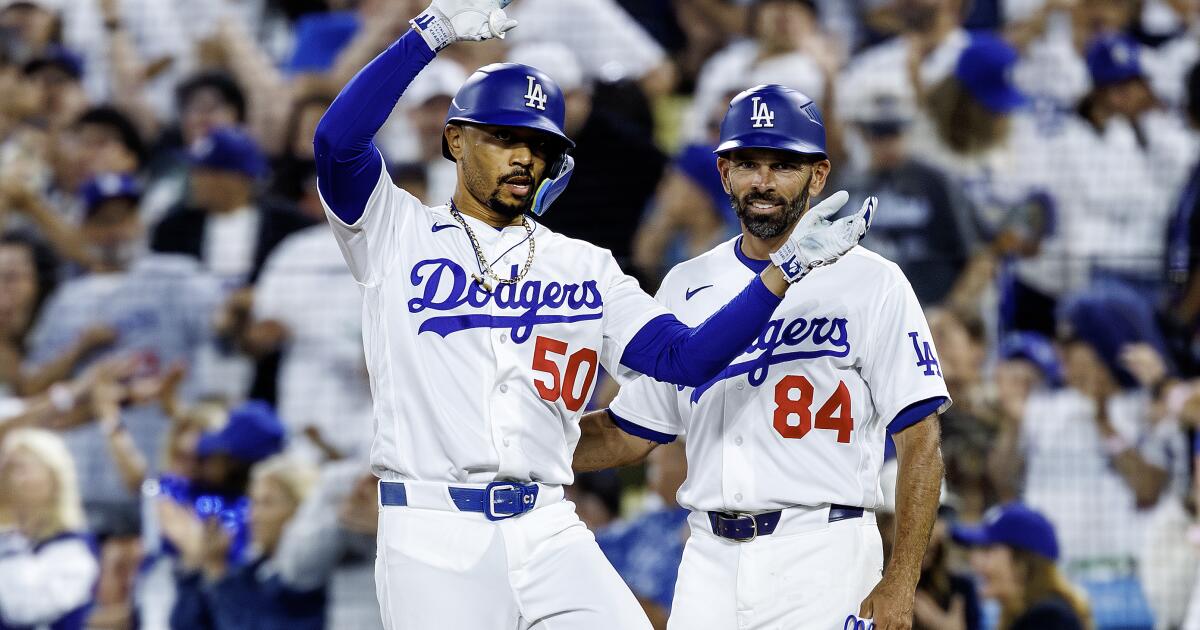
Mookie Betts’ first hit this series against the Rockies couldn’t have come at a more opportune time. With the crack of the ball against his bat, Tommy Edman scored from third, giving the Dodgers the lead.
And as Betts reached first, he pointed to Freddie Freeman, whose single put Edman in scoring position. It had taken a team effort to overcome another middling start from Roki Sasaki, and Betts, who had little to show before his game-winning hit, took the chance to highlight the joint contribution in the Dodgers’ 4-3 rubber-match win over Colorado (38-56).
“It feels great,” Betts said of his nine-pitch battle. “Helping the boys win, that’s really all it is. We play the game to win, and coming through in a big moment is kind of what, when you’re a kid, playing in the backyard, getting that hit is what you always strive to do, and fortunately, I was able to do it.”
Given a three-run lead in the first inning, brought to the Dodgers by a wild pitch and Kyle Tucker’s two-run, line-drive single to left field, Sasaki seemed set up for success.
Still, he gave away the lead as quickly as it came. In the second inning, he left a fastball too far over the plate, and third baseman Kyle Karros drove the ball over the left-center wall. The slider he dealt two batters later to second baseman Edouard Julien also crossed the zone too far over the plate, and Julien rounded the bases with another homer. In the third, a sacrifice fly by Mickey Moniak evened the scored, 3-3.
Sasaki’s troubles this season have been hard to pin down since his last win on May 23, as Sasaki tries to claw back the triple-digit velocity that’s escaped him as of late.
Against the Rockies, his fastball topped out at 99.1 miles per hour before steadily dropping to 98. He had managed five strikeouts in his six innings when manager Dave Roberts replaced him with Jack Dreyer, though the three earned runs couldn’t be ignored.
But Roberts also acknowledged the possibility that the pitcher had been tipping his pitches, possibly since he was playing in Japan, and Sasaki has tried to address it after a three-inning, six-run start last week. Even if he had fully self-corrected, his control issues remain. In the third inning, he walked the tying runner, Brett Sullivan.
“I’ve been working on a lot of things like the tipping stuff,” Sasaki said through interpreter Kensuke Okubo. “Also, I need to make quality pitches.”
Sasaki regained some of his confidence in the fourth when he worked out of a two-base jam with two strikeouts and a flyball to right, something that didn’t go unnoticed by Roberts.
“You can see the demeanor walking off the mound, the confidence,” Roberts said. “For me, it was more of let him end on a high note, feeling good about his outing, and then go from there.”
The Dodgers’ problems were compounded by Alex Call wasting the team’s two challenges in his at-bat in the first inning when the team had already taken the lead. And maybe it would’ve been excusable if Call had driven in the runners on first and second, but instead he ended the inning on a strikeout, stranding both. Roberts called the situation an “outlier” and didn’t feel as though he needed to have a conversation with Call regarding the situation.
After the three-run first, the Dodgers (61-33) remained hitless until Max Muncy laced a double down the right-field line in the sixth, though to little avail. As the innings ticked forward, Colorado’s chances seemed to increase. The Rockies hold the best league batting average (.297) in the eighth and ninth innings (the Dodgers are fourth with .268). And the Dodgers relievers, within the same constraints, have a 3.83 ERA — not bad, but not in the top 10 either.
Third baseman Max Muncy can’t get his glove on a line-drive double by Kyle Karros in the fourth inning.
(Gina Ferazzi/Los Angeles Times)
So when Alex Vesia struggled against the Rockies in the eighth inning and Muncy suffered a throwing error, Colorado seemed in position to score with the bases loaded and one out. Vesia struck out TJ Rumfield and Edgardo Henriquez (4-0), his replacement, retired Karros on a fly ball to right.
After Betts’ single allowed the Dodgers to take the lead, Tanner Scott (13) shut down the Rockies with back-to-back strikeouts, avoiding the team’s eighth series loss of the season.
“Didn’t feel great,” Roberts said. “Fortunately, we won a series, but that’s not the kind of way you want to do it.”
Sports
Justin Verlander announces he will retire after this season: ‘I’ve realized that time has come’

NEWYou can now listen to Fox News articles!
One of the greatest pitchers in the history of baseball will be hanging up his cleats after this season.
Three-time Cy Young Award winner Justin Verlander announced on Wednesday that the 2026 season will be his last.
Amid an injury-riddled season with the Detroit Tigers, Verlander decided it’s time to go.
Detroit Tigers pitcher Justin Verlander watches from the dugout during a game against the Chicago White Sox at Comerica Park in Detroit June 21, 2026. (David Rodriguez-Munoz/USA Today Network via Imagn Images)
“This season has challenged me in ways I haven’t experienced before, both physically and mentally. I’ve always believed that as long as I could compete at the level I expect of myself, I’d keep playing. I never wanted to retire because of a milestone, a number, or a date on the calendar. I wanted the game to tell me when it was time. Over the last several months, I’ve realized that time has come,” Verlander said in a social media post.
“While I’m fully committed to giving my team everything I have for the rest of this season, I’ve decided this will be my last. It’s fitting that I get to finish where it all started – with the Detroit Tigers, the organization that drafted me and gave me my first opportunity.”
Verlander inked a one-year deal with the Tigers, with whom he spent his first 12½ seasons before being traded to the Houston Astros, in the offseason. In Houston, he returned to dominance, winning both of his World Series titles and two of his Cy Young Awards.
“Baseball has given me more than I could have imagined. It taught me discipline, resilience, and the value of continuing to adapt and evolve. I’ve been fortunate to play with and against incredible players, for outstanding organizations, and compete in-front of fans who deeply appreciate the game,” Verlander added in his announcement.
Justin Verlander of the Houston Astros celebrates after the Astros defeated the Philadelphia Phillies in Game 6 of the 2022 World Series at Minute Maid Park Nov. 5, 2022, in Houston, Texas. (Mary DeCicco/MLB Photos via Getty Images)
PHILLIES STAR SAYS ‘BS RULE’ IS KEEPING HIM FROM BEING NAMED ALL-STAR IN FRONT OF HOME CROWD
“To every teammate, coach, player, clubhouse attendant, and fan who has been part of this journey – thank you. It’s been a privilege to share the field with you. To my family, especially my wife Kate, thank you for standing beside me through every season, every rehab, and every high and low. I couldn’t have done this without you. It’s time for the next chapter. But first, I’m excited to finish this season the only way I know how – with everything I’ve got.”
Verlander is the active leader with 3,554 strikeouts, which is good for eighth all-time. He needs 21 to surpass Don Sutton and 87 to pass Tom Seaver.
The 43-year-old made his MLB debut in 2005 and won the American League Rookie of the Year Award the following season in what was just a small glimpse of what was to come.
Verlander was a Cy Young Award finalist on four other occasions, consistently near the top of the leaderboard in just about every pitching stat. MLB Commissioner Rob Manfred gave Verlander a legend’s exemption to this year’s Midsummer Classic, making him a 10-time All-Star.
One could argue that Verlander should have at least one more Cy Young Award on his mantle, but he is on the fast track to Cooperstown and very much in the conversation to join Mariano Rivera as the only player unanimously elected to the Hall of Fame.
Verlander’s best season came in 2022, when he pitched to a career-best 1.75 ERA along with a 0.829 WHIP. However, that came after he missed the entire 2021 season due to Tommy John surgery for an injury he suffered after pitching just one inning in the abbreviated 2020 season.
Houston Astros starting pitcher Justin Verlander throws against the Boston Red Sox during the first inning Aug. 22, 2023, in Houston. (AP Photo/Michael Wyke)
CLICK HERE TO DOWNLOAD THE FOX NEWS APP
He won his first Cy Young Award in 2011, when he was also awarded the MVP Award, and his second in 2019. Verlander’s 11 seasons between his first and final Cy Young Awards are the second-most behind Roger Clemens, who had 18 seasons between his first and seventh.
Verlander led the majors in innings and WHIP four times while recording the most strikeouts in three seasons.
Follow Fox News Digital’s sports coverage on X, and subscribe to the Fox News Sports Huddle newsletter.
-

 Delaware2 minutes ago
Plans advance for Delaware city’s first Chick-fil-A restaurant
-

 Florida5 minutes ago
Summer Scheming ‘26: Florida State Seminoles
-

 Georgia10 minutes ago
Travel and Leisure listed unique experiences in each state, including GA
-

 Hawaii17 minutes ago
Three West Hawaii sex offenders arrested – West Hawaii Today
-

 Idaho20 minutes ago
Idaho Power crews respond to outage affecting 2,163 customers in Canyon County
-
 Illinois32 minutes ago
As Illinois enters 10th year under Evidence-Based Funding model, equity remains an elusive goal
-

 Indiana35 minutes ago
FAIRFIELD NATIVE AND HIS WIFE FOUND DEAD IN THEIR NEWBURGH, INDIANA HOME
-

 Iowa40 minutes ago
From caviar nuggets to bison, 10 new Iowa State Fair food trends

