Sports
Brian Flores isn't afraid and isn't looking back — how about the rest of the NFL?


Brian Flores swiveled in a chair and repeated the question.
“Is there anything else I want to say? … Is there anything … Hmm … ”
It was a chilled December afternoon in Eagan, Minn., and the Minnesota Vikings’ defense coordinator was seated inside his dimly lit office. His eyes, shielded by a purple flatbill cap, fixated on the floor.
Five years ago, Flores accepted the Miami Dolphins’ head coaching job. He quickly orchestrated a rebuild, producing winning records in 2020 and ’21. Then in the spring of 2022, he was fired. Less than a month after his dismissal, Flores, Black and of Honduran descent, sued the NFL and three teams, including the Dolphins. He wrote that the league remains “rife with racism, particularly when it comes to the hiring and retention of Black head coaches, coordinators and general managers.”
Flores knew that his choice to file the lawsuit could jeopardize opportunities to do what he loved most. He felt the sacrifice was worth it so long as it brought along change. “This isn’t about me,” he said at the time. “This is about something that’s much bigger than me, which is a system in the NFL that, in my opinion, is broken.”
A conversation with Pittsburgh Steelers head coach Mike Tomlin landed him a job as a senior defensive assistant and linebacker coach in 2022. Last spring, Vikings head coach Kevin O’Connell sought someone who could maximize a talent-deficient defense that had been torched in the playoffs. Flores emerged as the best candidate, then proved it during the season.
Last year’s Vikings defense ranked 24th in DVOA, an all-encompassing metric that factors in strength of schedule. This year’s Vikings defense ranked 11th, even with the subtractions of premium edge rusher Za’Darius Smith, stout defensive lineman Dalvin Tomlinson and future Hall-of-Fame cornerback Patrick Peterson.
The 2023 transformation, paired with his overall resume, is why Flores’ name should be mentioned among the league’s premier head-coaching candidates in the coming days. Should be.
“Is there anything?”
His eyes drifted upward.
“The last five years have been so wild,” Flores said. “It’s been such a journey. And I’m not upset or regretful about any of it. It’s allowed me to grow.”
“What the hell is this defense?” Jason McCourty asked.
He was sitting inside a third-floor conference room at the Westin Hotel in Cincinnati, about a mile from the Bengals’ Paycor Stadium. Smiling mischievously across from him was Flores.
The two go back a ways. Beginning in 2010, Flores coached McCourty’s twin brother Devin in New England. Jason joined the fold in 2018, the year the Patriots last won a Super Bowl. He then played in Miami in Flores’ third year as the Dolphins’ head coach. They’ve kept in touch. Their families remain close. But now, it was time for business.
McCourty was a color commentator for the Vikings’ Week 15 game against the Bengals. To prepare, he and the production crew lobbed questions at coaches. Few were as forward as the one he just asked.
McCourty read aloud some statistics scribbled on the paper in front of him. Most six-man pressures in the NFL. Most drop-eight coverages. More players aligned on the line of scrimmage pre-snap than any other defense. More rotations from one-high safety to two-high safeties than all but one other defense. And all of this with a bunch of overlooked veterans and inexperienced late-round draft picks.
“Flo, I’ve been in your defenses,” McCourty said. “This is so different.”
Flores agreed, admitting the 2023 iteration of his system was “a little bit out there.” He recalled the players’ disoriented reactions initially. A defender lining up in the A-gap, the space across from the center and guard, would run coverage against a deep post route?
But those questions quieted quickly. Safety Josh Metellus aligned in the A-gap, then ran the deep post. Cornerback Byron Murphy Jr. blitzed. Edge rusher D.J. Wonnum dropped. The result? Turnovers, stops, even victories.
What the hell is this defense?
“It’s a defense that has been a lot of fun,” Flores said.
McCourty recognized Flores’ emphasis on the word. And he smiled.
Flores (left) coached Jason McCourty (right) in both New England and Miami, where the coach struck a more serious tone. (Mark Brown / Getty Images)
“It’s funny,” Flores said, swiveling in his office. “When you’re a coordinator or you’ve been a head coach, nobody remembers or cares. The steps. The sacrifice. The hours.”
Flores began as a player personnel assistant working atop a cluttered office desk in the back row of the Patriots’ second-floor personnel office. Longtime Pats executive Scott Pioli hired him on the recommendation of a college coach. The role? Work your butt off and don’t moan about it.
This was 2004, as the curtains opened on the Bill Belichick-Tom Brady dynasty. The building operated like a factory. Enter, do your job, leave. No excuses, no explanations; team over individual; the standard is the standard. The ethos was born out of a different era, a generation built on discipline, seniority and obedience. Second-guessing signaled disrespect. Complaints showed weakness.
The Patriots even asked each candidate for hire to take a psychological test. “The test was built around our culture and environment, and how demanding we were,” Pioli said. “Brian fit everything that we thought we needed and wanted.”
Around 6 a.m. every morning, Flores swiped his key card at Gilette Stadium, weaved his way up to the personnel department and settled into his desk. His duties varied. He picked up Pioli’s dry cleaning. He caravanned prospects from the airport to the stadium. He filtered scouting reports. And then there were the “point-of-attack tapes.”
Online film databases did not exist yet, so the Patriots acquired Betamax tapes with film from notable college games. It was Flores’ job to search the tapes for individual plays that told the story of each player the team had identified as draftable. He spliced together five minutes of plays and transferred them to a new tape. When scouts or coaches appeared to watch a player, they did not have to sort through an hour-long process.
“Coach Belichick doesn’t have six hours to sit there and look for a player,” said Tim Pichette, who worked alongside Flores on “the back-row crew.” “We trimmed the fat. Now, imagine having to do that for every prospect in the draft.”
Pichette learned his responsibilities from Flores, who had been hired to do the job a year earlier. Knowing Flores and Pichette would be working nearly 100-hour weeks with each other in the back row, Pioli had structured Pichette’s initial interview so he and Flores spent time together. Flores struck Pichette as genuine, “a guy I would never want to let down.”
They earned $20,000 a year for those 100-hour weeks — eventually moving into public housing together — yet loved the work. They appreciated when they identified some unknown defensive structure on film from some college defense out west. Flo, come check out this Cover-4 look. They’re manning up on the backside.
Sometimes, the Patriots’ scouts spent time with them. Nick Caserio, then the Patriots’ director of player personnel, would explain the importance of smart, versatile and dependable players. Jim Nagy, then a Patriots area scout, would ask them questions about themselves. Flores rarely spoke of his upbringing in the housing projects of Brownsville, Brooklyn. But the topic sometimes surfaced during late nights in their new apartment.
He talked about how he witnessed muggings during the day and heard gunfire at night. How Maria, his mother, parented strictly and his uncle, Darrel Patterson, introduced him to football. Flores shared his reverence for intense high school coach Dino Mangiero and explained that he chose to play linebacker at Boston College so he could be close to home and tend to the special needs of his younger brother, Christopher.
“We’d talk about that stuff, but our time was always pressed,” Pichette said. “And he had a famous saying. I can see him right now. He’d turn one hand over another and say, ‘You know what, Timbo? We gotta close the yearbook.’”

GO DEEPER
Vikings defensive coordinator Brian Flores has mastered art of psychological war on QBs
By 2008, Flores decided he wanted to more closely impact the result of the games. So, he packed his belongings from the back row of the second floor of Gilette Stadium and moved down to a makeshift room on the first.
“When coach Belichick takes a liking to you,” Nagy said, “you go downstairs.”
From 2008 to 2018, Flores held a variety of assistant coach roles on offense, defense and special teams. He cared deeply about his responsibilities. There was no other option. Belichick demanded excellence. Winning hinged on commitment and discipline, penalties and miscommunications lost games. If you weren’t serious about maximizing each day, how could you turn those margins in your favor?
“New England was way, way, way different,” longtime Patriots linebacker Rob Ninkovich said. “You’re held at a high standard, as it should be. Before I got there, I had been in New Orleans and Miami. I had seen infighting, a lack of leadership, a lack of direction — issues that can put a team in position to never accomplish anything.”
Draftees like safety Tavon Wilson found out you were going to push or be pushed. “I didn’t understand it,” Wilson said. “But it helped me want more for myself than I thought was possible. Flo did that.”
As a position coach, Flores provided more than X’s and O’s wizardry. He offered advice when Wilson asked about raising his young child and consoled Wilson in the immediate aftermath of his grandmother’s passing. Players dined at Flores’ house for Thanksgiving. Flores often joined players in conversations with their families in the parking lot after games. Wedged between Jason McCourty and former Patriots linebacker Kyle Van Noy during the team meetings in 2018, Flores even cracked jokes while Belichick spoke in front of the room.
That was Jason McCourty’s first season in New England. He had played for two other teams and been a part of locker rooms that finished seasons with winning records. The Patriots’ culture differed. “It had less to do with the individual and more about the whole of the team,” McCourty said. “And everybody firmly believed that.”
The belief, paired with talent, pushed the Patriots to the stage upon which McCourty had always dreamt of playing. By the time the Super Bowl against the Rams arrived, players knew Flores would be leaving to take the head coaching job in Miami, and they wanted a victory for a coach who maximized their strengths.
All season, cornerbacks Stephon Gilmore and J.C. Jackson blanketed receivers in man coverage. Second-and-long situations became Flores’ favorite for, as McCourty put it, “blitzing the hell out of people.” But to counteract the Rams’ receivers and motions, Flores, cornerbacks coach Josh Boyer and the rest of the staff shelved man coverage for zone.
“It totally caught them off guard,” McCourty said.
The Patriots secondary waited for Flores to call an all-out pressure against quarterback Jared Goff. They knew he would. In fact, on the sideline preceding Gilmore’s game-sealing interception, players prodded Flores. Send this s—. Let’s go.
“It was a microcosm of the season, sure, but also Flo’s aggressiveness,” McCourty said. “We had taken on his personality. We wanted it. We weren’t afraid.”
Slouched in a chair in one of the middle rows of the Dolphins’ team meeting room, McCourty focused on Flores, who, as per usual, paced with presence.
This was 2021. Flores was now in his third season as the Dolphins’ head coach, but the campaign had been McCourty’s first time seeing Flores in the role. The coach delivered that day’s message deliberately and intentionally. No fluff, no phoniness, no facade. Tip-toeing around the truth was not an option.
Listening to Flores’ message that day, McCourty thought to himself: Flo is so serious all the time. “I was used to him laughing and joking more,” McCourty said.
The change, McCourty believed, derived from the responsibility of a strenuous job. A head coach creates the culture, holds a building accountable and navigates mandates, recommendations and feedback provided by ownership, executives and the fan base.
Flores inherited a Dolphins team with one winning season in a decade. He lost his first seven games, the first three by a combined score of 133-16. But Miami rallied in the second half of the season, winning five of its final nine games, including a season-ending victory in New England.
It would become a pattern.
In Year 2, Flores elected to go with journeyman Ryan Fitzpatrick at quarterback over rookie Tua Tagovailoa to start the season. Tagovailoa, reportedly preferred by team owner Stephen Ross and GM Chris Grier, would eventually start nine games, and after beginning the season 0-2, Miami rode a five-game midseason win streak to a 10-6 record.
With Fitzpatrick in Washington the next season, Miami dropped seven straight games after opening with a victory in New England. Amid reports of strife with Tagovailoa, Flores helped pull the team together to win eight of the Dolphins’ final nine games, including another season-ending win over the Patriots, this one marking Miami’s’ first sweep of New England in more than two decades.
The day after that win, Ross fired Flores, saying “an organization can only function if it’s collaborative and works well together.”
Lance Bennett, a longtime friend of Flores’ and then the Dolphins’ assistant to the head coach, said the decision was an “eye-opener from the standpoint of where talent meets the marketplace.” “Success or talent may not always matter,” Bennett said. “Because there’s other fluff and nonsense.”
Players weighed in. Linebacker Jerome Baker shared that “(Flores) just wanted you to be the best player and best person you could be. He truly wanted us to win games and be great people.” Cornerback Byron Jones tweeted, “Thank you, Flo.”
Less than a month later, Flores filed a 58-page lawsuit in Manhattan federal court alleging, among other things, that Ross attempted to incentivize him to “tank,” or purposely lose games, shortly after he was hired in 2019 by offering him $100,000 for every loss that season.
Flores had two winning seasons on his NFL resume. He could have conceivably been a candidate elsewhere as early as that offseason. But the lawsuit complicated his future in the league. After all, who was going to take a chance on the guy suing his former boss?
“He could’ve easily … said, ‘Let me protect myself and not potentially be blackballed,’” Bennett said. “But that’s just how he is. It is what it is. This is wrong. This is unjust.”
But less than three weeks after he filed the lawsuit, Tomlin’s Steelers brought him in. Time around Tomlin fostered learning. Flores observed so many minor details, from how Tomlin structured practices and led meetings to when he pressed his team.
Straddling that line — when to challenge stars and when to buddy up with them — is a key aspect of the art of good coaching in today’s NFL. The Patriot Way doesn’t always work anymore, just ask Belichick. Collaboration has taken precedence over hierarchical division. Society is more conscious of the value of mental health. Constructive feedback can be delivered in myriad ways depending on the individual.
Flores, it seems, was paying attention to Tomlin’s example.
“There’s a (balance) between holding people accountable and being intense, and understanding you can’t play this game without having fun and enjoying it,” Vikings linebacker Jordan Hicks said. “Flo gets both sides.”

The Vikings defense took on Flores’ personality in his first season in Minnesota. (Stephen Maturen / Getty Images)
This Vikings defense was a byproduct of late-night film sessions in the Pittsburgh Panthers’ offices. Seated alongside Pitt wide receivers coach Tiquan Underwood, who had worked as a quality control coach under Flores in Miami, Flores scribbled the outline of head coach Pat Narduzzi’s three-deep, two-under, six-man pressure package on paper, adding entirely new plans to his already-loaded defensive playbook.
The 2023 defense was a max-pressure, max-coverage system that, in the words of linebackers coach Mike Siravo, consisted of “not standing there like it’s ‘Tecmo Bowl’” but not being so complex that the playbook contained “a conglomeration of s—, of different rules, where it’s like, ‘How the hell is this guy supposed to play football?’”
Minnesota’s was a disciplined defense, committing the fewest penalties in the NFL and ranking second in the league in fewest explosive plays allowed, per TruMedia. The unit took off in mid-October once Flores appointed rookie cornerback NaJee Thompson as the team’s “celebration coordinator.”
“We did the freakin’ limbo,” Hicks said. “The fact we pulled that off was pretty legit.”
Vikings defensive pass game coordinator Daronte Jones said the defense had a little bit of “I don’t give a f—” to it. Bennett, currently the Vikings’ defensive quality control coach, said the defense is built on boldness. “The boldness is what makes you say, ‘I want to run this, which has never been run before, and I’m going to have this player who has never done this before, do it.’”
The results taught Flores the value of constant innovation, of stretching the boundaries of traditionalist thought. Maybe most of all, of the importance of having fun.
“It’s gotta be fun,” Flores said last month. “Nothing else really matters if it’s not. I would say that’s a mistake I made in Miami. I didn’t make it fun enough.”
The conversation drifted to the future. To future opponents. To the possibility that his brother Christopher might soon move to Minnesota. He didn’t say it, nor did he use the hand motion that’s become a trademark, but he was closing the yearbook.
GO DEEPER
2024 NFL mock draft: Falcons, Bears pull off big trade; Caleb Williams goes No. 1
(Illustration: Sean Reilly / The Athletic; photo: Stephen Maturen / Getty Images)
“The Football 100,” the definitive ranking of the NFL’s best 100 players of all time, is on sale now. Order it here.



NEWYou can now listen to Fox News articles!
In just his second season at the helm, Curt Cignetti led Indiana to its first national championship.
During the Hoosiers’ title run, Cignetti became known for his demanding coaching style. Indiana opened spring practice Thursday, and incoming transfer wide receiver Nick Marsh got a crash course in what it means to play for Cignetti.
Marsh, who transferred from Michigan State, arrived at practice in gold cleats. After noting Marsh’s productive two-year stint in East Lansing, Cignetti pivoted to the wideout’s footwear.
Nick Marsh (6) of the Michigan State Spartans runs the ball up the field during the first quarter of a game against the Maryland Terrapins at Ford Field Nov. 29, 2025, in Detroit. (Mike Mulholland/Getty Images)
“I didn’t love those gold shoes he came out in today,” Cignetti said. “He learned what getting your a– ripped is all about. I don’t know if that happened to him very often at Michigan State. That was before practice started.”
INDIANA’S CURT CIGNETTI SHUTS DOWN NFL COACHING SPECULATION: ‘I’VE ALWAYS BEEN MORE OF A COLLEGE FOOTBALL GUY’
Marsh totaled 1,311 receiving yards and nine touchdowns at Michigan State. TCU quarterback Josh Hoover also headlines Indiana’s transfer additions.
An Indiana Hoosiers helmet during a game against the Ball State Cardinals at Lucas Oil Stadium Aug. 31, 2019, in Indianapolis. (Michael Hickey/Getty Images)
Cignetti added that the coaching staff has “more work to do with this group than the first two teams,” noting the group is still learning more about players the team will likely rely on next season.
Indiana Hoosiers head coach Curt Cignetti during the second quarter against the Miami Hurricanes in the 2026 College Football Playoff national championship at Hard Rock Stadium Jan. 19, 2026, in Miami Gardens, Fla. (Alex Slitz/Getty Images)
Indiana went 16-0 en route to a thrilling win over Miami in the College Football Playoff national championship in January.
Cignetti framed his callout of Marsh’s cleats as an early message about expectations.
“That was a wake-up call,” Cignetti said of the receiver’s pre-practice cleats. “But he’s really worked hard, done a great job for us.”
Follow Fox News Digital’s sports coverage on X, and subscribe to the Fox News Sports Huddle newsletter.
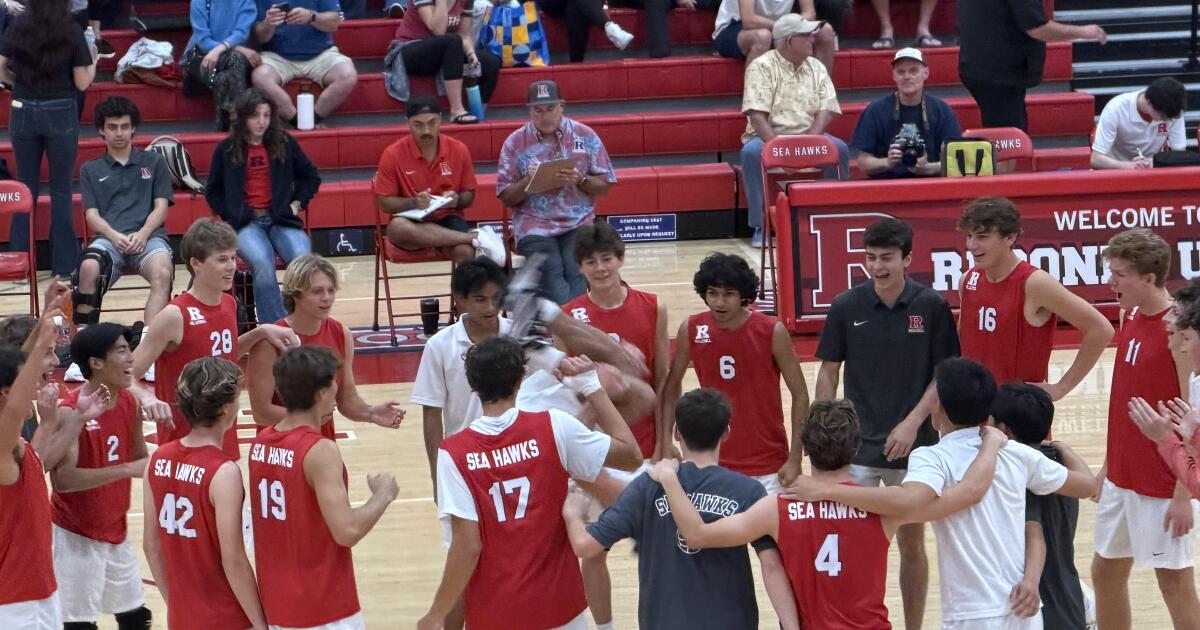
Redondo Union didn’t care that Mira Costa’s volleyball team was ranked No. 1 in California. This was their South Bay rival coming to their gym Thursday night, and anything can happen when a team digs deep and doesn’t fear losing.
The Sea Hawks (14-2) were aggressive from the outset and came away with a 27-25, 21-25, 25-22, 21-25, 15-13 victory.
“Chemistry,” setter Tommy Spalding said about the Sea Hawks’ triumph. He’s one of three players headed to MIT, and all three had big matches.
At one point on back-to-back plays, Carter Mirabal had a block and Vaughan Flaherty followed with a kill off an assist from Spalding. Chemistry.
JR Boice, a Long Beach State commit, was delivering kills, and Cash Essert’s serving and all-around play kept Mira Costa’s Mateo Fuerbringer looking frustrated. The Sea Hawks’ focus was on Fuerbringer, who came alive in the fifth set with six kills, but Redondo was able to come back from an 11-9 deficit.
It was only Mira Costa’s second loss in 25 matches. Redondo Union took over first place in the Bay League.
Baseball
Orange Lutheran 3, Jacksonville (Fla.) Trinity Christian 2: The Lancers advanced to the semifinals of the National High School Invitational in Cary, N.C., behind a walk-off single in the eighth inning by Andrew Felizzari. Brady Murrietta had tied the score with a squeeze bunt in the bottom of the seventh. CJ Weinstein had two doubles for the Lancers.
Venice (Fla.) 12, Harvard-Westlake 0: The Wolverines were limited to three hits at the National High School Invitational in Cary, N.C.
Casteel (Queen Creek, Ariz.) 3, St. John Bosco 2: The Braves suffered their first defeat in North Carolina. Jack Champlin threw five innings and also had two RBIs.
Chatsworth 6, Taft 3: Tony Del Rio Nava threw six innings and had two RBIs in the West Valley League win.
Granada Hills 4, El Camino Real 3: A two-run single by Nicholas Penaranda in the seventh inning keyed a three-run inning for the Highlanders in their West Valley League upset. JJ Saffie had three hits for ECR.
Cleveland 4, Birmingham 3: The Cavaliers pushed across a run in the top of the 10th inning to break a 3-3 tie in the West Valley League win. Joshua Pearlstein finished with three hits, including a home run.
Sun Valley Poly 4, San Fernando 2: Fabian Bravo gave up four hits in 6 2/3 innings for the Parrots, who are tied with Sylmar for first place in the Valley Mission League. Ray Pelayo struck out eight for San Fernando.
Verdugo Hills 15, Kennedy 1: Cutlor Fannon had two doubles and four RBIs in the five-inning win. Anthony Velasquez added two singles and four RBIs.
Westlake 9, Agoura 4: Jaxson Neckien hit a three-run home run to power the Warriors.
Thousand Oaks 7, Calabasas 5: Gavin Berigan, Jeff Adams and Cru Hopkins each had two hits for the Lancers.
Oaks Christian 11, Newbury Park 2: Dane Disney contributed three hits in the Marmonte League win. Carson Sheffer had two doubles and three RBIs.
Santa Monica 12, Simi Valley 4: Ryan Breslo and Johnny Recendez had two RBIs and a triple for Santa Monica. Ravi Chernack had three RBIs.
Dana Hills 7, Corona Santiago 0: Gavin Giese finished with eight strikeouts over six innings and gave up one hit for Dana Hills.
Softball
Sherman Oaks Notre Dame 10, Sierra Canyon 0: Kelsey Luderer contributed three hits and two RBIs while freshman Ainsley Jenkins threw five scoreless innings.
Chaminade 15, Louisville 2: Norah Pettersen had two hits and four RBIs.
Carson 10, San Pedro 0: Atiana Rodriguez finished with three hits, including a double and triple, and three RBIs.
Huntington Beach 6, El Modena 2: Willow Kellen had three hits for the Oilers.
Murrieta Mesa 15, Chaparral 0: It’s a 16-0 start for the Rams. Tatum Wolff hit two home runs.

NEWYou can now listen to Fox News articles!
The fiancée of Buffalo Sabres star Rasmus Dahlin received a roaring welcome home in her first appearance of the season Wednesday night, months after undergoing a lifesaving transplant after she suffered heart failure during a vacation in France.
Carolina Matovac, 25, was shown on the jumbotron during Wednesday’s game against the Boston Bruins. Fans cheered as she waved, and Dahlin, who was also shown on the screen in a split, cracked a smile at the crowd’s reaction.
Carolina Matovac and Rasmus Dahlin of the Buffalo Sabres pose on the red carpet at the Metro Toronto Convention Centre in Toronto, Ontario, Canada, Feb. 1, 2024. (Nicole Osborne/NHLI via Getty Images)
“Welcome home to Carolina Matovac, the fiancée of our captain Rasmus Dahlin,” the arena announcer said. “She is back with us, attending her first game of the season. The Sabrehood loves you, Carolina.”
In an open letter to fans in September, Dahlin shared that Matovac had been feeling ill for several days during their trip, which led to her experiencing “major heart failure.”
“Fortunately, she received CPR on multiple occasions, and up to a couple of hours at a time to keep her alive, which ultimately saved her life. Without her receiving lifesaving CPR, the result would have been unimaginable. It is hard to even think about the worst-case scenario,” he wrote at the time.
Rasmus Dahlin (of the Buffalo Sabres prepares for a faceoff during a game against the New York Rangers at KeyBank Center in Buffalo, N.Y., Oct. 9, 2025. (Bill Wippert/NHLI via Getty Images)
Matovac remained on life support for weeks before receiving the transplant in France.
JACOB WINTERTON, FORMER OHL PLAYER AND BROTHER OF NHL’S RYAN WINTERTON, DEAD AT 25 AFTER CANCER BATTLE
In January, Matovac revealed she was pregnant when her heart failed, adding that her unborn child was the reason she went to the hospital initially.
“You will always hold a special place in our hearts as our first baby, even though we never had the chance to meet. Our love for you is endless,” she wrote in a post on Instagram on what was supposed to be her due date.
“Though you didn’t get to experience this world, you played a vital role in ensuring that I could continue to be a part of it.”
Buffalo Sabres defenseman Rasmus Dahlin follows the puck in the first period against the Ottawa Senators at the Canadian Tire Centre in Ottawa, Ontario, Canada, on April 1, 2025. (Marc DesRosiers/Imagn Images)
CLICK HERE TO DOWNLOAD THE FOX NEWS APP
Despite taking some time to be with Matovac as she recovered in their native Sweden, Dahlin is second on the team with 65 points, and the Sabres are on the cusp of ending an NHL-record 14-season playoff drought.
The Associated Press contributed to this report.
Follow Fox News Digital’s sports coverage on X, and subscribe to the Fox News Sports Huddle newsletter.

Showers and falling temperatures across Maryland Friday

Woman struck, fatally injured, while walking on the Lodge Freeway, state police say

Think you’re middle class in Massachusetts? Here’s the income range

Over 840,000 Minnesotans Assist Aging Loved Ones, Shaping Their Daily Lives

What channel is Mississippi State baseball vs Ole Miss on today? Time, TV schedule to watch college baseball game

Florida High School Football Rankings: Top 25 teams – Oct. 21

How old is Bo Nix? What to know about Oregon quarterback ahead of 2024 NFL Draft

Cleary's 21 help Le Moyne down Central Connecticut State 69-64 in OT

99th annual Pony Swim held in Virginia

Indiana Members Credit Union announced as new anchor tenant at Bottleworks District

Video: Will ICE Change Under Its New Leader?

DHS shutdown breakthrough comes at cost for Republicans as funding fights nears end

Rubio joins crucial G7 talks as Iran war set to dominate second day

A surprise resignation could open the door for an independent to win a Montana Senate seat

Video: Savannah Guthrie Says She Believes Her Mother Was Taken for Ransom
-

 Detroit, MI1 week ago
Drummer Brian Pastoria, longtime Detroit music advocate, dies at 68
-

 Science1 week ago
How a Melting Glacier in Antarctica Could Affect Tens of Millions Around the Globe
-

 Movie Reviews1 week ago
‘Youth’ Twitter review: Ken Karunaas impresses audiences; Suraj Venjaramoodu adds charm; music wins praise | – The Times of India
-
 Science1 week ago
I had to man up and get a mammogram
-

 Sports6 days ago
IOC addresses execution of 19-year-old Iranian wrestler Saleh Mohammadi
-

 New Mexico5 days ago
Clovis shooting leaves one dead, four injured
-
 Business1 week ago
Disney’s new CEO says his focus is on storytelling and creativity
-

 Texas1 week ago
How to buy Houston vs. Texas A&M 2026 March Madness tickets