Sports
Bengals’ Ja’Marr Chase takes credit after second quarter scuffle with Chiefs: ‘I started it off’


Cincinnati Bengals wide receiver Ja’Marr Chase was talking before, during and after he lost to the Kansas City Chiefs on Sunday.
In the week leading up to the game, Chase said Kansas City didn’t “have a Jalen Ramsey” in its secondary, saying he was just “adding fire to the fuel” to the rivalry.
Officials get between Chiefs safety Mike Edwards and Cincinnati Bengals wide receiver Ja’Marr Chase on Dec 31, 2023, at GEHA Field at Arrowhead Stadium in Kansas City. (Scott Winters/Icon Sportswire via Getty Images)
During the second quarter of Sunday’s 25-17 Kansas City win, Chase was called for an unnecessary roughness penalty after he got into a shoving match with Chiefs cornerback L’Jarius Sneed.
CHIEFS STAR TRAVIS KELCE REVEALS NEW YEAR’S RESOLUTION: ‘I’M DONE WITH IT’
After the game, Chase kept talking.
“Just trash-talking. Can’t handle it,” Chase said after the game when asked about the scuffle with Sneed.
“I started it off,” Chase added when asked who instigated the trash-talking. “Their whole defense was mad at me. It started at the beginning on the game. You’ve seen it. Everybody’s seen it. That’s just what I like to do.”
Chase also appeared to double down on his criticism of Kansas City’s secondary, saying the Chiefs’ defense has a “good upfront. That’s it.”
Cincinnati Bengals wide receiver Ja’Marr Chase runs for a first down as Chiefs defensive tackle Tershawn Wharton defends, Sunday, Dec. 31, 2023, in Kansas City. (AP Photo/Charlie Riedel)
The star wide receiver had three catches for 41 yards as Cincinnati dropped to 8-8 on the season and was eliminated from playoff contention.
“We had some words during the game,” Sneed said after the game, according to The Kansas City Star. “But, you know, check the stats.”
It was a frustrating season for Cincinnati after losing quarterback Joe Burrow to a season-ending wrist injury in mid-November.
The Bengals won three straight to move to 8-6 before dropping their last two games.
Cincinnati Bengals head coach Zac Taylor celebrates with Jake Browning after a touchdown at GEHA Field at Arrowhead Stadium on Dec. 31, 2023, in Kansas City, Missouri. (Jamie Squire/Getty Images)
“He’s one of the best players on planet Earth,” head coach Zac Taylor said of Burrow, “but that’s just part of life. And you know, you have to be able to deal with it and move on. We’re not the only team that deals with losing players. I’m proud of the way this team continued to fight. Proud of the way Jake [Browning] stepped in and continued to lead. This team did not lay down for anybody. It has not gone our way the last two weeks, but that doesn’t mean I’m not proud of what these guys did.”
Kansas City secured their eighth consecutive AFC West title with the Week 17 victory.
The Associated Press contributed to this report



NEWYou can now listen to Fox News articles!
In just his second season at the helm, Curt Cignetti led Indiana to its first national championship.
During the Hoosiers’ title run, Cignetti became known for his demanding coaching style. Indiana opened spring practice Thursday, and incoming transfer wide receiver Nick Marsh got a crash course in what it means to play for Cignetti.
Marsh, who transferred from Michigan State, arrived at practice in gold cleats. After noting Marsh’s productive two-year stint in East Lansing, Cignetti pivoted to the wideout’s footwear.
Nick Marsh (6) of the Michigan State Spartans runs the ball up the field during the first quarter of a game against the Maryland Terrapins at Ford Field Nov. 29, 2025, in Detroit. (Mike Mulholland/Getty Images)
“I didn’t love those gold shoes he came out in today,” Cignetti said. “He learned what getting your a– ripped is all about. I don’t know if that happened to him very often at Michigan State. That was before practice started.”
INDIANA’S CURT CIGNETTI SHUTS DOWN NFL COACHING SPECULATION: ‘I’VE ALWAYS BEEN MORE OF A COLLEGE FOOTBALL GUY’
Marsh totaled 1,311 receiving yards and nine touchdowns at Michigan State. TCU quarterback Josh Hoover also headlines Indiana’s transfer additions.
An Indiana Hoosiers helmet during a game against the Ball State Cardinals at Lucas Oil Stadium Aug. 31, 2019, in Indianapolis. (Michael Hickey/Getty Images)
Cignetti added that the coaching staff has “more work to do with this group than the first two teams,” noting the group is still learning more about players the team will likely rely on next season.
Indiana Hoosiers head coach Curt Cignetti during the second quarter against the Miami Hurricanes in the 2026 College Football Playoff national championship at Hard Rock Stadium Jan. 19, 2026, in Miami Gardens, Fla. (Alex Slitz/Getty Images)
Indiana went 16-0 en route to a thrilling win over Miami in the College Football Playoff national championship in January.
Cignetti framed his callout of Marsh’s cleats as an early message about expectations.
“That was a wake-up call,” Cignetti said of the receiver’s pre-practice cleats. “But he’s really worked hard, done a great job for us.”
Follow Fox News Digital’s sports coverage on X, and subscribe to the Fox News Sports Huddle newsletter.
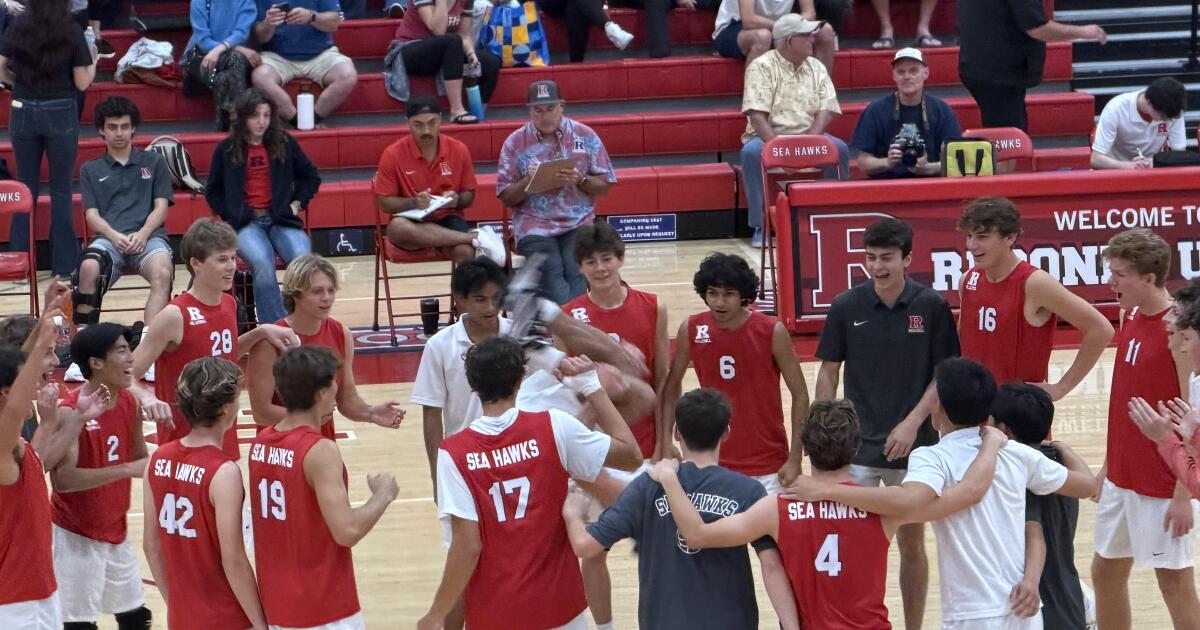
Redondo Union didn’t care that Mira Costa’s volleyball team was ranked No. 1 in California. This was their South Bay rival coming to their gym Thursday night, and anything can happen when a team digs deep and doesn’t fear losing.
The Sea Hawks (14-2) were aggressive from the outset and came away with a 27-25, 21-25, 25-22, 21-25, 15-13 victory.
“Chemistry,” setter Tommy Spalding said about the Sea Hawks’ triumph. He’s one of three players headed to MIT, and all three had big matches.
At one point on back-to-back plays, Carter Mirabal had a block and Vaughan Flaherty followed with a kill off an assist from Spalding. Chemistry.
JR Boice, a Long Beach State commit, was delivering kills, and Cash Essert’s serving and all-around play kept Mira Costa’s Mateo Fuerbringer looking frustrated. The Sea Hawks’ focus was on Fuerbringer, who came alive in the fifth set with six kills, but Redondo was able to come back from an 11-9 deficit.
It was only Mira Costa’s second loss in 25 matches. Redondo Union took over first place in the Bay League.
Baseball
Orange Lutheran 3, Jacksonville (Fla.) Trinity Christian 2: The Lancers advanced to the semifinals of the National High School Invitational in Cary, N.C., behind a walk-off single in the eighth inning by Andrew Felizzari. Brady Murrietta had tied the score with a squeeze bunt in the bottom of the seventh. CJ Weinstein had two doubles for the Lancers.
Venice (Fla.) 12, Harvard-Westlake 0: The Wolverines were limited to three hits at the National High School Invitational in Cary, N.C.
Casteel (Queen Creek, Ariz.) 3, St. John Bosco 2: The Braves suffered their first defeat in North Carolina. Jack Champlin threw five innings and also had two RBIs.
Chatsworth 6, Taft 3: Tony Del Rio Nava threw six innings and had two RBIs in the West Valley League win.
Granada Hills 4, El Camino Real 3: A two-run single by Nicholas Penaranda in the seventh inning keyed a three-run inning for the Highlanders in their West Valley League upset. JJ Saffie had three hits for ECR.
Cleveland 4, Birmingham 3: The Cavaliers pushed across a run in the top of the 10th inning to break a 3-3 tie in the West Valley League win. Joshua Pearlstein finished with three hits, including a home run.
Sun Valley Poly 4, San Fernando 2: Fabian Bravo gave up four hits in 6 2/3 innings for the Parrots, who are tied with Sylmar for first place in the Valley Mission League. Ray Pelayo struck out eight for San Fernando.
Verdugo Hills 15, Kennedy 1: Cutlor Fannon had two doubles and four RBIs in the five-inning win. Anthony Velasquez added two singles and four RBIs.
Westlake 9, Agoura 4: Jaxson Neckien hit a three-run home run to power the Warriors.
Thousand Oaks 7, Calabasas 5: Gavin Berigan, Jeff Adams and Cru Hopkins each had two hits for the Lancers.
Oaks Christian 11, Newbury Park 2: Dane Disney contributed three hits in the Marmonte League win. Carson Sheffer had two doubles and three RBIs.
Santa Monica 12, Simi Valley 4: Ryan Breslo and Johnny Recendez had two RBIs and a triple for Santa Monica. Ravi Chernack had three RBIs.
Dana Hills 7, Corona Santiago 0: Gavin Giese finished with eight strikeouts over six innings and gave up one hit for Dana Hills.
Softball
Sherman Oaks Notre Dame 10, Sierra Canyon 0: Kelsey Luderer contributed three hits and two RBIs while freshman Ainsley Jenkins threw five scoreless innings.
Chaminade 15, Louisville 2: Norah Pettersen had two hits and four RBIs.
Carson 10, San Pedro 0: Atiana Rodriguez finished with three hits, including a double and triple, and three RBIs.
Huntington Beach 6, El Modena 2: Willow Kellen had three hits for the Oilers.
Murrieta Mesa 15, Chaparral 0: It’s a 16-0 start for the Rams. Tatum Wolff hit two home runs.

NEWYou can now listen to Fox News articles!
The fiancée of Buffalo Sabres star Rasmus Dahlin received a roaring welcome home in her first appearance of the season Wednesday night, months after undergoing a lifesaving transplant after she suffered heart failure during a vacation in France.
Carolina Matovac, 25, was shown on the jumbotron during Wednesday’s game against the Boston Bruins. Fans cheered as she waved, and Dahlin, who was also shown on the screen in a split, cracked a smile at the crowd’s reaction.
Carolina Matovac and Rasmus Dahlin of the Buffalo Sabres pose on the red carpet at the Metro Toronto Convention Centre in Toronto, Ontario, Canada, Feb. 1, 2024. (Nicole Osborne/NHLI via Getty Images)
“Welcome home to Carolina Matovac, the fiancée of our captain Rasmus Dahlin,” the arena announcer said. “She is back with us, attending her first game of the season. The Sabrehood loves you, Carolina.”
In an open letter to fans in September, Dahlin shared that Matovac had been feeling ill for several days during their trip, which led to her experiencing “major heart failure.”
“Fortunately, she received CPR on multiple occasions, and up to a couple of hours at a time to keep her alive, which ultimately saved her life. Without her receiving lifesaving CPR, the result would have been unimaginable. It is hard to even think about the worst-case scenario,” he wrote at the time.
Rasmus Dahlin (of the Buffalo Sabres prepares for a faceoff during a game against the New York Rangers at KeyBank Center in Buffalo, N.Y., Oct. 9, 2025. (Bill Wippert/NHLI via Getty Images)
Matovac remained on life support for weeks before receiving the transplant in France.
JACOB WINTERTON, FORMER OHL PLAYER AND BROTHER OF NHL’S RYAN WINTERTON, DEAD AT 25 AFTER CANCER BATTLE
In January, Matovac revealed she was pregnant when her heart failed, adding that her unborn child was the reason she went to the hospital initially.
“You will always hold a special place in our hearts as our first baby, even though we never had the chance to meet. Our love for you is endless,” she wrote in a post on Instagram on what was supposed to be her due date.
“Though you didn’t get to experience this world, you played a vital role in ensuring that I could continue to be a part of it.”
Buffalo Sabres defenseman Rasmus Dahlin follows the puck in the first period against the Ottawa Senators at the Canadian Tire Centre in Ottawa, Ontario, Canada, on April 1, 2025. (Marc DesRosiers/Imagn Images)
CLICK HERE TO DOWNLOAD THE FOX NEWS APP
Despite taking some time to be with Matovac as she recovered in their native Sweden, Dahlin is second on the team with 65 points, and the Sabres are on the cusp of ending an NHL-record 14-season playoff drought.
The Associated Press contributed to this report.
Follow Fox News Digital’s sports coverage on X, and subscribe to the Fox News Sports Huddle newsletter.

How to Watch No. 1 Texas Longhorns Hosting No. 15 Texas A&M in Lone Star Showdown

Utah Falls in Emotional, Physical Game Against Capitals | Utah Mammoth

46 anti-Trump No Kings protests planned in Vermont. How to go

Virginia bill targets vape shops that sell to underage buyers – WTOP News

These Wisconsin Rapids restaurants are offering Easter specials

Florida High School Football Rankings: Top 25 teams – Oct. 21

How old is Bo Nix? What to know about Oregon quarterback ahead of 2024 NFL Draft

Cleary's 21 help Le Moyne down Central Connecticut State 69-64 in OT

99th annual Pony Swim held in Virginia

Indiana Members Credit Union announced as new anchor tenant at Bottleworks District

Video: Will ICE Change Under Its New Leader?

DHS shutdown breakthrough comes at cost for Republicans as funding fights nears end

Rubio joins crucial G7 talks as Iran war set to dominate second day

A surprise resignation could open the door for an independent to win a Montana Senate seat

Video: Savannah Guthrie Says She Believes Her Mother Was Taken for Ransom
-

 Detroit, MI1 week ago
Drummer Brian Pastoria, longtime Detroit music advocate, dies at 68
-

 Science1 week ago
How a Melting Glacier in Antarctica Could Affect Tens of Millions Around the Globe
-

 Movie Reviews1 week ago
‘Youth’ Twitter review: Ken Karunaas impresses audiences; Suraj Venjaramoodu adds charm; music wins praise | – The Times of India
-
 Science1 week ago
I had to man up and get a mammogram
-

 Sports6 days ago
IOC addresses execution of 19-year-old Iranian wrestler Saleh Mohammadi
-

 New Mexico4 days ago
Clovis shooting leaves one dead, four injured
-
 Business1 week ago
Disney’s new CEO says his focus is on storytelling and creativity
-

 Texas1 week ago
How to buy Houston vs. Texas A&M 2026 March Madness tickets