Sports
Back with Dodgers, Freddie Freeman details son’s 'heartbreaking' fight for life

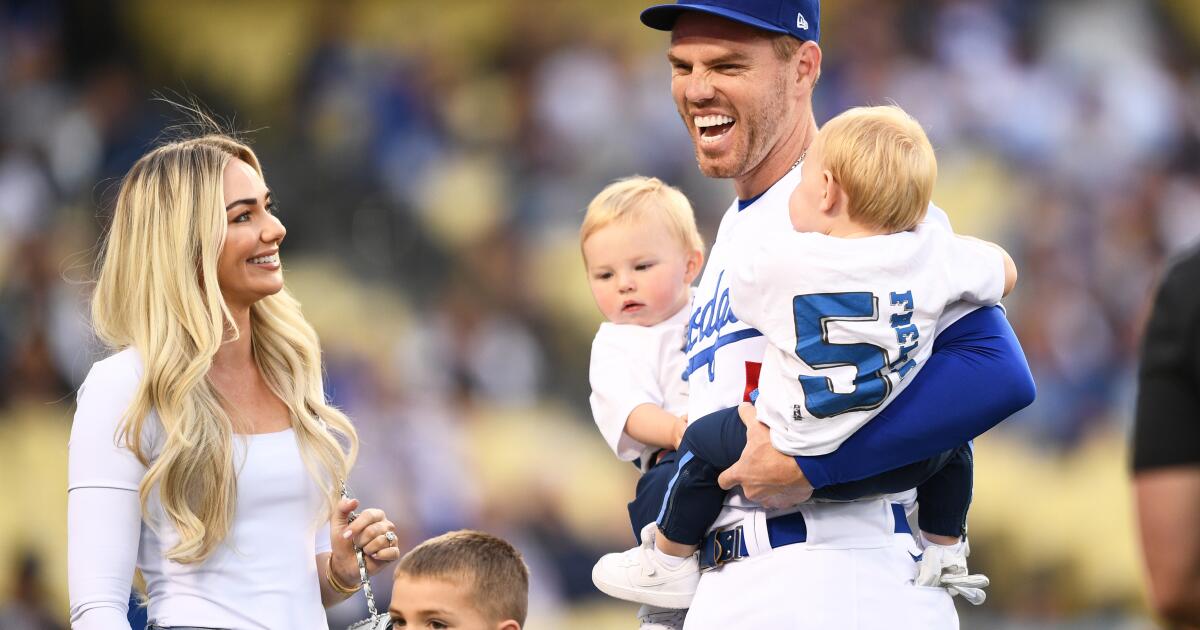
Freddie Freeman was equipped with a towel as he walked into a Dodger Stadium interview room Monday afternoon. An emotional sort in the best of times, the veteran first baseman knew he wouldn’t get a minute into recounting the brutal ordeal his 3-year-old son, Maximus, went through over the last two weeks without crying.
He was right … and he didn’t care. The tears flowed, and so did the gratitude of an eight-time All-Star who returned after an eight-game absence, his son home from the hospital and on a long but hopeful road of recovery from Guillain-Barré syndrome, a rare neurological condition in which the body’s immune system attacks the nerves.
“Max is doing all right … but he’s got to relearn how to do pretty much everything,” Freeman said, pausing several times to rub his eyes and collect his thoughts. “Terrible syndrome, Guillain-Barré … but it’s a good thing I’m here, because it means things are trending better. No one should have to go through this, especially with a 3-year-old.”
Freeman and his wife, Chelsea, noticed Max walking with a limp on the morning of July 22, a Monday, and by that night, Max couldn’t walk. The symptoms, according to visits with several doctors, were consistent with transient synovitis, which can cause a pain in the hip after a viral infection.
By that Tuesday, Max couldn’t sit up, and by Wednesday night, July 24, while Freeman was playing a home game against the San Francisco Giants, Max had stopped eating and drinking and was taken to the emergency room. Doctors still suspected transient synovitis and recommended Tylenol. Max was discharged at 3:30 a.m.
Freeman played a day game against the Giants on about an hour of sleep that Thursday and traveled — somewhat reluctantly — with the Dodgers to Houston that night for the start of an eight-game, three-city trip.
“I called Chelsea on Facetime and said, ‘I don’t know if I should be leaving right now,’ ” Freeman said. “Something was off. It just felt wrong to leave. But we did just because [we thought] it would be OK.”
Things were not OK. Freeman had gone through his normal pregame routine in Houston’s Minute Maid Park that Friday before joining Max’s visit to a pediatrician via Facetime.
“And thankfully, that pediatrician said, ‘You need to go to the hospital now — this is not transient synovitis,’ ” Freeman said. “They were ready to call an ambulance for him, because they didn’t think he was going to be able to breathe that long … so I immediately told Scott [Akasaki, traveling secretary] to help get me home.”
With Max having “rapidly declined,” according to an Instagram post from Chelsea, he was rushed to the emergency room at Children’s Hospital of Orange County, “and within 2 ½ hours, he had a ventilator in,” Freddie Freeman said.
A paralysis began to drift upward, from Max’s feet toward his waist and then his shoulders, which was affecting his diaphragm and his breathing. Freddie arrived at the hospital at about 10 p.m., his youngest son hooked up to a ventilator and feeding tube.
“My 3-year-old son needing help to breathe, when five days earlier, he was doing front flips,” Freeman said, when asked to recall the toughest part of the ordeal. “You just wish you could switch. You really do. Like, I’ve been through a lot in my life. I lost my mom when I was 10, but you can’t really compare any of this because both are awful.
“But seeing your kid fighting for his own life when there’s nothing he or anybody else could do. His immune system started attacking his own nerves, and that’s the heartbreaking thing. He can’t breathe on his own, he’s on a ventilator, that was hard.
“I know Dodgers fans wouldn’t like this, but I would gladly strike out with the bases loaded in the bottom of the ninth inning in Game 7 of the World Series 300 million times in a row than to see that again.”
There was encouraging news, though, when doctors diagnosed Max with Guillain-Barré and immediately started IVIG (intravenous immunoglobulin) treatments, which are made from donated plasma that contains healthy antibodies to help stop the harmful antibodies from damaging the nerves. Max responded well to two rounds of IVIG.
“He was starting shoulder-shrug, which was a massive sign for us, because that means, so paralysis starts from your toes up, so now [when it recedes] it goes top to bottom,” Freeman said. “It was starting to move back down, which was huge.”
Max’s condition continued to improve early last week, so much so that within 48 hours of experiencing full-body paralysis, he was excavated from his breathing tube and taken off a ventilator.
“It was [last] Wednesday at 10:46 p.m., I’ll never forget — he had his ventilator pulled, and within six minutes, he was sitting on me,” Freeman said. “I can’t tell you how good that felt, to be able to hold my son again. That was a special time, just knowing how hard he fought in those five days.
“When he was born, we were trying to figure out a name. We had two kids at that time, and Chelsea came upon ‘Maximus.’ I was like, ‘That’s a strong name.’ I said I didn’t know it was gonna have to be proved true within four years of his life, with how strong this little boy is.”
Freeman, who had started every one of the team’s first 104 games, missed the entire trip in which the Dodgers lost five of eight games at Houston, San Diego and Oakland. But when Max came home from the hospital on Saturday, Freeman could breathe a little easier.
“I mean, if you talked to me six days ago, I would never have been able to speak to you guys, I just couldn’t,” Freeman said. “But the reason I’m able to get through this is because of the huge wins we’ve been getting the last few days with him. It’s been a miraculous recovery. That’s what they say to us.”
Freeman went through rigorous workouts at his old high school, El Modena in Orange, on Saturday and Sunday and felt like he was ready to return on Monday. Greeting him were teammates and coaches who wore #MaxStrong shirts with No. 5 Freeman on back during batting practice before the series opener against the Philadelphia Phillies.
“I don’t know whose idea it was, but that was the first time I cried today, when I walked in and saw those,” Freeman said of the T-shirts. “It means a lot. The support from this organization has been … there’s no words. I can’t even put it into words, really. Things happen. I’m just so glad that he was able to be at CHOC.
“Dr. [Jason] Knight and his staff in the [pediatric intensive care] unit. The nurses day and night, absolutely incredible. The respiratory therapists, neurology, every department. I mean, I’m here nine days after, and it feels like a miracle, it really does. I can’t thank them enough.”
Freeman was among the team’s hottest hitters when he left the team, and he entered Monday night’s game with a .288 average, .888 on-base-plus-slugging percentage, 16 homers, 26 doubles and 67 RBIs on the season.
In his absence, a Dodgers offense that was already playing without the injured Mookie Betts and Max Muncy hit only .213 (65 for 301) on the eight-game trip, the fourth-worst average in baseball in that span.
But Freeman was back in the Dodgers lineup, batting third and playing first base, on Monday night, a little rusty but buoyed by the knowledge that 3-year-old Max would be at home watching Daddy on television.
“My brain is still a little mushy — not much sleep for mom and dad and the rest of the family — but we’re hanging in there,” Freeman said. “We’ve been told [Max] is going to make a full recovery. We just don’t know how long it’s going to be. But the prognosis of recovery is good.”


NEWYou can now listen to Fox News articles!
For the first time at a FIFA World Cup, finishing third in your group does not necessarily mean going home.
With 48 teams competing in 2026, FIFA expanded the field to include the eight best third-place finishers across all 12 groups. The top two teams in each group advance automatically, and the remaining eight spots in the 32-team knockout bracket go to the highest-ranked third-place teams, determined by points, goal difference, goals scored and other tiebreakers.
That means 12 teams will be competing for eight spots, and the race to stay in the top eight is one of the most compelling subplots of the final days of the group stage.
Here’s where the third-place standings sit heading into the final round of group stage matches on June 24.
Third-Place World Cup Standings
| Rank | GP | Points | Goal Diff. | |
| 1 | Bosnia & Herz. | 3 | 4 | -1 |
| 2 | Sweden | 2 | 3 | 0 |
| 3 | Scotland | 2 | 3 | 0 |
| 4 | Croatia | 2 | 3 | -1 |
| 5 | Algeria | 2 | 3 | -2 |
| 6 | Paraguay | 2 | 3 | -2 |
| 7 | Cape Verde | 2 | 2 | 0 |
| 8 | Belgium | 2 | 2 | 0 |
| Cutline | ||||
| 9 | Czechia | 2 | 1 | -1 |
| 10 | DR Congo | 2 | 1 | -1 |
| 11 | Ecuador | 2 | 1 | -1 |
| 12 | Senegal | 2 | 0 | -3 |
The third-place standings will shift considerably over the next two days as the final round of group stage matches is played. Follow the live standings at FOXSports.com and watch every match on FOX and FS1, streaming live on FOX One.
Standings as of the end of Bosnia and Herzegovina vs. Qatar and Canada vs. Switzerland on Wednesday.

2026 FIFA World Cup Standings Rules
How Do Points Work? How Do Tiebreakers Work?
In a group, a team will earn three points for a win, one point for a draw, and no points for a loss. That could mean some teams are equal on points at the end of the three-game group stage. That leads us to tiebreakers.
If two or more teams finish equal on group-stage points, here is the order of who finishes on top:
1. Most points obtained in the head-to-head matches played between the tied teams;
2. Superior goal difference in the head-to-head matches played between the tied teams;
3. Most goals scored in the head-to-head matches played between the tied teams;
There are even more tiebreakers if any teams remained locked after all that. From there, ties are broken by these rules:
4. Superior goal difference in all group matches
5. Most goals scored in all group matches
6. Highest team conduct score in all group matches (taking into account yellow cards and red cards)
7. FIFA World Ranking
Which Third-Place Teams Will Advance?
To fill out the World Cup knockout bracket, the best eight third-place teams out of the possible 12 in the tournament will advance. The criteria for those teams are based on:
1. Points
2. Goal difference
3. Goals scored
4. Highest team conduct score in all group matches (taking into account yellow cards and red cards)
5. FIFA World Ranking
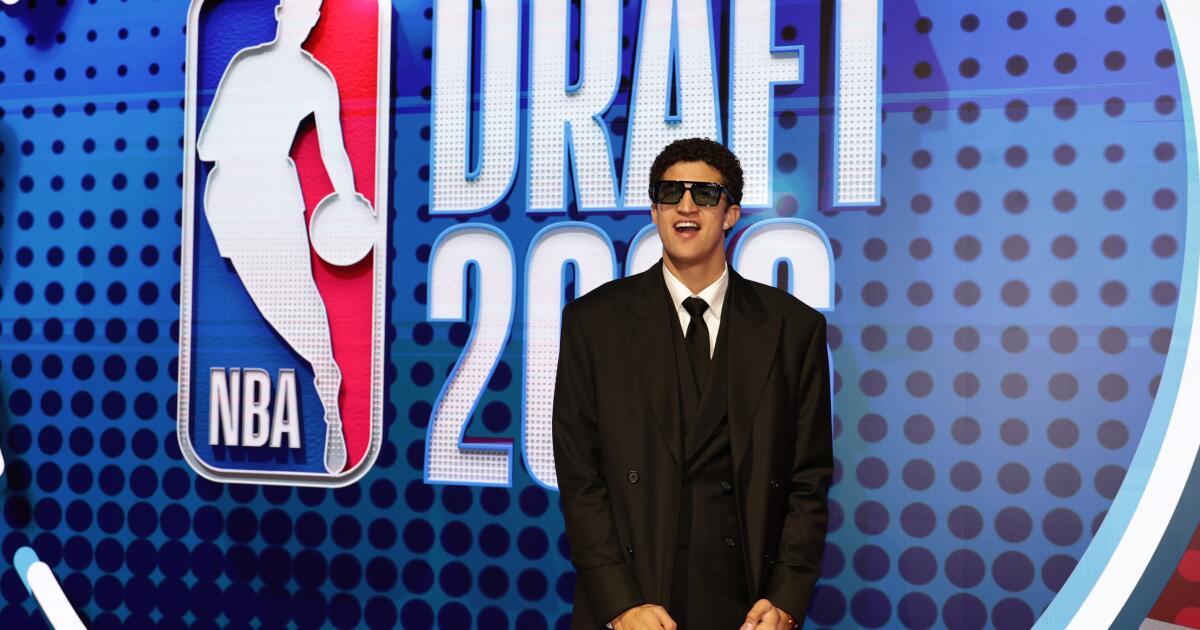
Until Tuesday night, only one Mexican-born player had been an NBA draft pick. Eduardo Nájera was selected 38th overall in the second round by the Houston Rockets in 2000 and enjoyed a 12-year career as a backup forward with five teams.
Karim López joined him when the Detroit Pistons snapped him up at No. 21, making him the first Mexican-born first-round draft selection.
Lopez donned the Pistons’ cap handed to him by NBA commissioner Adam Silver, then was immediately traded to the Memphis Grizzlies.
López, a 19-year-old 6-foot-9 forward, became emotional when Silver announced the pick. He sobbed beneath the cap.
“It’s just super special,” he said. “I’m blessed. I mean, I have no words.”
Born in Hermosillo in the Mexican state of Sonora, López joined the prestigious Joventut Badalona youth academy in Badalona, Spain, at age 14 to accelerate his development. The academy counts former NBA players Ricky Rubio, Rudy Fernández and Raül López among its alumni.
During his post-draft television interview, he displayed a custom design inside his suit jacket: Mexico’s tricolor flag.
“I just wanted to represent my culture, represent where I’m from, represent my faith, and just represent myself, basically,” López said. “Show who I am.”
Memphis clearly targeted López while adroitly obtaining five second-round picks in the process. They received three picks from the Pistons and two from the Oklahoma City Thunder in return for moving back from the No. 16 draft position.
Whether López fulfills his potential and becomes the fifth Mexican-born player to take the court with an NBA team remains to be seen. Reviews are mixed.
Draft experts John Hollinger and Sam Vecenie of the Athletic differed in their evaluation, with Hollinger giving the pick a thumbs-up while Vecenie expressed reservations.
“I had Karim López rated quite a bit higher than [the No. 21 pick] and was surprised to see him slide this far,” Hollinger wrote, giving the pick an “A” grade partially because the Grizzlies also collected the five second-round picks.
Vecenie pointed out that López doesn’t shoot well and has defensive deficiencies, saying that his game might be better suited for European leagues than the NBA.
“I’m not sure how he gets on an NBA court early in his career,” he wrote. “I love his frame and physicality. I love that he rebounds and attacks with aggression. But I’m not sure he’s good enough without the ball to make an early impact in the NBA.”
Should López make the Grizzlies’ roster, he would join Horacio Llamas, Gustavo Ayón, Jorge Gutiérrez and Nájera as the only NBA players born in Mexico.
“It means a lot to me,” Lopez said. “It’s just a great opportunity for me and my country to have this platform and have this opportunity. So super blessed and definitely take it with a lot of pride.”
Noteworthy NBA players of Mexican descent born in the United States include former UCLA standout Jaime Jaquez Jr. and former Lakers reserve Juan Toscano-Anderson.
Jaquez averaged 15.4 points a game in 2025-2026, his third season with the Miami Heat. Toscano-Anderson played five seasons in the NBA — including winning a championship with the Golden State Warriors in 2022 — and now is with Pallacanestro Trieste of the top Italian league.
López is already a veteran of international basketball, having spent the last two seasons with the New Zealand Breakers in Australia’s top pro league. He averaged 11.9 points and 6.1 rebounds last season.
He will join No. 3 overall pick Cameron Boozer with the Grizzlies, who are rebuilding after finishing 25-57 and 13th in the Western Conference last season.
“A goal of mine is to hopefully reach young people in Mexico,” Lopez told ESPN in March when he declared for the draft. “Trying to grow the sport and inspire athletes and people in general to follow their dreams. Show people that it doesn’t matter where you’re from.”

NEWYou can now listen to Fox News articles!
The 2026 NBA Draft finally saw the top college prospects get chosen along with some friendly fire among ESPN and basketball analysts on Tuesday night.
Jay Williams, Richard Jefferson and Kenny Smith were among those covering the draft and offering their analysis during the event. One exchange among the three former NBA players went awry and led to an awkward moment.
ZERO BS. JUST DAKICH. TAKE THE DON’T @ ME PODCAST ON THE ROAD. DOWNLOAD NOW!
Jay Williams of the Chicago Bulls and Tony Parker of the San Antonio Spurs share a laugh during the 2003 got milk? Rookie Challenge Game at Phillips Arena in Atlanta, Georgia, on Feb. 8, 2003. (Nathaniel S. Butler/NBAE)
ESPN recalled the moments each former player was drafted. Smith went No. 6 overall in 1987 to the Sacramento Kings, Richard Jefferson was selected at No. 13 by the Houston Rockets before being traded to the New Jersey Nets in 2001 and Williams was chosen No. 2 overall by the Chicago Bulls in 2001. Williams’ career was cut short due to a motorcycle crash.
ESPN’s Kevin Negandhi asked why Williams received a big ovation. Williams explained that most people who had gone to Duke were from the New York or New Jersey area.
“They also didn’t see the future coming, so they were cheering,” Jefferson said.
Williams responded, “Wow.”
TNT basketball analyst Kenny Smith appears on air before the NCAA Men’s Basketball Tournament Final Four semifinal game between the Purdue Boilermakers and the North Carolina State Wolfpack at State Farm Stadium in Glendale, Ariz., on April 6, 2024. (Mitchell Layton/Getty Images)
Smith admitted that Williams was an “unbelievable talent” but “his career trajectory would’ve been a lot different if he didn’t like motorcycles.”
Williams tried to brush it off, saying all of what Smith was saying was “on record” and that he “wrote a book about it.”
“I guess everybody that goes to Duke isn’t that smart,” Jefferson quipped. “What? He wrote a book about it. I’m agreeing with him.”
The awkwardness filled the air after that as the Toronto Raptors were getting ready to make a selection.
Williams’ incident occurred in June 2003. He suffered a fractured pelvis, three torn ligaments in his knee and he severed a nerve in his leg. Williams violated the terms of his contract by riding the motorcycle in the first place.
Referee Richard Jefferson watches the game between the New York Knicks and Portland Trail Blazers during the 2022 Las Vegas Summer League at the Thomas & Mack Center in Las Vegas, Nev., on July 11, 2022. (Garrett Ellwood/NBAE via Getty Images)
CLICK HERE TO DOWNLOAD THE FOX NEWS APP
He tried to make his way back into the NBA through the G League but never got there. He played 75 games for the Bulls in his rookie season and averaged 9.5 points per game.
-

 Health14 minutes ago
Does Metformin Help With Weight Loss? How To Maximize Your Results
-
 Lifestyle29 minutes ago
A judge says the Kennedy Center must update him on its plans — and address that tarp
-

 Technology39 minutes ago
A new paper argues Microsoft exaggerated its quantum claims a year ago
-

 World44 minutes ago
Colombia’s ‘El Tigre’ secures presidency as leftist rival finally concedes defeat
-

 Politics51 minutes ago
Comer probes alleged Biden collusion with gun control activists in Glock lawsuit
-

 Sports59 minutes ago
2026 World Cup Third-Place Standings: Who’s In, Who’s On The Bubble
-

 Technology1 hour ago
FCC phone ID plan could end burner phones
-
 Business1 hour ago
Sony Pictures invests $100 million in virtual reality venue Cosm

