Sports
'American Sports Story: Aaron Hernandez': How violence, drugs and football made a monster

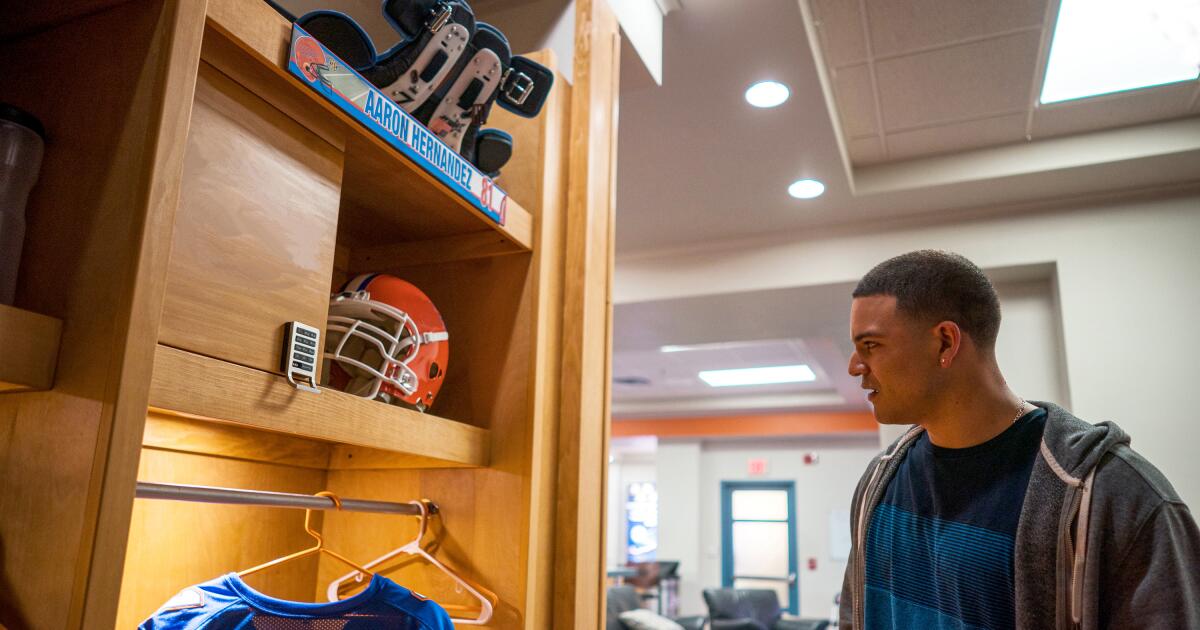
In 2009, superstar tight end Aaron Hernandez helped the Florida Gators win a national championship. In 2012, Hernandez played in a Super Bowl for the New England Patriots and signed a $40-million contract extension.
But that same year he was investigated in connection with a double homicide. A year later he shot Alexander Bradley, one of his best friends, through the eye and murdered another man, Odin Lloyd. Two years later, Hernandez was convicted of Odin’s murder, and in 2017 Hernandez killed himself while in prison.
Those are the headlines of Hernandez’s brief and violent life and death, the details that reach beyond the die-hard football fan and create a hard-to-shake image in popular culture. While Hernandez clearly had drug problems, committed violent crimes and grew increasingly paranoid, his fuller story is a complicated one: Hernandez suffered physical abuse in a violent and dysfunctional family; was sexually abused as a boy; felt compelled by society’s strictures to hide his homosexuality; was chewed up and spit out by college football’s powers-that-be; and his brain was severely damaged, resulting in chronic traumatic encephalopathy, or CTE, that likely affected his behavior.
Those nuances and much more were uncovered and laid out by the Boston Globe’s Spotlight investigative team in 2018, in a series of newspaper articles and a podcast. That was followed by a 2020 Netflix docuseries, “Killer Inside: The Mind of Aaron Hernandez.”
1
2
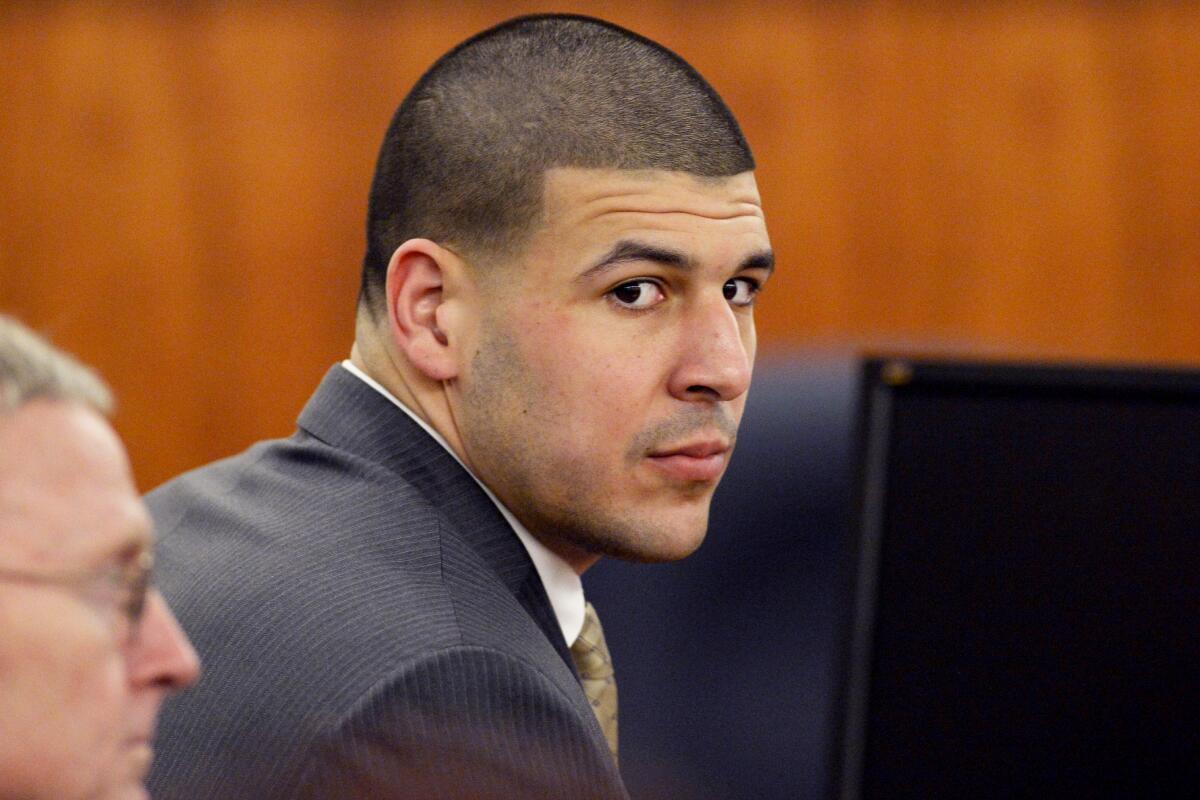
1. Aaron Hernandez in 2009 when he played for Florida. (Dave Martin / Associated Press) 2. In 2015, Hernandez during jury deliberation at his murder trial. (AP Pool)
But these days, more Americans get their facts from scripted series than from newspaper series, podcasts and documentaries, whether it’s “When They See Us,” Ava DuVernay’s Netflix limited series about the Central Park Five or the “American Crime Story” retellings of the O.J. Simpson saga and the murder of Gianni Versace. Now the “American Crime Story” producing team is branching out with “American Sports Story: Aaron Hernandez,” a 10-episode retelling of Hernandez’s life and death based on the Globe’s reporting. The limited series premieres Tuesday at 10 p.m. on FX with two episodes and streams the following day on Hulu.
Brad Simpson, one of the series’ executive producers, says they were tipped off by FX’s top executives, Nick Grad and John Landgraf, that the podcasts were about to be released, so they read the Globe’s articles.
“It had this deep reporting that we love to have in our shows, and we started developing the series with an eye toward it being part of our different franchises about the culture of America,” he says.
Simpson says fellow executive producer Ryan Murphy loved that this was a story about “a person with a fractured identity, as so many of our shows are.”
The reporting revealed a story that was “far more heartbreaking and complex than I had considered,” says Nina Jacobson, another executive producer. “When you think you know a story and then you come across something deeply reported, that really changes how you see it [and] that always makes me stand up at attention.”
She adds that since football is our national religion, Hernandez’s rise and fall “was not just the story of one person but a mirror back to us as a country.”
Numerous writers were interested in tackling the tale but the producers chose Stuart Zicherman because of his résumé — Simpson cites “The Americans” — but also because he is a passionate football fan who nonetheless has the emotional distance to see the damage the game can wreak on people. Simpson says Zicherman had a compelling pitch about the intersection of celebrity, sports, sexuality and masculinity.
“It’s character first and football second, and what made this story different from a million sports stories out there is the story about Aaron as well as his family, the people on his team and the coaches,” he says. “It becomes a Shakespearean tragedy with compelling characters at the center.”
Zicherman says he went in for his initial pitch with a huge scroll that, when unfurled, laid out all of the story’s twists and turns. “I love writing about stories people think they know but they really don’t,” he says. “We tend to label people, and Hernandez was a monster, but no one’s born a monster and I wanted to tell that story without forgiving him for what he did.”
Zicherman drew on the “American Crime Story” concept of “taking a crime or event and making it about something much bigger in the fabric of America.”
The show explores toxic masculinity at home and in locker rooms, how violence on the football field can spill into daily life, and how a dysfunctional family can be both a support and a trap.
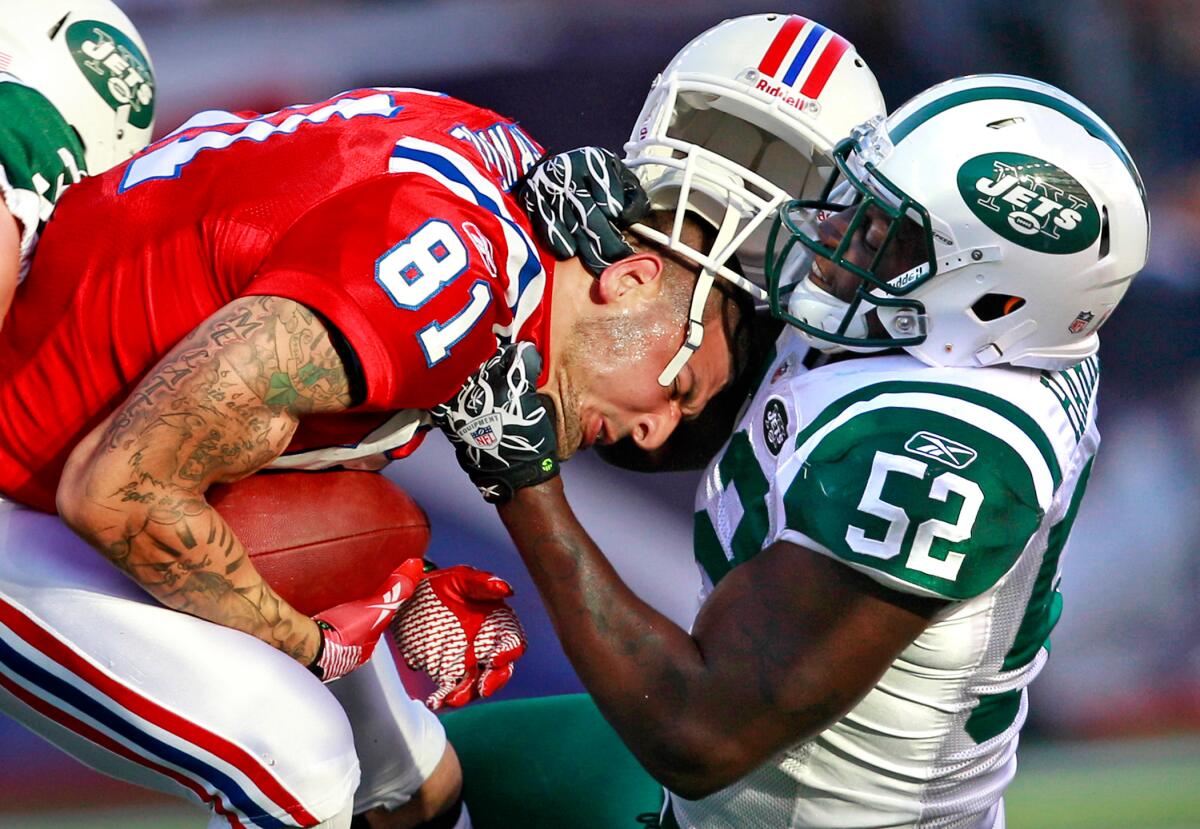
Aaron Hernandez, left, in 2011 as a New England Patriots tight end. After his death, Hernandez was found to have the degenerative brain disease chronic traumatic encephalopathy.
(Elise Amendola / Associated Press)
There’s also the issue of CTE, the brain injury caused by repeated blows to the head. “We obviously don’t want to say CTE is what turned Aaron into a murderer — he’d been exposed to violence and was prone to violence — but he did become very paranoid with an even shorter temper,” Zicherman says, noting that Hernandez’s drug use also would have exacerbated his brain injuries.
He lays out the story to show the people and institutions who directly harmed Hernandez or at least failed to “change the narrative” because of their own selfish motivations, like then-Florida coach Urban Meyer, who seduced Hernandez and his family with promises he didn’t keep and then shoved the young man out the door when he became a challenge.
“We make commodities out of our athletes and we don’t always see what’s best for them,” Zicherman says. “The Patriots were also blinded by his talent.
“But I also want the audience to see that there’s a much bigger picture here and that we’re all a bit complicit — we raise our athletes up and pay them a fortune and build them up as heroes,” he says, only to turn on them when things go awry.
Beyond the big picture, Zicherman focused on Hernandez’s story as someone “trying to find his authentic self,” giving him a throughline as Hernandez jumps from childhood to high school to Florida, the NFL and eventually the world of drugs and crime that consumed him. “By the end he’s gone mad with all the secrets he was keeping.”
Zicherman says the Globe’s Spotlight team not only provided a meticulous and thorough story, they let him come to Boston “to ask a million questions” and then they visited the writers’ room to answer even more. “They’d talked to everybody and they’d done that work, and they were a tremendous resource,” he says.
But journalists and documentary filmmakers are hemmed in by what they can demonstrably prove. Zicherman says the series resists overt fictionalization, but they felt it had to go further than the Spotlight series.
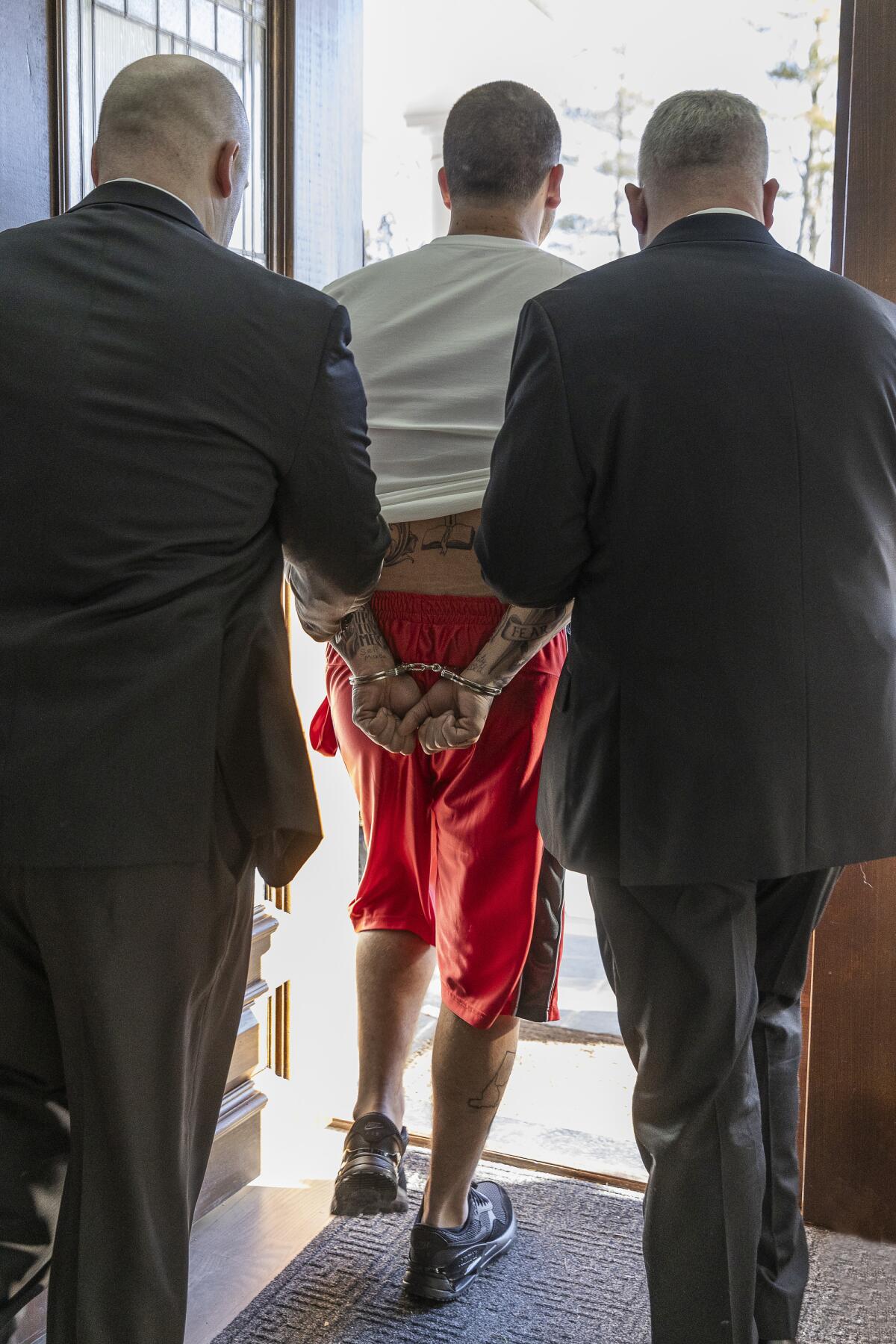
Josh Rivera as Aaron Hernandez, who was convicted of the murder of Odin Lloyd, in a scene from “American Sports Story.”
(Eric Liebowitz / FX)
“In the writers’ room we spent a lot of time connecting the dots and trying to emotionally figure out why things happen and give the answers to things,” he says.
Most important was explaining why Hernandez murdered Lloyd. “It always bothered me that in all the research no one knew,” Zicherman says. “It was a clumsy attempt that seemed unpremeditated and it didn’t make sense.”
Theories include that Hernandez wanted to keep a lid on his sexuality or his involvement in the double homicide, but Zicherman thinks it was more about how far Hernandez had descended.
“I built to the murder from the stew of all the moments throughout the season,” Zicherman says. “Hernandez is hiding so many secrets and suffusing them with drug use, and he’s paranoid as hell because he’s taken a lot of hits to the head. It’s all of those things combined; I don’t think it was a singular thing.”
Beyond the scripts, the most important factor would be casting Hernandez. Here, the team got lucky. Jacobson was producing “The Hunger Games: The Ballad of Songbirds and Snakes” and watching Josh Rivera at work. “I got to really see what he was made of,” she says of Rivera, who had previously co-starred as Chino in Steven Spielberg’s “West Side Story.” “He’s an incredibly sophisticated, grounded, natural and charismatic actor. And he was that on every take.”
But while Jacobson was sold, she also trusted Murphy’s judgment and wanted to let the audition process play out “to see if he would float to the top for Ryan as well.”
At the end of callbacks, after mixing and matching actors contending for various jobs, Murphy turned and said, “Well, it’s obviously Josh,” so they called him back in before he could leave the audition.
Zicherman says a lot of the other actors emphasized the violence and darkness, but Rivera “played the vulnerability and other emotional components and the interior emotionality. Once we had him I started stripping dialogue away to let moments play on his face — the other characters could talk and we can watch his heartbreak.”
(Rivera, he adds, is also a “goofball who likes to sing and dance and make jokes,” and that Hernandez, before things went bad, was the class clown.)
Rivera is in nearly every scene. Simpson notes that he had to work out regularly to stay big and endured multiple hours of makeup for the tattoos. “He shouldered it incredibly well and he was always game and enthusiastic,” Simpson says. “He was often exhausted, but the fact that he didn’t slip into a dark place is a testament to who Josh is as a human being. He set the tone for the set.”
Simpson recalls only one day where Rivera was, understandably, overwhelmed by the task. “We were in a muddy field at 3 a.m. reenacting the murder of Odin Lloyd, and there was just a moment where Josh had to stop. He turned to everybody and said, ‘This is just too incredibly sad,’” Simpson says. “I think we were all haunted by that moment.”



Sports
Brooke Slusser sparks liberal social media meltdown by speaking about SJSU transgender volleyball scandal

NEWYou can now listen to Fox News articles!
Left-wing social media users launched a volley of insults at 23-year-old Brooke Slusser in recent days.
In response, dozens of high-profile women’s rights activists have come to the former San Jose State University volleyball player’s defense.
Slusser has addressed the critics herself in a statement to Fox News Digital.
“I would just say people that don’t know my life or my trauma don’t have room to say how good or bad my time at SJSU was. I hope they never have to understand going through something as awful as that,” she said.
She has also acknowledged the responses in a series of TikTok posts, as she has become more active on the platform this week to speak about her alleged experience at SJSU.
The online hate campaign started after Slusser shared details about living arrangements in the same apartment with transgender volleyball teammate Blaire Fleming while at San Jose State university, in an interview with Fox News Digital.
During the interview, she said, “You find out you’re just chilling in a bed with a man that you have no idea about… I [was] unknowingly sharing a bed at that time with a man,” and alleged SJSU volleyball coach Todd Kress encouraged her to live in the same apartment as the trans teammate when another group of players were also looking for a final tenant.
The fallout of the interview has prompted high-profile activists, lawmakers and even an actor to speak out, taking a side behind or against Slusser.
Many critics echoed the sentiment that “nothing bad” happened to Slusser, despite the fact that the anxiety from the situation ultimately led to her developing an eating disorder and not being able to complete her college degree.
Former “Glee” actor Kevin McHale even appeared to mock Slusser’s appearance.
A coalition of “save women’s sports” activists rushed to Slusser’s defense, with OutKick host Riley Gaines, XX-XY Athletics founder Jennifer Sey, Sen. Tommy Tuberville, R-Ala., women’s tennis legend Martina Navratilova and former ESPN star Sage Steele leading the charge to defend Slusser from the pro-trans detractors.
“Brooke has every right to feel violated. This is a violation of her personal space and boundaries. She was lied to. She would not have agreed to room with or play with a man,” Sey wrote in response to one critic.
Navratilova wrote in response to that same critic, “Brooke has every right to be mad. Try again with the punishment wish…”
Slusser finds herself at the center of a sports culture war flashpoint at a time when the conflict over her school’s handling of her transgender former teammate has reached a political impasse.
‘HORRIBLE’ MOMENTS EXPOSED FOR UNR VOLLEYBALL PLAYERS WHEN THEY WERE ROPED INTO THE SJSU TITLE IX SCANDAL
After the U.S. Department of Education’s Office of Civil Rights (OCR) announced at the end of January that an investigation into the university for its handling of a trans athlete and other players concluded that the school violated Title IX, SJSU and the California State University system declined to resolve the violation.
Instead, SJSU President Cynthia Teniente-Matson announced Friday that the school and the California State University (CSU) system are suing the federal government to challenge the investigation.
“Because we believe OCR’s findings aren’t grounded in the facts or the law, SJSU and the CSU filed a lawsuit today against the federal government to challenge those findings and prevent the federal government from taking punitive action against the university, including the potential withholding of critical federal funding,” Teniente-Matson said Friday.
“This is not a step we take lightly. However, we have a responsibility to defend the integrity of our institution and the rule of law, while ensuring that every member of our community is treated fairly and in accordance with the law. Our position is simple: We have followed the law and cannot be punished for doing so.”
The school is also requesting that OCR rescind its findings and close its investigation.
Teniente-Matson affirmed the university’s commitment to defending the LGBTQ community in the announcement.
“Our support for the LGBTQ members of our community, who have experienced threats and harms over the last several years, remains unwavering. We know the attention the university has received around this issue and the investigative process that followed have been unsettling for many in our community,” the university president said.
Among ED’s findings, it determined that a female athlete discovered that the trans student allegedly conspired to have a member of an opposing team spike her in the face during a match. The department claims “SJSU did not investigate the conspiracy, but later subjected the female athlete to a Title IX complaint for ‘misgendering’ the male athlete in online videos and interviews.”
Slusser alleged in a November 2024 lawsuit against the Mountain West that she and former assistant coach Melissa Batie-Smoose were made aware of a meeting between Fleming and Colorado State women’s volleyball player Malaya Jones on Oct. 2, 2024, during which Fleming discussed a plan with Jones to have Slusser spiked in the face during a match the following night.
Slusser’s own lawsuit partially survived motions to dismiss last week as well.
Colorado District Judge Kato Crews dismissed all the plaintiffs’ charges against the Mountain West Conference but did not dismiss charges of Title IX violations against the CSU system.
Crews deferred his ruling on whether to dismiss those charges until after a decision in the ongoing B.P.J. v. West Virginia Supreme Court case, which is expected in June.
CLICK HERE TO DOWNLOAD THE FOX NEWS APP
Brooke Slusser #10 and Blaire Fleming #3 of the San Jose State Spartans call a play during the first set against the Air Force Falcons at Falcon Court at East Gym on October 19, 2024 in Colorado Springs, Colorado. (Andrew Wevers/Getty Images)
The CSU provided a statement to Fox News Digital in response to Crews’ ruling.
“CSU is pleased with the court’s ruling. SJSU has complied with Title IX and all applicable law, and it will continue to do so,” the statement said.
The outcomes of the lawsuits by and against SJSU on this issue could ultimately set a consequential precedent for the future of women’s sports in America.
Follow Fox News Digital’s sports coverage on X, and subscribe to the Fox News Sports Huddle newsletter.

INDIAN WELLS — Jessica Pegula never needed tennis.
She simply kept showing up for it anyway, through the long and often anonymous slog of the professional tour.
Now 32 and the oldest player in the top 10, Pegula is having her best season start yet.
The fifth-ranked American reached the Australian Open semifinals for the first time in January, falling to eventual champion Elena Rybakina. She followed that by capturing the Dubai 1000-level tournament, just a rung below the majors.
She is 15-2 so far in 2026, tied with Victoria Mboko in match wins and second only to Ukraine’s Elina Svitolina (17-3), who she defeated 6-2, 6-4 in the Dubai final.
Pegula is guaranteed to emerge from this week’s BNP Paribas Open in Indian Wells as the top-ranked American, overtaking No. 4 Coco Gauff, if she reaches the final.
Jessica Pegula kisses the Dubai trophy after defeating Elina Svitolina in the finals on Feb. 21.
(Altaf Qadri / Associated Press)
First, she will have to get past No. 12-seed Belinda Bencic of Switzerland, her fourth-round opponent on Wednesday. Bencic has not dropped a set in four previous meetings with Pegula.
“That will be a challenge for me,” said the characteristically even-keeled Pegula after defeating former French Open champion Jelena Ostapenko in the third round on Monday.
A late bloomer, Pegula has taken the long road.
She failed to qualify for Grand Slam main draws in 12 of 14 attempts from 2011 to 2018, and didn’t reach the third round at a major until the 2020 U.S. Open at age 26. All three of her Grand Slam semifinal runs — along with her 2024 U.S. Open final — have come after she turned 30.
Pegula said this week that her patience and persistence stem from “always being a little more mature for my age even when I was younger.”
“I think as I’ve gotten older, your perspective changes as well,” she added.
Pegula, whose parents are principal owners of the NFL’s Buffalo Bills and the NHL’s Buffalo Sabres, acknowledges that her wealthy family background can cut two ways.
Financial security offers freedom to push through the sport’s early years on tour, when results are uncertain and the grind is relentless. That same cushion might make it easier to walk away if the climb becomes too frustrating.

Jessica Pegula plays a backhand against Donna Vekic during their match at the BNP Paribas Open at Indian Wells.
(Clive Brunskill / Getty Images)
Pegula says her motivation to pursue tennis came well before her family’s fortune grew.
“I’ve been wanting to be a professional tennis player and No. 1 in the world since I was like 7,” she said in a small interview room after beating Ostapenko this week.
“It’s a privilege, but at the same time I don’t want to do myself a disservice of not taking the opportunity as well,” she explained. “I’ve always looked at it that way.”
In the last few seasons, that maturity on the court has dovetailed with a growing leadership role off it.
Pegula has served for years on the WTA Player Council and was recently tapped to chair the tour’s new Tour Architecture Council, a working group tasked with examining the increasingly demanding schedule and structural pressures players say have intensified in recent seasons. The panel is expected to explore changes that could reshape the calendar and player workload in coming years.
Pegula said she hadn’t put up her hand to be involved but agreed after several players approached her to take the lead role — though she declined to say who they were.
“I think maybe as you mature … you realize how important it is to give back to the sport,” she said last week.
Life has also provided grounding and a wider lens.
Pegula’s mother, Kim, suffered a serious cardiac arrest in 2022, a situation she discussed in detail in a moving 2023 essay for “The Players’ Tribune.”
The Buffalo native and Florida resident also married businessman Taylor Gahagen in 2021. Gahagen helps “holds down the fort” at home with the couple’s dogs and travels with her when possible. He is with her in Indian Wells.
“I have an amazing support system,” Pegula says.
Despite winning 10 WTA singles titles, achieving a career singles high of No. 3 in 2022 and the No. 1 doubles ranking, Pegula’s low-key demeanor means she flies a bit under the radar.
She’s not one for fashion statements, outlandish antics or attention-seeking initiatives, her joint podcast with close friend Madison Keys notwithstanding.
Instead, Pegula tends to go about her business quietly, relying on a calm temperament and a methodical style that wears opponents down over time.
She gets the job done — the Tim Duncan of the women’s tour.
“She’s just all about lacing them up and competing between the lines, and then trying to be as big an asset as she can to her peers off the court,” says Mark Knowles, the former doubles standout who has shared coaching duties with Mark Merklein since early 2024.
“I think one of her great attributes is she’s very level-headed,” Knowles adds. “She doesn’t get too high, doesn’t get too low.”
Her tennis identity echoes her steadiness.
Instead of bludgeoning opponents with power, the 5-foot-7 Pegula beats them with savvy, steadiness and tactical variety. A careful student of the game, she studies matchups and patrols the court with a composed efficiency that incrementally drains big hitters and outmaneuvers most rivals long before the final score confirms it.
Keys calls that consistency her “superpower.”
“She doesn’t lose matches that she shouldn’t lose,” the 2025 Australian Open champion said this week.
Because of injuries in the early part of her career, Knowles says Pegula might have less wear-and-tear than other players her age. And he and her team have prioritized rest and recovery, which included the decision to skip the tournament in Doha last month following her tiring Australian Open run.
On brand, there was no panic in Pegula after dropping the first set in her two matches so far at Indian Wells. As she’s done all season, she steadied herself to earn three-set wins.
Bucket-list goals remain, however. Chiefly, capturing a Grand Slam title.

Jessica Pegula returns a shot to Jelena Ostapenko during the BNP Paribas Open in Indian Wells on Monday.
(Matthew Stockman / Getty Images)
Pegula jokes that she briefly interrupted a run of American female success when she fell in the 2024 U.S. Open final to No. 1 Aryna Sabalenka. But seeing close friend and teenage phenom Keys capture her major in Melbourne last year — after many wondered if her window had passed — hit closer to home.
“I think Madison winning Australia just motivated me even more,” Pegula says.
Although Pegula believes she is among the best hardcourt players in women’s tennis, that confidence hasn’t translated into success in the California desert. She has reached the quarterfinals just once in 10 previous appearances in Indian Wells.
“Why not try and add that one to the resume?” says Knowles, noting that she had never won the title in Dubai until last month. “She’s playing still at a very high level.”
Pegula says the key to keeping things fresh is maintaining her love of the game by continuing to improve and experiment with new ideas, a process that keeps her engaged mentally and eager to compete.
“I’m not afraid to kind of take that risk of changing and working on different things,” she says, “which just keeps my mind working and problem solving.”
For a player who never needed tennis, she remains determined to see how much more it can give her.

NEWYou can now listen to Fox News articles!
Miami Heat star Bam Adebayo made NBA history on Tuesday night.
Adebayo scored 83 points, all while setting league marks for free throws made and attempted in a game for the Miami Heat in a 150-129 win over the Washington Wizards. It is the second-highest scoring game for a player ever, only to Wilt Chamberlain’s famed 100-point game.
“An absolutely surreal night,” Heat coach Erik Spoelstra told reporters after the game.
Adebayo started with a 31-point first quarter. He was up to 43 at halftime, 62 by the end of the third quarter. And then came the fourth, when the milestones kept falling despite facing double-, triple- and what once appeared to be a quadruple-team from a Wizards defense that kept sending him to the foul line.
He finished 20 of 43 from the field, 36 of 43 from the foul line, 7 for 22 from 3-point range.
After the game, he was seen in tears while he hugged his mother, Marilyn Blount, before leaving the floor after the game.
“Welp won’t have the highest career high in the house anymore,” Adebayo’s girlfriend, four-time WNBA MVP A’ja Wilson, wrote on social media, “but at least it gives me something to go after.”
MAGIC’S ANTHONY BLACK MAKES INCREDIBLE DUNK OVER FOUR DEFENDERS IN HISTORIC NBA GAME
Bam Adebayo #13 of the Miami Heat celebrates during the fourth quarter of the game against the Washington Wizards at Kaseya Center on March 10, 2026, in Miami, Florida. (Megan Briggs/Getty Images)
The NBA’s previous best this season was 56, by Nikola Jokic for Denver against Minnesota on Christmas night. The last player to have 62 points through three quarters: one of Adebayo’s basketball heroes, Kobe Bryant, who had exactly that many through three quarters for the Los Angeles Lakers against Dallas on Dec. 20, 2005.
He wound up passing Bryant for single-game scoring as well. Bryant’s career-best was 81 — a game that was the second-best on the NBA scoring list for two decades.
Adebayo scored 31 points in the opening quarter against the Wizards, breaking the Heat record for points in any quarter — and tying the team record for points in a first half before the second quarter even started.
He finished the first half with 43 points, a team record for any half and two points better than his previous career high — for a full game, that is — of 41, set Jan. 23, 2021, against Brooklyn.
CLICK HERE TO DOWNLOAD THE FOX NEWS APP
Adebayo’s season high entering Tuesday was 32. He matched that with a free throw with 5:53 left in the second quarter, breaking the Heat first-half scoring record.
Adebayo’s 43-point first half was the NBA’s second-best in at least the last 30 seasons — going back to the start of the digital play-by-play era that began in the 1996-97 season.
The Associated Press contributed to this report.
Follow Fox News Digital’s sports coverage on X, and subscribe to the Fox News Sports Huddle newsletter.

The Rally Point: Navy Leaders on the importance of Navy Week in Hawaii

‘God is not silent,’ testifies Elder Clement M. Matswagothata to BYU–Idaho students

Expert breaks down how big the hailstones were in Indiana, Illinois storms

Elderly couple identified as the 2 killed in Lake Village, Indiana, during suspected tornado touchdown

Gov. Kim Reynolds signs ban on local civil rights ordinances

Florida High School Football Rankings: Top 25 teams – Oct. 21

Cleary's 21 help Le Moyne down Central Connecticut State 69-64 in OT

How old is Bo Nix? What to know about Oregon quarterback ahead of 2024 NFL Draft

99th annual Pony Swim held in Virginia

Indiana Members Credit Union announced as new anchor tenant at Bottleworks District

Reporter’s Notebook: Trump’s SAVE Act ultimatum runs into Senate reality

Not ‘a litre of oil’ to pass Strait of Hormuz, expect $200 price tag: Iran

Tornadoes hit Illinois, Indiana and Texas as severe storms sweep US

EXCLUSIVE: ICE says El Paso detention facility will stay open under new contractor after $1.2B deal scrapped

Von der Leyen ‘acting outside of competence,’ Araud tells Euronews
-

 Wisconsin1 week ago
Setting sail on iceboats across a frozen lake in Wisconsin
-

 Massachusetts1 week ago
Massachusetts man awaits word from family in Iran after attacks
-

 Detroit, MI5 days ago
U.S. Postal Service could run out of money within a year
-

 Pennsylvania6 days ago
Pa. man found guilty of raping teen girl who he took to Mexico
-

 Miami, FL7 days ago
City of Miami celebrates reopening of Flagler Street as part of beautification project
-

 Sports7 days ago
Keith Olbermann under fire for calling Lou Holtz a ‘scumbag’ after legendary coach’s death
-

 Michigan2 days ago
Operation BBQ Relief helping with Southwest Michigan tornado recovery
-

 Virginia1 week ago
Giants will hold 2026 training camp in West Virginia