West Virginia
No. 20 West Virginia cranks up defense, holds off CU Buffs


Fast break
Why the Buffs lost: West Virginia’s defense locked down the Buffs in the second half, holding them to 21 points and forcing 10 turnovers.
Three stars:
1. West Virginia’s Jordan Harrison: Scored a game-high 18 points and racked up six steals.
2. CU’s Jade Masogayo: Finished with a team-high 13 points while also pulling down five rebounds.
3. West Virginia’s Gia Cooke: Scored six of her 12 points in the fourth quarter and also finished with three rebounds.
Up next: The Buffs host No. 14 TCU on Sunday (1 p.m., ESPN+).
Opportunities to beat nationally ranked opponents don’t come around often.
The Colorado women’s basketball team had one of those opportunities on Wednesday and let it slip away.
No. 20 West Virginia cranked up its defense in the second half and held on for a 61-55 victory against the Buffaloes at the CU Events Center.
“I’m disappointed in that one,” CU head coach JR Payne said. “I thought we certainly had our opportunities. West Virginia’s a really good team. I mean, they’re No. 20 in the country for a reason, but I think when we turn on the film, we’re going to see that there was a lot of really missed opportunities that were us, whether that’s lack of execution or soft passes or not executing or whatever.
“Games like this are super frustrating because it’s such a cool opportunity to have a great team on your home floor as you’re climbing in the rankings in the conference and all of that. So I’m pretty bummed about the outcome, but certainly we played hard. We competed.”
CU never (15-8, 6-5 Big 12) never trailed by more than nine and even that deficit lasted just 14 seconds. The Buffs also never seized the lead in the second half, as they struggled offensively against one of the best defensive teams in the country.
The Buffs trailed 37-34 at the half and scored just 21 points after intermission, going 7-for-28 (25%) from the floor with 10 turnovers in the final two quarters.
“I don’t think they did anything really differently,” CU guard Zyanna Walker said. “I think it was just us, like, just self-inflicted wounds; just us being unorganized and just being lackadaisical with the ball and just not catching the ball where we want to catch it and getting the shots that we want to get.”
Still, the Buffs stayed in the game because their own defense was solid. West Virginia came out hot in the first quarter (8-for-15, 53.3%), but was just 16-for-43 (37.2%) the rest of the way.

Jordan Harrison led the Mountaineers with 18 points, including going 3-for-3 on 3-pointers in the first half. As a team, West Virginia was 7-for-11 beyond the arc in the first half, but 0-for-7 in the second.
“We came in at halftime and we’re like, ‘Yeah, we got to guard the three better,’” Walker said. “So we definitely made that an emphasis in the second half.”
Rebounding also kept the Buffs close. They had a 39-33 advantage, led by Tabitha Betson’s season-high 10, and limited West Virginia to six second-chance points.
“Yeah, it was definitely a huge part of the game,” Betson said. “A big part of how they play is rebounding, offensive rebounding in particular. Us limiting their second-chance opportunities definitely kept us in the game and kept it close.”
Offensively, Jade Masogayo led the Buffs with 13 points, Desiree Wooten had 12 and Logyn Greer 11. All three, and Betson, hit big shots to give the Buffs a chance down the stretch, despite their overall struggles.
Betson hit a layup with 4:51 to play cut the Mountaineers’ lead to 52-50, but CU was just 1-for-8 from the floor the rest of the way, outscored 9-5 down the stretch.
“There’s lots of good things that happened,” Payne sad. “It’s just that everybody is so good (in the Big 12). I always say, you don’t have to play perfect basketball; not by any stretch. But the things that we can control, we have to control. And I think there’s some areas that we didn’t do that and that’s I think what bit us in the butt in the end.”
Notable
CU had a three-game losing streak snapped and lost at home for just the second time this season. … Walker finished with eight points, eight rebounds and two steals. … The two teams combined for 43 points in the first quarter. … Harrison, who leads the Big 12 in steals per game, at 2.9, had six against the Buffs. She has 18 steals in her last three games. … This was CU’s eighth consecutive game decided by nine points or less.
No. 20 West Virginia 61, Colorado 55
WEST VIRGINIA (19-5, 9-3 Big 12)
McCray 2-6 0-1 4, Wheeler 3-9 1-2 7, Cooke 5-11 1-2 12, Shaw 5-13 0-0 11, Harrison 6-10 3-4 18, Woodley 0-1 0-0 0, Thomas 0-0 0-0 0, Makalusky 3-6 0-0 8, Riviere 0-2 1-2 1. Totals 24-58 6-11 61.
COLORADO (15-8, 6-5 Big 12)
Masogayo 2-7 9-9 13, Dutat 1-2 0-0 2, Walker 4-11 0-0 8, McErlane 0-0 0-0 0, Betson 3-9 1-2 7, Wooten 5-15 1-4 12, Greer 4-7 2-2 11, Gooden 0-2 2-2 2, Nworie 0-0 0-0 0. Totals 19-53 15-19 55.
West Virginia 24 13 10 14 – 61
Colorado 19 15 8 13 – 55
3-point goals – WVU 7-18 (Harrison 3-4, Makalusky 2-3, Shaw 1-6, Cooke 1-4, Woodley 0-1), Colorado 2-9 (Wooten 1-3, Greer 1-2, Betson 0-2, Gooden 0-2). Rebounds – WVU 33 (McCray 10), Colorado 39 (Betson 10). Assists – WVU 7 (Shaw, Harrison 2), Colorado 9 (Wooten 4). Steals – WVU 11 (Harrison 6), Colorado 8 (Wooten 3). Turnovers – WVU 15, Colorado 17. Total fouls – WVU 19, Colorado 14. Fouled out – None. Attendance – 2,097.



Trump says soaring college football costs are hitting sports
U.S. President Donald Trump on Friday (March 6) said the soaring cost of paying for football at colleges was harming school sports in general and the problem would need to be addressed by legislation, adding he might sign an executive order about it.
FRISCO, TX − West Virginia football coach Rich Rodriguez made a public plea for some reason and logic to return to major college football after decades of conference expansion, contraction and realignment from coast to coast.
He made his pitch at his news conference at the annual Big 12 Conference media days here Wednesday, July 8. Rodriguez proposes about 60 teams to come together, share their money and divide themselves into regional sections, sort of like how college football used to be with the former Big East, Pac-12, Big 12, Southeastern and Atlantic Coast Conferences.
“Can’t we all come together and shake hands and give each other a group hug and then have an Eastern regional and a South regional and a North regional, and then everybody share the money?” Rodriguez said. “And, you know, with this money for everybody, we all can get along, like 60 of us or so. I think that would be great. I don’t know. Did anybody else say that? Probably not. They might be afraid. Hell, I don’t care.”
PRESEASON COACHES RANKINGS: Big Ten | SEC | ACC
Rodriguez, 63, made his comments in the context of his team not playing rival Pittsburgh in the Backyard Brawl again until 2029. They used to play regularly as independents and then members of the Big East before Pitt left to join the ACC in 2013. Since then, realignment has ripped apart regional leagues such as the Pac-12, which saw four marquee West Coast teams depart in 2024 to pursue more money in the Big Ten while others left for the Big 12 and ACC.
Meanwhile, Congress is considering a bill, the Protect College Sports Act, that would allow the pooling of television rights between more than 100 schools. It aims to spread the wealth more beyond just two dominant leagues.
“I’m not speaking for anybody other than Coach Rod, that he would love for all the Power Four teams to come together, shake hands, and then, hey, let’s pick the biggest TV package in the history of TV packages,” Rodriguez said. “And then we could have Pitt, Virginia Tech and Penn State and Maryland and Cincinnati and maybe Virginia or North Carolina, one of those, all right there. And our fans could drive to it. You know, we have a rivalry every year, and everybody makes money. Nobody gets fired. Players did good.”
Rodriguez noted his pitch might not fly in today’s world but wanted to throw it out there before it’s too late. He previously served as head coach at Michigan and Arizona.
“Wouldn’t that be fun?” he asked. “Can we put that together? I got all the (athletic directors) out there shaking their head like I’m nuts. I’m just, I mean, this is, you know, I got more time, a lot more time behind me than ahead of me. I want to just get this thing right before I leave.”
Follow reporter Brent Schrotenboer @Schrotenboer. Email: bschrotenb@usatoday.com
West Virginia
West Virginia town’s entire police force fired after ex-sergeant claims evidence room was broken into

A tiny West Virginia town has been left without a police department after every officer was fired following a dispute over an apparent break-in at the department’s evidence room.
The Barrackville Police Department announced in a Facebook post Tuesday that, effective immediately, every member of the department had been relieved of duty by the Barrackville Town Council and Mayor Tom Straight.
A former sergeant, identified only as Sgt. Hunt, told 12 News he arrived at the department Tuesday morning and found the evidence room had been broken into.
Hunt said he immediately called a meeting with Straight and the town council.
According to Hunt, council members had previously said they wanted to inventory the department without any officers present.
He also claimed a council member admitted to taking a set of police keys.
After accusing members of the town government of breaking into the evidence room, Hunt said he and the department’s only other officer were immediately removed from active duty.
Hunt said the department’s police clerk also resigned, leaving the town with no police staff. He said he informed the mayor and council that he would be seeking whistleblower protection.
The mass firing came less than a week after Barrackville Police Chief Zachary Freeburn resigned. Hunt said the chief quit over what he described as repeated clashes with the town council over how much control it had over the department.

Marion County Sheriff Roger Cunningham told the station that deputies will continue responding to calls in Barrackville while the town of 1,288 people is without a police department.
Resident Isabella Pham said she hopes the turmoil comes to an end.
“I just think that the town right now is in a little bit of a mess,” Pham told the West Virginian Times.
“We’ve gone through a lot of different people, and I’m just hoping that at the end of this, we can get a little bit of stability, transparency and security, and get back to having a stronger community versus a town of pitchforks and torches.”
-
 Business6 minutes ago
California soccer fans sue StubHub after it fails to deliver expensive World Cup tickets
-
 Entertainment9 minutes ago
Lucas Museum to give free annual passes to South L.A. neighbors, host community preview day
-
 Lifestyle14 minutes ago
Meow Wolf taps famed L.A. animation house for its new Los Angeles venue
-
Politics21 minutes ago
Column: Trump decries ‘communism’ while his government takes ownership of companies
-
 Science24 minutes ago
‘I’d rather my house burn down than get cancer’: Herbicide use upends California’s fight to save forests
-
 Sports29 minutes ago
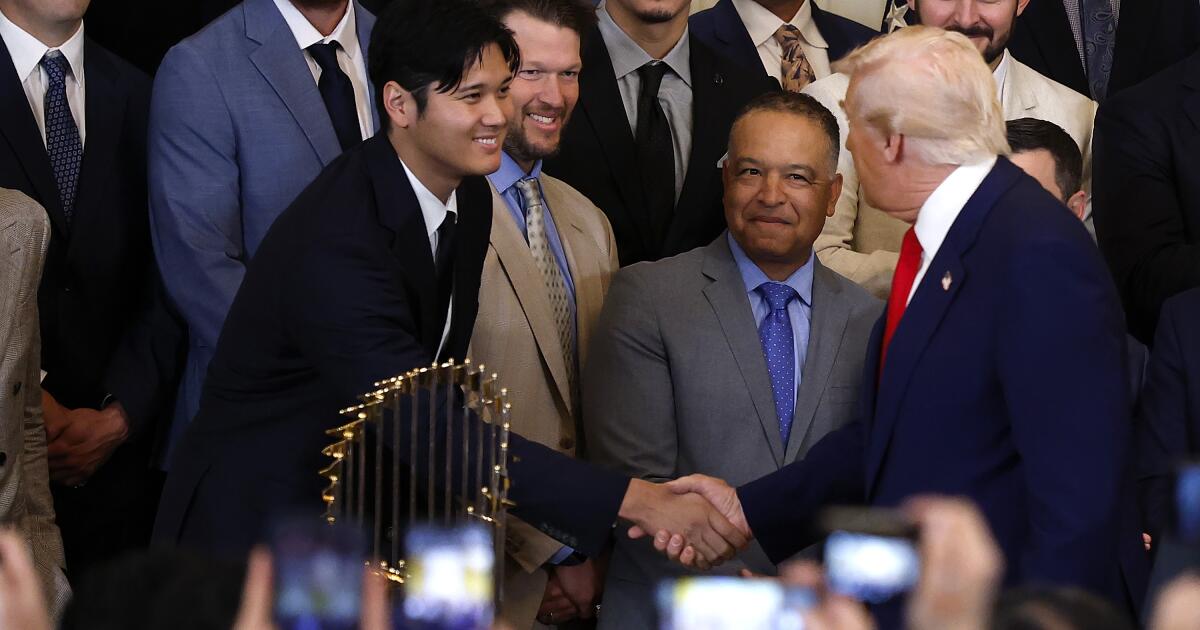
Dodgers scheduled to visit White House in late July to celebrate 2025 World Series win
-

 World39 minutes ago
Former US Olympian pleads not guilty in DC reflecting pool vandalism case
-
 News1 hour ago
Former Olympian pleads not guilty in reflecting pool vandalism charges


