Washington, D.C
9 Great Things to Do in Washington, DC in June 2024 – wyandottedaily.com


Washington, DC is a vibrant and exciting city with something to offer everyone. The balmy June weather makes it the perfect time to explore the city’s many outdoor attractions, from the National Mall to the Smithsonian museums. There are also plenty of indoor activities to enjoy, such as visiting the White House or the International Spy Museum. Whether you’re looking for culture, history, or just a fun day out, Washington, DC has something for you. Here are 9 great things to do in Washington, DC in June 2024:
1. Visit the National Mall
The National Mall is a 2-mile-long park that stretches from the Lincoln Memorial to the Capitol Building. It’s home to some of the city’s most iconic landmarks, including the Washington Monument, the World War II Memorial, and the Martin Luther King, Jr. Memorial. In June, the National Mall is a great place to enjoy a picnic, go for a walk, or simply take in the sights. You can also take a ranger-led tour of the Mall to learn more about its history and significance.
2. Explore the Smithsonian Museums
The Smithsonian Institution is the world’s largest museum and research complex. It comprises 19 museums, 9 research centers, and the National Zoo. The Smithsonian museums are free to enter, making them a great option for budget-minded travelers. In June, the Smithsonian museums offer a variety of special exhibitions, programs, and events. You can check the Smithsonian website for a full list of what’s happening during your visit. Some popular Smithsonian museums include the National Museum of Natural History, the National Air and Space Museum, and the National Museum of American History.
3. Visit the White House
The White House is the official residence of the President of the United States. It’s one of the most iconic buildings in the world and a must-see for any visitor to Washington, DC. Tours of the White House are free, but they must be booked in advance. You can book a tour online or by calling the White House Visitor’s Office. Tours are available on a first-come, first-served basis, so it’s important to arrive early. If you’re not able to get a tour, you can still take a walk around the White House and admire its beautiful architecture.
4. Visit the International Spy Museum
The International Spy Museum is a fascinating museum that tells the story of espionage throughout history. The museum has a collection of over 1,000 artifacts, including spy gadgets, weapons, and vehicles. You’ll learn about the history of espionage, from the ancient Egyptians to the modern era. The museum also has a number of interactive exhibits, where you can test your own spy skills. The International Spy Museum is a great place to visit for adults and children alike.
5. Take a walk or bike ride along the Potomac River
The Potomac River is a beautiful river that flows through Washington, DC. There are several trails along the river that are perfect for walking, running, or biking. You can enjoy stunning views of the city skyline, the Lincoln Memorial, and the Jefferson Memorial. You can also rent a kayak or canoe and explore the river from a different perspective. The Potomac River is a great place to relax and enjoy the outdoors.
6. Visit the National Zoo
The National Zoo is home to over 2,000 animals from all over the world. The zoo is free to enter, making it a great option for families. You can see animals such as lions, tigers, elephants, gorillas, and pandas. The zoo also has a number of educational programs and exhibits. You can learn about the animals and their habitats, and you can even get up close and personal with some of the animals. The National Zoo is a fun and educational place to visit for all ages.
7. Attend a concert or show at the Kennedy Center
The Kennedy Center is a performing arts center that hosts a variety of events, including concerts, plays, and dance performances. The Kennedy Center is home to the National Symphony Orchestra, the Washington National Opera, and the Washington Ballet. In June, the Kennedy Center offers a variety of special events, such as outdoor concerts and free performances. You can check the Kennedy Center website for a full list of what’s happening during your visit.
8. Visit a farmer’s market
Washington, DC is home to several farmer’s markets that offer fresh fruits, vegetables, and other products. Farmer’s markets are a great way to support local farmers and get fresh, healthy food. You can also find a variety of prepared foods, such as sandwiches, salads, and baked goods. Farmer’s markets are a great place to visit for a bite to eat or to stock up on groceries. Some popular farmer’s markets in Washington, DC include the Dupont Circle FreshFarm Market, the Eastern Market, and the Georgetown Farmers’ Market.
9. Explore the U Street Corridor
The U Street Corridor is a vibrant and historic neighborhood in Washington, DC. The neighborhood is home to a variety of restaurants, bars, and shops. You can also find live music venues, art galleries, and theaters. The U Street Corridor is a great place to spend an evening or afternoon. You can grab a bite to eat, see a show, or simply people-watch. The neighborhood is also home to the African American Civil War Museum and the Howard University Museum. These museums tell the story of African Americans in Washington, DC, and their contributions to the city and the nation.
Culture, Best Months to Visit, Nearby Transportation, Local Food, Best Hotels, Conclusion
Washington, DC is a city with a rich culture and history. The city is home to a variety of museums, monuments, and historical sites. It’s also a great place to experience the arts, with a variety of theaters, concert halls, and art galleries. Washington, DC is a great city to visit any time of year, but June is an especially nice time to visit. The weather is warm and sunny, and there are plenty of outdoor events and activities to enjoy. You can easily get around Washington, DC by using the city’s public transportation system. The Metro is a subway system that can take you to most of the city’s major attractions. You can also use the city’s buses or taxis to get around.
Washington, DC has a variety of local food options to choose from. You can find everything from classic American fare to international cuisine. Some of the city’s most popular dishes include half-smokes, Ben’s Chili Bowl, and Ethiopian food. You can also find a variety of restaurants that cater to vegetarians and vegans. Washington, DC has a variety of hotels to choose from, to fit all budgets. Some of the city’s most popular hotels include The Willard InterContinental, The Hay-Adams, and The Jefferson Hotel. No matter what your interests are, you’re sure to find something to love in Washington, DC.



One family, four generations with DC Metro
As Metro celebrates 50 years of service, one D.C. family is marking the milestone with a legacy of their own — four generations who have all worked on the system, helping keep the region moving for decades.
WASHINGTON – D.C. residents got on their first Metro train 50 years ago on March 27, 1976. Here’s a look back at the beginning.

Connecticut Avenue; NW; looking south. evening traffic-jams are aggravated by metro subway construction in Washington D.C. ca. 1973 (Photo by: HUM Images/Universal Images Group via Getty Images)
View of the Metro Center subway station (at 13th and G Streets NW) during its construction, Washington DC, November 16, 1973. (Photo by Warren K Leffler/PhotoQuest/Getty Images)
Standing in the cavernous tunnel, planners wearing hard hats discuss the construction progress of the Metro Center subway station at the intersection of 13th and G Streets in Washington, DC, November 16, 1973. (Photo by Leffler/Library of Congress/In
WASHINGTON, DC – NOVEMBER 07: FILE, Metro construction miners and blasters on a jumbo drill outside the hole they are working on at Rock Creek Parkway and Cathedral Ave NW in Washington, DC on November 7, 1973. (Photo by James K.W Atherton/The Washin
WASHINGTON, DC – MARCH 4: FILE, View of the Post Office at North Capital and Mass Avenue NE, and 1st NE where subway tunnels were being constructed in Washington, DC on March 4, 1974. (Photo by Joe Heiberger/The Washington Post via Getty Images)
WASHINGTON, DC – AUGUST 29: FILE, Workers rig a pipe at the entrance to the Rosslyn Metro Station in Washington DC on August 29, 1974 (Photo by Larry Morris/The Washington Post via Getty Images)
WASHINGTON, DC – MARCH 27: FILE, The crowd at Rhode Island Station on opening day of the Washington Metro on March 27, 1976. (Photo by James A. Parcell/The Washington Post via Getty Images)
WASHINGTON, DC – MARCH 28: FILE, Reverend Leslie E. Smith of the Episcopal Church, right, and George Docherty of New York Avenue Presbyterian church hold a joint service at the new Metro Center station in Washington, DC on March 28, 1976. (Photo by D
WASHINGTON, DC – JULY 1: FILE, An aerial view of metro construction where it crosses the Washington Channel. The Potomac River, the Pentagon and Northern Virginia can be seen in the distance. (Photo by Ken Feil/The Washington Post via Getty Images)
WASHINGTON, DC – JANUARY 27: FILE, A packed train of commuters on the Silver Spring metro on the Red Line on January 27, 1987. (Photo by Dudley M. Brooks/The Washington Post via Getty Images)
WASHINGTON, DC – JULY 4: FILE, Thousands of people press their way into the Smithsonian Subway station after the Independence Day fireworks in Washington, DC on July 4, 1979. (Photo by Lucian Perkins/The Washington Post via Getty Images)

Among the liquor store, barber shop and dry cleaners at the Watergate Complex’s retail plaza, there is a new pop-up museum dedicated to the scene of the crime that toppled Richard Nixon’s presidency.
Among the liquor store, barber shop and dry cleaners at the Watergate Complex’s retail plaza, there is a new pop-up museum dedicated to the scene of the crime that toppled Richard Nixon’s presidency.
The temporary exhibit features the work of artist Laurie Munn — portraits of members of the Nixon administration and those connected to the Watergate break-in. The exhibit features members of Congress, the media and some who were on Nixon’s enemies list.
Keith Krom, chair of the Board of Directors of the Watergate Museum, told WTOP the exhibit was first featured in the gallery in 2012 for the 40th anniversary of the break-in at the Democratic National Committee.
“When she (Munn) learned about our museum effort, she offered to reassemble them as a way for us to expand awareness of the museum,” Krom said.
Krom, who lives in the Watergate, said his favorite portrait is of one of the special prosecutors, whose firing sparked the “Saturday Night Massacre” in 1973.
“I had the pleasure of being a student of Archibald Cox,” Krom said. “He served as my mentor for my third-year writing project.”
Krom said during this time, at the Boston University School of Law, he spent a great deal of time with him.
“I didn’t realize how much he must have gone through. Here he was, this one man, who was challenging the president of the United States over something pretty serious,” Krom said.
The pop-up opened in October and was recently extended to stay open until April 25. Krom said the hope is to find it a permanent location within the Watergate Complex, where they can “present the history of Watergate, but with two perspectives.”
The first would be on the building’s “architectural significance to D.C.,” he said.
“You may not like the design, you actually may hate it,” Krom said. “But you cannot deny that it changed D.C.’s skyline.”
The secondary focus would, of course, be on the mother of all presidential scandals that changed the course of American history.
“That’s where that suffix ‘-gate’ started and continues to be used for almost every scandal that comes out today,” Krom said.
The inspiration for the museum spawned from an interaction from a tourist outside the Watergate.
“He says, ‘This is the Watergate, right?’ And I was like, ‘Yeah, it’s one of the buildings,’” Krom recalled.
The tourist then asked Krom, “So where’s the museum?”
“I was like, ‘Oh, we don’t have a museum.’ And he literally just looked at me and said, ‘That’s so sad.’ And he got on his bike and rode away,” Krom said.
While the self-proclaimed political history nerd said he “still gets goose bumps” when he drives by the Capitol at night, Krom hopes that when people leave the museum, “they’ll walk away with a new appreciation for how our government works, the guardrails that are in place.”
“Maybe an understanding that those guardrails themselves are kind of frail, and they probably need our collective help in making sure they last — that’s what we hope to accomplish,” Krom said.
Get breaking news and daily headlines delivered to your email inbox by signing up here.
© 2026 WTOP. All Rights Reserved. This website is not intended for users located within the European Economic Area.

According to the National Park Service at the National Mall, famous cherry blossoms around the nation’s capital have hit peak bloom conditions. The National Park Service X account for the National Mall proclaimed this morning, “PEAK BLOOM! PEAK BLOOM! PEAK BLOOM!”
It became apparent yesterday that the bloom would be at peak today. “Despite a sunny afternoon and patches of blue sky, the cherry blossoms remain at Stage 5: Puffy White,” the Park Service wrote on X yesterday. Stage 5, “Puffy White”, is the final stage blossoms go through before being in full bloom. They start at Stage 1 as a “Green Bud”, grow into Stage 2 with “Florets Visible”, and then florets become extended at Stage 3. In Stage 4, there is “Peduncle Elongation” which sets the stage for the puffy blossoms to appear in Stage 5. Puffy White and Peak Bloom are defined as when 70% of the blossoms on the trees reach that stage.

Peak bloom varies annually depending on weather conditions; the most likely time to reach peak bloom is between the last week of March and the first week of April. According to the Park Service, extraordinary warm or cool temperatures have resulted in peak bloom as early as March 15 in 1990 and as late as April 18 in 1958.
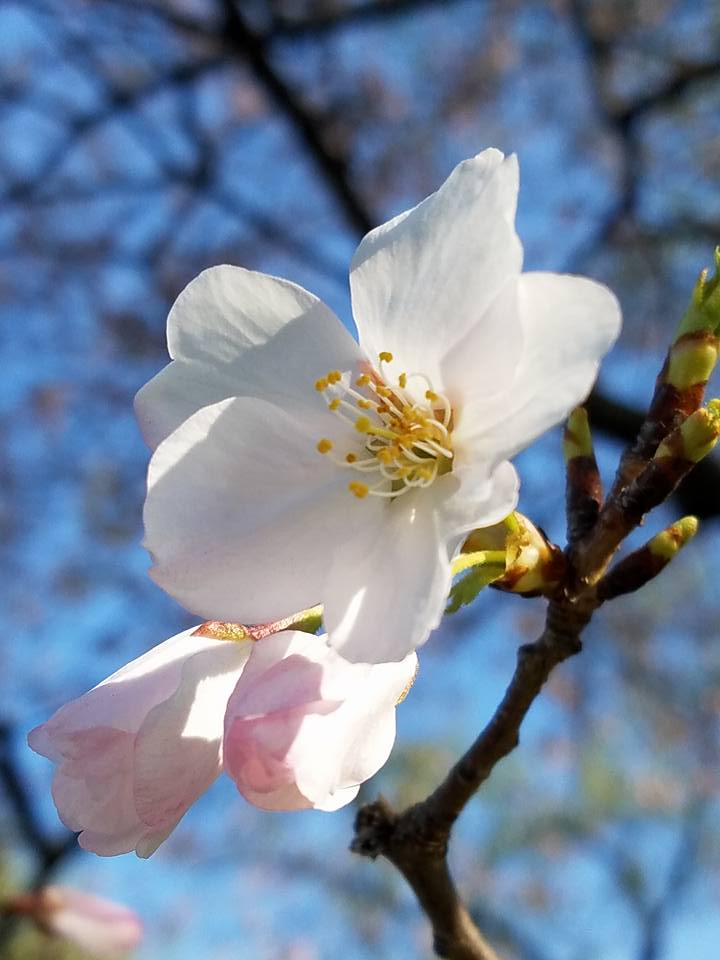
The planting of cherry trees in Washington DC originated in 1912 as a gift of friendship to the People of the United States from the People of Japan. In Japan, the flowering cherry tree, or “Sakura,” is an important flowering plant. The beauty of the cherry blossom is a symbol with rich meaning in Japanese culture.
Dr. David Fairchild, plant explorer and U.S. Department of Agriculture official, imported seventy-five flowering cherry trees and twenty-five single-flowered weeping types from the Yokohama Nursery Company in Japan. After experimenting with growing them on his own property in Maryland, he deemed that the cherry tree would be perfect to plant around the Washington DC area. This triggered an interest by a variety of individuals to plant the tree around Washington. In 1909 the Mayor of Tokyo, Yukio Ozaki, donated 2,000 trees to the United States on behalf of his city. When the trees arrived, they were riddled with disease and insects and to protect other agriculture, they were burned. The Tokyo Mayor made a second donation of trees in 1910, this time amounting to 3,020 trees. This started the forest of cherry trees that now line the Potomac basin around Washington DC. In a gesture of gratitude back to Japan, President Taft sent a gift in 1915 of flowering dogwood trees to the people of Japan. Thousands of trees have been added since, including another gift of 3,800 trees from Japan in 1965.


2 Candidates Emerge in NC State’s Coaching Search

Former North Dakota deputy remains free on bail despite new charge

Remains of Ohio airmen killed in Iraq will be brought back March 29

Rapper Snoop Dogg to star in, produce ‘God of the Rodeo’ film shot in Oklahoma

Convicted murderer sentenced to life in prison for Falls City, Oregon killing in 2024

Florida High School Football Rankings: Top 25 teams – Oct. 21

How old is Bo Nix? What to know about Oregon quarterback ahead of 2024 NFL Draft

Cleary's 21 help Le Moyne down Central Connecticut State 69-64 in OT

99th annual Pony Swim held in Virginia

Indiana Members Credit Union announced as new anchor tenant at Bottleworks District

WATCH: Senate hearing goes silent after Angel Father confronts top Dem over daughter’s death

US diplomat Marco Rubio denounces settler violence, tolls in Hormuz strait

Iran-linked hackers have breached FBI Director Kash Patel’s personal emails | CNN Politics

Live: CPAC 2026 Day 2

Video: Will ICE Change Under Its New Leader?
-

 Detroit, MI1 week ago
Drummer Brian Pastoria, longtime Detroit music advocate, dies at 68
-

 Movie Reviews1 week ago
‘Youth’ Twitter review: Ken Karunaas impresses audiences; Suraj Venjaramoodu adds charm; music wins praise | – The Times of India
-

 Sports6 days ago
IOC addresses execution of 19-year-old Iranian wrestler Saleh Mohammadi
-

 New Mexico5 days ago
Clovis shooting leaves one dead, four injured
-
 Business1 week ago
Disney’s new CEO says his focus is on storytelling and creativity
-

 Technology5 days ago
YouTube job scam text: How to spot it fast
-

 Tennessee4 days ago
Tennessee Police Investigating Alleged Assault Involving ‘Reacher’ Star Alan Ritchson
-

 Texas1 week ago
How to buy Houston vs. Texas A&M 2026 March Madness tickets