Virginia
How does West Virginia fill out the 2025 class needs with recruiting?


West Virginia has 22 current high school or junior college commitments in the 2025 recruiting class so how will the coaching staff go about filling the rest of the remaining slots?
The Mountaineers still have needs left to fill. Which ones take priority with the remaining slots?
The Mountaineers have filled a need at quarterback with a commitment from Mentor (Oh.) 2025 quarterback Scotty Fox.
As for the rest of the positions, the program has two Drexel Hill (Pa.) Monsignor Bonner 2025 wide receiver Jalil Hall and Hurricane (W.Va.) 2025 wide receiver Tyshawn Dues, one tight end in De Forest (Wi.) 2025 tight end Jackson Accuard,i and four offensive linemen in Olney (Md.) Good Counsel 2025 offensive lineman Gavin Crawford, Olney (Md.) Good Counsel 2025 offensive lineman Eidan Buchanan, Parma (Oh.) Padua Franciscan 2025 offensive lineman Brandon Homady and Cincinnati (Oh.) La Salle 2025 offensive tackle Jahmir Davis.
On the defensive side, the Mountaineers have five defensive line commitments in Nashville (Tn.) Lipscomb Academy defensive lineman Amir Leonard-Jean Charles, Miami (Fla.) Northwestern 2025 defensive end Wilnerson Telemaque, Cleveland Heights (Oh.) 2025 defensive lineman Brandon Caesar, Upper Marlboro (Md.) Wise 2025 defensive lineman Taylor Brown and Huntingtown (Md.) 2025 defensive lineman Evan Powell, one linebacker in Douglasville (Ga.) 2025 linebacker Michael Hastie, two pass-rushing linebackers in Coconut Creek (Fla.) Monarch 2025 defensive end Romando Johnson and Glendora (Ca.) Citrus College 2025 edge Keenan Eck and six defensive backs in Columbus (Oh.) Marion Franklin 2025 cornerback Dawayne Galloway, Bel Air (Md.) 2025 safety Julien Horton, Lakeland (Fla.) 2025 defensive back Sammy Etienne, Huntington (W.Va.) 2025 safety Zah Jackson, Columbus (Oh.) Beechcroft 2025 athlete Tyrell Russell and Wyndmoor (Pa.) La Salle College High School 2025 spear Chris Fileppo.
The Mountaineers also have transfer additions from: two quarterbacks in Jayden Henderson (Texas A&M) and Max Brown (Charlotte); two running backs in Tye Edwards (Northern Iowa) and LJ Turner (Catawba College); five wide receivers in Cam Vaughn (Jacksonville State), Oran Singleton (Eastern Michigan), Cyrus Traugh (Youngstown State), Jarod Bowie (Jacksonville State), Jeff Weimer (Idaho State); two tight ends in Johnny Pascuzzi (Iowa) and Jacob Barrick (Jacksonville State); six offensive lineman Will Reed (Princeton), Walter Young Bear (Tulsa), Kimo Makane’ole (LSU), Robby Martin (N.C. State), Ty’kieast Crawford (Arkansas) and Wyatt Minor (Youngstown State); one defensive lineman in Braden Siders (Wyoming); two linebackers in Chase Wilson (Colorado State) and Ashton Woods (North Carolina); one pass rushing linebacker in Jimmori Robinson (Texas San Antonio); four safeties in Fred Perry (Jacksonville State), Jordan Walker (UT Chattanooga), Justin Harrington (Washington) and William Davis (Virginia Union); and finally five cornerbacks with Michael Coats (Nevada), Jordan Scruggs (South Alabama), Devonte Golden-Nelson (Akron), Jason Chambers (Appalachian State) and Derek Carter (Jacksonville State).
So what positions are left to fill?
The Mountaineers should not take another quarterback with Fox, Henderson, and Brown filling the need in the 2025 cycle although they could look at a younger option with multiple years of eligibility. The Mountaineers should be done at running back with the two experienced transfers in the mix.
Tight end remains a position that could potentially have another addition depending on the options that are there in the transfer portal.
West Virginia could still add at least one more at wide receiver to round out that position group although that would only be for the right addition likely a slot type that can create after the catch.
On the offensive line, the Mountaineers have three commitments in place from high school and six more from the portal but this is the biggest priority. There will need to be several more additions.
That means overall, the offensive side of the ball could still take anywhere from 4-5 more players at the various spots.
On the defensive line West Virginia has five commitments and a transfer addition, but the program could look at adding at least one more depending on the options.
Inside linebacker won’t be as heavily hit this cycle but the Mountaineers could still add one more outside Hastie and the transfers while outside linebacker is likely set with Robinson, Eck, and Johnson.
The defensive backfield has been hit heavily in this class but could still add some pieces likely through the junior college ranks or transfer portal.
That means that on defense the Mountaineers still need to add as many as 4-5.


Residents of an Arlington community are banding together to help each other in the wake of a string of vandalism. The neighborhood of Arlington Mill in southwest Arlington has been targeted for the last week, and nearly three dozen cars have had their windows smashed out, county police said.
Residents say they’re frustrated, frightened and aggravated that no one has been caught.
Evidence of the damage is everywhere in the neighborhood, with glass all over the road and in the grass. So many cars have been damaged that workers from a local auto glass repair shop came through the neighborhood and stuck their business cards under windshield wipers.
“It’s just frustrating,” Jose Santos said.
He parks his car in a lot where multiple cars have had their windows smashed out.
“They put up signs inside all the buildings, right now, trying to tell people, ‘Hey, leave your belongings at home,’” Santos said.
Police say the first calls came in last week, reporting multiple windows smashed in Arlington Mill, up and down the intersection of 7th Road S. and S. Florida Street.
Then even more cars were damaged late Sunday into Monday.
One witness saw three males and guessed they were between 18 and 24 years old.
Arlington County police say they’ve increased patrols in the neighborhood.
“We’ve had three incidents in the Arlington Mill neighborhood over about the last week, in which suspects broke the windows to about 35 vehicles parked in the neighborhood,” Ashley Savage of the Arlington County Police Department said.
Police say it doesn’t appear anything valuable has been stolen from the cars, but the peace of mind that’s been taken from Arlington Mill is invaluable, and nearly three dozen people have car windows to replace.

Gov. Abigail Spanberger speaks at a press conference announcing there is a deal to authorize cannabis sales and put the legislation in the upcoming budget, Tuesday, June 16, 2026, in Richmond, Va. (Mike Kropf/Richmond Times-Dispatch via Getty Images)
Richmond Times-Dispatch via Getty Images
For the last five years, Virginia cannabis has existed in a strange policy gap.
Adults could legally possess it. They could grow it at home. They could gift it. They could consume it. But if they wanted to walk into a licensed adult-use dispensary and buy a tested, labeled product from a regulated business, Virginia still had no legal retail market.
That contradiction has defined the Commonwealth’s cannabis story since 2021, when Virginia became the first state in the South to legalize adult-use possession. The original promise was bigger than decriminalization. It was supposed to be the beginning of a regulated commercial market—one that would move consumers away from the illicit market, create room for small businesses and farmers, and finally give the state an enforceable framework for products already being sold and consumed.
Instead, Virginia legalized the front end of adult use without opening the front door of the industry.
Since then, the state has been caught in political limbo. Retail implementation stalled after the 2021 elections. Republican control of the House slowed the process. Former Gov. Glenn Youngkin later vetoed adult-use retail bills. Operators, investors and would-be applicants watched session after session with the same question: when would Virginia finally stop treating cannabis like something adults could legally have, but not legally buy?
The answer appeared close in 2026. With Gov. Abigail Spanberger in office and Democrats controlling the General Assembly, cannabis advocates expected the retail framework to finally move. Lawmakers sent the governor a bill that would have launched adult-use sales in 2027. Spanberger returned it with amendments, including a later sales date, a lower possession limit than lawmakers proposed, a higher future tax rate and tougher enforcement provisions. The legislature rejected those changes.
Then came the veto.
For many in the industry, Spanberger’s May veto landed as political whiplash. After years of delay, the state had once again stopped short of launching a legal adult-use marketplace. Worse, the veto came from a governor many advocates and operators expected to be more receptive than her predecessor.
For Brett Puffenbarger, CEO of Old Dominion Cannabis, the moment carried personal weight. Puffenbarger has spent nearly a decade in the cannabis industry and saw Virginia’s 2021 legalization as a chance to bring that experience back home.
“I have been in cannabis for almost a decade, and when Virginia first legalized adult use, it looked like an opportunity to build on that career in my home state,” Puffenbarger said via email. “I had been in Florida for years, but I was born and raised in Virginia. We moved back five years ago because we believed the Commonwealth would eventually open a regulated market. Now Old Dominion Cannabis is preparing to compete for cultivation and manufacturing licenses.”
That kind of long-range planning is common in cannabis. It is also risky. Markets can take years to open. Rules can change overnight. A state can legalize possession and still leave businesses waiting for a real path to licensure.
Virginia became a case study in that uncertainty.
The veto seemed to push the market another year down the road. But within weeks, the same framework came back in a different vehicle: the state budget. Spanberger, Sen. Lashrecse Aird and Del. Paul Krizek announced a compromise that would create a regulated adult-use retail market through budget language, with sales beginning July 1, 2027.
That turnabout changed the mood almost immediately.
“When the veto came down, we thought, ‘Here we go again—another year gone,’” said Jody Roun, COO of Old Dominion Cannabis, via email. “To see the conversation turn around this quickly through the budget process was surprising and exciting. For operators who have been planning around a moving target, it finally feels like there is a path.”
The compromise is not the same bill lawmakers originally passed. It reflects concessions to the governor, especially on timing, taxes, possession limits and enforcement. But it also preserves several priorities from legislators and advocates, including a larger retail cap, statewide access and a framework designed to give small businesses, farmers and microbusinesses a chance to participate.
Here are 10 key pieces of the framework Virginia is now poised to put into law:
1. Adult-use retail sales would begin July 1, 2027. The Virginia Cannabis Control Authority would begin accepting license applications on February 1, 2027, giving regulators time to write rules, establish testing standards and build the oversight structure before stores open.
2. Adults 21 and older would have a legal retail channel. Virginia already legalized adult possession and limited home cultivation, but this framework would finally allow consumers to purchase regulated cannabis from licensed retailers.
3. The adult possession limit would increase from one ounce to two ounces. That is less than the 2.5-ounce limit lawmakers originally sought, but higher than the current possession limit.
4. The state would allow up to 350 retail cannabis establishment licenses. Regulators would not be required to issue them all at once, but the cap is designed to create enough access to compete with the illicit market.
5. Localities would not be able to opt out of the market. That matters because local bans in other states have often left consumers with limited legal access and preserved demand for unregulated sellers.
6. Delivery services are expected to be allowed as part of the regulated market. Combined with the retail cap and no local opt-outs, delivery could become an important tool for statewide access, especially in rural areas.
7. The tax structure would start relatively low. Adult-use cannabis would carry a 6% state excise tax at launch, increasing to 8% beginning July 1, 2029. Local governments could add another 1% to 3.5%, in addition to existing retail sales taxes.
8. The Cannabis Control Authority would gain expanded oversight over intoxicating hemp products. The compromise is designed to close Virginia’s 25:1 hemp loophole and move intoxicating hemp regulation away from the Department of Agriculture and Consumer Services and under the cannabis regulator.
9. The framework includes stronger child-safety and advertising rules. It would require child-resistant packaging, ban cartoon advertising and prohibit products shaped like animals, fruits, vehicles or humans.
10. The state would add stronger compliance and enforcement tools. Retailers could face escalating penalties for failing to check IDs, including possible license revocation for repeated underage sales. Stores would also have to be at least 1,000 feet from schools, hospitals, playgrounds and drug treatment facilities, while the CCA could maintain a public licensee registry, create a tip line and audit ownership and financial relationships.
“The cannabis license application cycle goes through peaks and valleys,” said Justin Singer, a partner at Feuerstein Kulick LLP and chair of the firm’s Regulatory Compliance and Licensing practice via phone interview. “We have been in an extended valley for sought-after licenses for some time, and as a result we have seen a tremendous amount of interest in this upcoming application process.”
Put together, the framework signals that Virginia is trying to do more than open stores. It is trying to correct the imbalance created in 2021: legal adults, legal possession, legal home cultivation—but no legal commercial channel for most consumers.
The challenge now is execution.
Cannabis regulators across the country have learned that legal markets do not automatically beat illicit ones. Taxes that are too high, licensing that is too slow, limited access, lack of capital and burdensome rules can all keep consumers in the unregulated market. Virginia’s relatively modest starting excise tax may help. So could the 350-store cap, if the state issues licenses in a way that creates real geographic coverage.
But questions remain. How quickly will cultivation and manufacturing licenses be processed? How much room will there be for independent operators? Will microbusinesses and impact applicants have meaningful access to banking and capital? Will existing medical operators have a first-mover advantage? And can the state build a market that is regulated enough to protect consumers without being so expensive and slow that it recreates the same illicit-market incentives legalization was supposed to solve?
For companies like Old Dominion Cannabis, the answer will determine whether Virginia becomes a real opportunity or simply another tightly controlled market dominated by the best-capitalized players.
Still, after five years of waiting, the significance of this moment is hard to ignore. Virginia is no longer debating whether adults should be allowed to possess cannabis. That question was answered in 2021. The question now is whether the Commonwealth can build a functioning legal industry around that decision.
The budget compromise does not end the work. It starts it.
For operators, the next several months will be about applications, compliance, capital and partnerships. For regulators, it will be about writing rules that can survive contact with the market. For consumers, it could mean finally having a legal way to purchase tested cannabis products in the first Southern state to legalize adult use.
Virginia took the symbolic step five years ago. Now it may finally be taking the commercial one.

RICHMOND, Va. — Jerrod Buford first picked up a paintbrush as a kid, never imagining that same creative outlet would carry him through his darkest days in prison.
Buford, who grew up in Williamsburg, was convicted and arrested as a young man and spent almost a decade behind bars. During that time, he struggled deeply.
“Turning to drugs and alcohol to kind of shadow over emotions,” Buford said. “Looking for acceptance, approval. Not just from my parents, but from friends, from, you name it. I mean, I tried to commit suicide, I don’t even know how many times,” Buford said.
WTVR
It was inside prison walls that art became more than a hobby.
“Throughout my prison time, I learned, the freedom that I desired, I’ve always had it. I got, I found it, in a box,” Buford said.
More than three years after his release, Buford continues to advocate for art as a tool for healing. He describes his work as a gift he feels called to share.
“I received a blessing from God that just allowed me to display what he’s given me,” Buford said.
For Buford, creating art is also a way of processing his past.
“That’s what art has done for me. It’s given me the ability to look at parts of my life, all parts of my life, and find the good and the negative, learn from the negative,” Buford said.
He shares his story and artwork with a wide audience through social media, including live sessions on TikTok, and holds art classes with new communities.
The Story Cafe
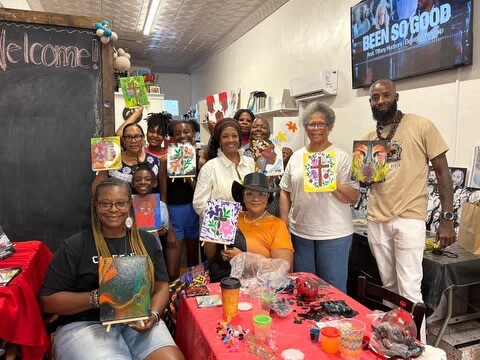
Buford said his mission is to help others find their own path toward healing — whatever form that takes.
“What I strive to do is guide this person to just create, man. Don’t care what people think about your creation, you just need to get it out,” Buford said. “Whether it’s with art, addressing your mental health, getting your life right — just do it.”
CBS 6 is committed to sharing community voices on this important topic. Email your thoughts to the CBS 6 Newsroom.
📲: CONNECT WITH US
Blue Sky | Facebook | Instagram | X | Threads | TikTok | YouTube

This story was initially reported by a journalist and has been converted to this platform with the assistance of AI. Our editorial team verifies all reporting on all platforms for fairness and accuracy. To learn more about how we use AI in our newsroom, click here.
-

 Florida5 minutes ago
Florida Lottery Mega Millions, Jackpot Triple Play results for June 26, 2026
-
Georgia12 minutes ago
Georgia Lottery Mega Millions, Cash 3 results for June 26, 2026
-

 Hawaii14 minutes ago
Police recover 19 gaming machines, $7K in Kakaako gambling bust
-

 Idaho20 minutes ago
The reactor race has begun
-

 Illinois27 minutes ago
New Illinois bill aims to overhaul public defense system | The Chicago Report
-

 Indiana29 minutes ago
Driver airlifted after NW Indiana police chase ends with crash into tree
-

 Iowa35 minutes ago
Vote: Class 1A Iowa High School Softball Midseason Player Of The Year
-

 Kansas42 minutes ago
Salina Stars Unite for Final High School Stage at Kansas Shrine Bowl

