Virginia
Fast and curious, Virginia pioneers autonomous racing


The University is home to some of the best coaches in the world. Lars Tiffany, Andres Pedroso and Todd DeSorbo are regarded as arguably the very best in their respective sports. The Cavaliers also boast a handful of other prestigious coaches, though, and one of them teaches mechanical engineering in Olsson Hall.
When one thinks of collegiate athletics, racing self-driving cars is certainly not the first event that comes to mind. Yet in the School of Engineering and Applied Science, Associate Professor Madhur Behl is rising as one of the University’s best coaches, leading a cohort of all-star mathletes. Currently composed of 21 undergraduates and a handful of graduate veterans, the Virginia autonomous car racing team is a pioneer on the frontier of artificial intelligence, with an autonomous racecar that has reached a top speed of nearly 150 miles per hour.
Autonomous racing is certainly unique. It is a sport, art and science combined into one easily defined task — getting an autonomous AI car to cross the finish line first. Racing is ingrained in American media, demonstrated by famous quotes like, “If you ain’t first, you’re last.” Despite this common line from a Will Ferrell movie, sometimes progress is worthy of praise as well. Rising from a mere concept to near-champions, the Virginia autonomous racing team has become a global leader in just four years.
After completing his doctorate from the University of Pennsylvania back in 2015, Behl wanted to research the possibility of commercial driverless cars. Behl’s accolades are extensive, as he is a respected leader in mechanical engineering. When he arrived on Grounds, he sought to experiment with autonomous vehicles — setting out to autotomize remote control miniature race cars. By using relatively inexpensive cars, Behl created a new discourse of accessibility in AI by using AI toy racecars as entertainment. Then, he upped the ante.
Working initially with graduate students, Behl formed a team of engineers and began working on a life-sized, fully autonomous AI racecar. While Behl himself is incredibly humble, it must be said that he is clearly one of the founding fathers of autonomous racing. The esteemed professor discussed the incredible story of his program with The Cavalier Daily.
The racing team first began officially competing in 2020, when the Indy Autonomous Challenge invited Behl’s team to a competition against other collegiate programs — marking the very first fully autonomous racing competition. The Indy Autonomous Challenge features two cars at once — an attacker and a defender. The competition begins with the defending car coasting at up to 80 miles per hour, and the attacker must pass them within two laps. If the attacker clears, then the roles switch. If both attackers succeed, then the speed is increased until one car cannot keep pace or commits a penalty.
The AI can commit infractions such as accelerating past the coasting speed as the defender or operating in an unsafe manner with braking or steering. Again, the car is fully autonomous — the engineers cannot communicate with the car and are essentially high-profile witnesses for the race.
At its inception, Virginia was an underdog program, having never finished higher than fifth place at any competition from 2021-2023. However, much like the classic comeback of other Cavalier athletic programs, the team began to rise exponentially. At the famous Las Vegas Motor Speedway Challenge in January, Virginia made history.
The Cavaliers entered the competition unseeded — meaning they had to earn a spot through a trial race. In that trial, they finished first and were awarded the top seed. Virginia kept advancing, eventually facing off against a team of students from Massachusetts Institute of Technology, Pittsburgh, Rochester Institute of Technology and University of Waterloo — dubbed MIT-PITT-RW — in the semifinal. The Cavaliers and MIT-PITT-RW fought in a tight battle, but Virginia ultimately triumphed due to a game-ending technical penalty on MIT-PITT-RW. The final then positioned the Cavaliers against the world-leading University of Munich team.
“This is the race we have been preparing for,” Behl said. “We were happy to be fighting for the top position … this race was going to go the distance, no one was backing out.”
In a heated offensive round, the Virginia car was running out of time to pass Munich. With mere seconds remaining, the car moved onto the rigid bank side of the track and passed Munich at an incredible 120 miles per hour in the middle of a difficult turn. While Behl’s squad wanted to push even further, Virginia unfortunately fell victim to game-ending defensive penalties — a similar circumstance to how it advanced to the final but with the roles reversed. Despite the loss, Behl’s team proved they belong among the world’s best.
“I’m very happy the team was able to demonstrate their capability,” Behl said.
The Munich team was 40 people strong and featured significantly more graduate-level experience than a Cavalier squad mostly composed of undergraduate students. However, despite a series of untimely penalties in the championship round, Virginia had reached its greatest peak yet.
“What they have achieved is nothing short of extraordinary,” Behl said.
The close loss aside, the Cavaliers have made their mark on the international stage. While Behl continues to work towards his goal of safe autonomous vehicles for commercial use, Virginia aims for a shot at glory on one of the most prestigious racing tracks in the world. In June, the Cavaliers will compete at the historic Monza Circuit in Italy — home of the Italian Grand Prix and several Formula 1 campaigns. Virginia is redefining the boundaries of sport, art and science as the team continues to soar.
“I see faster cars, more cars, and a brighter future in auto racing … Other leagues are popping up. This is not a one-off,” Behl said.
Behl then posed questions of potential races against human-controlled remote racing cars or even actual NASCAR drivers. Future races could also take place outside of a standard oval track or even in harsh weather conditions, according to Behl. As autonomous racing grows, Behl noted that the team is currently accepting applications.
What was intended to be a contained science experiment has morphed into an entirely new sport — and the future of AI. As the entire world continues to forge new horizons regarding AI, a crucial global leader in the field can be found here on Grounds — and he happens to be one of the greatest coaches at the University.


RICHMOND, Va. — Jerrod Buford first picked up a paintbrush as a kid, never imagining that same creative outlet would carry him through his darkest days in prison.
Buford, who grew up in Williamsburg, was convicted and arrested as a young man and spent almost a decade behind bars. During that time, he struggled deeply.
“Turning to drugs and alcohol to kind of shadow over emotions,” Buford said. “Looking for acceptance, approval. Not just from my parents, but from friends, from, you name it. I mean, I tried to commit suicide, I don’t even know how many times,” Buford said.
WTVR
It was inside prison walls that art became more than a hobby.
“Throughout my prison time, I learned, the freedom that I desired, I’ve always had it. I got, I found it, in a box,” Buford said.
More than three years after his release, Buford continues to advocate for art as a tool for healing. He describes his work as a gift he feels called to share.
“I received a blessing from God that just allowed me to display what he’s given me,” Buford said.
For Buford, creating art is also a way of processing his past.
“That’s what art has done for me. It’s given me the ability to look at parts of my life, all parts of my life, and find the good and the negative, learn from the negative,” Buford said.
He shares his story and artwork with a wide audience through social media, including live sessions on TikTok, and holds art classes with new communities.
The Story Cafe
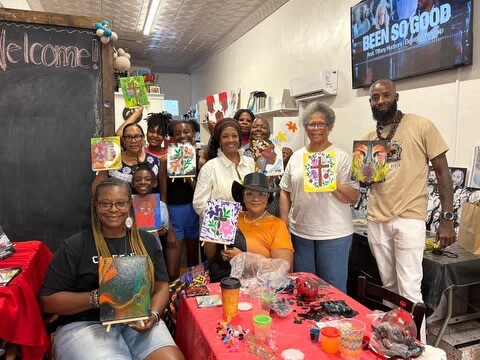
Buford said his mission is to help others find their own path toward healing — whatever form that takes.
“What I strive to do is guide this person to just create, man. Don’t care what people think about your creation, you just need to get it out,” Buford said. “Whether it’s with art, addressing your mental health, getting your life right — just do it.”
CBS 6 is committed to sharing community voices on this important topic. Email your thoughts to the CBS 6 Newsroom.
📲: CONNECT WITH US
Blue Sky | Facebook | Instagram | X | Threads | TikTok | YouTube

This story was initially reported by a journalist and has been converted to this platform with the assistance of AI. Our editorial team verifies all reporting on all platforms for fairness and accuracy. To learn more about how we use AI in our newsroom, click here.

Lovingston, VA (7News) — Good Morning Washington interviews Amanda Beckwith of Virginia Distillery Company- one of the contributing distilleries to the Virginia Spirits Board’s 250th Celebration Trio Pack, a special, exclusive release created to commemorate America’s upcoming 250th anniversary. This limited-edition package features a curated collection of a rum, a gin, and a whiskey, all crafted from scratch by distillers in Virginia to celebrate the rich history and current state of distilling within the Commonwealth.
Beckwith elaborates on VA Distillery Company’s role in the project, noting her focus on Virginia-grown grain to make the bottle of unique whiskey that is included in the Trio Pack. It is also worth noting that the Trio Packs themselves were bottled and produced right here at Virginia Distilling Company!
American single malts are the newest official category of American whiskey, distilled from one grain and from a single distillery. Virginia Distillery Co specializes in this new category of whiskey and crafted their contribution to the Trio Pack with this very specialty. Given the limited remaining availability of the Trio Pack, its historical value and collectible nature, the message it loud and clear encouraging viewers to grab a pack before they are all gone!
BE THE FIRST TO COMMENT
21+ Please drink responsibly, this content is sponsored by Virginia Distillery Company.


Powerball, Mega Millions jackpots: What to know in case you win
Here’s what to know in case you win the Powerball or Mega Millions jackpot.
Just the FAQs, USA TODAY
The Virginia Lottery offers multiple draw games for those aiming to win big.
Here’s a look at June 24, 2026, results for each game:
Powerball
Powerball drawings are held Monday, Wednesday and Saturday at 11 p.m.
13-14-16-21-38, Powerball: 14, Power Play: 2
Check Powerball payouts and previous drawings here.
Saturday, June 27, 2026
Pick 3
DAY drawing at 1:59 p.m. NIGHT drawing at 11 p.m. each day.
Night: 3-1-5, FB: 8
Day: 7-8-8, FB: 4
Check Pick 3 payouts and previous drawings here.
Pick 4
DAY drawing at 1:59 p.m. NIGHT drawing at 11 p.m. each day.
Night: 4-7-2-1, FB: 7
Day: 7-3-4-6, FB: 3
Check Pick 4 payouts and previous drawings here.
Pick 5
DAY drawing at 1:59 p.m. NIGHT drawing at 11 p.m. each day.
Night: 7-5-2-6-9, FB: 0
Day: 6-9-4-0-7, FB: 0
Check Pick 5 payouts and previous drawings here.
Cash Pop
Drawing times: Coffee Break 9 a.m.; Lunch Break 12 p.m.; Rush Hour 5 p.m.; Prime Time 9 p.m.; After Hours 11:59 p.m.
Coffee Break: 12
After Hours: 08
Prime Time: 13
Rush Hour: 01
Lunch Break: 14
Check Cash Pop payouts and previous drawings here.
Cash 5
Drawing every day at 11 p.m.
09-12-15-24-43
Check Cash 5 payouts and previous drawings here.
Bank a Million
Bank a Million draws are held every Wednesday and Saturday at 11 p.m.
18-21-25-33-36-39, Bonus: 13
Check Bank a Million payouts and previous drawings here.
Millionaire for Life
Drawing everyday at 11:15 p.m.
03-04-10-36-37, Bonus: 05
Check Millionaire for Life payouts and previous drawings here.
Feeling lucky? Explore the latest lottery news & results
This results page was generated automatically using information from TinBu and a template written and reviewed by a Center for Community Journalism (CCJ) editor. You can send feedback using this form.
-
 Kansas2 minutes ago
Video shows disruption during Osawatomie City Council meeting with data center developer
-

 Kentucky7 minutes ago
Kentucky Lottery Cash Ball, Pick 3 Evening winning numbers for June 25, 2026
-

 Louisiana14 minutes ago
Guest Column: To win in manufacturing, the U.S. needs La. energy and improved permitting
-

 Maine17 minutes ago
High bacteria advisories reported at multiple Maine swimming spots
-

 Maryland22 minutes ago
Maryland governor vows special session to redraw congressional maps after election
-

 Michigan29 minutes ago
Michigan Recruiting Intel: Quarterback updates, notes on top targets
-

 Massachusetts32 minutes ago
Reed: Fight for tax relief is far from over
-

 Minnesota37 minutes ago
Children’s Minnesota doctor warns of Benadryl challenge dangers

