Virginia
Column: GO Virginia invests in the Hampton Roads “portfolio of assets”


For much of the past decade, Virginia has fallen behind other states in competing for economic development because we failed to make critical investments in our workforce, site development and entrepreneurship. Further, our localities often competed with each other instead of collaborating to lift up the entire Hampton Roads region. The Virginia Initiative for Growth & Opportunity (GO Virginia), created through a business-led, bipartisan effort in 2015, is reversing that trend.
GO Virginia has similarly made a major contribution to Hampton Roads’ economic development, and its support, combined with other critical investments and initiatives, marks last year as a banner year in the evolution of our regional economy. Our economic prospects for this year and beyond are exciting.
The Hampton Roads region benefited in 2023 with investments in several critical areas. We made meaningful progress last year with:
- The announcement of a $300 million-$500 million investment from the U.S. Department of Energy in the Jefferson Lab High Performance Data Facility, which will make Hampton Roads a national leader in data science and analytics.
- Investments in transportation infrastructure, such as the Hampton Roads Bridge-Tunnel, highway expansion, the Port of Virginia, rail and broadband, totaling $6 billion.
- Expansion of our green energy infrastructure and associated technology, including offshore wind, subsea cable, and the creation of a green hydrogen hub, which was supported by a GO Virginia grant.
- The creation of a “Global Internet Hub” with Richmond through RVA757 Connects, also supported with GO Virginia funding.
- The continued development of our workforce and talent programs, bringing more than $50 million in investments from U.S. Economic Development Administration (EDA), U.S. Navy and other programs, which was initially leveraged with GO Virginia talent pathways funding.
- Working with our localities, the Hampton Roads Alliance had its best performance in the past 25 years, announcing 13 projects totaling 2,860 jobs and $626 million in capital investment.
- Expansion of our entrepreneurship system, bringing new funding from the U.S. EDA which was initially leveraged with GO Virginia funds to 757 Collab.
- Identifying emerging opportunities for the region related to uncrewed systems and autonomy, airport/electric vertical take-off and landing (eVTOL), and coastal resilience, also supported with GO Virginia funds.
- All of these impressive investments, which will help transform our region and advance economic growth, are the result of careful coordination and planning. Our region’s economic growth strategy is shaped by a GO Virginia regional Economic Growth & Diversification (G&D) Plan, managed by the Hampton Roads Executive Roundtable, which is the support organization for GO Virginia Region 5 in Hampton Roads.
Our regional plan, available at roundtablehr.org, identifies key industry clusters for growth as well as the investments and initiatives needed for expansion. Our region already has a unique set of assets and opportunities unlike any others across the country, with the largest Navy base in the world, the significant presence of NASA, and leading industry clusters related to our water and maritime economy. The G&D plan is also used to collaborate with other regions across the commonwealth and further leverage resources. Last year, GO Virginia invested $35 million in our region and stimulated an associated $47 million of matching investment funds.
Collaboration among our regional economic development organizations is another area of focus. Last year, several organizations with similar missions merged for strategic focus, and a new Regional Organizations Presidents Council was established to align regional organizations, coordinate activities, avoid duplication and identify new issues and opportunities ahead.
There are certainly more investments to be made in 2024 and beyond to take advantage of existing and emerging opportunities. Education and training, talent attraction/retention, housing, child care and branding are also critical to our growth trajectory.
What is exciting for the Hampton Roads region today is the mix of investment and collaboration to build on this strong foundation of unique assets for growth ahead. GO Virginia has been a key catalyst in our region’s emergence and we are excited about our future prospects.
Cliff Fleet and Dennis Matheis are co-chairs of the Hampton Roads Executive Roundtable. Tom Frantz serves as chair and Lynn Taylor as vice chair of the GO Virginia Region 5 Council.


RICHMOND, Va. — Jerrod Buford first picked up a paintbrush as a kid, never imagining that same creative outlet would carry him through his darkest days in prison.
Buford, who grew up in Williamsburg, was convicted and arrested as a young man and spent almost a decade behind bars. During that time, he struggled deeply.
“Turning to drugs and alcohol to kind of shadow over emotions,” Buford said. “Looking for acceptance, approval. Not just from my parents, but from friends, from, you name it. I mean, I tried to commit suicide, I don’t even know how many times,” Buford said.
WTVR
It was inside prison walls that art became more than a hobby.
“Throughout my prison time, I learned, the freedom that I desired, I’ve always had it. I got, I found it, in a box,” Buford said.
More than three years after his release, Buford continues to advocate for art as a tool for healing. He describes his work as a gift he feels called to share.
“I received a blessing from God that just allowed me to display what he’s given me,” Buford said.
For Buford, creating art is also a way of processing his past.
“That’s what art has done for me. It’s given me the ability to look at parts of my life, all parts of my life, and find the good and the negative, learn from the negative,” Buford said.
He shares his story and artwork with a wide audience through social media, including live sessions on TikTok, and holds art classes with new communities.
The Story Cafe
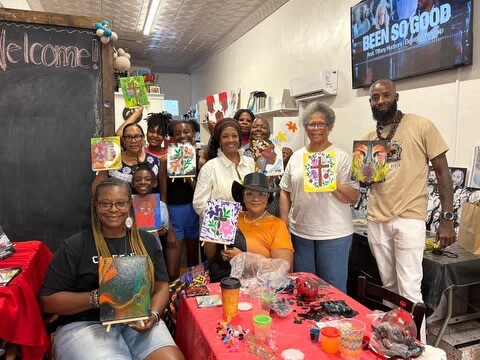
Buford said his mission is to help others find their own path toward healing — whatever form that takes.
“What I strive to do is guide this person to just create, man. Don’t care what people think about your creation, you just need to get it out,” Buford said. “Whether it’s with art, addressing your mental health, getting your life right — just do it.”
CBS 6 is committed to sharing community voices on this important topic. Email your thoughts to the CBS 6 Newsroom.
📲: CONNECT WITH US
Blue Sky | Facebook | Instagram | X | Threads | TikTok | YouTube

This story was initially reported by a journalist and has been converted to this platform with the assistance of AI. Our editorial team verifies all reporting on all platforms for fairness and accuracy. To learn more about how we use AI in our newsroom, click here.

Lovingston, VA (7News) — Good Morning Washington interviews Amanda Beckwith of Virginia Distillery Company- one of the contributing distilleries to the Virginia Spirits Board’s 250th Celebration Trio Pack, a special, exclusive release created to commemorate America’s upcoming 250th anniversary. This limited-edition package features a curated collection of a rum, a gin, and a whiskey, all crafted from scratch by distillers in Virginia to celebrate the rich history and current state of distilling within the Commonwealth.
Beckwith elaborates on VA Distillery Company’s role in the project, noting her focus on Virginia-grown grain to make the bottle of unique whiskey that is included in the Trio Pack. It is also worth noting that the Trio Packs themselves were bottled and produced right here at Virginia Distilling Company!
American single malts are the newest official category of American whiskey, distilled from one grain and from a single distillery. Virginia Distillery Co specializes in this new category of whiskey and crafted their contribution to the Trio Pack with this very specialty. Given the limited remaining availability of the Trio Pack, its historical value and collectible nature, the message it loud and clear encouraging viewers to grab a pack before they are all gone!
BE THE FIRST TO COMMENT
21+ Please drink responsibly, this content is sponsored by Virginia Distillery Company.


Powerball, Mega Millions jackpots: What to know in case you win
Here’s what to know in case you win the Powerball or Mega Millions jackpot.
Just the FAQs, USA TODAY
The Virginia Lottery offers multiple draw games for those aiming to win big.
Here’s a look at June 24, 2026, results for each game:
Powerball
Powerball drawings are held Monday, Wednesday and Saturday at 11 p.m.
13-14-16-21-38, Powerball: 14, Power Play: 2
Check Powerball payouts and previous drawings here.
Saturday, June 27, 2026
Pick 3
DAY drawing at 1:59 p.m. NIGHT drawing at 11 p.m. each day.
Night: 3-1-5, FB: 8
Day: 7-8-8, FB: 4
Check Pick 3 payouts and previous drawings here.
Pick 4
DAY drawing at 1:59 p.m. NIGHT drawing at 11 p.m. each day.
Night: 4-7-2-1, FB: 7
Day: 7-3-4-6, FB: 3
Check Pick 4 payouts and previous drawings here.
Pick 5
DAY drawing at 1:59 p.m. NIGHT drawing at 11 p.m. each day.
Night: 7-5-2-6-9, FB: 0
Day: 6-9-4-0-7, FB: 0
Check Pick 5 payouts and previous drawings here.
Cash Pop
Drawing times: Coffee Break 9 a.m.; Lunch Break 12 p.m.; Rush Hour 5 p.m.; Prime Time 9 p.m.; After Hours 11:59 p.m.
Coffee Break: 12
After Hours: 08
Prime Time: 13
Rush Hour: 01
Lunch Break: 14
Check Cash Pop payouts and previous drawings here.
Cash 5
Drawing every day at 11 p.m.
09-12-15-24-43
Check Cash 5 payouts and previous drawings here.
Bank a Million
Bank a Million draws are held every Wednesday and Saturday at 11 p.m.
18-21-25-33-36-39, Bonus: 13
Check Bank a Million payouts and previous drawings here.
Millionaire for Life
Drawing everyday at 11:15 p.m.
03-04-10-36-37, Bonus: 05
Check Millionaire for Life payouts and previous drawings here.
Feeling lucky? Explore the latest lottery news & results
This results page was generated automatically using information from TinBu and a template written and reviewed by a Center for Community Journalism (CCJ) editor. You can send feedback using this form.
-

 Iowa1 minute ago
Iowa City Regina baseball finds winning formula under new leadership
-
 Kansas4 minutes ago
Video shows disruption during Osawatomie City Council meeting with data center developer
-

 Kentucky9 minutes ago
Kentucky Lottery Cash Ball, Pick 3 Evening winning numbers for June 25, 2026
-

 Louisiana16 minutes ago
Guest Column: To win in manufacturing, the U.S. needs La. energy and improved permitting
-

 Maine19 minutes ago
High bacteria advisories reported at multiple Maine swimming spots
-

 Maryland24 minutes ago
Maryland governor vows special session to redraw congressional maps after election
-

 Michigan31 minutes ago
Michigan Recruiting Intel: Quarterback updates, notes on top targets
-

 Massachusetts34 minutes ago
Reed: Fight for tax relief is far from over

