South
Two Southwest flight attendants hurt after jet dives to avoid mid-air collision


WASHINGTON: Two flight attendants on a Southwest Airlines flight departing Burbank, California, were injured on Friday after pilots took evasive action to dodge another aircraft on takeoff, the airline said.
Southwest Flight 1496 sharply descended nearly 500 feet, according to flight tracking websites, marking the second time in a week that a US commercial jet was forced to make abrupt flight maneuvers to avoid a potential mid-air collision.
The incident also appeared to be the fourth involving military aircraft since March.
The airline and the Federal Aviation Administration said the Southwest pilots took action after receiving cockpit alerts of other aircraft traffic being dangerously close. The Southwest Boeing 737 continued on to Las Vegas, where it landed uneventfully.
Flight-tracking service Flightradar24 identified the other aircraft as a Hawker Hunter fighter jet – British-built aircraft – that crossed in front of the Southwest flight.
The planes came within 7.82km of each other laterally and 107m vertically. The US Air Force and Defense Department did not immediately respond to inquiries regarding the military jet’s presence near Burbank.
The FAA was investigating.
Two flight attendants were treated for injuries, the airline said, without providing detail.
No injuries were immediately reported by passengers, according to Southwest. But one passenger told Fox News Digital the sharp descent stirred panic onboard.
“It was terrifying. We really thought we were plummeting to a plane crash,” Caitlin Burdi said in an on-camera interview. After the incident, “the pilot came on (the intercom), and he told us we almost collided with another plane.”
According to a statement from Southwest, the incident began when its crew responded to “two onboard traffic alerts” while taking off from the Hollywood Burbank Airport north of Los Angeles, “requiring them to climb and descend to comply with the alerts.”
Three earlier close calls
In a separate incident one week ago, a SkyWest Airlines jet operating as a Delta Connection flight from Minneapolis reported taking evasive action to avoid a possible collision with a US Air Force bomber during a landing approach over North Dakota on July 18.
The FAA said on Monday it was investigating last Friday’s near-miss incident involving SkyWest Flight 3788, an Embraer ERJ-175 regional jet, which landed safely at Minot, North Dakota.
The Air Force confirmed a B-52 jet bomber assigned to Minot Air Force Base had conducted a ceremonial flyover of the North Dakota State Fair last Friday around the time of the SkyWest incident.
The Air Force said the bomber cockpit crew was in contact with local air traffic control before, during and after the flyover, and that the Minot International Airport control tower “did not advise of the inbound commercial aircraft” as the B-52 was departing the area.
The FAA has said that air traffic services were provided by the Minot air traffic control tower, which is run by a private company and not FAA employees.
The National Transportation Safety Board and FAA are investigating a March 28 close call involving a Delta Airbus A319 jet and a group of Air Force jets near Reagan Washington National Airport. The four Air Force T-38 Talons were heading to nearby Arlington National Cemetery for a flyover at the time.
There has been intense focus on military traffic near civilian airplanes since an Army helicopter collided with an American Airlines regional jet on January 29 near Reagan National, killing 67 people.
In early May, the FAA barred Army helicopter flights around the Pentagon after another near miss.



TV, kickoff times set for 2026 Delaware football schedule
Blue Hens with numerous national TV appearances in second Conference USA season
The all-important recruiting game is sped up now that Delaware is a Football Bowl Subdivision outfit as it heads into its second season in Conference USA.
With the start of preseason practice still a month away, Blue Hens coaches have been busy watching future prospects show their skills during on-campus camps as they attempt to build future rosters.
At least 15 Class of 2027 high school recruits have already verbally committed to accepting Delaware’s scholarship offer as of June 30, according to social media reports.
Recruits are not officially part of the UD program until December’s signing period.
That list includes four players from Delaware high schools – Cape Henlopen quarterback Jameson Tingle, Middletown linebacker Mekhi Corbin and offensive linemen Mario Castillo from Red Lion and Game Medico of Salesianum.
Delaware Class of 2027 commits
Douglass Callihan, 6-0, 215, LB, Gilmer/Ellijay, Georgia
Charles Carpenter-Simms, 6-2, 200, DB, Dexter Southfield/Brookline, Massachusetts
Mario Castillo, 6-6, 290, OL, Red Lion Christian Academy/Bear, Delaware
Mekhi Corbin, 6-1, 210, LB, Middletown/Middletown, Delaware
Austin Farrell, 6-3, 265, DL, Iona Prep, New York City
Kodi Gbanite, 6-3, 250, DT, Livingston/Livingston, New Jersey
Cooper Hodson, 6-3, 310, OL, Providence Day School/Charlotte, North Carolina
Chase Hyacinth, 6-4, 220, DE, Eagle Academy, New York City
Gabe Medico, 6-5, 260, OL, Salesianum/Wilmington, Delaware
Darius Smith, 6-1, 170, DB, Millbrook/Raleigh, North Carolina
Ronny Taylor, 5-11, 180, DB, Jenkins/Savannah, Georgia
Jameson Tingle, 6-2, 185, QB, Cape Henlopen/Lewes, Delaware
Aaron Truedell, 5-9, 170, RB, Lakeland Christian/Lakeland, Florida
Charles Williams, 5-10, 170, WR, Bamberg-Ehrhardt/Bamberg, South Carolina
Anthony Willis, 6-2, 180, WR, Bergen Catholic/Oradell, New Jersey
Contact Kevin Tresolini at ktresolini@delawareonline.com and follow on Twitter @kevintresolini. Support local journalism by subscribing to delawareonline.com and our DE Game Day newsletter.
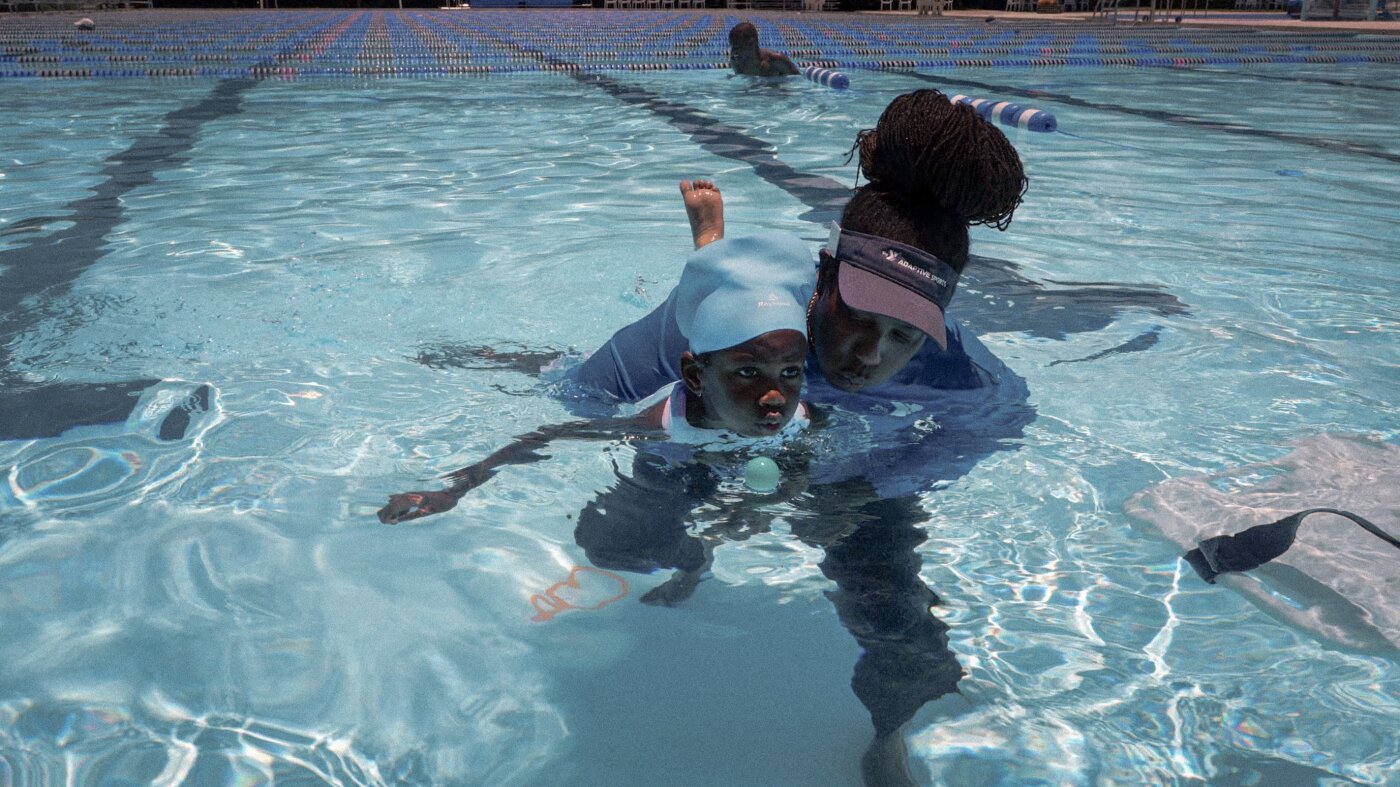
Garland Jones, recreational therapist and senior program director of the YMCA of South Florida’s special needs program, teaches Mackenzie Wesley, 5, to breathe safely in water by using a ping pong ball as a visual aid.
LA Johnson/NPR
hide caption
toggle caption
LA Johnson/NPR
WESTON, Fla. — Mackenzie Wesley sports a big grin and bright blue Lilo & Stitch swim gear as she runs into her weekly swim lessons. It’s fitting, because the 5-year-old has something in common with movie character Lilo: She adores water.
“Whether it’s the pool or beach, she enjoys it fully,” says her dad Steven Wesley.
Mackenzie isn’t alone: Many kids with autism share a natural love for water because it can be sensory bliss — the feeling on their skin, the pressure and the sparkle of the water can all be soothing. Lucky for her, Mackenzie lives here, less than an hour outside of Miami in a state that’s dotted with bodies of water.

But there’s a tragic reality tied to that fact, as Mackenzie’s mom, Brittany Bucknor, is all too aware. “In Florida, there’s water everywhere, and also with kids her age, and also just being on the spectrum, it’s a very — way higher — rate of having an incident of drowning.”
Kids with autism are 160 times more likely than other children to die from drowning, according to a seminal 2017 study from Columbia University. In fact, in Florida, most children drown in backyard pools. That’s largely because about half of autistic children have a tendency to wander from safe settings. That fact, combined with an attraction to water can make for a dangerous combination. Quality swim lessons can help.
That’s one of the reasons Mackenzie’s parents enrolled her in Swim Buddies, the YMCA of South Florida’s low-cost program aimed at children with disabilities. It’s also why the state of Florida, which has one of the highest childhood drowning rates in the nation, is expanding a voucher program on July 1 that will put children ages 1-7 who have autism at the front of the line for subsidized swim lessons. “We have tragic circumstances and stories across the state of Florida of young children with autism that are wandering away, they’re eloping from their homes, from their classrooms,” says Florida state Rep. Anna Eskamani, a Democrat, and one of the lawmakers who sponsored the bipartisan bill that changed the state’s swim vouchers.
“These [tragedies] are so preventable, but if that child at an early age does not have access to drowning prevention and swimming lessons, then those statistics will only continue.”
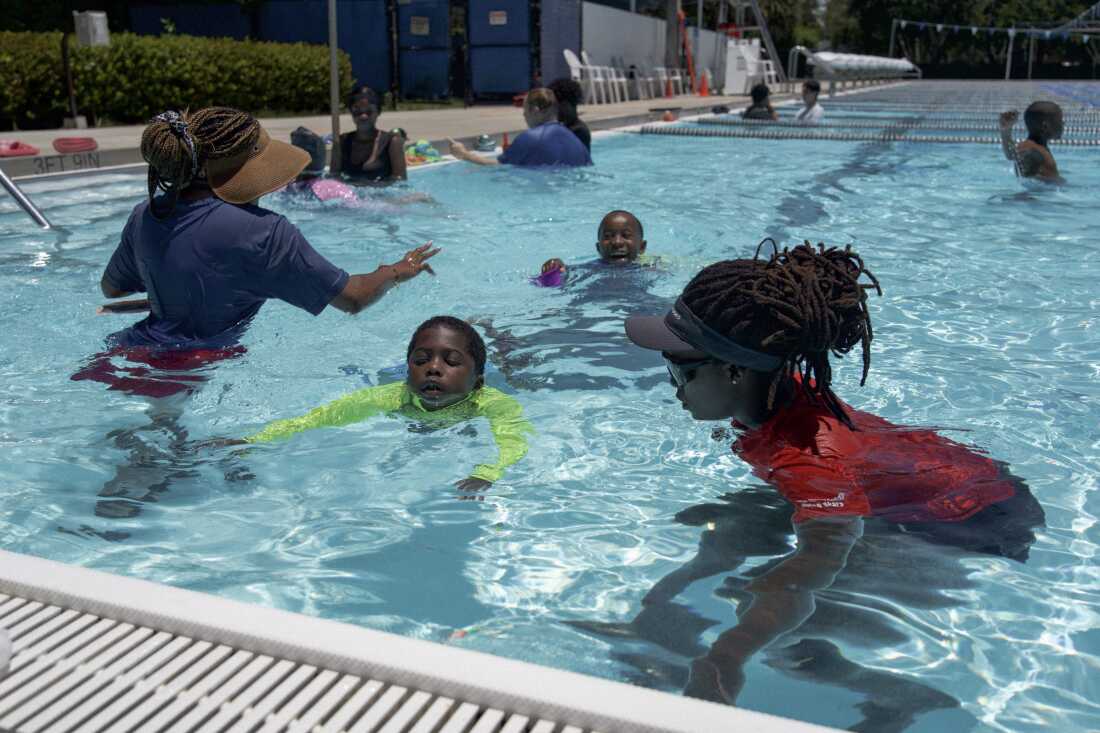
Recreational therapist Tiera Chaney works with Amir Williams, 6, during a recent Swim Buddies session.
LA Johnson/NPR
hide caption
toggle caption
LA Johnson/NPR
Once the updated law takes effect, many healthcare providers across the state will begin providing parents of newborns with information about drowning prevention and the state swim program, Eskamani says. Generally, the voucher comes out to about $200, she says, and pays for up to eight swim lessons.
A “whole-person” approach
The YMCA of South Florida has one of the largest adaptive recreational programs for kids with special needs in the area, including those with autism, who make up the fastest-growing group of children with disabilities. “We provide this program for those with a variety of disabilities, primarily over 60 percent of our youth who do come have a diagnosis of autism,” says Alison Bregman-Rodriguez, vice president of the YMCA of South Florida, where she oversees 64 locations, 27 of which serve children with learning differences. “This program, however, does serve all who want to feel like they belong.”
When Mackenzie’s parents learned that their local YMCA already had a robust and low-cost program for one-on-one instruction with kids with disabilities in mind, they jumped on the opportunity. “I really appreciate the program and specifically Miss Garland. She’s been very patient with Mackenzie and challenged her too,” Bucknor says.
She is referring to Garland Jones, who oversees the special needs recreational program here and also spends time working directly with swimmers, alongside other recreational therapists and trained volunteers. Jones agrees that patience is key in working with kids with disabilities, something that’s emphasized in the training for instructors. “We come at everything with a whole-person approach instead of just a physical approach. We do the physical, the emotional, the social.”

A selection of colorful, sparkly toys are often used for positive reinforcement and redirection in Swim Buddies lessons.
LA Johnson/NPR
hide caption
toggle caption
LA Johnson/NPR
The program’s hallmarks are individualization and one-on-one instruction rather than traditional group lessons. Staffers assess each child to learn about their needs and tailor their lessons in response. “We might have a kid who loves to get in the bathtub and splash around in the water or we might have a child who is very fearful of getting in the water,” Jones says.
On this recent summer Sunday, Tania Santiago Perez is sitting poolside, observing the Swim Buddies lessons. She is a professor at Florida International University who studies effective swim instruction for children with autism, including at this YMCA, with research partner and professor Tana Carson. Their research shows that when done right, swim instruction for kids with autism can help save lives. “The fact that we have been seeing that in five or six sessions they’re able to improve swim skills, to us, is very powerful,” Santiago Perez says.
Each lesson begins with group introductions to help swimmers build trust with the teachers and fellow participants in the pool. “That’s one thing to promote group cohesion and then the socialization with other kids,” says Santiago Perez. “Because with kids with autism, sometimes they’re very to themselves and that social behavior is one thing we want to develop.”
After the meet-and-greet, each child must wait to be explicitly told it’s safe to enter the water.

The adaptive swim lessons at the YMCA of South Florida serve more than 600 children with disabilities, but the program is overwhelmed with requests. Jones says she hopes the state will provide more funding to help facilities like theirs meet the need.
LA Johnson/NPR
hide caption
toggle caption
LA Johnson/NPR
Because many autistic children are prone to “eloping,” or running away suddenly, Santiago Perez says instructors are trained to stay no more than an arm’s length from each swimmer.
During one Swim Buddies session, a swimmer dashes out of the pool. “So the therapist is trying to redirect him back to get inside the pool,” says Santiago Perez as she points to the instructor gently but firmly guiding the child physically and with clear verbal commands.
Next, the instructor tries luring the child back into the pool with a sparkly pink rubber duck, which does the trick. “Toys help a lot because at the end of the day, they’re kids and kids learn by play and positive reinforcement,” Santiago Perez says.
In another corner of the pool, Garland Jones is working with Mackenzie Wesley on safe breathing techniques above the water because, in the past, putting her face under water has been uncomfortable and led to choking. Jones is using a bright blue ping pong ball in front of Mackenzie so she can see how her breath is physically moving the ball.
Once Mackenzie is eased in, Jones helps her practice blowing bubbles in the water, making a humming noise to show what it should sound like. “Hmmmm,” mimics Mackenzie. Then she ducks her head under water and pops back up, with a smile on her face. “Mackenzie has grown so much. I’m so proud of her,” says Jones, who’s been working with her in Swim Buddies for over a year. “We had a couple of instances where she was [swallowing] water a lot.” Now, she blows bubbles and goes under water like a pro.
Demand overwhelms supply of lessons
Parents looking on during Swim Buddies lessons have heard about the swim voucher program, and many were excited that it could make life-saving lessons affordable for lower-income families. “People who don’t have kids on the spectrum don’t take in mind that we’re paying a lot already for stuff like behavioral therapy, speech, occupational therapy,” says Augusto Sandino, whose son David has been in Swim Buddies for a year and a half. “All the programs, everything is money, man. So every little bit helps, and also, creating these inclusive communities is a big win.”
While Florida maintains a list of approved providers around the state, Jones and Santiago Perez both share the concern that many facilities lack enough qualified instructors. “You have people who are biters, spitters, who will scratch, things of that nature,” Jones says. “I just think we need more individuals who are trained in working with individuals with special needs so that they can be successful.”
The YMCA of South Florida is already overwhelmed with requests for its specialized swim lessons. Alison Bregman-Rodriguez, the vice president, says they do their best to find a spot for every child, but they don’t want to compromise the quality of lessons they provide. And while the voucher may increase demand, facilities like this often have to leverage other sources of money to keep programs like Swim Buddies afloat.

Researcher Tania Santiago Perez of Florida International University helped train some of the instructors at the Swim Buddies program. Her research has found that even after five or six quality lessons, most kids with autism showed improvement.
LA Johnson/NPR
hide caption
toggle caption
LA Johnson/NPR
Even before the new priority for children with autism, demand for swim lessons outstripped supply. “The problem is access,” says Santiago Perez. In the program’s first year, only about a third of families who applied for vouchers actually got them. She worries that the gap will only increase.
NPR reached out to the Florida Department of Health for details about how the changes to the swim program will work. They declined an interview and did not answer questions about how many vouchers would be available.
As Mackenzie Wesley’s swim lesson comes to an end, her parents wrap her in a towel and share that just a few weeks ago, she had a big milestone: She was invited to her very first pool party. “She was in the pool like she was a pro, an expert,” her mom says. “She had her little floatie and she was doing her own thing, so she’s been a lot more confident in the water and a way stronger swimmer for sure.”
This, says Garland Jones, is the kind of milestone that makes her work so rewarding. It means Mackenzie is on her way to having the skills that will allow her to embrace her natural love for water, and to do it safely.
Edited by: Nirvi Shah
Visual design and development by: LA Johnson

ALBANY, Ga. (WWSB) – A man on the run since a March murder in Bradenton has been arrested in Georgia, officials said.
Maurice McCary, 35, was located Tuesday in Albany, Georgia, nearly four months after fleeing the scene of a shooting on March 8 that left one man dead and another injured.
Following a tip, local law enforcement found him hiding under a bed before taking him into custody. McCary will be extradited to Manatee County to face charges.
On March 8, 27-year-old Jamari Murray-Barnes and 22-year-old De’Ryan Lopez were stopped at a traffic light at the intersection of U.S. 41 and 53rd Avenue West in Bradenton.
McCary allegedly pulled his vehicle alongside theirs and fired multiple shots into the car, fatally wounding Murray-Barnes and injuring Lopez.
Detectives believe the shooting stemmed from an altercation involving the men at a local bar two nights earlier.
Copyright 2026 WWSB. All rights reserved.
-

 Colorado5 minutes ago
Where to watch Miami Marlins vs Colorado Rockies: TV channel, start time, streaming for July 1
-

 Connecticut7 minutes ago
Lamont signs law in Norwich to stop pay to contractors violating wages
-

 Delaware13 minutes ago
Delaware has gotten these 15 verbal commitments from football recruits
-
Florida19 minutes ago
Kids with autism are prone to drowning. Florida is trying to prevent that
-

 Georgia22 minutes ago
Bradenton man wanted for murder is found hiding in Georgia
-

 Hawaii28 minutes ago
Few state bills this year face potential veto – West Hawaii Today
-

 Illinois38 minutes ago
West Suburban hospital sends permanent layoff notices to about 500 furloughed employees
-

 Indiana43 minutes ago
Extreme heat peaks before holiday weekend storms | July 1, 2026

