South
Toxic heavy metals detected in popular rice brands across America, study shows

NEWYou can now listen to Fox News articles!
Heavy toxic metals could be in the rice you’re about to buy at the grocery store.
Healthy Babies, Bright Futures, a nonprofit organization based in Washington, D.C., that seeks to reduce babies’ exposure to toxic chemicals, revealed that arsenic was found in 100% of the 145 rice samples purchased from stores throughout the United States.
“We found four toxic heavy metals in rice – arsenic, cadmium, lead and mercury,” according to the new report.
BROWN RICE FAR WORSE THAN WHITE RICE WHEN IT COMES TO TOXINS, STUDY FINDS
“While each contaminant has different health effects, they can contribute to serious risks like cancer, developmental harm including IQ loss and accumulation in the body over time,” the report said.
The study included 10 forms of grain and more than 100 brands from stores in 20 different U.S. metropolitan areas, from Seattle to Los Angeles and New York to Miami.
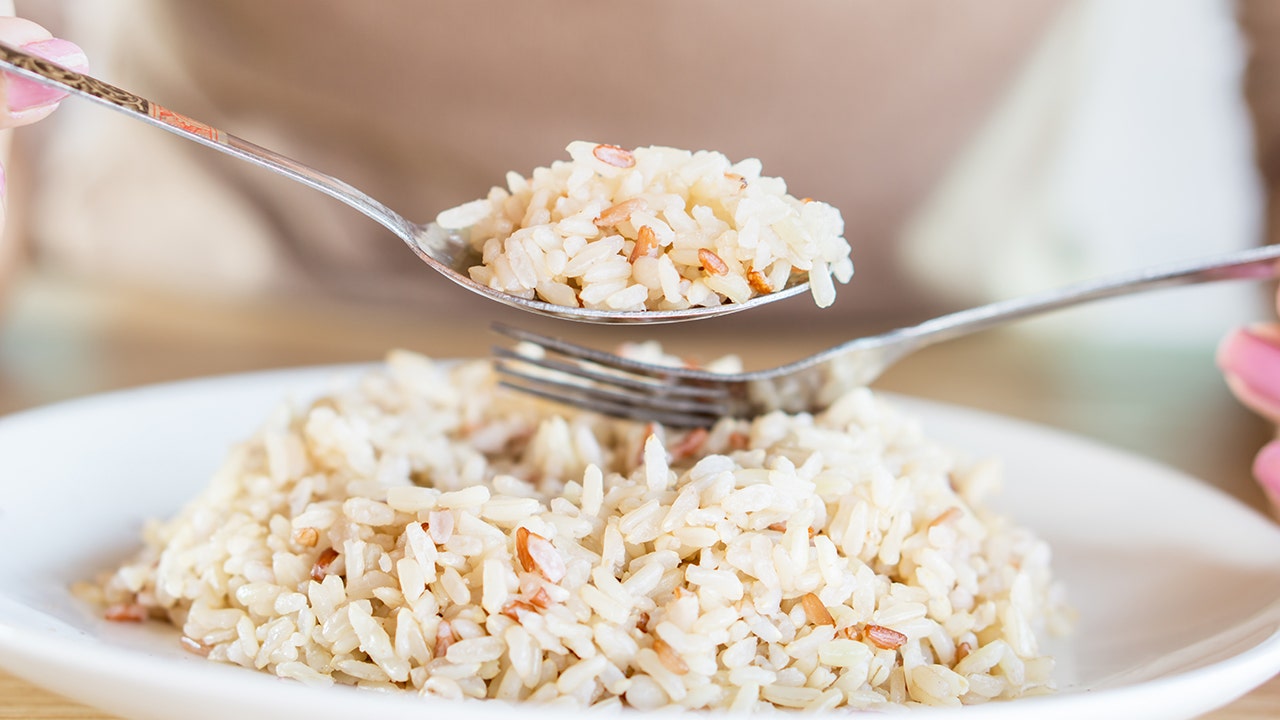
A new study revealed that arsenic was found in 100% of all rice samples purchased from stores throughout the country. (iStock)
“Arsenic was found at the highest levels, with cadmium next,” the report stated.
One in four rice samples exceeded the federal limit set for arsenic in infant rice cereal, according to the study.
“No such limit exists for rice itself – the bags and boxes of rice served at family meals – despite it being widely consumed by infants and toddlers,” the report said. “Additionally, cadmium was found in all but one sample, with some showing elevated levels.”
STUDENTS COOK ANCIENT RICE DISH BASED ON 2,000-YEAR-OLD MANUSCRIPT WITH SURPRISINGLY HEALTHY RESULTS
Long-term exposure to arsenic from food and water can cause cancer and skin lesions, according to the World Health Organization.
Michael Klein, a spokesperson for the USA Rice Federation, based in Arlington, Virginia, told Fox News Digital that American-grown rice “contains the lowest levels of inorganic arsenic in the world.”
“America’s rice farmers and rice companies are fully committed to providing wholesome, high-quality and nutritious food.”
“America’s rice farmers and rice companies are fully committed to providing wholesome, high-quality and nutritious food,” Klein said.
“We know that arsenic in food is alarming for many consumers and that you may have questions,” he said. “And while we do not agree that there is a public health safety issue as a result of trace amounts of arsenic in rice, we will continue to work with the U.S. Food and Drug Administration (FDA) to ensure the U.S. rice supply meets any threshold established.”
Brown rice grown in the southeast or labeled “grown in the USA” had the highest average levels of heavy metals, data from the study showed.
Brown rice grown in the southeast had the highest average levels of heavy metals, according to data from the study. (iStock)
White rice grown in the southeast showed consistently higher levels of heavy metals, primarily arsenic, than rice grown in California, the data revealed.
Thai jasmine rice and Indian basmati rice, as well as rice grown in California, generally contained lower heavy metal levels than other varieties tested.
CLICK HERE TO SIGN UP FOR OUR LIFESTYLE NEWSLETTER
However, basmati rice from India and arborio rice from Italy had the highest average cadmium levels, per the study.
Lead and mercury were found at the lowest levels, the study showed.
One in four rice samples tested exceeded the federal limit set for arsenic in infant rice cereal, according to the study. (iStock)
“The U.S. rice industry does not dispute that there is arsenic in rice,” Klein said. “Arsenic is found in virtually everything that grows in the ground.”
However, Klein called the data misleading — adding that every example highlighted in the new report is below the recommended guidance of the FDA.
Information provided by the FDA on its website specifies the permitted levels of heavy metals found in food.
For more Lifestyle articles, visit foxnews.com/lifestyle
As part of its “closer to zero” guidance, the FDA has a higher standard for processed foods intended for babies and young children.
“We hope families come away with simple, practical steps they can take right now to reduce exposure – like cooking rice in extra water and draining it, swapping in other grains like quinoa or barley and choosing lower-arsenic rice types such as California-grown, Thai jasmine or Indian basmati,” Healthy Babies, Bright Futures research director Jane Houlihan told Fox News Digital.
CLICK HERE TO GET THE FOX NEWS APP
“We’re also urging the FDA to set enforceable limits on arsenic in all rice, not just baby cereal, to better protect children and families across the country.”



When Charleston residents and visitors opened their weather app over Fourth of July weekend, the first numbers they saw didn’t tell the whole story.
While meteorologists predicted a high of 94 degrees on Independence Day, the heat index, known as the “feels like” temperature, was projected to exceed 100. That’s what forecasters use to determine the actual heat risk and to issue advisories, watches and warnings.
The heat index is what stepping outside actually feels like to the human body when the temperature and humidity are combined. In Charleston, bouts of extreme heat indexes are hotter and longer than the region previously experienced.
Between 1979 and 2023, Charleston saw an increase of 19 days annually with a heat index over 80 degrees, according to Climate Central.
The National Weather Service office in Charleston uses the heat index to decide when to issue extreme heat warnings, watches and advisories. The determination is made from records maintained by the S.C. Department of Public Health, as well as the equivalent agency in Georgia, regarding EMS calls for heat-related emergencies.
The days with the highest number of calls were compared to conditions such as daily temperature and heat index. There were several cases where call volumes for heat-related illness were high, despite the heat index sitting below the advisory threshold at the time. Ultimately, the National Weather Service office lowered the requirements for a heat advisory to be issued.
Today, heat alerts fall into one of three categories:
-
Heat Advisory: Issued when the heat index is between 108 and 112 degrees for at least two hours. During this time, people are encouraged to reschedule outdoor activities during the heat of the day. If being outside is necessary, people are encouraged to stay in the shade and drink lots of water.
-
Extreme Heat Watch: Issued when the heat index is 113 degrees or higher for 24 to 72 hours. When this alert is issued, people should adjust their outdoor plans. In this case, the conditions for an extreme heat event are all there, but the timing and exact outcome are uncertain.
-
Extreme Heat Warning: Issued when the heat index exceeds 113 degrees for at least two hours.
When this alert is issued, people should avoid outdoor activities during the heat of the day and stay in air conditioned spaces as much as possible.
In South Carolina, heat-related emergency room visits tend to peak during July. The most-recent data available from the state Department of Public Health indicates that Charleston County saw 713 emergency department visits for heat-related illness in July 2024.
Those most at risk, according to the state, are construction workers and landscapers, followed by postal carriers, recreation workers, farmers and lifeguards, among others.
Meteorologists expect a hot summer this year, as an “extremely strong” El Niño has formed in the Pacific Ocean. The global weather phenomenon is known to cause wetter conditions and a less-active hurricane season in the Southeast, as well as higher temperatures.
Climate scientists fear that the El Niño could thrust the world over the 1.5 degree Celsius, or 2.7 degree Fahrenheit, threshold of increased global surface temperatures above pre-industrial levels. Numerous scientific and political documents use that threshold when considering the turning point for climate change’s most intense and potentially irreversible impacts.

Our audio player uses an automated voice, which may mispronounce words and names or fail to reflect the tone of an article.
`;
container.style.display = ‘block’;
const toggleBtn = document.getElementById(‘btn_toggle_audionative’);
toggleBtn.addEventListener(‘click’, e => {
e.preventDefault();
container.style.display = container.style.display === ‘none’ ? ‘block’ : ‘none’;
});
if (toggleBtn) toggleBtn.style.display = ‘flex’;
const script = document.createElement(‘script’);
script.src=”https://elevenlabs.io/player/audioNativeHelper.js”;
script.type=”text/javascript”;
document.body.appendChild(script);
}
loadWidget();
In partnership with
Nashville Banner
The Nashville Banner is a nonprofit digital newspaper in Nashville, Tennessee.
The protocol that took effect in 2025 sheds new light on Tony Carruthers’ botched execution, when Dr. Mark Fowler spent nearly an hour trying, and failing, to place a secondary IV line.

WASHINGTON — On the fourth anniversary of the Dobbs v. Jackson decision, which overturned the constitutional right to abortion, Samantha Casiano carried a picture of her daughter, Halo, with her to meetings on Capitol Hill.
The photo showed Halo without a fully formed skull and brain, leading to her death four hours after she was born. Casiano’s OB-GYN had told her 20 weeks into her pregnancy that the defect was “incompatible with life,” but while Casiano said she could see her doctor wanted to help her end the pregnancy, she also saw the physician’s hands were tied by the life imprisonment Texas doctors can face for providing abortions under the state’s laws.
“She had to choose between her life and mine,” Casiano said.
Casiano was one of several women who traveled to Washington last month with Free & Just, a national nonprofit formed after the 2022 Supreme Court ruling that upended abortion access across the country, to speak with federal lawmakers as part of their “Abortion Stories on the Hill” campaign. It was the second June in a row in which women, like Casiano, trekked with Free & Just to the Capitol to relive some of their worst moments in an effort to explain to lawmakers how abortion restrictions delayed their medical care or forced them to carry a nonviable baby to term — an experience Casiano described as watching her daughter “suffocate.”
“I was more prepared this time,” Casiano said, comparing her first visit to Washington, in 2025, to a practice run. “I made sure to look the staffers in their eyes and let them know who I was.”
But not everyone was receptive to the message. After Casiano shared Halo’s story and photo with a staffer for her congressman, U.S. Rep. Morgan Luttrell, R-Magnolia, she was told the office is “pro-life” and escorted out minutes after.
“It was a slap in the face,” she said. “I really wish that [the staffer] would have taken a deep breath with me.”
Despite their annual visits to the Hill and efforts to share their stories with lawmakers, abortion advocates have struggled to break through in a Congress that, since Dobbs, has lacked the numbers to roll back state bans or otherwise loosen restrictions.
Rather, some GOP lawmakers say they want to further clamp down on abortion by targeting pills like mifepristone, which now account for nearly two‑thirds of abortions nationwide. In Texas, telehealth makes up virtually all abortion care that still happens within state law, according to recent estimates.
U.S. Rep. Beth Van Duyne, R-Irving, said advocates’ warnings about the effects of abortion bans were overblown and intended to “scare the shit out of people.” And she criticized federal rules that allow abortion medication to be prescribed virtually and mailed to patients.
“What you saw with Dobbs was the same scare tactics we always hear from Democrats about what Republicans are going to do, and history has proven them wrong once again,” Van Duyne said, adding that she still sees work to be done in scrapping federal policies allowing drugs like mifepristone “that actually kill a baby.”
Abortion and the campaign trail
Advocates like Casiano are also confronting the reality that, at least in Texas, abortion access is not top of mind for voters. In a recent Texas Politics Project poll, just 2% of voters named abortion as the most important problem facing the state, with inflation and the economy and a host of other issues ranking higher.
That disconnect is something Kaitlyn Kash, an Austin mom who joined a 2023 lawsuit challenging Texas’ narrow medical exceptions to its abortion bans, says she thinks about when she talks to Texans about her own experience.
Kash, who has spent the last three Dobbs anniversaries on the Hill, said she tries to be careful when speaking about abortion and reframes it as a broader fight over access to reproductive healthcare — and as an issue that’s interwoven with the economy, people’s families and their freedoms.
“You can have more than one issue. I don’t think people understand that you’re not voting about abortion, you’re voting for reproductive healthcare because they’re all interrelated,” Kash said. “It’s a continuum of care, and doctors need the ability to be able to give you that care.”

Raven E. Freeborn, a former abortion doula and president of Avow, a Texas-based abortion-rights organization, said she doesn’t see abortion as separate from voters’ pocketbook worries.
“Abortion rights and access are vital to affordability,” she said. “Not being able to access abortion when you need it, that’s an economic justice issue. You’ll likely miss work, so you’re going to lose wages. Economic justice, affordability, reproductive justice, and abortion access are all living inside the same constellation.”
While Casiano, Kash and others have failed to move the needle on Capitol Hill, their stories, along with the deaths of Texas women due to delayed treatment, have helped generate changes at the state level. Last year, Texas lawmakers passed Senate Bill 31, dubbed the Life of the Mother Act, a measure that directs doctors to use “reasonable medical judgment” in medical emergencies involving a patient’s life or serious harm. The law says a medical crisis need not be “imminent” before healthcare providers can act, and that a doctor can only be charged if the state can prove “no reasonable doctor” would have made the same call.
But some advocates say that has not helped when it matters. Texas Equal Access Fund, an abortion access advocacy group, has called SB 31 a “fake fix,” arguing it adds legal red tape for physicians without resolving the gray area around the ban’s exceptions, still leaving pregnant patients in medical limbo.
Additionally, two Austin-area emergency rooms were the subject of a recent federal complaint from a woman alleging she was denied miscarriage care, even with the new clarifying language on the books.
John Seago, president of Texas Right to Life, an anti-abortion group that helped craft Texas’ abortion bans and SB 31, said he sees the remaining problems not as flaws in the statutes but as failures in how hospitals and attorneys are applying them. That was the impetus, he explained, behind the new law’s requirement for the Texas Medical Board to create training for doctors who perform obstetrics care.
“We passed Senate Bill 31 last session to require education of physicians on this topic, because we want the message to be very clear that whenever there’s a serious situation like an ectopic pregnancy or miscarriage, there is no hesitation, that doctors are supposed to serve those women and help them immediately,” he said. “[If] the attorney at the hospital misrepresented the law, that’s just malpractice.”

Freeborn pushed back, describing abortion as more than an emergency moment, but also as “healthcare, a political bargaining chip and a moral clause.”
“These doctors are wrestling with everything that’s in the room with them about a healthcare procedure — stigma, shame, disinformation — and that is not true of other medical care,” Freeborn said. “Birthing people are navigating their reproductive realities, and their ability to have bodily autonomy and govern over themselves is often in question by way of their relationship to something else.”
Some research has found that Texas’ abortion restrictions are linked to worsening mental health among reproductive‑age women. A study of more than 15,000 Texas women found that reports of “frequent mental distress” rose significantly after the state in 2021 banned most abortions after about six weeks.
Cracking down on abortion pills
Meanwhile, Seago’s group and other anti-abortion advocates have been moving to restrict the flow of abortion drugs to states like Texas where the procedure is banned. The Texas GOP, for example, listed “protect life” as one of its eight legislative priorities at last month’s convention, a plank that includes a call for “strong criminal penalties and new enforcement tools to fight abortion and abortion pill trafficking.”
In a letter signed last week by more than 80 anti-abortion groups, advocates urged Acting Attorney General Todd Blanche to settle a lawsuit challenging the Food and Drug Administration’s Biden-era policy allowing mail delivery of mifepristone.
“Pro-life states cannot enforce their laws while an FDA regulation gives cover to mail-order abortionists and DOJ defends the profits of abortion drug manufacturers,” the letter said.
Texas Attorney General Ken Paxton has filed two civil suits since 2024 against out‑of‑state providers he says illegally mailed abortion pills to Texans.
In a statement marking the four-year anniversary of Dobbs, Jonathan Saenz, president of the conservative advocacy group Texas Values, celebrated that Texas “has been a beacon of life” since the decision, while calling for action on drugs like mifepristone.
“As the state where Roe v. Wade originated, Texans have a deep and personal stake in never going back to that deadly time period,” said Saenz, one of the signatories on the letter to Blanche. “Sadly, illegal mail order abortion pills are still being sent into Texas and we must continue working hard to protect moms and babies from this type of exploitation.”
Abortion advocates like Kate Cox say lawmakers should focus instead on Texas’ post-Dobbs medical landscape. The Dallas mother, who traveled to New Mexico to terminate her pregnancy in 2023 after her fetus was diagnosed with a genetic condition that’s almost always fatal, said she is concerned that the state’s severe abortion penalties, even with SB 31, will push OB‑GYNs to practice in other states and make Texas a less attractive place for top medical talent.

“I think new OB-GYNs coming out of school look at the situation, and they don’t want to come practice in Texas, where they would have to navigate what would be a very different situation in other states,” said Cox, the first adult woman to seek a court’s permission to have an abortion post-Dobbs. “I was in the emergency room four times, and I asked my doctor, ‘If I choose not to continue the pregnancy, can I make that decision?’ And she said, ‘Not in Texas.’ I think that puts them in a very difficult spot.”
That’s why Cox wants lawmakers to focus less on prescribing what doctors can do and more on recognizing the volatile realities of pregnancy.
“Every pregnancy is different. Some bring joy, some bring heartbreak, and some bring medical emergencies,” Cox said. “The Legislature can write a law that covers every possibility with compassion. And the more we learn about pregnancy, the more we realize how unpredictable it can be. Instead of trying to legislate every scenario, we should trust families and the physicians that are caring for them.”
Source link
-

 Rhode Island3 minutes ago
New bilingual school blocked from opening under R.I.’s new charter school ban – The Boston Globe
-

 South-Carolina6 minutes ago
What triggers a heat advisory in South Carolina?
-

 South Dakota11 minutes ago
Water hampers growth near Sioux Falls but solution near
-
Tennessee18 minutes ago
Tennessee reduced training in IV placement in new lethal injection protocol
-
Texas21 minutes ago
Texas abortion stories fail to sway Congress post-Dobbs
-

 Utah26 minutes ago
Chicago breaks Utah’s 10-game unbeaten streak – Equalizer Soccer
-
 Vermont33 minutes ago
The Velomont bike trail is getting more accessible – one trail at a time
-
.jpg?w=400&resize=400,240&ssl=1 "On Virginia’s Crooked Road, the Hills Are Alive—With Bluegrass, Old-Time, and Country Jams")
.jpg?w=80&resize=80,80&ssl=1 "On Virginia’s Crooked Road, the Hills Are Alive—With Bluegrass, Old-Time, and Country Jams") Virginia36 minutes ago
Virginia36 minutes agoOn Virginia’s Crooked Road, the Hills Are Alive—With Bluegrass, Old-Time, and Country Jams

