South-Carolina
In South Carolina, measles shows how far apart neighbors can be on vaccines


Kate Morrow and her 8-year-old twins, Jack and Lilly, at their home in Spartanburg County, S.C. Morrow struggles to understand why many of her neighbors haven’t vaccinated their kids.
Mike Belleme for NPR
hide caption
toggle caption
Mike Belleme for NPR
When Kate Morrow gave birth to twins eight years ago, they were very premature, with compromised immune systems.
“We counted on the community to keep our children safe,” Morrow says. She trusted that her neighbors were vaccinating their children to protect other vulnerable people in her community — including her twins. But that’s no longer the case.
Morrow and her family moved to Spartanburg County, S.C., in 2019. The area is the epicenter of the biggest measles outbreak in the U.S. in more than three decades, with nearly 1,000 confirmed cases. Measles — one of the world’s most contagious diseases — was declared eliminated in the U.S. in 2000, thanks to widespread vaccination and school vaccine requirements.
But with the current resurgence of measles, the country is at risk of losing that elimination status.

In Spartanburg County, school vaccination rates have fallen to just under 89% — well below the 95% threshold needed to prevent community outbreaks.
And it’s not just Spartanburg. There are places around the country where vaccination rates have sunk to levels low enough to allow outbreaks to flare, says Michael Osterholm, director of the University of Minnesota’s Center for Infectious Disease Research and Policy.
“There are a lot more South Carolinas waiting to happen,” he says.

Spartanburg County is the epicenter of the largest measles outbreak in the U.S. in decades.
Mike Belleme for NPR
hide caption
toggle caption
Mike Belleme for NPR
Morrow says it’s hard for her to understand why so many parents in her community are turning against vaccines.
“How did we get here?” she asks. “How did we get to a place where we don’t trust our doctors to do the very best thing for our children? How did we get to a place where vaccinations have become political?”
The answer is a mix of widespread misinformation, lingering resentment over COVID mandates, and politicians at the local and national level who are sowing mistrust of vaccines.
‘I don’t trust anything anymore’
Margarita DeLuca says she didn’t give much thought to vaccines until COVID hit. She has three children and lives in neighboring Greenville County. When the COVID vaccine was first rolled out, DeLuca was scared that it had been developed too quickly to be trustworthy, and she was opposed to vaccine mandates.
“I think it should have been a choice. It shouldn’t have been shoved down your throat like you have to do it,” DeLuca says.
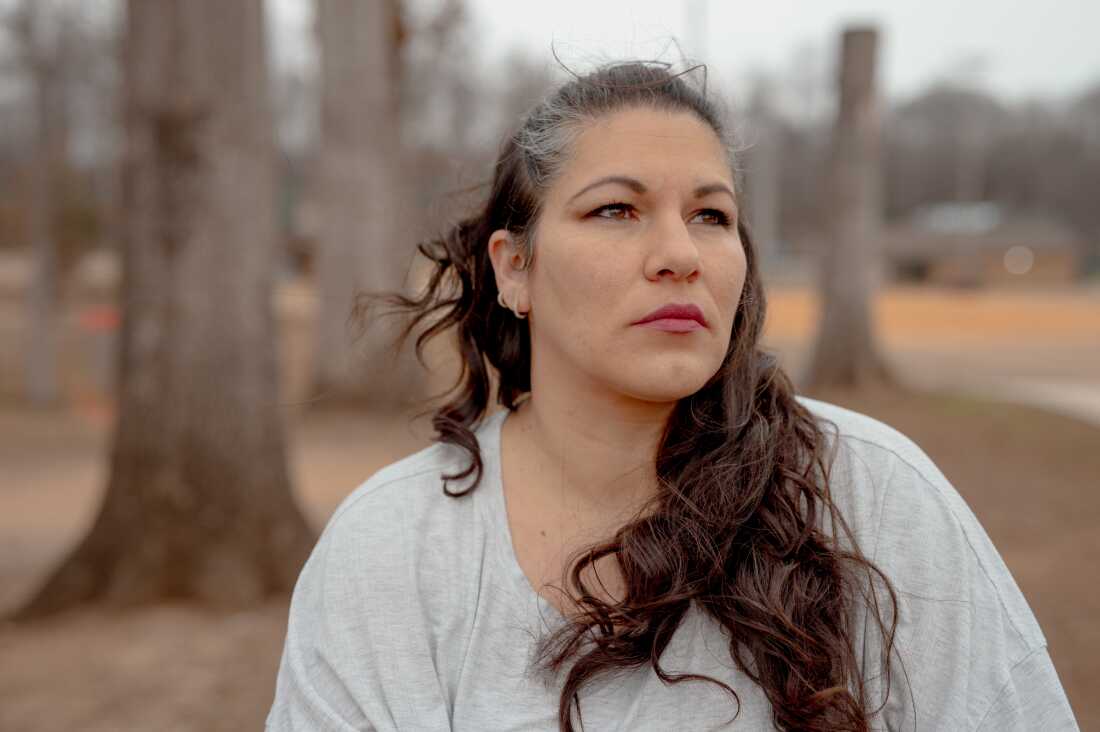
Margarita DeLuca’s eldest child got all his routine vaccinations until his 2-year-old shots. After he developed a fever and had a seizure, DeLuca worried the vaccines were to blame.
Mike Belleme for NPR
hide caption
toggle caption
Mike Belleme for NPR
DeLuca is not alone. Resentment over vaccine mandates and other public health measures during the pandemic prompted more parents to question vaccine requirements, says Dr. Martha Edwards, president of the South Carolina chapter of the American Academy of Pediatrics.
“COVID hit and people really didn’t like the mandates and that was a big boiling point,” Edwards says. “And in South Carolina, that really has caused a lot of people to escalate their feelings of ‘don’t tell me what to do.’ “
Still, when DeLuca’s eldest child, Nikko, was born in the summer of 2021, she got him his routine shots for the first couple of years of his life.
But about a week after he got his 2-year-old vaccinations, Nikko spiked a fever and experienced a seizure.
“He froze up and then he started convulsing right in my arms — the scariest thing ever,” DeLuca recalls.
Nikko recovered. Her pediatrician at the time told her these seizures can happen when toddlers get high fevers, and it’s unlikely vaccines played a role. But DeLuca remains dubious.
“He hasn’t had any seizures since. But he hasn’t had any vaccines either. I’m not saying it’s from that, but there is a chance,” she says.
So, like a growing number of parents nationwide, DeLuca decided to forgo vaccinations for Nikko, now 4, and his twin infant siblings.
“I’m grateful that I did not vaccinate them right now,” she says. “Maybe at 5 years old, their bodies are bigger and they have a higher immune system. They can handle things.”
Local pediatrician Stuart Simko with Prisma Health in Greer, S.C., says he hears this from other parents. And he tries to explain why delaying vaccinations is risky.
“This is the time where your child is at a higher risk, the younger they are, for complications from many of the things that we vaccinate against,” he says.

For instance, the measles, mumps and rubella, or MMR, vaccine can prevent serious complications from measles like brain swelling and pneumonia, both of which have been documented among children in this outbreak. Vaccines can also prevent immune amnesia, a phenomenon where the virus wipes out parts of the immune system, leaving kids vulnerable to new infections for several years.
And the virus can be deadly. Before the first vaccines were developed in the 1960s measles used to kill hundreds of U.S. children every year.
Simko says he tries not to judge parents but to listen to their fears.
“The parent who’s choosing not to vaccinate their child, they’re not trying to make a bad medical decision. They want what’s best for their child. And we have to understand where they’re coming from,” he says.
Social media is a big problem. Many of Simko’s patients are overwhelmed by information; some of it is good, he says and some is just not backed by science.
DeLuca says she no longer knows what to believe when it comes to online information.
“I don’t trust anything anymore. I really don’t.”
Exemptions rise, vaccination rates fall
Spartanburg County is a solidly conservative part of South Carolina. Dotted with small towns, its sprawling countryside is home to rural communities, conservative faith groups and a sizable Slavic immigrant population. All of these groups tend to have lower vaccination rates across the U.S.

A neighborhood in Spartanburg County, S.C. It’s a solidly conservative area dotted with small towns.
Mike Belleme for NPR
hide caption
toggle caption
Mike Belleme for NPR
In the majority of states, parents can apply for nonmedical exemptions to required vaccines for religious, personal or philosophical reasons. In Spartanburg County, the use of religious exemptions has skyrocketed since the pandemic. Today, nearly 10% of students in the county have a religious exemption — up from 3.4% at the start of the 2020-21 school year.
The result is that vaccination rates among school children are dropping. The majority of schools in Spartanburg County now have vaccination rates below the 95% threshold required to prevent measles outbreaks. In one public charter school — which has seen dozens of students quarantined for measles — the vaccination rate is a shockingly low 21%.
Republican state Sen. Josh Kimbrell, a lifelong Spartanburg resident, says he understands why parents have grown more skeptical of vaccines in the wake of what he calls the government’s “overbearing” response to COVID. But he says the distrust has gotten “out of control.”

The exemptions have become easy to obtain — parents can download a form and they don’t have to state their religious reasoning. All they have to do is get it notarized.
“I know people who haven’t set foot in a church in five years who suddenly decide it’s a religious liberty exemption and don’t have a religious reason,” Kimbrell says. “They just don’t want to do it. And that’s fine but just say that.”
Public health researchers say eliminating nonmedical exemptions to vaccine requirements could help raise falling vaccination rates. But in South Carolina, where opposition to government mandates is firmly entrenched, that’s unlikely to happen. Last week, the state legislature shot down a bill that would have kept unvaccinated children out of schools.
And it’s not just South Carolina. A recent study found the rate of nonmedical exemptions to vaccines has risen steadily in the majority of U.S. counties, and this trend has accelerated since the pandemic.
Parents changing their minds
Gene Zakharov is one of those Spartanburg parents who got religious exemptions for his children. He owns a cafe, 121 Coffee, in sight of Emmanuel Church where he’s an active member of the leadership team.

Gene Zakharov is part of a large Slavic community in Spartanburg County, S.C. He initially decided not to vaccinate his two youngest kids, but changed his mind as measles started to spread.
Mike Belleme for NPR
hide caption
toggle caption
Mike Belleme for NPR
Zakharov is part of the large Slavic community drawn to Spartanburg by its conservative politics and sunshine. He says many people from the former Soviet Union who settled here “don’t believe in vaccines.”
“People who lived there have a big distrust in the government, to say the least,” he says.
He and his wife didn’t vaccinate their two youngest children. They worried about potential side effects from vaccines. But they changed their minds after their 13-year-old daughter was exposed to measles at a friend’s house and spent time in quarantine.
“It doesn’t hit you until you actually come in contact with something like this. You’re like, well, thank God my kid is all right. But you know, what if she wasn’t?”

Zakharov is not the only parent questioning earlier decisions. As the measles outbreak exploded in January, pediatrician Stuart Simko says his phone started ringing.
“I’ve had several patients who’ve said no to vaccinations in the past who’ve said, ‘Hey, what do you think of the MMR?’ ” he says. “What do you think about measles? It’s in our backyard.”
He explains how dangerous the measles virus can be. And “a lot of people are changing their minds,” Simko says.
Combatting myths and fears
Tracy Hobbs changed her mind recently.
Last month Hobbs brought her 5-year-old twins, Joseph and Alice, to a mobile vaccine clinic to get their first dose of the measles, mumps and rubella vaccine. The twins should have gotten their first shots around 12 months of age, but Hobbs decided against it at the time. That’s because her oldest child, now 7, was diagnosed with autism shortly after he got his first measles vaccine.
Hobbs says she saw conflicting information about whether the vaccines were to blame.
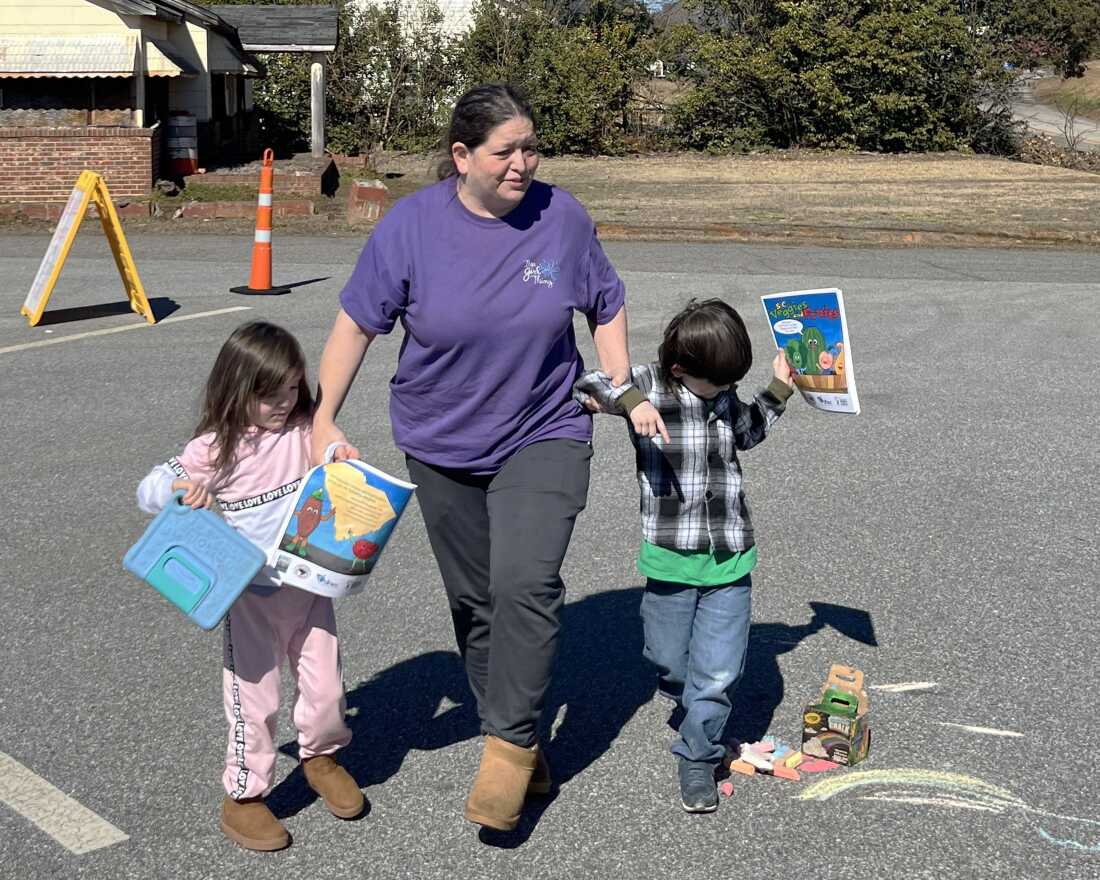
Tracy Hobbs brought her 5-year-old twins to a mobile clinic to get their measles, mumps and rubella vaccines. She was reluctant to vaccinate her kids because of misinformation, but changed her mind. The measles isn’t something to play with, Hobbs said.
Rebecca Davis for NPR
hide caption
toggle caption
Rebecca Davis for NPR
“We were afraid that if we had gotten the kids the vaccines, that it might actually cause autism,” Hobbs says. “And that’s really messed us up because what are you supposed to believe?”
Claims linking the vaccine to autism stem from a 1998 study that has been thoroughly debunked by a large body of research, but this misinformation still circulates widely. Health Secretary Robert F. Kennedy Jr. has long promoted the discredited claim and he recently directed the Centers for Disease Control and Prevention to change its website to say the link can not be ruled out. Hobbs says all the conflicting information out there is confusing.
“You have one person saying, hey, this could cause the kid to get autism. And then you have somebody saying, no. I’ve gotten conflicting information since the day they were born,” she says.
But when her twins were also diagnosed with autism, even though they weren’t vaccinated, Hobbs changed her mind. With measles spreading rapidly around her, she decided to get them the shot. “The measles aren’t really something to play with,” Hobbs says.
‘Not an outlier’
Spartanburg mom Kate Morrow says it pains her to know this kind of misinformation about vaccines and autism still circulates. One of her twins has autism. Both are fully vaccinated.
She wants to encourage parents to trust the science and to speak openly with their pediatrician about their fears.
She feels so strongly about this that she’s helping a pro-vaccine advocacy group called South Carolina Families for Vaccines get off the ground. “I’m rooting for the mom in the middle that’s feeling lost and scared and doesn’t really know what to do,” Morrow says.
There’s some evidence that outreach efforts are working. State epidemiologist Linda Bell says vaccination rates in Spartanburg County were up by 133% in February compared to the previous year. And new measles cases have slowed significantly.
But the danger hasn’t disappeared altogether, says Scott Thorpe, executive director of the Southern Alliance for Public Health Leadership.
“I think what keeps me up at night more than anything else is that Spartanburg is not an outlier,” he says. He notes that just across the border in western North Carolina, there are lots of counties with lower vaccination rates. “And we’ve already started to see some cases there.”
Across the U.S., there have been 12 new measles outbreaks so far this year, and more than 1,280 confirmed cases, according to the CDC.
“It’s just kind of percolating in all these places,” Thorpe says. “And eventually it’s going to catch on and turn into a big outbreak, just like Spartanburg. And it’s just going to keep on happening as vaccination rates get lower.”
This story was edited by Jane Greenhalgh and Carmel Wroth



Video of SCHSL 5A Division 1 Upper State track and field championships
Here’s video of some of the action from the SCHSL Class 5A Division 1 Upper State boys and girls track and field championships held May 8 at Dorman.
Riley Vaughn of Spartanburg girls Track and Field was named the 2025-26 South Carolina girls Gatorade Player of the Year.
Vaughn won the shot put and discus events at the Class 5A-D1 state championships. She nailed a 13.1 meters on the shot and 41.77 meters on the discus. Her 14.41 in the shot at the region meet was the state’s best for 2026.
The 5-foot-10 junior helped lead Spartaburg to a fifth-place team finish. Vaughn had also competed on the national stage after taking third place in the shot put event at the Under Armour Nationals.
“Unbeaten in the discus throw on home state soil this year, Vaughn achieved success in both throws, but really sparkled in the shot put circle,” PrepCalTrack editor, Rich Gonzalez, said. “Her season-best there was the state’s top mark in the event in seven years and moved her to No. 4 on South Carolina’s all-time list.”
Vaughn is now part of an elite group of athletes who have won the prestigious award, including four-time Olympic gold medalist Sydney McLaughlin, five-time Olympic medalist Sanya Richards, and 11-time Olympic medalist Allyson Felix.
Vaughn was also named to the Greenville News’ All-Upstate First Team in girls’ Track and Field for the second consecutive season.
Kamryn Jackson covers high school and college sports for the Spartanburg Herald-Journal, Greenville News, Anderson Independent Mail, and the USA TODAY Network. Please email her at KEJackson@gannett.com and follow her on X @KamxJack (formerly Twitter).


COLUMBIA, S.C. (WIS) – With the primary season concluded, South Carolina’s gubernatorial race is coming into focus, marking the first time in nearly a decade that Gov. Henry McMaster will not appear on the ballot.
Republican Attorney General Alan Wilson and Democratic state Rep. Jermaine Johnson have secured their parties’ nominations and will face off in November as they begin shifting their campaigns toward the general election.
Wilson, a Lexington native and combat veteran, has served as the state’s attorney general since 2011. He is campaigning on a platform focused on tax reform, government transparency, and affordability, including a proposal to eliminate the state income tax.
“I think it signals to us that our message of talking about the people of South Carolina and our message of hope … resonated with the voters,” Wilson said, referencing his primary victory.
Johnson, who has represented Richland County in the South Carolina House since 2021 and lives in Hopkins, is centering his campaign on what he calls a need for change and new leadership. He is seeking to become the state’s first Democratic governor since the late 1990s.
“People are just angry … because their lives just aren’t getting any better,” Johnson said. “If we elect the same type of leadership, we will get the same type of result.”
Johnson pointed to Republican primary results, including the defeat of the sitting lieutenant governor in the GOP runoff, as evidence that voters are open to change.
Wilson has selected state Sen. Mike Reichenbach of Florence County as his running mate, saying Reichenbach would spearhead an effort to audit state agencies if elected.
Johnson has not yet announced a lieutenant governor candidate but said he expects to do so within the next month.
Feel more informed, prepared, and connected with WIS. For more free content like this, subscribe to our email newsletter, and download our apps. Have feedback that can help us improve? Click here.
Copyright 2026 WIS. All rights reserved.
-

 Los Angeles, Ca53 minutes ago
Jury says it is deadlocked in trial of man accused in Palisades Fire
-

 Detroit, MI1 hour ago
Scene active as police shoot, kill man on Detroit’s west side
-

 San Francisco, CA1 hour ago
Civil grand jury report warns of wildfire risk at SF’s Glen Canyon Park
-

 Dallas, TX1 hour ago
Ivory Coast advances at World Cup, how to buy Ivory Coast tickets
-

 Miami, FL2 hours ago
Men used fake credentials to enter Brazil vs. Scotland match at Miami Stadium, deputies say
-

 Boston, MA2 hours ago
3 arrested after trying to break into downtown building, Boston police say – The Boston Globe
-

 Denver, CO2 hours ago
RTD to bring back BroncosRide bus service after 5-year suspension
-

 Seattle, WA2 hours ago
FOLLOWUP: Sound Transit Board finalizes $400+ million spending installment for West Seattle light rail

