Miami, FL
What should Dolphins do with Tua Tagovailoa? Predicting how offseason unfolds for Miami QB


It’s not fair that one game can define how you view an entire season, but that’s what likely will happen with the Miami Dolphins. The Dolphins finished the regular season with the No. 1 offense in the league (401.3 yards per game) and No. 2 scoring offense (29.2 points per game), but fans aren’t feeling great about the future following the 26-7 Super Wild Card Weekend loss to the Kansas City Chiefs on Saturday night.
The Dolphins underachieving against good teams was a common theme all year. Miami went 1-5 vs. eventual playoff teams in the regular season, and 10-1 vs. teams that did not make the playoffs. If you count the most-recent Chiefs loss, Miami went 1-6 vs. playoff teams, and finished with a -110 point differential in those games. The monster victories over teams like the Denver Broncos or New York Jets don’t seem as great when you’re disappearing against teams that are half-decent.
Miami also crumbled down the stretch. Over the final four games of the 2023 campaign, the Dolphins scored 20-plus points just one time, and scored one touchdown on their final 16 offensive possessions. There’s plenty of blame to go around, but the play of quarterback Tua Tagovailoa is and will continue to be a major storyline.
Tagovailoa had a great year overall. He finished the regular season as a top seven favorite to win NFL MVP, and helped guide the Dolphins to their first 11-win season since 2008. The 25-year-old led the NFL in passing yards with 4,624, was tied for fifth in passing touchdowns with 29, finished third in completion percentage (69.3%) and picked up 222 first downs through the air, which was tied for the second-most in the NFL. But, he was not dominant consistently or vs. everyone.
|
W-L |
1-5 |
10-1 |
|
Completion % |
65.0 |
71.7 |
|
Passing yards per game |
232.3 |
293.6 |
|
TD-INT |
7-6 |
22-8 |
Against Kansas City on Saturday night, Tagovailoa completed 20 of 39 passes for 199 yards, one touchdown and one interception, while Miami recorded just 264 yards of total offense. Tagovailoa froze in what was the fourth-coldest game in NFL history, as one of the best offenses during the regular season didn’t even get to the red zone. Even Tagovailoa’s lone touchdown pass wasn’t a thing of beauty.
Tagovailoa entered this week having lost each of the five coldest starts of his career. It’s a narrative that has been around for a couple years now. Tagovailoa is 6-14 in games under 70 degrees, and 23-4 in games of 70 or more degrees. Is Miami just doomed to lose every road playoff game it will play in the future that’s not in a warm climate or indoors?
This offseason will be an interesting one for Miami. Tagovailoa is under contract for one more year thanks to Miami picking up his fifth-year option, which is fully guaranteed. So, sorry to those overly outraged fans who are hoping Tagovailoa will be cut this offseason. That’s not happening. Instead, Tagovailoa’s representation will likely ramp up talks on a potential extension.
Spotrac’s market value tool predicts Tagovailoa is in line to sign a six-year, $302,781,786 extension that carries an AAV of $50.46M. That hypothetical contract would place Tagovailoa over Russell Wilson as the fifth-highest paid quarterback in the NFL. Is Miami comfortable locking in Tagovailoa on a deal near $50M per year? Is Miami even sold on Tagovailoa as its future quarterback? These are questions general manager Chris Grier and the front office will have to ponder in the coming months. There are benefits to locking down the quarterback you’re sold on as soon as possible, but Tagovailoa’s situation is not like the ones of Joe Burrow or Justin Herbert.
Some will look at how the 2023 season ended and be completely sold that Tagovailoa cannot take the Dolphins where they want to go. I don’t know if we can say that definitively. I think we can say Tagovailoa is not someone like a Patrick Mahomes or Lamar Jackson who can shoulder the load by themselves offensively, and will teams to victories. I also think we can say Tagovailoa is not the first quarterback you’re choosing in a game played in freezing conditions.
If I had to guess what happens next, it’s that the Dolphins do not sign Tagovailoa to an extension, and handle the upcoming season as a true “prove-it” campaign. Tagovailoa has made strides each year under Mike McDaniel. What’s that next step? Performing well against your best competition, and winning postseason games.


Three people were hurt after a building caught fire on Lincoln Road on Sunday, according to authorities.
The Miami Beach Fire Department said it was working a fire near 230 Lincoln Road.
The flames had spread from a fire in a manhole that “ignited an FPL vault of an adjacent building,” officials said.
Three people were taken to Mount Sinai Medical Center with minor injuries.
The building was evacuated, and FPL has shut off power to the surrounding area, the fire department said.
Drivers were asked to avoid the area of Collins Avenue between 16th and 17th streets while crews worked the scene.
Miami, FL
“Love & Hip Hop: Atlanta” star Tommie Lee among 6 arrested during World Cup match in Miami, sheriff says

Reality television personality Tommie Lee — whose real name is Atasha Jefferson — best known for her appearances on “Love & Hip Hop: Atlanta,” was among six people arrested during the England vs. Norway FIFA World Cup match in Miami on Saturday, according to the Miami-Dade Sheriff’s Office.
The sheriff’s office said 60,024 fans attended the match. Deputies also reported 19 ejections from the stadium, adding that all incidents were isolated and handled quickly.
Authorities have not yet released the circumstances surrounding Jefferson’s arrest or any charges she may face.
A social media account that regularly reports celebrity news claimed Sunday that Jefferson was arrested July 11 and released July 12 after posting a $1,000 bond. The post also alleged she is facing a felony charge of interference with a sporting or entertainment event and said she later shared a video on Snapchat appearing to be in good spirits after her release.
What we don’t know
CBS News has not independently verified those claims, including the reported charge, bond amount or release information, and Miami-Dade Sheriff’s Office has not publicly confirmed those details.
CBS News has also not independently verified what led to the encounter, and the sheriff’s office has not said what prompted deputies to take Jefferson into custody.
CBS News has requested Jefferson’s arrest report, booking information and any charging documents from the Miami-Dade Sheriff’s Office. A request for comment has also been sent to Jefferson’s representatives.
Reality TV star’s legal troubles in South Florida amid World Cup festivities
Jefferson rose to national prominence as one of the breakout personalities on “Love & Hip Hop: Atlanta” before later appearing on several Zeus Network reality series, where she has remained a frequent cast member.
This is not Jefferson’s first legal issue in South Florida. In 2024, she was arrested in Miami Beach on a battery charge following an incident outside LIV Nightclub. Court records from that case alleged she physically confronted another person before officers took her into custody.
Saturday’s arrest comes as Miami continues hosting FIFA World Cup matches that have drawn tens of thousands of fans from around the world. Despite the arrests and ejections, the sheriff’s office said the event proceeded safely and described the incidents as isolated.
This is a developing story. CBS News will update this article as additional information, including the exact circumstances surrounding Jefferson’s arrest and any charges, becomes available.

The reaction to the trade was predictable. The moment Pat Riley landed his whale and the Heat sent most of their young talent and a war chest of draft picks to Milwaukee for Giannis Antetokounmpo, the conversation turned away from how Miami finally landed the star they had been seeking, to calf strains and Giannis not being the superstar player that he once was.
“He only played 36 games last year.” ”The calf injuries keep coming back.” “He’s 31, turning 32.” “They bet the franchise on a body that’s breaking down.”
Various voices on Giannis Antetokounmpo
I’ve spent Over 15 years working with youth, collegiate and pro athletes on exactly this question, not “is he hurt,” but “what does this injury actually mean for what comes next.” And I’ll say it plainly: I’M NOT WORRIED ABOUT GIANNIS. Not in the way the panic merchants want you to be.
Let me be clear about what I’m NOT claiming. I’m not his trainer. I don’t have his imaging, his force-plate data, or his medical file. And I’m not going to insult you by telling you calf strains are nothing, because in a 31-year-old NBA forward with 13 years in the NBA, they are decidedly something. The fear has a real basis.
The soleus and the gastrocnemius, which are the two muscles of your calf, both funnel down into the Achilles tendon. When a calf is compromised and an athlete returns before it has its full capacity back, the load it can’t absorb has to go somewhere, and the Achilles is next in line. We’ve watched it happen on the biggest stages. Those are the facts and I take it seriously. I just don’t think it’s the story here.
Here’s why…
He’s one of the most durable superstars of his era
Before we talk about what’s fragile, look at what’s been bulletproof. Strip away the two COVID-compressed seasons that the entire league played short, and strip away last year (where he wa shut down by the team), and across his other ten campaigns Giannis averaged roughly 73 games a season and never once dipped below 63. He cleared 72 games in 7 different seasons. For more than a decade, the single most physically violent player in basketball, a 6’11”, 250+ pound freight train who initiates more contact per possession than almost anyone alive — was, by availability, an iron man.
Tissue tolerance, connective-tissue quality, recovery capacity, and movement efficiency are stable characteristics of an athlete, and Giannis has eleven years of evidence that his are elite. One brutal season doesn’t erase that baseline. When a historically available athlete has one wrecked year, the honest question should be “what was different about that year.” And a lot was.
The injuries are soft tissue, not structural
Here’s the piece that many are missing, and it’s the heart of my optimism. Call me a fan if you want, but I hate seeing ANYONE get injured. I’m rooting for Giannis to bounce back.
There are two broad categories of injury, and they age completely differently. The first is structural: torn ligaments, ruptured tendons, cartilage and joint degeneration, stress fractures. These leave a permanent mark. A reconstructed ACL is never the original. Cartilage doesn’t grow back. These are the injuries that genuinely shorten careers, because the tissue itself is changed forever and the clock only runs one direction.
The second category is soft-tissue strains or muscle. A calf strain, a groin strain, a hamstring pull. And muscle is the one tissue in the lower body that, when managed properly, heals back to full structural integrity. It is not a cumulative wound. A calf you strained in December and rehabbed correctly is not a weaker calf in March; it’s a healed calf. There’s no scar that compounds the way an arthritic joint compounds. Strains are frustrating, they’re disruptive to a season, and they recur when you rush them, but they are not a countdown timer ticking toward catastrophe.
Now go down Giannis’s list from last season: a low-grade groin strain. A calf strain. A re-aggravated calf. An ankle sprain. A knee hyperextension with a bone bruise. Look at that honestly. The ankle sprain is acute meaning it’s a one-off mechanical event as opposed to a sign of decay. The knee hyperextension and bone bruise are traumatic. That could be somebody’s leg, a bad landing, a freak gather (no pun intended). A bone bruise heals. None of those four are degenerative. None of them are the kind of injury that feeds the next one.
Which leaves the calf. The one real recurrence. So let’s talk about the calf specifically, because that’s where the argument is actually won or lost.
What a soleus strain is
Your calf is two muscles doing two different jobs. The gastrocnemius is the showy one that crosses both the knee and the ankle, it’s fast-twitch, it’s what fires when you sprint and explode off the floor. The soleus sits underneath it, crosses only the ankle, and it’s the endurance muscle. It’s considered the postural workhorse that absorbs force every time you decelerate, land, and push off, thousands of times a night in the case of many athletes. Giannis’s recurring problem has been the soleus.
Soleus strains are classic high-mileage, fatigue-and-load injuries. They show up in athletes who run an enormous volume on a heavy frame which is the literal job description of a player who logged the third-highest workload on a bad team.
And here’s the critical part: soleus strains are notoriously slow to heal and notoriously easy to re-tweak. The calf is one of hardest lower-leg structures to truly load-test before return. It can pass every clinical check, feel 100 percent walking and even jogging, and still not have the deep capacity to handle a full-speed game’s worth of repeated max-effort decelerations. Return a week early and you’re injuring healed tissue that hadn’t been rebuilt to game-level capacity yet.
Last season was the worst possible environment for getting that management right. Consider the context Giannis was actually operating in. Milwaukee went 32-50 and missed the playoffs. The franchise eventually fired its coach.
Giannis spent the entire year as the center of a trade saga that, by every report, had him wanting out for over a year. A declining team with a disgruntled superstar and a front office weighing his trade value against his health is the textbook setup for muddled, hurried, incentive-conflicted return decisions which are exactly the conditions under which a soleus strain becomes two soleus strains.
Now change the environment as he lands in Miami. Known for being an organization with a near-mythological reputation for conditioning and body management, a culture that has rehabilitated and extended careers other teams gave up on.
He pairs with Bam Adebayo, which means for the first time in years Giannis doesn’t have to be the entire offensive and defensive engine every single night. As of now the roster isn’t fully complete but they will add to that so that there’s lower usage and a shared load. Real return-to-play standards instead of playoff-desperation math. You take the most fixable injury pattern on his chart and drop it into the best possible setting to fix it.
His game is built to age
There’s a movement argument too. Giannis isn’t a stop-start, pull-up, hard-cut guard whose game is one violent deceleration after another. He’s a downhill, long-stride force athlete. His value comes from length, gather, straight-line pressure, rim protection, and playmaking. Those are skills that lean on size and feel, and they degrade gracefully with age in a way that twitchy, change-of-direction games don’t. The same frame that makes him an injury talking point is the frame that lets him dominate without living on the edge of his physical limits every possession.
What would actually change my mind? If the recurring issue were structural, like a partial Achilles tear, chronic patellar tendon breakdown that imaging showed was degenerating, cartilage loss in the knee, I’d be writing a very different column.
If he came back this season and strained the same calf a third and fourth time despite a clean environment and proper protocols, that would tell me something about the tissue I can’t see. And the Achilles risk that follows calf injuries in some athletes is real enough that it should govern how Miami brings him back: slowly, on capacity-based criteria.
EVERY great athlete in his thirties requires careful management. That’s just the truth.
I’m not telling you he’s invincible. But I’m not willing to bet against eleven years of durability and the most fixable problem on the chart if you want. I’ll take the Greek Freak, the new setting, and the science that we’ll all be watching a productive age-32 season with a lot less fear than the headlines are selling you.
 Add us as a preferred source on Google
Follow
-

 New York1 hour ago
How a Family of 5 Lives on $46,000 a Year in Wakefield
-

 Los Angeles, Ca1 hour ago
Southern California braces for 110-degree heat, thunderstorms this week
-
 Detroit, MI2 hours ago
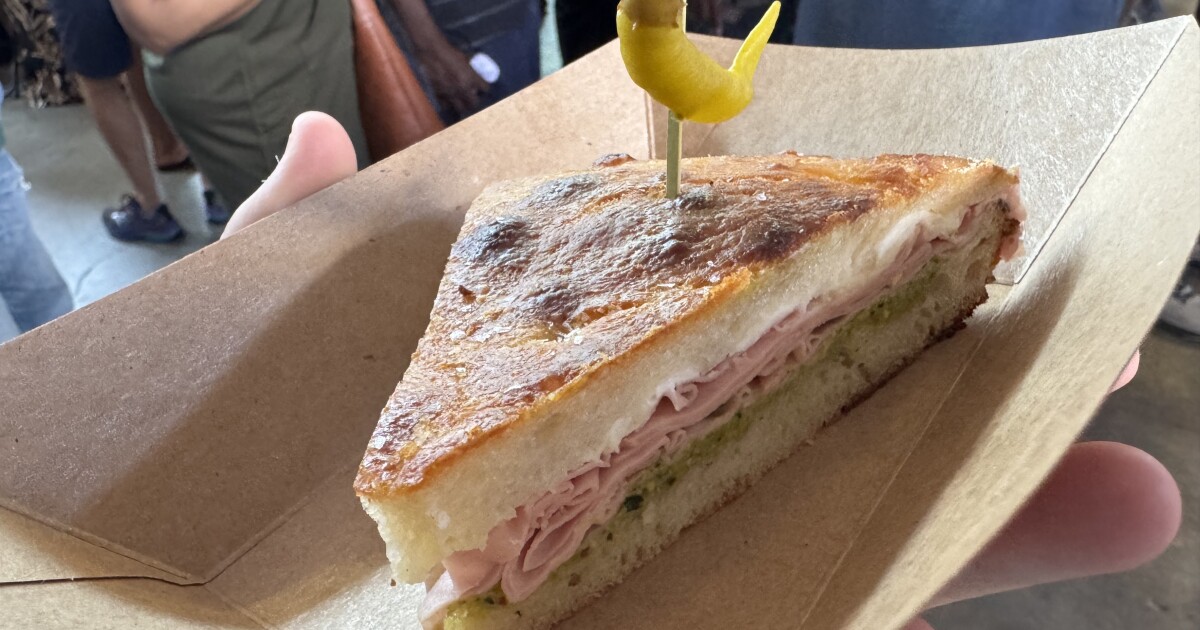
Detroit Sandwich Party returns to Eastern Market on Sept. 6
-

 San Francisco, CA2 hours ago
A Leak of San Francisco Police Drone Footage Exposes the New Reality of Urban Surveillance
-

 Dallas, TX2 hours ago
Viral East Dallas coffee shop fears major sales drop amid six-week road closure
-

 Miami, FL2 hours ago
3 hurt in fire on Lincoln Road that started underground
-

 Boston, MA2 hours ago
Rideshare driver charged in Logan airport passenger assault to appear in court
-

 Denver, CO2 hours ago
Denver area events for July 13

