
Connect with us

South

Metal detectorist stumbles upon rare medieval pilgrim badge

Published

on

Metal detectorist stumbles upon rare medieval pilgrim badge


Join Fox News for access to this content

Plus special access to select articles and other premium content with your account – free of charge.

Please enter a valid email address.

By entering your email and pushing continue, you are agreeing to Fox News’ Terms of Use and Privacy Policy, which includes our Notice of Financial Incentive. To access the content, check your email and follow the instructions provided.

Having trouble? Click here.

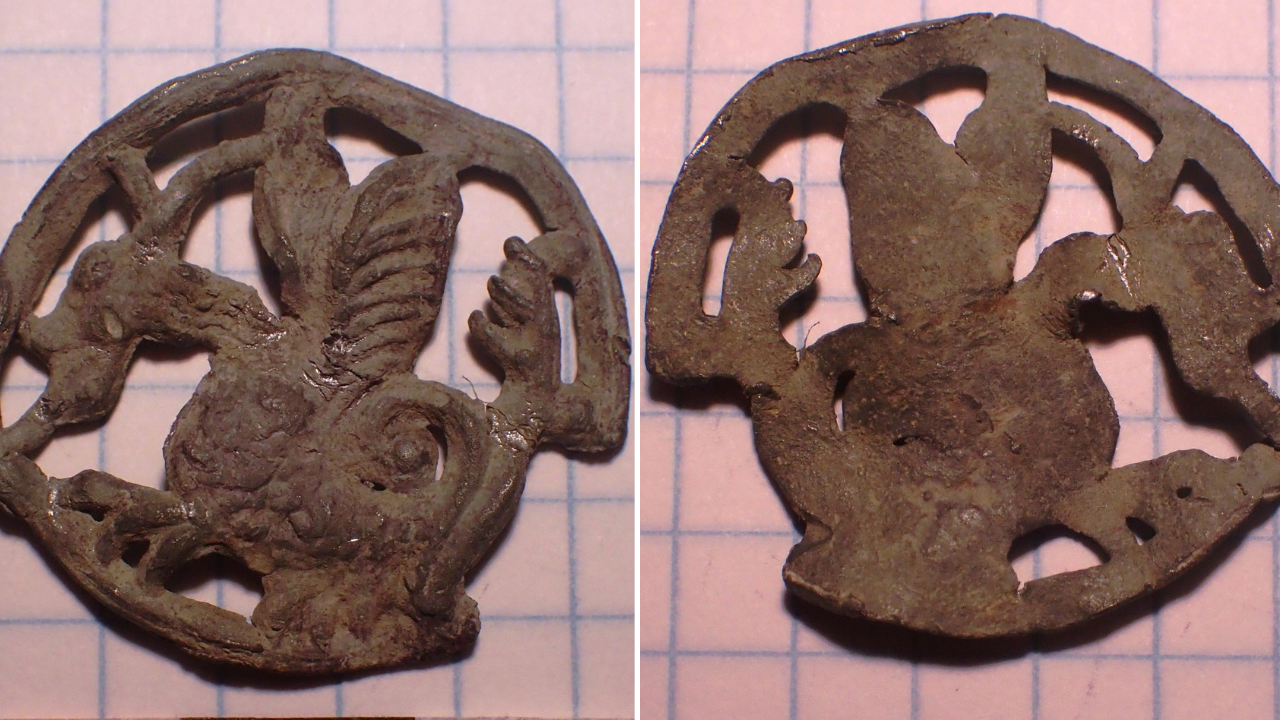
A metal detectorist in southeastern Poland recently unearthed a Christian pilgrim badge from the Middle Ages, state officials say.

Advertisement

The badge was found in the village of Wólka Nieliska, less than 50 miles southeast of Lublin, according to the Lublin Provincial Conservator of Monuments (WKZ).

The pendant, made from lead and alloy, has a diameter of around 2.8 centimeters and is 1 millimeter thick.

ANCIENT TOMB FILLED WITH GOLD, SACRIFICIAL VICTIMS UNCOVERED BY ARCHAEOLOGISTS: ‘SPECIAL TYPE OF BURIAL’

In a Facebook post that was translated to English, the WKZ said that the badge “features a dragon enclosed in a circle.”

A medieval pilgrim’s badge was found in the village of Wólka Nieliska, less than 50 miles southeast of Lublin, Poland. (Lublin Provincial Conservator of Monuments via Facebook)

Advertisement

Archaeologist Thomsz Murzyński told Fox News Digital that the artifact was given to him by an anonymous metal detectorist. Murzyński then handed the badge over to the government.  

Medieval pilgrims wore badges for a variety of reasons: not only did they believe it could protect them from disease and danger, but it also marked them as Christian travelers as they journeyed through unfamiliar territories. 

“Such badges served as a kind of talisman, intended to provide the person wearing it with success in the journey and to protect such a person from all kinds of ‘evil,’ i.e. assault, theft, diseases and other random accidents,” the WKZ described.

ARCHAEOLOGISTS UNCOVER HOARD OF ANCIENT SKELETONS PART OF ‘COMPLEX FUNERARY SYSTEM’

The badge is made from lead and alloy and has a diameter of around 2.8 centimeters. (Lublin Provincial Conservator of Monuments via Facebook)

Advertisement

“They were also a way to distinguish yourself and manifest your destination.”

Travelers could also purchase the badges as souvenirs at pilgrimage sites, which many did as a commemoration of their trips. According to the WKZ, not many medieval badges have been found in Poland.

The badges date back to the early Middle Ages and gained popularity in the 12th century after Thomas Becket’s death inspired mass pilgrimages to Canterbury Cathedral. Pilgrim badges fell out of favor by the 16th century.

CLICK HERE TO SIGN UP FOR OUR LIFESTYLE NEWSLETTER

A 13th century Spanish miniature of a poor man and a pilgrim receiving hospitality at a monastery. (Photo12/Universal Images Group via Getty Images)

Advertisement

According to the WKZ, the badges could depict anything from exotic animals to Christian symbols.

“They had various forms and shapes – spiral, square, in the form of cross, shells, rings, shield,” the Facebook post read. “They featured figures of saints, knights, human heads and chests, as well as zoomorphic figures (birds, animals, dragons).”

CLICK HERE TO GET THE FOX NEWS APP

Archaeologists say that similar medieval pilgrim’s badges are hard to find in Poland. (Lublin Provincial Conservator of Monuments via Facebook)

Fox News Digital reached out to the WKZ for comment. 

Advertisement

For more Lifestyle articles, visit www.foxnews.com/lifestyle.


Source link

Delaware

Mike Purzycki was enough for Wilmington. We’ll miss him | Opinion

Published

on

Mike Purzycki was enough for Wilmington. We’ll miss him | Opinion


4-minute read

play

Mike Purzycki died Tuesday, May 19 at 80. The public record of his life — the Riverfront, the mayoralty, the housing reforms, the man who turned an industrial wasteland into a regional destination — is real and earned. We read it Tuesday morning. We recognize the city Purzycki helped to build.

There is another piece of Purzycki’s life, less public and to us no less important, that the three of us are uniquely positioned to tell. I, Tony Allen, served as the founding chair of the Wilmington HOPE Commission, and Mike served as my co-chair throughout my tenure. With first Provey Powell and then Charles A. Madden as our executive director, and Wolfie Chambers as one of our most important volunteers and advisors — now one of the nation’s leading voices on second chances and gun violence prevention — we built something together that does not appear in the public chronology of Purzycki’s life. The moment of his passing is the right moment to name it.

We come to this tribute from three vantage points: a returning citizen turned national advocate, the executive director who ran the institution day to day, and the co-chair who sat with Purzycki at a round table, grappling with the difficult topics that carried their own advocates and opponents on every side — race, community, crime, brokenness, repair and whole cloth reform — we dealt with it all and then went about the business of trying to do something about it. The relationship the three of us had with Purzycki was an argument we kept choosing to have in the same room. He pushed us. We pushed him. Individually, we all held positions about structural injustice that sometimes made each of us bristle, one to another. Regardless of what side we landed, no one flinched. That is what made the work real, and what makes this tribute possible.

We want to honor Purzycki honestly. He was not a man so certain about Black people that he believed he knew what was best for us. He would have been the first to reject that framing on its facing, noting first that no group of people is a monolith, nor is one group superior in their judgement of another. It was the systems that created the circumstances, a point we all regularly rallied around. Purzycki was our ally — and on some days, our co-conspirator in a fight no one in his world was asking him to take up.

Advertisement

Wolfie Chambers remembers Mike Purzycki

I have been called “the Mayor of Wilmington” in some quarters, and I take no offense to it, but I want to be clear about the chronology. By the time the HOPE Commission and Mike Purzycki entered my life, I had already come home and decided who I was going to become. The Center for Structural Equity I founded at the University of Delaware in 2020. The federal legislation I helped shape. The book I wrote on violence in our city. The presidential pardon I received in January 2025. None of that was given to me. I built it, with the help of many — and Purzycki was one of those many, not the architect of it.

Purzycki never saw the man in front of him as broken. He assumed I was a partner. The first real conversation he and I had, he did not ask me about my time inside. He asked me what I thought the commission was getting wrong. I told him. He disagreed with me on several points, and we went around on it for the better part of an hour. That was the day I knew I could work with him.

We argued over the years about a great deal. About whether young men in our neighborhoods were primarily victims of a system or co-authors of the conditions they lived in — both, of course, but the weighting was a real fight. About how hard to push law enforcement, particularly later when he was mayor and accountability for police conduct sat on his desk. About what counted as success when a man came home. About who got the credit and who got the microphone. Purzycki did not always win those arguments. Neither did I. That is how I know he respected me. It was two men — one Black, one white — who could argue without feeling the need to break each other. As some young people used to say, “Mike was a real one,” even when we simply could not agree.

Advertisement

Charles A. Madden rememebrs Mike Purzycki

I ran the HOPE Commission for many years. For most of that time, I had two co-chairs at the top of the house — Tony Allen and Mike Purzycki — and the way that worked was the engine of everything we built. And while the HOPE Commission brought us together, it was Purzycki the man who has meant so much to my personal and professional development. We spent countless hours together creating countless memories and mutual lessons. What centers my relationship with Purzycki is the fact that he cared about me (the whole person). He fought for me both figuratively and literally AND helped shape the man, the father and professional I am becoming. During a car ride from his home in Maryland, I turned to Purzycki and called him a “painful” man. To be clear, my saying as much was truly a compliment. In fact, his “painful” way is the very reason I hold him in such high regard. The “painful” man expected and demanded excellence from me while modeling as much in our every interaction. I will miss Purzycki painful way of caring and showing up for me in ways few men have.

They did not always see the same problem when they looked at the same room. Allen came from the Urban League, from a public-policy lineage that ran through high profile elected officials, from stout academic grounding in Urban Affairs. PUrzycki came from real estate. He had built the Riverfront. He thought in terms of capital stacks, development timelines,and the leverage of public investment against private return. They had different vocabularies, and a lot of my job was translating between them — and then, when they had argued each other into a synthesis neither would have arrived at alone, helping the staff turn it into a program.

Purzycki pushed me on accountability — on whether we were measuring results, on whether the men we served were being asked enough of themselves, on whether we were too forgiving. I pushed him on context — on what it actually takes to come home to a city that has decided in advance you will fail, on the systems that produce the men we were serving, on the difference between mercy and infantilization. We did not always agree about where the line was. We agreed it had to be drawn together.

He was the rare leader who showed up when there was nothing for him to gain. He was the rare white civic leader who did not flinch when the conversation got harder than his comfort. He was wrong sometimes, and he could be told so to his face. That is a different gift than benevolence.

Mike’s work on reentry was never the work that won him votes. It was never the work that drew the press. It was the work he did anyway. That tells you what he was made of.

Advertisement

Tony Allen remembers Mike Purzycki

I co-chaired the Wilmington HOPE Commission with Mike Purzycki for many years. The hours we logged together at the head of that table are the foundation of what I want to say.

I came to that role from a particular vantage point, a student of W.E.B. Du Bois recognizing both privilege and responsibility in my Black community with Frederick Douglass type sensibilities, in effect that “power concedes nothing without demand.” That double inheritance made me right about nothing. But holding both worldviews in equal measure did teach me the texture of the long argument: that real civic work is not about who is correct in the moment, but about who is still in the room five, 10, 15, 25 years later, not still asking the harder question, but rather the hardest question and never giving up on the work.

Purzycki was such a man.

Our work together with Charles A. Madden, our board and at the prodding of known voices like Wolfie Chambers produced specific things. The expansion of resources into Southbridge — a family crisis therapist at the elementary school, a juvenile probation officer dedicated to the community, outreach workers — of the community — on the ground, and constant advocacy for what many thought of as the forgotten or worse yet, the unworthy. Perhaps most important was a home, the Achievement Center, built with an iconic American black fraternity, Kappa Alpha Psi, that gave our work visible, physical agency, that still shapes the function, face and work of the HOPE Commission today, still anchored in Wilmington but now spread to Dover under the leadership of state Sen. Darius Brown. All of it was instinct meeting investment, under intense pressure, with many competing views. Dare I say, “out of many, ONE!”

But the deeper thing — the thing I have come back to often, and will come back to more now — was something Reverend Lawrence Livingston named in a Delaware Today profile of Black leadership in our state a decade ago. He said that effective leadership in our community is about being “Black enough.” And he defined the term this way: “If you can understand the nature of oppression, whether you are white, Hispanic, or any other ethnicity, then you are Black enough.”

Advertisement

I have thought about that line in relation to Mike many times. He understood the nature of oppression — not as a thing he had experienced, but as a thing he had decided to know. He read it in the data. He heard it in the rooms. He sat with it in the lives of the men our Commission served. He let it change what he believed and how he led. He never claimed our experience as his. He never confused empathy with equivalence. I would not parse these words to ever say my dear friend Purzycki was “Black enough,” but he was enough and there when we all needed him most.

Legendary state Sen. Margaret Rose Henry once observed that the work of civil rights in our generation has shifted from voting rights and equal housing to economic justice, and that our leadership now extends to a broader and more economically driven community. Purzycki lived inside that shift. The Riverfront. The Achievement Center. The mayoralty. They were of a piece — investments in a city whose economic future and whose racial reckoning could no longer be separated.

That is the man I was proud to lead beside. That is the man whose absence I will feel for a long time.

Advertisement

Together, we remember Mike Purzykci

We are not writing a hagiography. Mike Purzycki’s record, like every public servant’s, is a mixed one, and the three of us hold our own critiques of pieces of it. We argued with him in his lifetime. We will continue those conversations now in his memory, because he would have wanted us to.

What we are saying is narrower and more durable than tribute. On the question of what a city owes the men it has sent away — and what those men owe themselves — Purzycki showed up for the long argument, did not flinch from the parts of it that were uncomfortable for him and built, with us, something that did not exist before.

In the by and by, achievements are fleeting, but the legacy of the Honorable Michael S. Purzycki endures.

To Bette, to Gage, to Adriane, to Mick, to his grandchildren — we share your grief. The man you loved at home was the same man with whom we went to battle, together, the same man who built a piece of this city that forever will stand. We loved him, too. We will miss him.

Darryl “Wolfie” Chambers is the founder of the Center for Structural Equity. Charles A. Madden is the former executive director of the Wilmington HOPE Commission. Tony Allen is the president of Delaware State University.

Advertisement


Source link

Continue Reading

Florida

Man who stabbed woman, her daughter to death in Coral Springs to be executed

Published

on

Man who stabbed woman, her daughter to death in Coral Springs to be executed


A Florida man convicted of fatally stabbing of his cousin’s girlfriend and the couple’s 4-year-old daughter is set to be executed Thursday evening.

Richard Knight, 47, is scheduled to receive a three-drug injection starting at 6 p.m. at Florida State Prison near Starke. Knight was sentenced to death after being convicted of two counts of first-degree murder in 2006 for the deaths of Odessia Stephens and her four-year-old child, Hanessia Mullings.

This would be Florida’s seventh execution so far this year, following a record 19 executions in 2025. Republican Gov. Ron DeSantis oversaw more executions in a single year in 2025 than any other Florida governor since the death penalty was reinstated in 1976. The previous record was set in 2014 with eight executions.

According to court records, Knight had been living in Coral Springs, near Fort Lauderdale, with his cousin, his cousin’s girlfriend and their daughter in June 2000. Knight and Stephens frequently argued about Knight living there. One evening while Knight’s cousin was at work, Stephens told Knight that he would need to move out the next morning. Knight became angry and stabbed Stephens multiple times and then attacked the young girl, officials said.

Advertisement

While being held at the Broward County Jail following his arrest, Knight confessed the killings to another inmate, who testified against Knight during his trial.

The Florida Supreme Court denied Knight’s appeals last Friday. The court rejected his claim of newly discovered evidence, pointing out that an unidentified fingerprint found on a knife at the murder scene was known about and addressed during Knight’s original trial. The court also rejected claims based on Florida’s execution protocols and warrant process.

A final appeal was still pending before the U.S. Supreme Court.

A total of 47 people were executed in the U.S. in 2025. Florida led the way with a flurry of death warrants signed by DeSantis. Alabama, South Carolina and Texas tied for second with five executions each.

An execution was scheduled for Thursday in Tennessee. And another execution is planned in Florida on June 2. Andrew Richard Lukehart, 53, was convicted of fatally beating of his girlfriend’s infant daughter in 1996.

Advertisement

All Florida executions are carried out via lethal injection of a sedative, a paralytic and a drug that stops the heart, according to the Department of Corrections.


Source link

Continue Reading

Georgia

What channel is Tennessee softball vs Georgia on today? Time, TV schedule to watch Knoxville Super Regional Game 1

Published

on

What channel is Tennessee softball vs Georgia on today? Time, TV schedule to watch Knoxville Super Regional Game 1


Tennessee softball opens the Knoxville Super Regional with Game 1 against Georgia on May 21 at Sherri Parker Lee Stadium.

The Lady Vols (45-10) went 3-0 in regional play last week to advance to the second weekend.

Georgia (41-18) allowed two runs over three games in the Athens Regional last weekend to advance to the super regionals.

Advertisement

The winner in the best-of-three format will advance to the Women’s College World Series in Oklahoma City. The two programs did not play in the regular season.

Here’s how you can watch Tennessee softball vs. Georgia:

Tennessee softball vs Georgia on May 21 at Sherri Parker Lee Stadium will be televised on ESPN2.

Advertisement
  • Game time: 7 p.m. Eastern
  • Date: Thursday, May 21
  • Game 1: 7 p.m. on Thursday, May 21, ESPN2
  • Game 2: 3 p.m. on Friday, May 22, ESPN2
  • Game 3 (if necessary): 11 a.m. on Saturday, May 23, ESPN


Source link

Continue Reading
Advertisement

Trending
