Louisiana
Louisiana’s LNG exports are driving out fishermen and driving up utility bills across the U.S.

Phillip Dyson once tried working a job that wasn’t shrimping. He lasted three days on an oil rig before going right back to his boat.
“The man said, you just tell me you want the job, we’ll fire the other guy,” he said with a laugh. “I said, don’t fire that man, ’cause I ain’t coming back.”
For more than half a century, Dyson has been fishing the coastal waters of Cameron, Louisiana. Forty years ago, Cameron Parish was the top seafood port in the United States. Today, it’s ground zero for America’s LNG export boom, a multibillion-dollar industry — the U.S. is the top exporter in the world — that has reshaped the landscape, the economy, and the daily lives of the people who have lived here for generations.
When Dyson looks out from the shrimp dock now, he doesn’t recognize what he sees: spindly cranes, cylindrical cooling towers and the constant hum of the construction and processing of liquified natural gas (LNG) terminals rising above the marsh.
Ian McKenna
/
More Perfect Union
The terminals run day and night, super-cooling natural gas into liquid form where it’s loaded onto massive tanker ships for export to places like Europe and Asia.
Shrimpers like Dyson are catching about half of what they used to, driving many out of the industry.
“There used to be 200 shrimp boats in this town — down to 15,” Dyson said. “You went from a fishing town to a town that didn’t care less about the fishermen.”
Dyson is stubborn and set in his ways. Shrimping is all he knows. He doesn’t want to leave Cameron. He buried his parents here. Scattered his daughter’s ashes in the water.
“I would never want to leave her behind,” he said. “But I’m gonna have to.”
‘You’re just surrounded’

Ian McKenna
/
More Perfect Union
Cameron Parish was an attractive destination for reasons both geographic and financial. It sits close to the Haynesville Shale formation, one of the country’s most productive natural gas fields, has no parish-wide sales tax and LNG companies have secured industrial tax exemptions that, according to community advocates, amount to nearly a billion dollars a year across the three operating terminals — roughly $6 million per permanent job created.
“They don’t only export gas — they export the profits,” said James Hiatt, a former oil and gas worker who founded For a Better Bayou, a southwest Louisiana environmental community organization. “That’s the key.”
The company at the center of the expansion is Venture Global, which operates the Calcasieu Pass terminal, known as CP1, just outside of Cameron. In a March earnings call, the company reported it made more than $6 billion in 2025 alone — tripling its profits from the previous year.
In an interview last year on CNBC, Venture Global’s CEO, Mike Sabel, described the company in terms residents find difficult to square with their daily reality: “Ultimately our business is that we manufacture and operate machines that produce money.”
President Donald Trump’s administration approved a second Venture Global terminal in Cameron — CP2 — just two months after taking office in 2025. Nationally, 17 new export terminals are either under construction or have won approval from the Federal Energy Regulatory Commission (FERC). Six of them are in southwest Louisiana.
Robyn Thigpen, a local resident and executive director of the advocacy group Fishermen Involved in Saving Our Heritage (FISH), described the sense of encirclement many people feel.
“When you turn here,” she said, pointing in different directions from the beach in Cameron, “the cranes off in the distance is the expansion to CP1. 12 miles back into town is Hackberry LNG. Probably about 30 miles this direction is Sabine LNG. So you’re just surrounded.”
‘No shrimper can make it here’

Ian McKenna
/
More Perfect Union
Last August, while Venture Global was dredging a shipping channel at CP1 — pumping out mud and sediment to clear a path for vessels — something went wrong. The company spilled hundreds of acres of sediment into the surrounding marsh.
The mud blanketed the area where Tad Theriot, a shrimper turned oysterman, had been growing his harvest. He pivoted to oyster farming two years ago, after years of declining shrimp catches made the traditional livelihood impossible to sustain.
The dredge spill devastated his oyster operation almost overnight.
“Half of them died,” Theriot said. “We lost 50% on the big ones, even more than that.”
Out on the water, the evidence was plain — oysters pulled from cages bore what his farming partner Sky Leger called “mud blisters,” deposits of silt visible inside the shell.

Ian McKenna
/
More Perfect Union
“Before you try, tell me — would you eat it if you knew that that was there?” Leger said, pointing to dark splotches on the iridescent cup of a fresh oyster. “How does that get there?”
Venture Global told More Perfect Union and Gulf States Newsroom in a statement that the “isolated discharge was quickly contained,” and that there were “no significant offsite impacts” as a result of the spill.
The Louisiana Department of Wildlife and Fisheries documented increased oyster mortality near the spill site in September, and fishermen have since requested a more comprehensive government study.
To date, no significant enforcement action has been taken against the company.
But according to documents obtained by More Perfect Union, Venture Global offered some affected fishermen $20,000 — on the condition they could never sue or speak negatively about the company again. When asked about the offer, Venture Global said the company “has communicated directly” with local fishermen “to develop mitigation and remediation plans, and minimize the potential for an event like this again.”
Theriot said he’d never take the money.
“That’s not right,” he said flatly. “I have hundreds of thousands of dollars worth of oysters. I want hundreds of thousands of dollars.”
Advocates like Hiatt called the settlement offers part of a pattern the company is using to sidestep accountability through financial and political power.
“After this spill, more people are understanding that these corporations don’t give a f— about you,” he said. “All they care about is how much money they can make.”
Last month, a pipeline part of an under-construction project operated by Delfin LNG ruptured near Holly Beach in Cameron Parish. The ensuing explosion resulted in “catastrophic injuries” to a contractor working for the company, according to a lawsuit filed in Texas that accused the company of negligence and failing to “ensure the pipeline was free of flammable vapors and materials.”
“It’s a reminder that these things are happening in a community that doesn’t even have a hospital,” Thigpen said, noting that the worker was taken to a hospital in Port Arthur, Texas, roughly 45 minutes away. “It’s another example of why we can’t trust these companies to do the right thing.”
‘You can’t afford this and food’

Ian McKenna
/
More Perfect Union
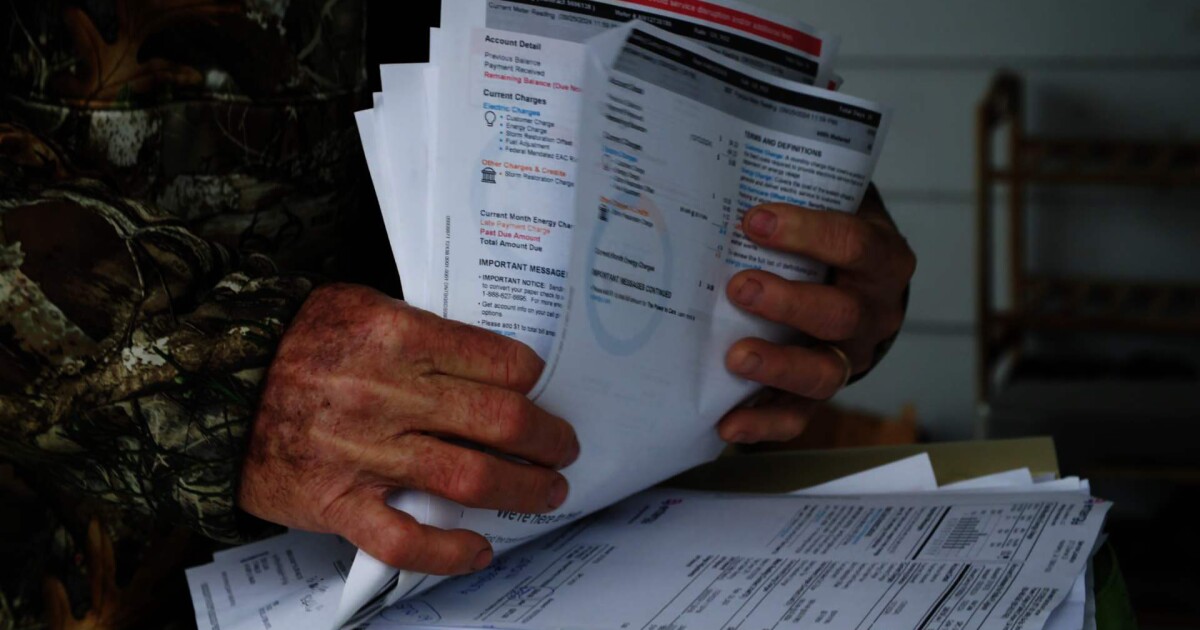
The impacts of Cameron’s transformation don’t stop at the bayou’s edge. The LNG export boom is being felt in the utility bills of Americans across the country.
Eight LNG export terminals now consume more natural gas each day than all 74 million American households connected to gas utility service combined. The federal government projects the benchmark price of natural gas will average 22% higher in 2026 than in 2025, citing LNG exports as a driving factor.
A Public Citizen analysis found domestic natural gas prices were $12 billion higher for residential customers in just the first nine months of 2025 compared to the same period the year before — roughly $124 per household.
“It’s simple supply and demand,” Slocum said. “You’re forcing Americans to compete with their counterparts in Berlin and Beijing for access to U.S. natural gas. And that pushes the domestic price up. The more we export, the higher the prices the rest of Americans will pay to heat and cool their homes.”
In Hackberry, Louisiana — minutes down the road from Cameron Parish’s other export terminal — fisherman Eddie Lejuine and his wife Michelle have watched their bills climb. Lejuine depends on a refrigerated storage container to keep his catch marketable. Without it, he can’t work.
“You can’t afford this and food,” Michelle Lejuine said. “What are you gonna do? You gonna eat or are you gonna have electricity?”
Eddie Lejuine put it plainly: “We’re catching less fish, [making] less money, paying higher bills.”
Trump’s promise, the industry’s windfall

During the 2024 campaign, Trump pledged to cut Americans’ energy bills in half within 12 months. He repeated it at rallies and put it in writing in a Newsweek op-ed.
On his first day back in the White House, one of his earliest executive orders undid former President Joe Biden’s pause on pending LNG export approvals — a pause that was implemented, in part, because consumer advocates argued the existing review process failed to account for domestic price impacts.
The ties between Venture Global and the Trump administration run deep. According to reporting by the Wall Street Journal and the Washington Post, the company’s CEO was present at a private 2024 meeting at which Trump reportedly asked oil and gas executives to contribute $1 billion to his campaign.
Slocum argued the gap between Trump’s promise and his policy is not an accident.
“What Trump has done is to prioritize the financial interests of the natural gas industry,” he said. “And the natural gas industry’s primary financial directive is to maximize LNG exports.”
Electricity prices jumped 6.9% in 2025 year over year, according to Goldman Sachs.
‘Find somewhere else to build this’

Ian McKenna
/
More Perfect Union
More than 90% of Cameron Parish voted for Trump in 2024. The mood among the fishermen who remain is harder to categorize than partisan politics.
When asked if he’d vote for Trump again, Lejuine said: “No, I’m not. I’m hoping we have a better selection of something.”
Hiatt, a self-described third-generation oil and gas worker, framed it as a matter of basic fairness rather than ideology.
“This is ‘America Last’ policy,” he said, “to export our natural resources to the highest bidder at the expense of every American.”
Dyson, standing at the dock in the late afternoon light, said what he would tell Venture Global and the politicians like Trump and Louisiana Gov. Jeff Landry, who championed the expansion: “Find somewhere else to build this s—. I never thought I’d have seen this place like this. Never in my lifetime.”
His electricity bill runs $350 to $500 a month for a 990-square-foot house, he said. He and his wife receive about $1,300 a month together on Social Security. With what he’s catching, it’s not enough.
He said he won’t stop shrimping, but he can’t do it in Cameron.
“This is what I do. That’s what I’m gonna do till they throw dirt on me. That might not be here, but I will fish till it’s over.”
This story was produced by the Gulf States Newsroom, a collaboration between Mississippi Public Broadcasting, WBHM in Alabama, WWNO and WRKF in Louisiana and NPR. This story was produced in collaboration with More Perfect Union.



NEWTON COUNTY, Texas. (KPLC) – A DeRidder man reported missing was found dead in the Sabine River Sunday morning, according to the Newton County Sheriff’s Office.
Newton County Sheriff Colton Havard said Jordan Jamal Allen was located around 7:50 a.m. on July 12 with help from Texas Parks and Wildlife game wardens, the Beauregard Parish Sheriff’s Office, and 409 Search and Rescue.
Authorities say the body was recovered not far from where Allen went under Friday night near the U.S. 190 bridge east of Bon Wier at the Texas-Louisiana state line.
The sheriff said that Allen and a woman were said to be wading across the river Friday when the current began pulling the woman.
The sheriff said Allen tried to help her, but went under around 8:45 p.m. and wasn’t seen again. He said the woman made it back to land safely.
We will have more in this story as it develops.
Copyright 2026 KPLC. All rights reserved.

MONDAY
RED STICK FLY FISHERS PROGRAM: 7 p.m., Bluebonnet Regional Library, 9200 Bluebonnet Blvd., Baton Rouge. Open to the public. Email Brian Roberts: roberts.brian84@gmail.com. Website: rsff.org
WEDNESDAY
FLIES & FLIGHTS: 7-9 p.m, Rally Cap Brewing, 11212 Pennywood Ave., Baton Rouge. Casual fly tying. Open to public. Email Chris Williams: thefatfingeredflytyer@gmail.com
THURSDAY
ACADIANA FLY RODDERS PROGRAM: 6 p.m., Pack and Paddle, 601 E. Pinhook, Lafayette. Open to public. Email Darin Lee: at cbrsandcdc@gmail.com. Website: acadianaflyrodders.org
FRIENDS OF NRA/SOUTHWEST LA BANQUET: 6 p.m., Riverside Bar & Grill, 3748 Louisiana 3059, Lake Charles. Call Brack Cole 337-912-1620. Email: jbcoleair@yahoo.com
ONGOING
STATEWIDE TOURNAMENT & ANGLERS RODEO/S.T.A.R.: Through Sept. 7, Coastal Conservation Association’s summer-long fishing event. Tagged redfish, coastal/offshore species categories & youth division. CCA membership required. Website: ccalouisiana.com/star
LOTTERY HUNTS
DOVE/TEAL: July 27 application deadline for dove hunt on Elbow Slough Wildlife Management Area and teal hunt on White Lake Wetlands Conservation Area. Website applications only on Wildlife & Fisheries/Louisiana Outdoors License, Permits and Tags webpage. Fee $8.50. Details: dove hunt, David Hayden at dhayden@wlf.la.gov; teal hunt, Lance Ardoin at lardoin@wlf.la.gov
AROUND THE CORNER
JULY 21 — LAFAYETTE KAYAK FISHING CLUB MEETING: 6 p.m., Pack and Paddle, 601 E. Pinhook, Lafayette. Call 337-232-5854. Website: lafayettekayakfishing.com
JULY 21-22 — GULF COUNCIL SHRIMP COMMITTEE MEETING: Gulf Council office, 4107 W. Spruce St., Tampa, Florida. In conjunction with Scientific and Statistical committees. Website: gulfcouncil.org
JULY 23 — ACADIANA BUGS & BREWS: 6 p.m., Pack and Paddle, 601 E. Pinhook, Lafayette. Casual fly tying and local beers provided. Open to the public. Email Darin Lee: cbrsandcdc@gmail.com. Website: packpaddle.com
JULY 23-25 — International Grand Isle Tarpon Rodeo, Grand Isle Marina & Otto Candies Pavilion, Grand Isle. Website: tarponrodeo.org
JULY 24-25—BASSMASTER JUNIOR CHAMPIONSHIP: Kentucky Lake, Paris, Tennessee. Website: bassmaster.com
JULY 26 — SOUTH LOUISIANA HIGHPOWER CLUB MATCH: 8:30 a.m., Ascension Parish Sheriff’s Range, St. Landry Road, Gonzales. NRA XTC & F-Class match rifle or service rifle, 200-yard/50-rounds match course. Fee $15 members, $20 nonmembers, $5 juniors. $25 annual club (first match free) and Civilian Marksmanship Program membership (allows purchases from CMP). Call Mike Burke, 337-380-8120. Email: SouthLAHighPower@hotmail.com
FISHING/SHRIMPING
SHRIMP: Spring inshore season closed except for Breton/Chandeleur sounds; all outside waters open.
OPEN RECREATIONAL SEASONS: Private recreational red snapper; gray triggerfish; flounder; lane, blackfin, queen and silk snappers and wenchmen among other snapper species; all groupers except closed for goliath and Nassau groupers in state/federal waters.
CLOSED SEASONS: Greater amberjack; bluefin tuna; gag, goliath and Nassau groupers in state/federal waters. Commercial greater amberjack season closed.
LDWF UPDATES
Closed: Roads on Pomme de Terre, Richard Yancey & Bogue Chitto WMAs (flooding)
Drawdowns: Saline Lake (Natchitoches/Winn parishes through Oct. 5); Iatt Lake (Grant Parish through Oct. 5).
-

 Idaho54 seconds ago
Idaho Property Taxes are Here to Stay
-

 Illinois7 minutes ago
Man charged with trespassing at Illinois Gov. JB Pritzker’s home in Chicago on July 4: documents
-

 Indiana13 minutes ago
Indiana seeks coal ash program as feds move to rollback regulations
-

 Iowa19 minutes ago
Several Iowa High School Baseball Standouts Selected In MLB Draft
-

 Kentucky31 minutes ago
How one small KY town put aside its differences to celebrate America | Exclusive
-

 Louisiana37 minutes ago
Meta’s Louisiana Data Center to Surpass $250 Billion Price Tag
-

 Maine43 minutes ago
6 concerts, theater productions planned this week in central Maine
-

 Maryland49 minutes ago
Readers vote for best ice cream shop on Lower Shore of Maryland

