A mother and her three children who were found dead in a burning home in rural southeastern Indiana on Tuesday suffered gunshot wounds, authorities say.
The woman, Naomi Briner, 35, was found by firefighters in the house at around 4 p.m. Tuesday along with her children Adelia Briner, 12; Leland Briner, 8; and Iyla Briner, 6, according to Sgt. Stephen Wheeles of the Indiana State Police. The house is located in the 1600 block of East Telegraph Hill Road just outside Madison.
When police and fire crew arrived on the scene, the house was up in flames, police said.
HISTORIC ABANDONED INDIANA HIGH SCHOOL WITH CRIME HISTORY GOES UP IN FLAMES
Advertisement
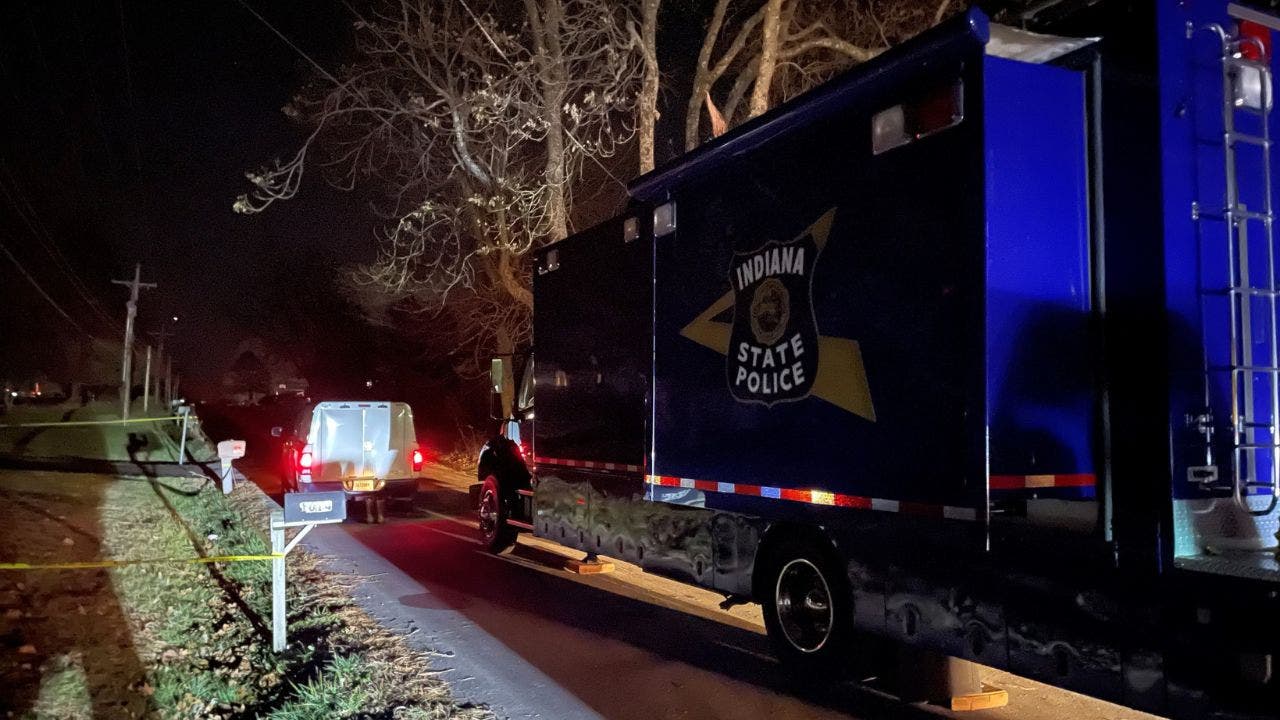
A mother and her three children were found dead in a burning home in rural southeastern Indiana on Tuesday and authorities have now revealed that they all had gunshot wounds. Pictured is an Indiana State Police truck.(Indiana State Police via Facebook)
Upon entering the residence, fire crews located the bodies of four victims inside and despite life-saving measures, all four individuals were pronounced deceased at the scene. The fire was extinguished and investigators were called to the location, Wheeles said via a statement on social media.
Photos from the scene show the charred roof of the home and a burned vehicle in the driveway. Christmas lights could also be seen strung across the yard.
A mother and her three children were found dead in a burning home in rural southeastern Indiana on Tuesday and authorities have now revealed that they all had gunshot wounds. Pictured is a tow truck at the scene.
INDIANA MAN FACES MURDER CHARGES IN DISAPPEARANCE OF 17-YEAR-OLD NEIGHBOR
Advertisement
Wheeles identified the family late Tuesday and revealed that they had all suffered gunshot wounds.
He did not provide any further details as to how they were shot and if there is a suspect wanted.
CLICK HERE TO GET THE FOX NEWS APP
“This is an ongoing investigation,” Wheeles said. “However, at this time, investigators do not believe that there is a threat to the public.”
“Indiana State Police Investigators continue to work closely with the Indiana Fire Marshal’s Office, Jefferson County Prosecutor’s Office, Jefferson County Coroner’s Office and Jefferson County Sheriff’s Office to thoroughly investigate this incident.”
Advertisement
The fire took place in the 1600 block of East Telegraph Hill Road just outside Madison.
Michael Dorgan is a writer for Fox News Digital and Fox Business.
You can send tips to michael.dorgan@fox.com and follow him on Twitter @M_Dorgan.
First grader Ruston Revell is pressing Virginia lawmakers to pass a bill that he argues will make schools safer for kids with diabetes.
This page contains a video which is being blocked by your ad blocker. In order to view the video you must disable your ad blocker.
Why a 6-year-old with diabetes is pushing for change in Virginia
Speaking in front of Virginia lawmakers, 6-year-old Ruston Revell needs a wooden stool to reach the microphone for his testimony about diabetes.
Advertisement
Dressed in his blue suit and red tie, he’s there on a mission.
“Living with diabetes isn’t easy, there are lots of ups and downs — just like my blood sugar,” Ruston told legislators in the Virginia General Assembly.
The legislation that brought Ruston from Prince William County to Richmond would update an existing law to specify how Virginia schools handle accommodations for students with diabetes.
“When I’m at school, my nurse and all my teachers help me when I need it, but not all kids like me are that lucky,” Ruston told WTOP. “These bills change that, so kids with diabetes can be safer in schools.”
He’s testified before committees in both chambers as corresponding bills move through the Virginia General Assembly. HB1301 and SB122 have both earned support in their respective chamber.
Advertisement
“Although, I’m small, my voice is big and it can change the world,” Ruston said.
In his testimony, the first grader clearly explained the care he requires to manage his Type 1 diabetes during the school day.
“He just pops up on his little stool and takes control of the room,” said Kelly Revell, Ruston’s mom. “It’s usually a little quiet, and after he finishes, he gets a whole room full of applause.”
Today, Ruston enjoys playing baseball, swimming and spending time at the playground.
But things were different before his diagnosis five years ago.
Advertisement
A life-changing diagnosis at 15 months old
During the summer of 2020, Kelly said her son started showing signs of diabetes, such as extreme thirst — symptoms she recognized because her father had been diagnosed in his 20s.
“He would just lounge around the house and have no interest in playing with his sister,” Kelly said. “He stopped eating, so he was eventually airlifted to Children’s National in D.C., where he was admitted to the pediatric ICU for nearly a week.”
At just 15 months old, Ruston was diagnosed with Type 1 diabetes. Kelly said that news was life-changing.
“Now, in order to keep him alive, we have to hurt him multiple times a day, by giving him four to five shots and even a dozen finger pricks just to make sure his blood sugar is in range,” she recalled.
Type 1 diabetes is an autoimmune disease where the body attacks cells that make insulin. A lack of insulin can lead to high blood sugar, which could cause serious health issues or be deadly.
Advertisement
“We had to wake up at 2 a.m. every night for six weeks, before we started utilizing technology, just to make sure that he was safe and healthy with his blood sugar,” Kelly said. “A lot of times, it resulted in phone calls to the hospital because he was at a dangerous level, and then we would be up for hours making sure he was back in range.”
For the Revell family, managing Ruston’s diabetes looks different nowadays.
Ruston Revell, 6, has traveled from Prince William County to Richmond to testify in favor of a bill surrounding Virginia schools and students with diabetes.
(Courtesy Kelly Revell)
Courtesy Kelly Revell
Ruston stands alongside Virginia Sen. Jeremy McPike, who sponsored the bill in the upper chamber.
(Courtesy Kelly Revell)
Courtesy Kelly Revell
Ruston and other advocates say the bill would make schools safer for kids with diabetes.
(Courtesy Kelly Revell)
Courtesy Kelly Revell
Ruston and his mom Kelly (middle) have joined other advocates in Richmond to press legislators to pass the bill.
(Courtesy Kelly Revell)
Courtesy Kelly Revell
The statewide regulations on diabetes care in school haven’t been updated since 1999, Kelly said.
(Courtesy Kelly Revell)
Courtesy Kelly Revell
Advertisement
How a 6-year-old handles his diabetes
Ruston knows how to prick his finger to check whether his blood sugar is in range.
“My mom and dad help me change my insulin pump every three days, and my CGM every 10 days,” Ruston said, referencing his continuous glucose monitor, known as a CGM.
“It hurts, but at least I don’t have to do shots. They’re the worst.”
Living with diabetes, Ruston needs to calculate the number of carbs he’s getting to determine his insulin dose, which is administered automatically through a pump.
“He is a pro at using a food scale,” Kelly said. “If he wants to eat anything, apple slices, we cut them up, and he puts them on the food scale and determines how many carbs are in that.”
Advertisement
Halfway through his interview with WTOP, Ruston’s phone beeped, flagging his low blood sugar and triggering a quick juice-box break.
That’s the kind of intervention he could require at school.
“When I’m low, Nurse Barnes tells Ms. Grant for me to have a juice box or gummies,” Ruston said, describing a snack to correct his blood sugar.
At his current school, Kelly said Ruston has had all his medical accommodations met since his first day of kindergarten.
“He gets so many hugs. Everyone knows him. He walks into the front office every day to visit the clinic, and they just they really take care of him,” she said.
Advertisement
Things were more complicated before Ruston began kindergarten. Kelly said the family was initially told that the accommodations requested by his doctor would not be allowed.
“What was most difficult at the time was the thought that a kindergartener would be responsible for alerting adults if his phone signaled a low or high blood sugar, rather than having trained staff receive those alerts directly through available technology,” she told WTOP.
The situation was resolved, but it drew Kelly’s attention toward legal protections for kids with diabetes.
What Kelly and Ruston are asking Virginia lawmakers to do
Ruston told lawmakers about his experience managing diabetes during the school day. (Courtesy Kelly Revell)
For the past several years, Kelly has been involved with an advocacy group, FOLLOWT1Ds, which argues that unclear or inconsistent school policies can create stress for families and put kids in danger.
“Prince William County has updated their diabetes policies recently, so more students with diabetes across our county are better protected,” Kelly said. “But that’s not happening everywhere in Virginia.”
The bills moving through the Virginia legislature would require school systems to create a divisionwide plan for supporting students with diabetes.
Advertisement
That would include making sure school staff are trained to follow through with a child’s medical orders.
“You really have to put in all of your trust in your school,” Kelly said. “This is a life-threatening disease, and if they forget to give him a juice box when he’s low, that can result in him going to the hospital, or it could be fatal.”
The legislation would also require schools have procedures for administering insulin and glucagon.
Families who have students with diabetes would send schools medical orders from their doctors that outline the child’s needs.
“A lot of times, the schools will either deny or modify these accommodations, even though they’re medically necessary,” Kelly said.
Advertisement
The statewide regulations haven’t been updated since 1999, Kelly said.
“While we’ve had all of these technology advances, like the insulin pump and the CGM, Virginia still hasn’t advanced their laws to align with standard methods of care that we’re using today,” Kelly said.
Ruston doesn’t receive insulin shots anymore. But Virginia law is behind on that front, according to Kelly and other advocates.
“Right now, the policy in Virginia, if his pump were to fall off while at school, they would, instead of reinsert the pump, they would give him a shot,” Kelly said.
In that scenario, Kelly said the school employee would have to calculate how much insulin to dose.
Advertisement
“I wouldn’t even know what to dose him, because with the pump, it’s automated nowadays,” she said. “It would require an immediate call to his doctor for guidance.”
She worries that it could lead to a miscalculation and health complications.
Kelly said the lack of consistency can impact older students, too. She said some high schoolers have gotten in trouble for having their cellphones at schools that ban the devices.
But those phones let students monitor their blood sugar, communicate medical treatments and administer insulin.
It’s the second year in a row that advocates like Kelly have asked legislators in Richmond to approve revisions to state law.
Advertisement
This time, Ruston is joining the push for change by sharing his story with lawmakers.
“I want to make sure other kids in different schools can have more help with diabetes,” Ruston told WTOP.
Anyone interested in following the legislation or submitting a comment to lawmakers can find more information on FOLLOW T1Ds’ website.
Get breaking news and daily headlines delivered to your email inbox by signing up here.
Photo: Dave Casebolt, left, signed an agreement Tuesday with West Virginia American Water Company President Scott Wyman (City of Nitro)
NITRO, W.Va. — It’s a done deal.
Nitro Mayor Dave Casebolt signed an agreement Tuesday with West Virginia American Water Company President Scott Wyman completing the sale of the Nitro Regional Wastewater Utility including the sewer plant for $20 million.
Advertisement
The water utility will now own and operate the city’s water and wastewater systems. The state Public Service Commission recently approved the deal.
Casebolt said it’s good to get the long-talked-about agreement signed. He said the city can’t afford to make the improvements required at the sewer plant.
“We’re looking at needing between 40 and 50 million dollars of upgrades to our system and expecting our four-thousand customer base to try to offset those costs is not even practical,” Casebolt said.
Casebolt said sewer bills are going to go up but he said they were going to go up regardless. He said the city was facing increasing rates by as much as 50 percent.
West Virgina American is planning $42 million in upgrades to the sewer system over the next five years, Casebolt said.
Advertisement
“It’s a much-need investment and actually allow the system to handle rainwater much better where it’s not backing up into people’s homes,” Casebolt said.
Artificial intelligence hasn’t yet triggered the broad job losses many feared — at least not for experienced workers.
That’s the takeaway from a new analysis by J. Scott Davis, an assistant vice president at the Federal Reserve Bank of Dallas, who examined employment and wage trends in industries most exposed to artificial intelligence.
Davis argues the data tell a more nuanced story — one that’s challenging the traditional career ladder, and helping older employees earn a bit more.
Since ChatGPT’s debut in late 2022, overall US employment has risen about 2.5%, according to Davis’ analysis, which uses an AI exposure index developed by researchers and published in the Strategic Management Journal. At the same time, employment in the sectors most exposed to AI has slipped by roughly 1%.
Advertisement
Wages tell a different story. The average weekly pay nationwide has climbed 7.5% since fall 2022. And across the most AI-exposed industries, wages have grown faster, up 8.5%.
If AI were simply replacing workers, both employment and wages would likely be falling, Davis wrote.
Instead, Davis points to a divide between “codified” knowledge — the kind learned from textbooks and in university courses — and “tacit” knowledge gained from hands-on work experience.
“Returns on job experience are increasing in AI-exposed occupations,” Davis wrote. “Young workers with primarily codifiable knowledge and limited experience will likely face challenging job markets.”
Using Bureau of Labor Statistics data, his analysis found that the occupations most exposed to AI tend to offer larger pay premiums for experienced workers.
Advertisement
In roles with less hands-on experience, AI exposure is associated with weaker wage growth, he wrote.
Workers under 25 in AI-exposed industries have also experienced employment declines, according to Davis’ analysis.
“There appears to be less cause for concern about widespread job displacement for older, experienced workers,” he wrote.
A less dire picture… so far
The findings offer a counterpoint to the more apocalyptic predictions about AI’s impact on the labor market.
Last week, Citrini Research published a memo, written from the hypothetical perspective in 2028, that theorized how AI could crush the US jobs market and trigger a broad-based market collapse.
Advertisement
“What if our AI bullishness continues to be right…and what if that’s actually bearish?” the memo asked.
Top executives inside the AI companies are worried about jobs, too.
Dario Amodei, the CEO of Anthropic, the company that runs Claude, warned that AI could eliminate 50% of entry-level office jobs. OpenAI’s head of product, Olivier Godement, said the life sciences, customer service, and computer engineering industries were all about to get automated. And Boris Cherny, the creator of Claude Code, said that he doesn’t believe the job title “software engineer” will exist next year.
For now, at least, the Dallas Fed paints a different picture of today’s jobs market. It points to less mass displacement and market ruptures — and more power for employees who already have their foot in the door.