


After a stellar run at Memphis Mike Norvell has had a rollercoaster run in Tallahassee as the Florida State Seminoles head football coach. Norvell finished his four year stint at Memphis with a 38-15 record.
Florida
Helene makes landfall in northwestern Florida as a Category 4 hurricane


CRAWFORDVILLE, Fla. (AP) — Hurricane Helene made landfall in northwestern Florida as a Category 4 storm as forecasters warned that the enormous system could create a “nightmare” storm surge and bring dangerous winds and rain across much of the southeastern U.S. There were at least three storm-related deaths.
The National Hurricane Center in Miami said Helene roared ashore around 11:10 p.m. Thursday near the mouth of the Aucilla River in the Big Bend area of Florida’s Gulf Coast. It had maximum sustained winds estimated at 140 mph (225 kph). That location was only about 20 miles (32 kilometers) northwest of where Hurricane Idalia came ashore last year at nearly the same ferocity and caused widespread damage.
Helene prompted hurricane and flash flood warnings extending far beyond the coast up into northern Georgia and western North Carolina. More than 1.2 million homes and businesses were without power in Florida, more than 190,000 in Georgia and more than 30,000 in the Carolinas, according to the tracking site poweroutage.us. The governors of those states and Alabama and Virginia all declared emergencies.
One person was killed in Florida when a sign fell on their car and two people were reported killed in a possible tornado in south Georgia as the storm approached.
“When Floridians wake up tomorrow morning, we’re going to be waking up to a state where very likely there’s been additional loss of life and certainly there’s going to be loss of property,” Florida Gov. Ron DeSantis said at a news conference Thursday night.
Helene was moving rapidly inland after making landfall, with the center of the storm set to race from southern to northern Georgia through early Friday morning. The risk of tornadoes also would continue overnight and into the morning across north and central Florida, Georgia, South Carolina and southern North Carolina, forecasters said. Later Friday, there would be the risk of tornadoes in Virginia.
“Helene continues to produce catastrophic winds that are now pushing into southern Georgia,” the hurricane center said in an update at 1 a.m. Friday. “Persons should not leave their shelters and remain in place through the passage of these life-threatening conditions.”
The hurricane’s eye passed near Valdosta, Georgia, as the storm churned rapidly north into Georgia Thursday night. The National Hurricane Center issued an extreme wind warning for the area, meaning possible hurricane-force winds exceeding 115 mph (185 kph).
Flooded streets after the Hurricane Helene are seen in Madeira Beach, Fla.,Thursday, Sept. 26, 2024. (Max Chesnes/Tampa Bay Times via AP)
At a hotel in the city of 55,000 near the Florida line, dozens of people huddled in the darkened lobby after midnight Friday as winds whistled and howled outside. Electricity was out, with hall emergency lights, flashlights and cellphones providing the only illumination. Water dripped from light fixtures in the lobby dining area and roof debris fell to the ground outside.
Fermin Herrera, 20, his wife and their 2-month-old daughter left their room on the top floor of the hotel, where they took shelter because they were concerned about trees falling on their Valdosta home.
“We heard some rumbling,” said Herrera, cradling the sleeping baby in a downstairs hallway. “We didn’t see anything at first. After a while the intensity picked up. It looked like a gutter that was banging against our window. So we made a decision to leave.”
Helene is the third storm to strike the city in just over a year. Tropical Storm Debby blacked out power to thousands in August, while Hurricane Idalia damaged an estimated 1,000 homes in Valdosta and surrounding Lowndes County a year ago.
“I feel like a lot of us know what to do now,” Herrera said. “We’ve seen some storms and grown some thicker skins.”
Even before landfall, the storm’s wrath was felt widely, with sustained tropical storm-force winds and hurricane-force gusts along Florida’s west coast. Water lapped over a road in Siesta Key near Sarasota and covered some intersections in St. Pete Beach. Lumber and other debris from a fire in Cedar Key a week ago crashed ashore in the rising water.
Beyond Florida, up to 10 inches (25 centimeters) of rain had fallen in the North Carolina mountains, with up to 14 inches (36 centimeters) more possible before the deluge ends, setting the stage for flooding that forecasters warned could be worse than anything seen in the past century.
Heavy rains began falling and winds were picking up earlier Thursday in Valdosta, Georgia, near the Florida state line. The weather service said more than a dozen Georgia counties could see hurricane-force winds exceeding 110 mph (177 kph).
In south Georgia, two people were killed when a possible tornado struck a mobile home on Thursday night, Wheeler County Sheriff Randy Rigdon told WMAZ-TV. Wheeler County is about 70 miles (113 kilometers) southeast of Macon.
The storm made landfall in the sparsely-populated Big Bend area, home to fishing villages and vacation hideaways where Florida’s Panhandle and peninsula meet.
“Please write your name, birthday, and important information on your arm or leg in a PERMANENT MARKER so that you can be identified and family notified,” the sheriff’s office in mostly rural Taylor County warned those who chose not to evacuate in a Facebook post, the dire advice similar to what other officials have dolled out during past hurricanes.
Still, Philip Tooke, a commercial fisherman who took over the business his father founded near the region’s Apalachee Bay, planned to ride out this storm like he did during Hurricane Michael and the others — on his boat. “If I lose that, I don’t have anything,” Tooke said. Michael, a Category 5 storm, all but destroyed one town, fractured thousands of homes and businesses and caused some $25 billion in damage when it struck the Florida Panhandle in 2018.
Many, though, were heeding the mandatory evacuation orders that stretched from the Panhandle south along the Gulf Coast in low-lying areas around Tallahassee, Gainesville, Cedar Key, Lake City, Tampa and Sarasota.
Among them were Cindy Waymon and her husband, who went to a shelter in Tallahassee after securing their home and packing medications, snacks and drinks. They wanted to stay safe given the magnitude of the storm, she said.
“This is the first time we’ve actually come to a shelter, because of the complexities of the storm and the uncertainties,” she said.
Federal authorities staged search-and-rescue teams as the weather service forecast storm surges of up to 20 feet (6 meters) and warned they could be particularly “catastrophic and unsurvivable” in Apalachee Bay.
“Please, please, please take any evacuation orders seriously!” the office said, describing the surge scenario as “a nightmare.”
This stretch of Florida known as the Forgotten Coast has been largely spared by the widespread condo development and commercialization that dominates so many of Florida’s beach communities. The region is loved for its natural wonders including the vast stretches of salt marshes, tidal pools and barrier islands.
“You live down here, you run the risk of losing everything to a bad storm,” said Anthony Godwin, who lives about a half-mile (800 meters) from the water in the coastal town of Panacea, as he stopped for gas before heading west toward his sister’s house in Pensacola.
School districts and multiple universities canceled classes. Airports in Tampa, Tallahassee and Clearwater were closed Thursday, while cancellations were widespread elsewhere in Florida and beyond.
While Helene will likely weaken as it moves inland, damaging winds and heavy rain were expected to extend to the southern Appalachian Mountains, where landslides were possible, forecasters said. Tennessee was among the states expected to get drenched.
Helene had swamped parts of Mexico’s Yucatan Peninsula on Wednesday, flooding streets and toppling trees as it passed offshore and brushed the resort city of Cancun. In western Cuba, Helene knocked out power to more than 200,000 homes and businesses as it brushed past the island.
Areas 100 miles (160 kilometers) north of the Georgia-Florida line expected hurricane conditions. The state opened its parks to evacuees and their pets, including horses. Overnight curfews were imposed in many cities and counties in south Georgia.
“This is one of the biggest storms we’ve ever had,” Georgia Gov. Brian Kemp said.
For Atlanta, Helene could be the worst strike on a major Southern inland city in 35 years, said University of Georgia meteorology professor Marshall Shepherd.
Helene is the eighth named storm of the Atlantic hurricane season, which began June 1. The National Oceanic and Atmospheric Administration has predicted an above-average Atlantic hurricane season this year because of record-warm ocean temperatures.
___
Hollingsworth reported from Kansas City, Missouri. Associated Press journalists Seth Borenstein in New York, Jeff Amy in Atlanta, Russ Bynum in Valdosta, Georgia, Danica Coto in San Juan, Puerto Rico, Andrea Rodríguez in Havana, Mark Stevenson and María Verza in Mexico City and Claire Rush in Portland, Oregon, contributed to this report.


At FSU Norvell started off slow winning only eight games in two years. Then the ‘Noles had an awakening and won 23 games from 2022-2023. And now that reality has come crashing back down with seven wins the past two seasons.
FSU will have 17 transfers in the 2-deep once again in 2026. It’s become a double-edged sword where he only way Norvell can keep his job (buyout be damned) after this year is to inject talent into the roster but he’s got a bad culture in the field house up at Doak Campbell Stadium.
Now let’s put the ‘Noles through The Goal, our 2026 Summer Scheming analysis system.
Acquisition: The ’Noles high school recruiting hasn’t been as ‘bad’ s advertised. FSU is 16th over the past three years in prep signings and 14th when it comes to the transfer portal for an average of 15th overall.
Development: Now this is the crazy part. Over the past couple of years the ‘Noles have only produced eight NFL players. Only eight have stuck it out from the 2025 and 2026 NFL Draft classes. Remember all of those drafts loaded with FSU talent like Jameis Winston and Jared Verse? Right now it’s Deuce Robinson and who else?
Deployment: This preseason Bill Connelly’s SP+ has FSU 35th in overall SP+. The Seminole offense is 45th, the defense 30th and the kicking game is 94th. So where as Mike Norvell has the 15th best players he’s producing the 35th best team. He’s revamped his coordinators once again sending Gus Malzahn off to the glue factory and promoting Tim Harris Jr to OC.
The bottleneck to success at FSU is the culture within the program. The Seminoles went hellbent on the transfer portal to improve from 5-7 to 10-3 and dipped their toe in again to move to 13-1. They were Jordan Travis’ leg away from competing for a national championship. But injuries do happen and losing your starting QB is a devastating one.

Mike Norvell has taken the Manny Diaz approach to the transfer portal and it’s killed any semblance of a culture that could possibly have been built in the FSU locker room AND he’s losing games.
The FSU strength of schedule is 45th of 138 in FBS per CFB News. Florida State faces SMU before an off week. Then they head to Tuscaloosa to play the Alabama Crimson Tide. After a cupcake, FSU hosts UVA before consecutive road trips to Louisville and Miami. The ‘Noles also face Clemson, Pitt and Florida over the back half of the schedule.
The inventory space includes returning production per Bill Connelly, the On3 top-100 list and the Athlon preseason All-Conference Team honorees. The ’Noles returning production is 48th in FBS at 57% production. FSU has two players on the On3 top-100 list in WR Deuce Robinson (74th) and DL Mandrell Desir (97th). The ‘Noles have one player on the Athlon All-ACC Team and that’s Robinson.

FSU hit the transfer portal for four of their five potential starting OL in ‘26. They also brought in QB Ashton Daniels (Auburn) and RB Quintrevion Wisner (Texas). Daniels is another FSU QB with a penchant for throwing interceptions.
Robinson averaged 19.3 yards per catch with six scores in 2025. Wisner adds over four yards per carry and three TD’s from his run at Texas. On defense M. Desir returns with 7.5 TFL’s and 6.5 sacks from a year ago.
Southern Miss transfer LB Chris Jones logged 9.5 TFL’s and 3.5 sacks a year ago. Another transfer, this one DB Nehemiah Chandler, picked up 13 PBU’s last season with two INT’s.
Mike Norvell is committing highway robbery with the past two seasons performances. After the 13-1 season and the Alabama opening with Nick Saban’s retirement, Norvell landed himself a nice raise up to $10.3M a season. The issue is they’ve only won six games per season under Norvell which adds up to $1.7M per win. That’s second to only Bill Belichick in the grand theft coaching category.
There is no chance the goal at FSU is anything short of eight wins. What a sad cry from only three seasons ago when the ‘Noles were potentially a national championship program. That’s the crux of the transfer portal, live by the transfer / die by the transfer.

Highly successful clubs have started to be extremely careful with who comes in and out of their program, think: Ohio State, Notre Dame, Indiana and even lately- Miami. The vetting process is pivotal for not bottlenecking your success by bringing in locker room cancers.
Season Prediction: I can see this winding up anywhere from 5-7 to 7-5. They’ve got the 2nd most players on the On3 top-11 than anyone else on Miami’s schedule (ND has five). They also have the 15th best grouping of talent in the country. And yet I just can’t see Daniels, four new OL, a new RB, and another dozen guys on defense gelling together under Mike Norvell and into some phoenix that rises from the ashes of the ACC cellar.

An Iranian-made drone displayed at the Biltmore Hotel served as a stark warning from national security advocates and South Florida officials who say Cuba’s growing military ties with Iran could pose a threat to the United States.
Former Florida Gov. Jeb Bush, chairman of the advocacy group United Against Nuclear Iran, joined U.S. Rep. Carlos Gimenez, R-Florida, to highlight concerns about what they say are roughly 300 Iranian drones that have been delivered to Cuba.
Standing alongside one of the drones, Bush described the weapon as among the deadliest battlefield threats faced by American forces in recent years.
“Most loss of life of the U.S. military than any single weapon that exists over the last 15 years,” Bush said.
Gimenez warned that the drones’ capabilities make them particularly concerning because of their ability to carry significant explosive payloads over long distances.
“This particular model, there is about over 100 pounds of explosives,” Gimenez said. “That’s a pretty big bang. That’s why they call them kamikaze drones — they crash into their target and they explode.”
According to Gimenez, the drones can reach speeds of about 115 miles per hour and travel more than 1,000 miles, placing South Florida well within range. He said the aircraft could also reach the U.S. naval base at Guantanamo Bay and other cities throughout the southeastern United States, including Tallahassee and Atlanta.
The congressman said one of the primary concerns is the potential for Iran-style drone warfare tactics, in which large numbers of drones are launched simultaneously to overwhelm air defense systems.
While the United States has sophisticated defense systems capable of intercepting incoming drones, Gimenez noted that a successful strike may require only one, or a handful of aircraft to penetrate those defenses.
The event was organized by United Against Nuclear Iran, which has sought to draw attention to expanding military and strategic cooperation between Iran and countries aligned with its interests, including Cuba.
Supporters of the group’s effort say the growing presence of Iranian military technology in the Western Hemisphere warrants increased attention from policymakers and defense officials.
For South Florida residents, the warning underscores the region’s proximity to Cuba and the continuing role the island nation plays in broader geopolitical tensions involving the United States and its adversaries.

Body camera video shows a man fighting with Florida deputies who were trying to rescue him from a snake-and-alligator-infested canal, authorities said.
The incident happened July 3 when Flagler County Sheriff’s Office deputies found a man lying on the ground shirtless in front of an elementary school.
The man, 47-year-old Ryan McMinn, who had been then subject of a previous welfare check, fled on foot, the sheriff’s office said.
A short time later, authorities received a call about a man trying to climb on the side of a house in Palm Coast.
Deputies responded and found McMinn near the canal behind the house and when he spotted the deputies, McMinn ran into the canal and started swimming, authorities said.
“What’s your name?” a deputy asks him in the bodycam footage, as McMinn is seen swimming backwards. “You getting tired?”
Officials said McMinn was ordered to get out of the water multiple times but refused, and when he started to show signs of exhaustion, two deputies went into the canal to pull him out.
The video released by the sheriff’s office on Monday shows the deputies wading into the water before a struggle ensues.
Authorities said McMinn tried to grab one deputy’s head to push it under the water, before he tried to grab the neck of the other deputy.
The deputies were able to get control of McMinn and get him safely to shore.
He was hospitalized before he was arrested and booked into jail on two counts of battery on a law enforcement officer.
“Battering a Deputy Sheriff will guarantee you the loss of your freedom and a trip to jail,” Flagler Sheriff Rick Staly said. “These deputies went into the water to rescue this guy, and he responded by fighting them. I commend our deputies for their willingness to get in a canal that usually have snakes and gators and pull this guy to safety before he drowned.”
-
 Business2 minutes ago
California soccer fans sue StubHub after it fails to deliver expensive World Cup tickets
-
 Entertainment5 minutes ago
Lucas Museum to give free annual passes to South L.A. neighbors, host community preview day
-
 Lifestyle10 minutes ago
Meow Wolf taps famed L.A. animation house for its new Los Angeles venue
-
Politics17 minutes ago
Column: Trump decries ‘communism’ while his government takes ownership of companies
-
 Science20 minutes ago
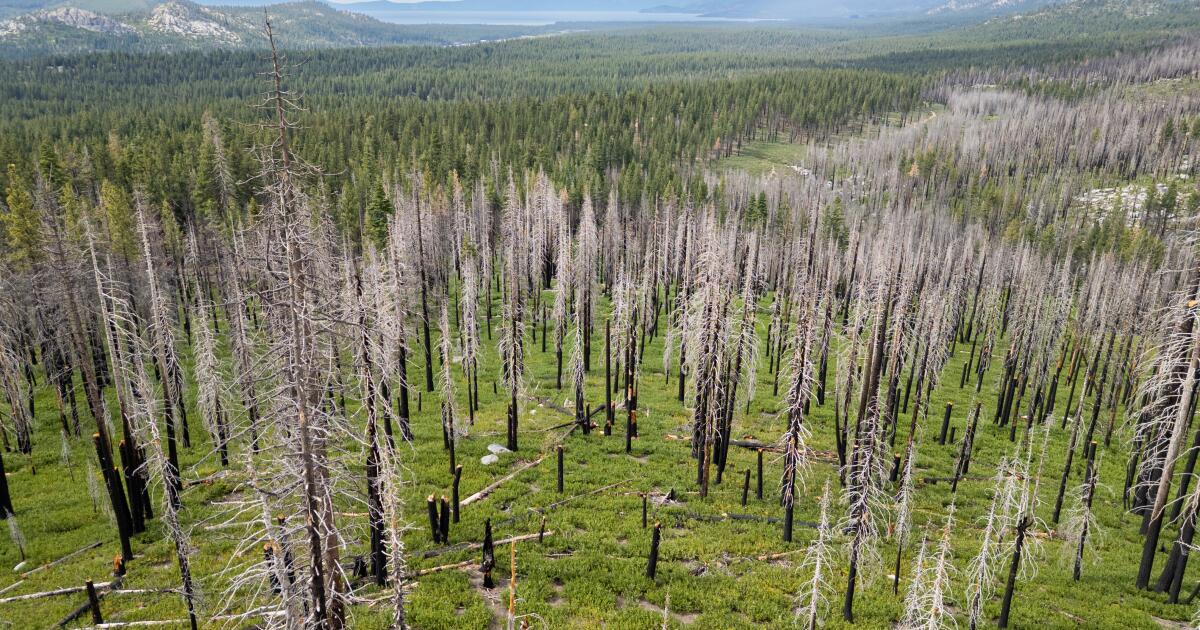
‘I’d rather my house burn down than get cancer’: Herbicide use upends California’s fight to save forests
-
 Sports25 minutes ago
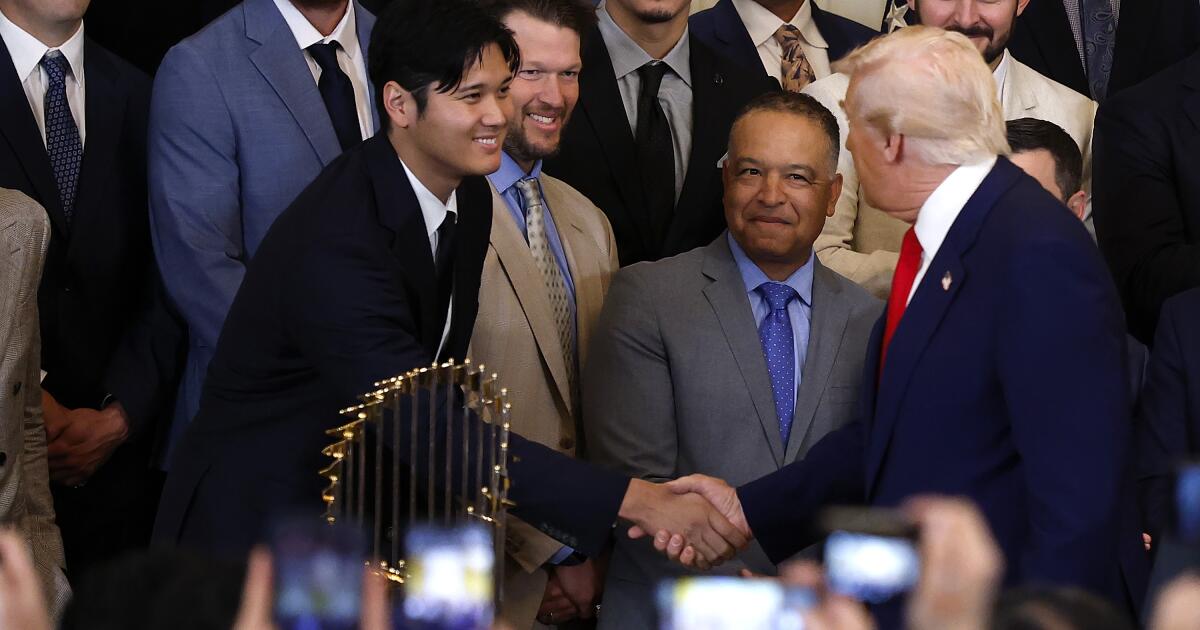
Dodgers scheduled to visit White House in late July to celebrate 2025 World Series win
-

 World35 minutes ago
Former US Olympian pleads not guilty in DC reflecting pool vandalism case
-
 News1 hour ago
Former Olympian pleads not guilty in reflecting pool vandalism charges


