Florida
Bringing marine life back to South Florida’s ‘forgotten edge’


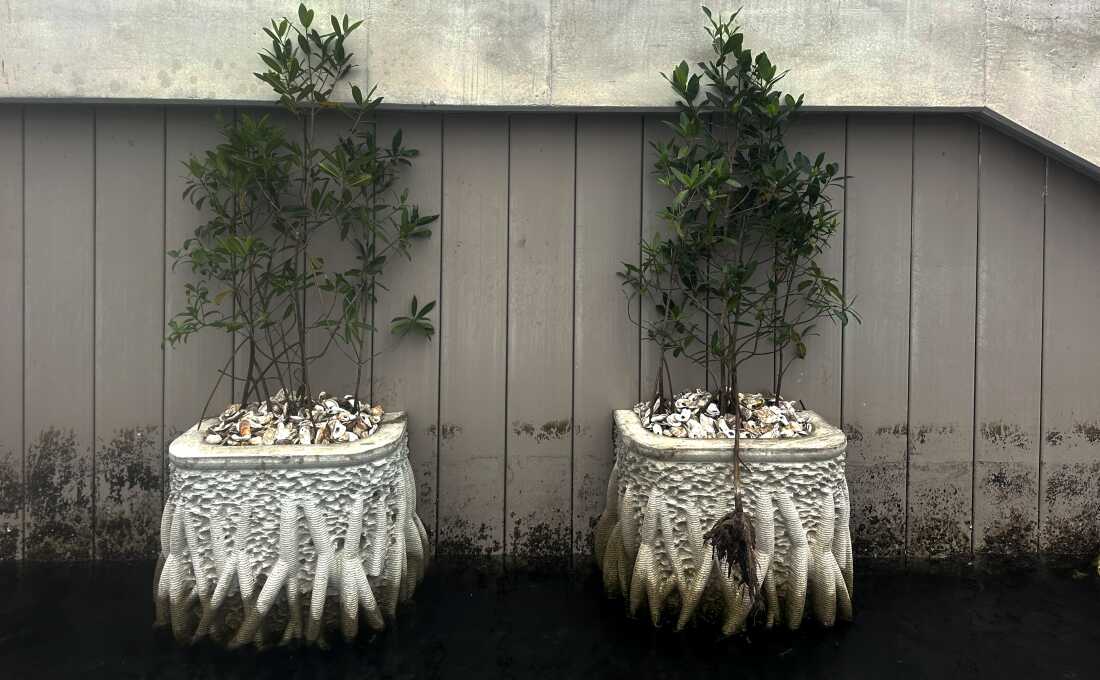
An experiment in nature-inspired design is underway in a South Florida residential canal. Two mangrove planters are being installed on a new seawall to provide habitat for marine wildlife.
Nathan Rott/NPR
hide caption
toggle caption
Nathan Rott/NPR
POMPANO BEACH, Fla. — At the back edge of a backyard, in a dead-end South Florida canal, Arthur Tiedeman is drilling holes into the face of a seawall his marine construction company recently installed.
The seawall is a newer design of reinforced concrete encased in vinyl. It’s a smooth, hardened ledge at the intersection of land and sea that’s designed to protect property and make the coastline more habitable for people.
The problem, Tiedeman says, is that it makes the coastline not very habitable to anything else. “It’s not a natural shoreline like mangroves and sand,” he says. “It’s just a straight giant wall.”
That’s why he and his crew are on a bobbing barge outfitted with a crane, installing two first-of-their-kind planters that, when hung, will house two living mangrove trees on the otherwise featureless wall.
The planters are pockmarked and rough-cut; etched and grooved to mimic oyster reefs and mangrove roots. They’re a wildlife-focused add-on — one of the latest products in a fast-growing commercial market that’s selling homeowners and municipalities on a more holistic approach to marine infrastructure.

“Even these tiny little pores you get, those are little pockets that tiny organisms will start to take up residence in,” says Keith Van de Riet, the designer of the new planters.
Nathan Rott/NPR
hide caption
toggle caption
Nathan Rott/NPR
“We’re in a time period — a golden era — where humanity has kind of realized what we’ve done here,” Tiedeman says, gesturing up the dredged canal. With the erasure of so much natural habitat, pollution, overfishing and climate change, populations of popular fish like grouper and snapper are declining. Water quality in many canals and bays is worsening.
There’s a growing recognition that municipalities and property owners need to “improve the shoreline and build infrastructure with the environment in mind,” Tiedeman says.

“That’s what makes all these properties worth what they’re worth,” he says, referencing the mansions lining the canal. “The water. And the enjoyment of the water.”
A “forgotten edge”
The new mangrove planters were designed by Keith Van de Riet, a professor at the University of Kansas, who’s helping with their installation.
An architect by training and an avid angler, Van de Riet has long been interested in finding ways to improve the design of coastal infrastructure so that it benefits more than just people. For more than a decade, his primary focus has been on seawalls, what he calls “a forgotten edge.”

“I’ve always wanted to be near water,” says Keith Van de Riet. “And the idea of creating things that are beneficial for people and other species — I find that appealing.”
Nathan Rott/NPR
hide caption
toggle caption
Nathan Rott/NPR
And the reason, he says, is simple: In many places it’s the only shoreline left. “This all would have been meandering mangroves, maybe a mangrove creek here that [people] just blew out,” he says.
By dredging the waterway and barricading its edges, people have taken that soggy horizontal plane — a life-rich intertidal zone that supports oysters, crabs, fish and birds — and collapsed it, he says, “into a vertical wall with a single dimension to it.”
Marine organisms don’t like homogeneity. They like nooks and crannies — places to hide.
“The more texture the better,” Van de Riet says.

For water-filtering oysters, a keystone species in marine habitats, concrete seawalls — the standard in South Florida for more than a century — can provide some of that texture. Van de Riet points to clusters growing on a concrete ledge just below the scumline, just one property down from where his planters are being installed.
It’s a sliver of habitat compared to what they’d have in a natural environment, he says, but a critical one. And it’s now at risk of shrinking further, as many of South Florida’s concrete seawalls, built in the post-World War II boom, are hitting the end of their lifetime — what Tiedeman calls the “seawall pandemic.” Those seawalls, it turns out, are increasingly being replaced with steel or vinyl — smooth, featureless products that offer no welcoming texture for living things.

Arthur Tiedeman measures the distance between scumline and the seawall’s top to determine where to put the planters.
Nathan Rott/NPR
hide caption
toggle caption
Nathan Rott/NPR
“We’re taking that last 1% [of habitat] that they’re clinging to and changing the material,” Van de Riet says, “pulling the rug out from under these oysters.”
His hope is that his mangrove planters will help sustain populations of those oysters through the transition.
Mimicking nature
Globally, there’s a lot of innovation happening and new products like Van de Riet’s becoming available, says Rachel Gittman, a coastal ecologist at East Carolina University.

Property owners can now buy artificial reef balls or request vertical oyster gardens. Miami Beach recently installed its first “living seawall,” a wide mangrove root-etched panel, designed to provide habitat and protect against storm surge. In southwest Florida, a similar-style wall panel, created by Van de Riet, has been in the water since 2016.
“There’s a push towards: Can we mimic nature — and can we reproduce it in a way that’s going to support biodiversity or productive fisheries or erosion protection?” Gittman says.
She’s not convinced all of the new products will work. It’s hard to emulate nature.
“But in places where the habitat has already been lost or someone’s just going to put in a regular seawall, I think it’s a better option,” she says. “Even a small little oyster reef can support a lot of organisms.”
The real challenge will be creating enough of them. A study published in 2021 found that only about 15% of the world’s coastal regions remain ecologically intact. Restoring those coastlines, Gittman says, will require significant policy changes from national and local governments.
She adds that in places like South Florida, where coastal infrastructure is being updated to accommodate rising seas and the vast majority of coastline is privately owned, it will take buy-in from homeowners as well.
“We are in this critical period where we could make huge leaps in terms of how our infrastructure is designed in this country if we make thoughtful investments and we don’t just build exactly what we had 50 years ago,” she says. “I hope that’s not what we do. But we don’t always learn from our mistakes.”
When it comes to improving the built environment, Keith Van de Riet says, “We have to look at these hybrid models.” Incorporating parts of nature — like mangrove trees — into infrastructure.
Arthur Tiedeman/APH Marine Construction
hide caption
toggle caption
Arthur Tiedeman/APH Marine Construction


TAMPA, Fla – New SNAP restrictions will start Monday in Florida.
What we know:
These changes will ban the purchase of many sugary sodas, energy drinks, candy and ultra-processed, shelf-stable prepared desserts.
Hunger Free America, an advocacy group, is against these restrictions.
Joel Berg, the CEO, said some regulation is a good thing, but he wants to see it support access to healthy foods as a choice.
“We do support mandates to mandate that healthier food is available in stores that do accept SNAP,” Berg said. “So, it makes a lot more sense to make it easier to get healthier food.”
Berg said these restrictions are unnecessary in achieving a healthier America.
“We should make America healthier again by making healthy food more affordable, convenient and physically available,” Berg said. “We shouldn’t micromanage the eating patterns of adults to try to achieve that goal.”
The other side:
This is part of the Make America Healthy Again initiative.
U.S. Secretary of Agriculture Brooke Rollins said, “Under the MAHA initiative, we are taking bold, historic steps to reverse the chronic disease epidemic that has taken root in this country for far too long.”
What they’re saying:
Berg said that these changes, on top of cuts to the program nationwide, will increase hunger.
“It’s not that low-income Americans don’t want healthier food; it’s that they can’t afford healthier food,” Berg said.
This coincides with the announcement that there will be cuts to WIC, the Special Supplemental Nutrition Program for Women, Infants and Children, which supplies food to mothers and young children.

“President Trump’s budget just announced that he’s proposing taking away fruits and vegetables from the WIC program for pregnant women and children under five,” Berg said. “So, they’re taking away healthier food.”
The WIC cuts would take away $1.4 billion in fruit and vegetable benefits from 5.4 million people.
Big picture view:
The SNAP changes come as part of the MAHA movement and include more than 20 other states that will implement changes over the next two years.
The Source: Information in this story comes from WIC, SNAP and interviews done by Fox 13’s Danielle Zulkosky.

WEST PALM BEACH, Fla. (CBS12) — The engines are revving for one final day of high-stakes bidding and family fun at the South Florida Fairgrounds.
Barrett-Jackson’s Palm Beach auction reaches its grand finale today with an action-packed “Super Saturday” lineup, promising to close out the weekend with a full slate of collector car sales, live entertainment, and fan attractions.
“Super Saturday,” presented by Seminole Casino Coconut Creek, officially kicks off at 8 a.m. when gates, food courts, and the exhibitor marketplace open to the public.
What to expect
- 8:00 a.m. – 11:00 a.m.: The Fantasy Bid presented by Dodge begins early, running in tandem with the automobilia auction in the arena.
- 9:00 a.m. – 5:00 p.m.: Thrill-seekers can catch Dodge thrill rides on the Barrett-Jackson Performance Track.
- 10:00 a.m.: New amenities open to the public, including the Stella Artois, Staging Lanes, and Food Court patios, which offer shaded seating and auction views.
- 10:45 a.m.: The national anthem will be performed in the auction arena, signaling the start of the main collector car auction at 11 a.m.
- Afternoon Entertainment: DJ sets run from noon to 5 p.m. across the various patios, and a detailing clinic by Adam’s Polishes is scheduled for 2 p.m. near the South Showcase.
For those unable to attend, the whole event will be livestreamed throughout the day on the Barrett-Jackson website and the HISTORY channel from 11 a.m. to 6 p.m.
Today’s finale comes on the heels of a high-energy Friday that saw significant sales and notable celebrity interest.
Star power was evident throughout the day, particularly with vehicles tied to the Busch family. A 1957 Ford Thunderbird Convertible owned by Samantha Busch and a 1969 Oldsmobile 442 Custom Coupe were among the day’s heavy hitters, each fetching $159,500. Kyle Busch’s 1956 Chevrolet Bel Air Custom Coupe also drew a strong bid, selling for $143,000.
Other Friday highlights included:
- 1968 Ford Mustang Eleanor Replica: $137,500
- 2004 Dodge Viper SRT-10 Mamba Edition: $132,000
- 1972 Chevrolet K5 Blazer Custom SUV: $126,500
- 1957 Ford Thunderbird Custom Convertible: $121,000
BE THE FIRST TO COMMENT
With a festival-style atmosphere and high-profile sales driving momentum, organizers expect a busy crowd for the final push at the auction block today.

ORANGE COUNTY, Fla. (CBS12) — A quiet Monday turned into a frantic race against time when a deputy stepped in to save a choking 1-year-old’s life.
According to the Orange County Sheriff’s Office, deputies responded to a call about a 1-year-old baby choking. Upon arrival, the responding deputy performed life-saving procedures to help the child breathe again.
See also: Two arrested after 6-year-old arrives at Florida school with bruises, deputies say
Body camera video shows a deputy holding the baby, flipping it over on its stomach, and beginning to pat the baby’s back.
BE THE FIRST TO COMMENT
When the baby begins to cry, the deputy is heard saying, “he’s good.”
-

 World1 minute ago
Bulgaria votes in eighth election in five years
-
 News31 minutes ago
Real estate investors are buying up long-term care facilities. Residents can suffer
-

 Detroit, MI3 hours ago
Former Piston shows Detroit what they’re missing as he dominates next to LeBron
-

 San Francisco, CA3 hours ago
Eastbound I-80 closure in San Francisco snarls traffic, slows business
-

 Videos3 hours ago
Can Keir Starmer survive the latest Mandelson revelations? | BBC News
-

 Dallas, TX3 hours ago
Petar Musa’s Brace Not Enough as FC Dallas Draws LA Galaxy 2-2
-

 Miami, FL3 hours ago
MLS: Messi double helps Inter Miami slay Rapids in front of huge crowd
-

 Boston, MA3 hours ago
From across Boston they flock to play for Latin Academy boys’ tennis, a co-op of 29 schools – The Boston Globe