Austin, TX
What is a pro-Palestine protest? Here’s why U.S. college students are protesting


Dozens of protesters at the University of Texas were arrested Wednesday during a peaceful, pro-Palestinian protest hosted on the campus by the Palestine Solidarity Committee.
“UT Austin does not tolerate disruptions of campus activities or operations like we have seen at other campuses,” the UT Division of Student Affairs said in a statement before the protest.
After about 45 minutes of the crowd marching south on the mall from the Gregory Gym area, Texas Department of Public Safety troopers and campus police ordered the protesters to disperse or “be arrested as per the penal code.”
Here’s why UT-Austin students are protesting:
What is a pro-Palestine protest?
Pro-Palestinian protests are demonstrations in support of Palestinian rights, typically calling for an end to Israeli occupation of Palestinian territories.
Protests began in the wake of the ongoing war between Israel and Hamas, triggered by the Palestinian militant group’s assault on Israeli communities Oct. 7, killing almost 1,200 people.
Israel’s subsequent bombardment and invasion of Gaza has killed tens of thousands of Palestinians — militants and civilians; men, women and children — and has fueled a dire humanitarian crisis.
Where is Palestine located?
Palestine is recognized as an independent state by the United Nations and more than 135 of its members, but it is not recognized by the U.S., according to History. The UN considers it a single occupied entity, but the official borders are undetermined, BBC News reported.
Though its borders have shifted over the years, Palestinian territories used to be what is now Israel, Gaza and the West Bank.
When searching for “Palestine” on Google Maps, the map zooms in on the Israel-Palestine region, and both the Gaza Strip and West Bank territories are labeled and separated by dotted lines. But there is no label for Palestine.
In an email statement, Google said it doesn’t label the borders because there isn’t international consensus on where the Palestinian boundaries are located.
Why are college students protesting?
The Palestine Solidarity Committee, a registered UT student group and a chapter of the national Students for Justice in Palestine, planned a protest Wednesday at the UT campus in solidarity with students across the U.S., including at Columbia University, Yale University and New York University, who are calling for an end to the Israel-Hamas war.
Across the country, pro-Palestinian student protesters have occupied campuses in tent encampments this week in a campaign to urge their universities to divest, an action students over the decades have demanded from their schools’ administrators.

At pro-Palestinian rally at UT-Austin, protesters arrested
Multiple protesters on UT-Austin’s campus were arrested during a pro-Palestinian rally held by students.
What is ‘divest’?
The word “divest” refers to diverting money from a university’s endowment — the pool of money a college has and tries to grow through investments. Some of the biggest university endowments in the country total nearly $50 billion and comprise thousands of funds.
The protesters opposed to Israel’s military attacks in Gaza say they want their schools to stop funneling endowment money to Israeli companies and other businesses, like weapons manufacturers, that profit from the war in Gaza.
“The university would rather enforce and put money into policing our communities and policing their own students then they would to supporting them,” said Anachí Ponce, a UT student who attended the protest. “These are students who are protesting a genocide and the lack of action from UT administration for the way that they haven’t been super helpful against hate crimes against Muslim students on campus.”
“It’s like, why is our money being used to fund bombs overseas?,” said Layla Saliba, a student protester researching endowment investments with the group Columbia University Apartheid Divestment. “Let’s reinvest this money in our community instead,” she said.
In addition to divestment, protesters across the U.S. are calling for a cease-fire and student governments at some colleges have also passed resolutions in recent weeks calling for an end to academic partnerships with Israel.
Are universities investing in Israel?
Protesters have called for a halt to investments in Israel, but experts say that might be too simplified a take on what colleges have done with their funds. To begin with, it’s difficult to define what an “investment” in Israel entails, said economist Sandy Baum, a senior fellow at the Urban Institute who studies college finances.
She said bigger investments are more obvious than smaller ones tucked away in mutual funds — an investment tool that pools money and spreads it out over many assets, and a type of financial tool on which many colleges rely.
Universities hire private companies to manage their endowments to preserve their funds over the long run, Baum said.
Debates about the investments of college endowments are complicated, Baum said, because some university stakeholders argue the money needs to produce the biggest return on investment possible to fund teaching and necessary programming and services.
“The purpose of the endowment is to have money that will allow the university to permanently provide educational opportunities so that they don’t have to go out and raise new money every year to continue operating,” she said.
The bigger a university’s endowment, the more is at stake. That’s one reason why pro-Palestinian student protesters at wealthy universities are fighting so hard this week, she said. There’s a lot of money involved.
“There are always going to be differencesof opinion about what you don’t want to invest in,” Baum said.



AUSTIN (KXAN) — Small hail peppered the Austin area as strong thunderstorms moved through Saturday.
A few of the storms dropped rain and up to pea-sized hail in San Marcos, Dripping Springs and the Austin metro area.
A Severe Thunderstorm Warning was issued for Williamson County around 8:15 p.m., and then canceled shortly after. However, it was enough for the Two Step Inn music festival in Georgetown to cancel shows for the rest of the evening. Event organizers say the festival will run as planned Sunday.
KXAN’s First Warning Weather team is monitoring the storms. We will update this post as the evening continues.

AUSTIN (KXAN) — Governor Greg Abbott and the Texas Society Sons of the American Revolution unveiled a new monument at the Texas State Cemetery on Saturday, dedicated to Texas Revolutionary War soldiers.
“We must educate every generation about why it is that America grew from a tenuous 13 colonies into the most powerful country in the history of the world,” said Governor Abbott. “This monument here is an enduring testament to the heroes who fought for the freedom that is unique to America.”
The monument was dedicated to 69 soldiers who fought in the American Revolutionary War and later settled in Texas, according to a press release.
Among those that were honored, Abbott recognized:
- José Santiago Seguín, grandfather of Texas Revolutionary hero Juan Seguín.
- Peter Sides, who fought in the 2nd Battalion of the North Carolina Regiment of the Colonial Army, and was later killed in the 1813 Battle of Medina, fighting for Mexican independence against Spain.
- Antonio Gil Y’Barbo, the founder of Nacogdoches.
- William Sparks, who fought as a mounted rifleman in the American Revolution and later settled in Texas. He had two sons and two grandsons who fought in the Texas Revolution.
“This year marks the 250th anniversary of the American Revolution, which not only gave freedom to the British colonies of North America, but inspired movements for freedom and liberty all over the world,” said TSSAR President Mel Oller. “Texans played a role in the war too, and it’s important to recognize them, and the sacrifices they made for our freedom.”
At the monument unveiling, Abbott was also inducted into the Sons of the American Revolution and received its Silver Good Citizenship Medal.
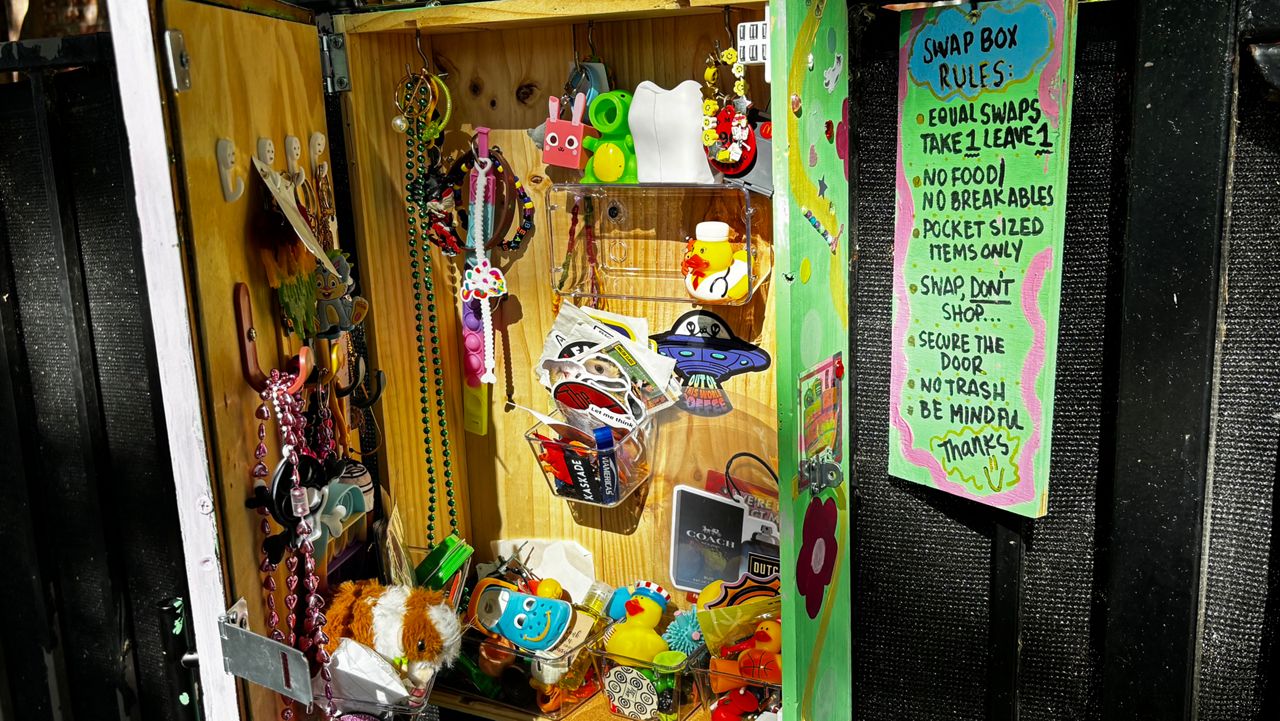
AUSTIN, Texas — Inside a green wooden box mounted to a steel fence, a treasure trove of trinkets awaits. Just a few miles north is another goodie box, this time covered in leopard print and inside a craft studio. Farther east, a simple white trinket box sits mounted on a wooden pole, decorated with stars and a crow saying, “Thanks for visiting!”
These boxes, filled to the brim with stickers, keychains, jewelry, collectibles and more, are known as trinket trade boxes. Austin has seen a sudden surge in these boxes over the last few months, and despite their varying locations, one sentiment ties them all together: trinket trading is a fun way to bring a bit of joy to the community.
“Little things that bring people joy is so important right now, which I think a lot of us can agree with, and I’ve seen all sorts of people use the box so far,” said Anna Arocha, whose trinket box is in The Triangle neighborhood downtown. “Little kids and all the way up to people in their 50s and 60s, I’ve seen stop by.”
Trinket trading operates on a simple system of take something, leave something. People can swap a toy car for a lanyard, a bracelet for a Sonny Angel, or a Pokémon card for a rubber duck.
“There was somebody who was just walking by with their kid in the stroller, and there was a finger puppet inside of the box, and I saw her swap something out and walk away with the little finger puppet,” Arocha said. “And it was just such a cute moment to see a mom and a kid enjoy something like that.”
Arocha put her crafting skills to work and made her green wooden box in just one day using craft wood and a wine crate last month. Amy Elms opted for a small, white junction box to ensure it could withstand harsh Texas weather. Ani’s Day & Night on East Riverside, which has a large outdoor space for picnic tables and food trucks, gave Elms permission to place her trinket box on their property in January.
Ally Chavez used her own property, Create! Studio ATX on West Anderson Lane, for her leopard-print box that opened in March.
“There wasn’t a ton up here in the north area, so we just kind of wanted to put it together and put it up for the studio just as a way to connect with the community in a way that no one has to spend money,” Chavez said.
Since their debuts, all three trinket boxes have garnered thousands of interactions on social media. When Arocha posted about the opening of her box in March, she racked up 100,000 views on TikTok. But with the excited comments came a bit of negative attention, and her cameras caught a thief trying to take all the trinkets. Arocha now locks the box at night.
“If somebody wants to do that, so be it,” Arocha said. “We can start over, and if the joy that it brings outweighs that every time, I think it’s worth doing.”
Arocha, Elms and Chavez’s boxes are now registered on a website called Worldwide Sidewalk Joy, alongside all the others in Austin and across the globe, as trinket trading grows to become a kind of new, modern geocaching.
“Honestly, it’s been I think even better than I expected so far,” Elms said. “I’ve had people… visiting Austin from out of town, and they’re making it a stop during their visit. I’ve also had multiple people reach out to me to ask how they can start their own trinket trade box, too, which I really love.”
-

 Culture13 minutes ago
Famous Authors’ Less Famous Books
-

 Lifestyle18 minutes ago
Sunday Puzzle: For Mimi
-

 Technology31 minutes ago
The future of local TV news has taken a Trumpian turn
-

 World37 minutes ago
Pope Leo says remarks about world being ‘ravaged by a handful of tyrants’ were not aimed at Trump: report
-

 Politics43 minutes ago
Trump renews bridge, power plant threat against Iran in push for deal, mocks ‘tough guy’ IRGC
-

 Health49 minutes ago
Loneliness may be silently eroding your memory, new research reveals
-

 Sports55 minutes ago
ESPN’s Stephen A Smith hears boos from WrestleMania 42 crowd
-

 Technology1 hour ago
Chinese robot breaks human world record in Beijing half-marathon