Arkansas
Prison board will vote Friday on Arkansas prison land purchase as residents stay angry • Arkansas Advocate


Despite public outcry about a lack of transparency, the Arkansas Board of Corrections will vote Friday morning on the state’s $2.95 million purchase of 815 acres in Franklin County for a prison.
Board Chairman Benny Magness confirmed the board’s meeting agenda during a town hall Thursday night in Charleston, where residents defiantly opposed locating a prison in their community.
“As chairman I’m calling the vote tomorrow, and I’m not going to be a part anymore of being put in a position to defend ourselves that we’re stalling the building of a 3,000-bed prison,” Magness told reporters following the meeting.
State officials for years have pursued construction of a new prison to alleviate overcrowding in existing facilities and county jails. The state spends roughly $30 million a year to house about 3,000 inmates in county facilities, according to the governor’s office. More prison beds also likely will be needed in the future due to the Protect Arkansas Act. Backed by Gov. Sarah Huckabee Sanders, the 2023 law overhauls the state’s parole system and eliminates the possibility of parole for the most serious offenders.
“The process we started in ‘22 was not getting the results we needed, so they, and I say they, the governor’s office, chose to do this process,” Magness told reporters.
Hundreds of local residents seeking answers about the state’s decision to purchase land for the prison in the Vesta community north of Charleston packed the local middle school’s gymnasium Thursday evening.
Community members as well as state and local officials said they were not involved in the decision-making process and were blindsided by the governor’s formal announcement about the purchase last Thursday.
The governor’s office touted the prison as an investment in public safety and economic development. The prison is expected to create several hundred construction jobs and employ 800 once it’s operational, according to a press release.
A few hours prior to the town hall, Corrections Secretary Lindsay Wallace emailed the media letters from the mayors of Calico Rock and Malvern citing the positive aspects of having prisons in their communities.
Security and safety, especially for their children and grandchildren, are major concerns for Jo Stubblefield and her son and daughter-in-law, Brandan and Rosa Cummings, who live on property that shares a fence line with the proposed prison site. Jo Stubblefield, whose husband is a cousin of Sen. Gary Stubblefield, R-Branch, told the Advocate they “were all very upset, very upset” about the proposed prison site.
The trio questioned how the state could pay for and staff a new prison when other local businesses are struggling to find employees.
“They can’t even pave the roads around here, yet you can buy a bunch of land without nobody knowing? I mean that just blows my mind,” Brandan Cummings said.
Rosa Cummings said a new prison isn’t needed and that releasing nonviolent criminals, like people who’ve been arrested for drugs, would free up bed space. While she hoped that state officials would listen to the community’s concerns Thursday, she said it wasn’t likely.
“I mean it’s the government. We don’t feel too confident obviously, that’s why we heard about it just the other day,” she said.
GET THE MORNING HEADLINES.
State legislators and members of the Department of Corrections and Board of Corrections attended the town hall Thursday. Local residents submitted questions ahead of time that were read by a moderator, including questions about costs and why the community wasn’t notified sooner.
Former Corrections Secretary Joe Profiri said the land purchase was not made public sooner because of concerns over a bidding war. Profiri was hired as a senior adviser to the governor after the prison board fired him in January.
“Ultimately what we were looking at was to make sure that the price of the land didn’t escalate and that we were good stewards of the taxpayer dollars to make sure that we didn’t pay more than the land was worth,” he said.
Profiri said the cost of the prison will depend on what design is ultimately selected, but he noted $330 million has been set aside by the Legislature and there’s another $75 million in reserves. Officials said they looked at a number of sites over several months. Profiri said they chose to purchase the Franklin County property about three months ago.
Magness said he learned about the decision two weeks ago, while state lawmakers like Rep. John Eubanks, R- Subiaco, and Stubblefield said they received word just a few days prior to last week’s formal announcement.
Stubblefield criticized the lack of transparency and said he was going to explore pursuing legal action because he believed officials broke state law by not notifying the public sooner. Wallace said lawyers she spoke with who reviewed the statute in question believed it didn’t apply to the Department of Corrections.
While community members were not allowed to ask questions Thursday night or bring signs, attendees made their opinions known by cheering or booing, and shouting phrases like “we don’t want it,” ‘we don’t consent,” “disrespect” and “liar.”
The town hall concluded after about an hour and a half, and Jo Stubblefield left unsatisfied with state officials’ responses.
“I feel like the governor’s office didn’t answer any questions they were asked,” she said.

The Board of Corrections’ special meeting on Zoom is scheduled to begin at 9 a.m. Friday. The agenda includes hiring a public information officer and voting on the Franklin County land.
YOU MAKE OUR WORK POSSIBLE.



Temperatures will climb to the upper 90s today and heat index values will get close to 105° this afternoon. There are heat advisories today for part of west and southwest Arkansas.
Today will bring a slight chance of showers or thunderstorms late in the day in Central Arkansas.
Friday will also bring a slight chance of showers and thunderstorms with very hot weather.
Rain chances increase and temperatures drop this weekend when a cold front moves through Arkansas.


Arkansas
ARKANSAS SIGHTSEEING: Randolph County can claim many firsts in Arkansas | Northwest Arkansas Democrat-Gazette

Copyright © 2026, Northwest Arkansas Newspapers LLC. (NWA Media)
All rights reserved.
This document may not be reprinted without the express written permission of Northwest Arkansas Newspapers LLC
Material from the Associated Press is Copyright © 2026, Associated Press and may not be published, broadcast, rewritten, or redistributed. Associated Press text, photo, graphic, audio and/or video material shall not be published, broadcast, rewritten for broadcast or publication or redistributed directly or indirectly in any medium. Neither these AP materials nor any portion thereof may be stored in a computer except for personal and noncommercial use. The AP will not be held liable for any delays, inaccuracies, errors or omissions therefrom or in the transmission or delivery of all or any part thereof or for any damages arising from any of the foregoing. All rights reserved.


Fort Smith Historic Site: Law, conflict and the West
Explore Fort Smith Historic Site, where westward expansion, federal justice and Native American history shaped life on the American frontier.
A former Arkansas Tech University graduate and commander of the U.S. Army Intelligence and Security Command is being remembered with two posthumous honors recognizing his lasting influence on the nation’s military intelligence operations.
The late Maj. Gen. Gary W. Johnston, a 1987 Arkansas Tech graduate and Russellville native, was honored during a dedication ceremony June 25 at Fort Huachuca, Arizona, where the Army officially named a newly consolidated military intelligence complex the Major General Gary W. Johnston Consolidated Mission Facility.
Johnston also was posthumously inducted into the Military Intelligence Hall of Fame for helping reshape Army intelligence through the integration of emerging technologies, including big data analytics, artificial intelligence and machine learning.
The new facility serves as a central hub for U.S. Army Intelligence and Security Command (INSCOM) operations at Fort Huachuca, known as the “Home of Army Intelligence.” It houses some of the Army’s most critical intelligence personnel and brings together units that had previously operated from aging buildings spread across the installation.
Army officials said the previous arrangement created operational challenges, including limited secure workspaces, outdated infrastructure and additional security requirements. Beginning in 2018, INSCOM launched an effort to consolidate those missions by renovating two existing buildings into a 16,300-square-foot intelligence operations center designed to improve collaboration and security.
The facility now houses INSCOM G3’s Detachment 52, elements of the U.S. Army Counterintelligence Command, representatives from the Ground Intelligence Support Activity, an emerging Foundry program element and other intelligence organizations.
Among those attending the dedication were Johnston’s wife, Brig. Gen. Amy Johnston, daughter Lauren Woodworth and granddaughter Arabella Woodworth.
Maj. Gen. Rhett R. Cox, commanding general of U.S. Army Intelligence and Security Command, said the building represents more than a new workplace.
“As we dedicate the U.S. Army INSCOM Major General Gary W. Johnston Consolidated Mission Facility, we do more than just open a new facility… we consecrate a tribute to his indelible legacy,” Cox said. “This facility will stand as a constant reminder of his service, his vision and his unwavering commitment to our nation and to the soldiers he led. It will inspire future generations of intelligence professionals to emulate his example of leadership and selfless service.”
Retired Chief Warrant Officer 5 Kevin Boughton, former INSCOM command chief warrant officer, said Johnston envisioned closer collaboration between the Army’s intelligence training and operational communities.
Boughton said Johnston believed the distance between the Intelligence Center of Excellence and INSCOM’s operational units “shouldn’t be measured in miles,” but instead by “a seamless flow of data, doctrine, and talent” where operational experience and institutional knowledge move freely between soldiers in the field and those training the next generation.
Johnston graduated from Russellville High School in 1983 before earning a Bachelor of Science in Business Administration from Arkansas Tech in 1987. Through the university’s Reserve Officers’ Training Corps program, he received his commission as a U.S. Army officer.
During a military career spanning more than 34 years, Johnston served in command and staff assignments ranging from platoon level to senior leadership within the Army and Department of Defense. He deployed in support of Operation Desert Shield, Operation Desert Storm, Operation Joint Endeavor, Operation Enduring Freedom and Operation Freedom’s Sentinel.
In 2015, Johnston became the seventh graduate of Arkansas Tech’s Army ROTC program to attain the rank of general officer. He was promoted to major general in 2017.
He concluded his military career as commanding general of U.S. Army Intelligence and Security Command, overseeing approximately 17,500 personnel operating in more than 40 countries.
Army leaders credited Johnston with helping modernize military intelligence by laying the groundwork for the establishment of the U.S. Army Counterintelligence Command, which was formally created in 2022 after his retirement. He also led development of what became the Army Intelligence Data Platform, designed to incorporate advanced data analytics, artificial intelligence and machine learning into intelligence operations while supporting future large-scale combat operations.
Johnston also promoted data science education within the military intelligence community by partnering with George Mason University to provide specialized training for Army warrant officers.
Colleagues remembered Johnston not only for his strategic vision but also for his leadership style. Despite working in one of the Army’s most demanding operational environments, they described him as a source of humor, kindness and encouragement whose focus remained on the soldiers, civilians and contractors carrying out the intelligence mission.
Johnston retired from active duty in 2021 and died in January 2022.
His latest recognitions add to previous honors from his alma mater. Johnston was a member of the inaugural Arkansas Tech Army ROTC Hall of Honor in 2017 and was inducted into the university’s Hall of Distinction in 2019.
-
 Business3 minutes ago
California soccer fans sue StubHub after it fails to deliver expensive World Cup tickets
-
 Entertainment6 minutes ago
Lucas Museum to give free annual passes to South L.A. neighbors, host community preview day
-
 Lifestyle11 minutes ago
Meow Wolf taps famed L.A. animation house for its new Los Angeles venue
-
Politics18 minutes ago
Column: Trump decries ‘communism’ while his government takes ownership of companies
-
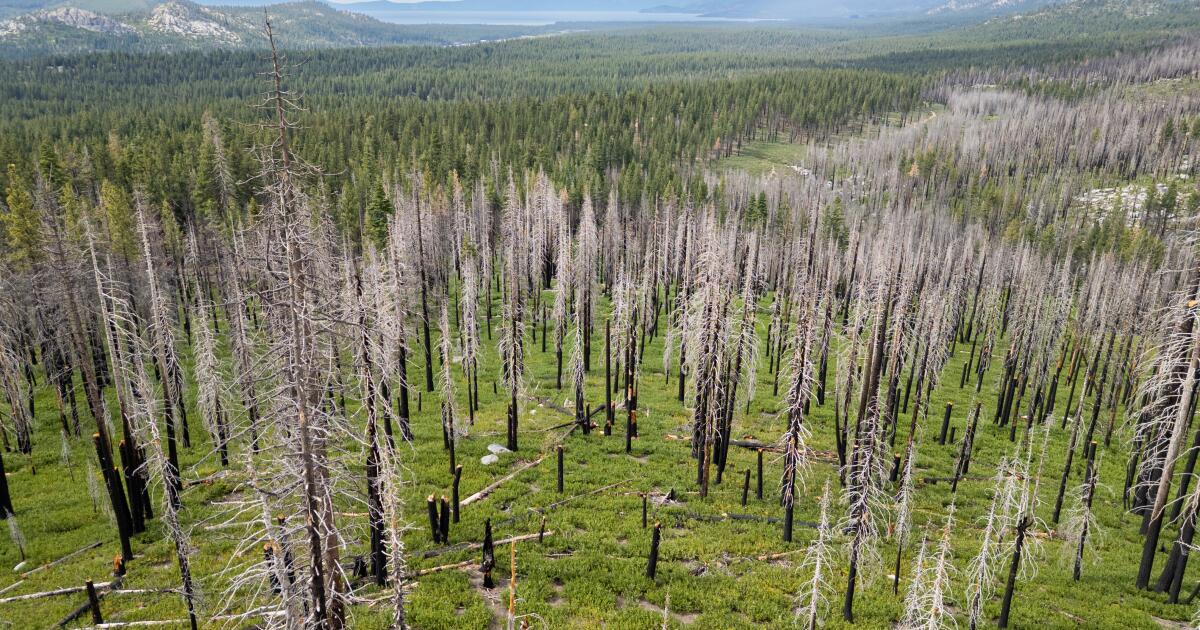 Science21 minutes ago
‘I’d rather my house burn down than get cancer’: Herbicide use upends California’s fight to save forests
-
 Sports26 minutes ago
Dodgers scheduled to visit White House in late July to celebrate 2025 World Series win
-

 World36 minutes ago
Former US Olympian pleads not guilty in DC reflecting pool vandalism case
-
 News1 hour ago
Former Olympian pleads not guilty in reflecting pool vandalism charges


