Uncommon Knowledge
Newsweek is committed to challenging conventional wisdom and finding connections in the search for common ground.


On February 16, the Alabama Supreme Court ruled that frozen embryos have the same legal rights as children in a move that immediately led the state’s largest hospital to pause in vitro fertilization (IVF) treatment.
The judgment by nine Republican justices was unanimous in then concluding that “unborn children are children.” This means that the Wrongful Death of a Minor Act applies to “all children, born and unborn, without limitation.” It is standard practice in IVF treatment for multiple embryos to be fertilized, with just one returned to the women’s womb and the others discarded.
As a result, clinics across Alabama put IVF treatments on hold; Gabrielle Goidel, who was just days away from retrieving her embryos after spending $20,000 in the hope of a child, told CNN that she had never “been this stressed in her life.”
A number of Republicans hit out at the ruling, including Donald Trump, by some margin the favorite for the 2024 GOP presidential nomination. He offered strong support for IVF treatment in a post on his Truth Social website.
Newsweek has created a brief summary of the nine Alabama Supreme Court justices who made the controversial ruling.
Tom Parker was elected as an associate justice to the Alabama Supreme Court in 2004 and became chief justice in 2018.
The Montgomery native studied at Dartmouth College, in Hanover, New Hampshire, before becoming a doctor of law at Vanderbilt University School of Law in Nashville, Tennessee.
Prior to joining the Supreme Court, Parker served as Alabama’s deputy administrative director of courts and also operated as a legal adviser to the chief justice.
Greg Shaw joined the Alabama Supreme Court in 2009 and was reelected in 2014, then again in 2020.
Born in Birmingham, Shaw studied at Auburn University, followed by Samford University’s Cumberland School of Law, after which he was admitted to the Alabama State Bar in 1982.
Shaw is married to Dr. Nicole Shaw, and the couple have two sons. They are both members of the Auburn United Methodist Church.
Alisa Kelli Wise was first elected to the Alabama Supreme Court in 2010 after which she was reelected in 2016 and 2022. Previously, she served as presiding judge of the court of criminal appeals and was the youngest women ever to serve on the court when first elected.
Raised on her family’s farm as a fifth-generation Alabamian, Wise received an undergraduate degree from Auburn University, then became a doctor of law at Faulkner University’s Thomas Goode Jones School of Law.
Wise and her husband, Arthur Ray, a former Montgomery County District Court Judge, are both members of St. James United Methodist Church.
Tommy Bryan was elected to the Alabama Supreme Court in 2012 and sworn in the following day. In 2018, he was reelected to the court without opposition.
Raised on a family farm in Crenshaw County, Bryan was educated at Troy University. He then studied at Jones School of Law.
Before being elected to the Alabama Supreme Court, Bryan served on the Alabama Court of Civil Appeals. He lives in Montgomery and attends the city’s First Baptist Church.
William Sellers, a specialist in tax litigation, was appointed to the Alabama Supreme Court in 2017 by Governor Kay Ivey to fill a vacancy.
He received a bachelor degree from Hillsdale College before studying for his juris doctorate at the University of Alabama and receiving a masters of laws in taxation from New York University in 1989. Before entering public service, Sellers practiced law for 28 years.
Sellers has been married to his wife for 35 years, and the couple have three children. They are both members of the Trinity Presbyterian Church.
Brady E. Mendheim, Jr. was appointed to the Alabama Supreme Court in 2018 by Governor Kay Ivey to fill a vacancy, before which he had served as a circuit judge for the 20th Judicial Circuit (Henry and Houston Counties) since 2009.
He was educated at Auburn University and Samford University’s Cumberland School of Law. Mendheim, Jr. is married and has three sons. Both he and his wife are members of First Baptist Church of Dothan.
In 2018, Sarah Hicks Stewart was elected to the Alabama Supreme Court, having previously served as a circuit judge in Mobile for 13 years, dealing with both criminal and civil cases.
Before joining the circuit bench in 2006, she spent 14 years in private practice, following her graduation from Vanderbilt Law School in 1992.
Stewart is married with three children and is active with Ashland Place Methodist Church.
James ‘Jay’ Mitchell was first elected to the Alabama Supreme Court in 2018, prior to which he worked as an attorney for Maynard, Cooper & Gale.
Born in Mobile, he graduated from Birmingham-Southern College and the University of Virginia School of Law, and also holds a master of arts from University College in Dublin, Ireland.
A member of Church of the Highlands, Mitchell is married and has four children.
Gregory Cook is the newest member of the Alabama Supreme Court, having been elected to the position in 2022.
He studied at Duke University before joining the United States Air Force where he reached the rank of captain. In 1991, Cook graduated from Harvard Law School, after which he went into private practice for 31 years.
Since 1991, Cook has been a member of the Dawson Memorial Baptist Church and he is married with three children.
Newsweek is committed to challenging conventional wisdom and finding connections in the search for common ground.
Newsweek is committed to challenging conventional wisdom and finding connections in the search for common ground.


TUSCALOOSA, Ala. (WBRC) – Pauline Love, the new head coach of the Alabama women’s basketball team, says her late college coach, Joye Lee-McNelis, is the reason she got into coaching.
Love played for Lee-McNelis at Southern Miss, describing her as a second mother. Lee-McNelis passed away last summer after a long battle with breast cancer.
Love said she once told Lee-McNelis she would never go into coaching, a conversation the two laughed about often.
“I used to tell her all the time, I would never do this. I would never put up with somebody like me or I would never work for somebody like her. I was like coach, you’re crazy. We used to laugh about it all the time and she was like you’ll see one day, you’ll see,” Love said.
Love had planned to work in the tech industry. Instead, she has spent 15 years in coaching.
“She pretty much paved the way for me. There’s no way I’d be sitting here if it wasn’t for her,” Love said.
Love returns to Tuscaloosa after previously serving as an assistant at Alabama. She was introduced as head coach in April, and was brought to tears when she mentioned Lee-McNelis during that introduction.
Her goals for the program are clear.
“I’m going to have a passion about it. I want to bring a Final Four to the University of Alabama and make Tuscaloosa proud,” Love said.
This year’s roster includes Spring Garden’s Ace Austin, back for her sophomore season.
Love said she wants her players to know that difficult times are part of the process.
“I can say for them, I’ve been there. I’ve done it. Just learn how to figure out and fight through hard things. You gotta do something hard and fight through it and I promise you it’s rewarding at the end of it,” Love said.
Love said she also wants to be a source of support for her players off the court, the same way Lee-McNelis was for her.
“I know we always get caught up in the money part of it, but I got a group of girls that doesn’t care about that. They want to care about making the fans happy and giving them something good to watch,” Love said.
Get news alerts in the Apple App Store and Google Play Store or subscribe to our email newsletter here.
Copyright 2026 WBRC. All rights reserved.

Alabama football fans are invited to a preseason pep rally Aug. 4 at the Tuscaloosa River Market.
The pep rally is part of the annual fall kickoff event hosted by the Tuscaloosa County chapter of the University of Alabama National Alumni Association.
The family friendly event will begin at 5:30 p.m. at the River Market, 1900 Jack Warner Parkway. Tickets, which include a barbecue dinner, cost $30 for adults and $15 for children ages 8 to 12. Children 7 years old and younger will be admitted for free.
The pep rally will feature live entertainment, a silent auction and a range of family-friendly activities. There will also be a cash bar with wine and beer.
Tickets can be purchased on the chapter’s website, tuscaloosacountyuaalumni.com. Membership in the local alumni chapter is not required for attendance.
University of Alabama President Peter Mohler and UA baseball coach Rob Vaughn will be part of the festivities.
Mohler began his duties as UA president on July 21, 2025.
Before being named UA president, Mohler spent nearly 15 years at Ohio State University, where he held senior leadership roles overseeing research, innovation and economic development. He also served as OSU’s acting president, providing leadership during a pivotal period for one of the nation’s largest public universities.
Mohler earned a bachelor’s degree in biology from Wake Forest University and a PhD in cell and molecular physiology from the University of North Carolina at Chapel Hill. He completed a postdoctoral fellowship at the Howard Hughes Medical Institute at Duke University Medical Center before joining the faculty at Vanderbilt University Medical Center.
Vaughn has been UA’s head baseball coach for three years, leading the Crimson Tide to the College Baseball World Series in 2026.
The Humble, Texas, native served as head baseball coach at Maryland for five seasons before coming to Tuscaloosa.
Vaughn played collegiate baseball at Kansas State, where his position was catcher.
Alabama begins the 2026 football season on Sept. 5 with a home game against the East Carolina Pirates. Kickoff is set for 11 a.m. at Bryant-Denny Stadium.
Other Alabama home games include Florida State on Sept. 19, South Carolina on Sept. 26, Georgia on Oct. 10, Texas A&M on Oct. 24, Chattanooga on Nov. 21 and Auburn on Nov. 28.
Reach Ken Roberts at ken.roberts@tuscaloosanews.com. To support his work, please subscribe to The Tuscaloosa News.

The Alabama teen charged in a heinous knife attack on his parents in their sleepy private community hissed that he was “gonna kill” his dad as he allegedly stabbed him — as new photos show the blood-soaked front porch where his butchered mom died.
The grisly scene unfolded on home surveillance footage Sunday night along Augustine Drive in the handsome Belforest complex — which captured the 17-year-old threatening his father, while allegedly knifing him.
“You can hear both of them coming out of the house, and there’s like one scream from the mom,” neighbor Shawn Scurry, 51, told The Post Wednesday.
“Then the dad is arguing with the [son] — and when I say arguing, I mean like, ‘Why are you doing this?’
“He’s basically saying, ‘I don’t want to die. Please stop. No.’ And then he’s repeating, ‘Somebody help me, please, help me’ very loudly,” Scurry said of the clip.
At one point, the audio captures the son “telling [the dad] he was gonna kill him.”
“Those words are in the video,” she said.
Meanwhile, a large pool of blood stained the front entrance of a neighbor’s home where cops say 37-year-old Samantha Baker was butchered around 9 p.m. Sunday.
Another haunting image exclusively obtained by The Post shows blood splattered and smeared across a glass window overlooking the spot where Samantha was found dead.
The bloodbath began after Samantha and her 46-year-old husband Lance Baker got into a heated argument with their 17-year-old son over a disciplinary issue inside their family home, Baldwin County Sheriff’s Office Captain Justin Correa told The Post Wednesday.
That’s when the boy — whose name is being withheld by police — turned a kitchen knife on his parents, allegedly stabbing them both “multiple times,” according to Correa.
The parents fled outside in a desperate bid to escape — but the attack continued.
Lance’s spine-chilling screams could be heard as he ran door to door down the block, leaving bloodied handprints on neighbors’ front doors while seeking help — with his son right on his tail, according to the traumatized neighbor.
“It was like fighting off a bee that keeps stinging you,” Scurry said, and claimed that another neighbor’s surveillance camera captured the teen repeatedly stabbing his father outside another nearby home.
Correa confirmed that doorbell camera footage of the assault had been handed over to police, and said at least “a few” of the neighbors were not home when Lance was looking for help.
Lance only “went to doors where people were on vacation — that’s why they didn’t answer, and that’s why he was becoming helpless,” Scurry claimed.
Scurry, who was home at the time, only became slightly aware of the horror unfolding when she spotted the Bakers’ dog wandering around her front door.
“I walked with the dog back to their house, rang their doorbell. Nobody answered, and I went around to the garage,” she recalled.
That’s when she heard cries in the distance.
“I heard … ‘Help me.’ I couldn’t find where it was coming from,” Scurry said, adding that she went back into her home after that.
The teen eventually retreated to his family’s home and called 911, said authorities, who described the attack as an isolated domestic matter.
Cops arrested him at the home without incident, according to Correa, who pushed back on reports that the alleged killer barricaded himself inside the house.
As emergency crews flooded their typically quiet street, Scurry said she stepped outside again and saw Samantha’s body before the coroner arrived.
“I saw her face down with stab wounds all over her back,” the shaken neighbor said.
Samantha, a realtor, was pronounced dead at the scene.
Lance, a US Army Reserve Battalion Commander with the 1184th Deployment and Distribution Support Battalion in Mobile, was flown to a local hospital in critical condition, according to cops.
As of Wednesday, the father of two was still in the hospital, where his condition had become stable, Correa said.
The teen, who will be tried as an adult, is facing charges of murder and attempted murder. He is being held in jail on a $1 million bond after his arraignment on Monday.
The family’s younger teen son was not at the home at the time of the attack, police said.
“A very sad event for sure,” Correa said.


Google turns old phones into cloud servers
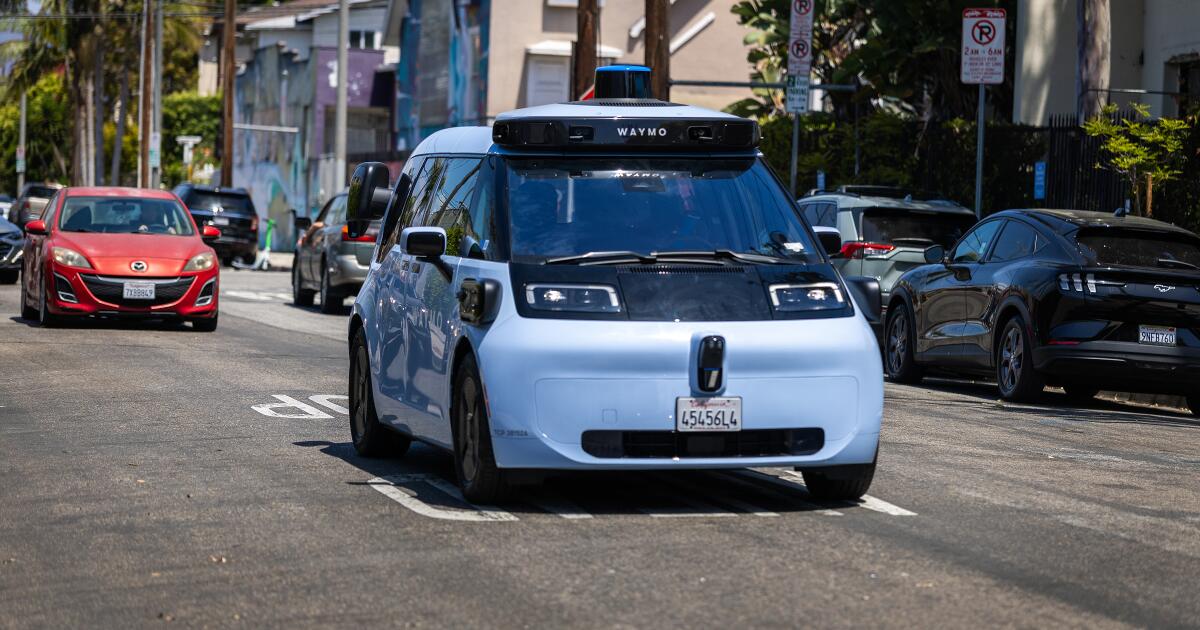
Waymo is starting robotaxi service in San Diego

‘Children of Blood and Bone’ author won’t see film after feud with star Amandla Stenberg
After her son’s death, she found a new purpose. ‘He’s whispering: Mom, this is your path’

Iran ceasefire is ‘over,’ Trump says, and orders additional strikes

Diarrhea-causing cyclosporiasis exceeds 1,000 cases in U.S. What Californians should know

Arthur Fery’s fairy-tale Wimbledon run puts British wild card on brink of history


Burnham on course to become next UK PM with backing of 322 Labour MPs


