Science
SpaceX Scrubs Launch of NASA SPHEREx and PUNCH Missions


Two NASA missions will have to wait longer for a launch aboard a single rocket. Both aim to unravel mysteries about the universe — one by peering far from Earth, the other by looking closer to home.
SpaceX on Saturday night announced on the website X around two hours before the scheduled launch time of 10:09 p.m. Eastern that it needed to continue checking the Falcon 9 rocket that was to lift the vehicles to orbit.
The company said it would announce the next launch attempt when it was possible to do so from Vandenberg Space Force Base in California.
The rocket’s chief passenger is SPHEREx, a space telescope that will take images of the entire sky in more than a hundred colors that are invisible to the human eye. Accompanying the telescope is a suite of satellites known collectively as PUNCH, which will study the sun’s outer atmosphere and solar wind.
What is SPHEREx?
SPHEREx is short for Spectro-Photometer for the History of the Universe, Epoch of Reionization and Ices Explorer. The mouthful of a name is fitting for the vastness of its goal: to survey the entire sky in 102 colors, or wavelengths, of infrared light.
The space telescope, which looks like a giant megaphone, will record around 600 images each day, capturing light from millions of stars in our cosmic backyard and even more galaxies beyond it. Using a technique called spectroscopy, SPHEREx will separate the light into different wavelengths, like a glass prism splitting white light into a rainbow of colors. The color spectrum of an object in space reveals information about its chemical makeup and distance from Earth.
Scientists will use data from SPHEREx to study how the total light emitted by galaxies has changed through cosmic time and to chart where frozen water and other ingredients essential for life exist across the Milky Way. A three-dimensional map of the way galaxies are unevenly clumped across the universe today — some parts thick with galactic gas and dust, others more sparse — will also help researchers deduce the physics behind inflation, the rapid ballooning of the cosmos that occurred a split second after the Big Bang.
What is PUNCH?
Led by the Southwest Research Institute, PUNCH stands for Polarimeter to Unify the Corona and Heliosphere. The mission consists of four satellites, each around the size of a suitcase.
One satellite carries a coronagraph, which will take pictures of the sun’s corona, or outer atmosphere.
The other three are equipped with cameras to capture wider views of solar wind, the hot plasma spewing from the sun’s corona that washes over the solar system.
Each satellite has three polarizing filters, through which only waves of light aligned in a particular direction can pass. That’s similar to the way polarized sunglasses block glare. By measuring polarized light, scientists can reconstruct the three-dimensional position, speed and direction of the solar wind as it streams away from the sun.
These measurements will help solar physicists understand the boundary where the sun ends and the solar wind begins. The satellites will also observe coronal mass ejections, violent blasts of solar material, as they evolve on their way to Earth. This data will help forecasters better predict the potential effects of space weather, from power outages to glittering northern lights.
Where are SPHEREx and PUNCH going?
Both missions will orbit approximately 400 miles above Earth’s terminator, the line separating day and night on our planet, circling over the north and south poles. This type of orbit is known as sun-synchronous because it keeps the spacecraft oriented in the same position relative to our sun.
That’s advantageous for PUNCH, as it allows the constellation of satellites to keep a clear view around the sun at any point along its orbit. It also allows SPHEREx to stay pointed away from the sun, avoiding infrared light from our home star that could mask fainter signals from faraway stars and galaxies.



Science
Trump administration seeks to limit federal funding that doesn’t ‘advance’ presidential policies

A new rule proposed by the White House Office of Management and Budget would fundamentally overhaul the way federal grants are awarded and overseen — a sweeping change that one scientific society said “would all but end the use of scientific merit in the selection of grants and programs across the government.”
Proposed in late May, the rule would give political appointees unprecedented control over federal grants for research, education and infrastructure, and specifies that government funds can only be spent on projects “aligned with administration policies and priorities,” according to a copy of the proposed rule.
The rule would also restrict research topics, limit U.S. scientists’ ability to collaborate with colleagues in other countries and make it easier for the government to suspend or cancel grants at any time.
The changes are intended to improve “transparency, accountability, and oversight for Federal awards” while “ensuring that American tax dollars are not wasted or misused,” according to the White House office.
But critics say that if the rule is implemented, the final sign-off for grants will no longer be in the hands of subject-matter experts within individual agencies, but in those of political appointees.
“This touches all parts of American life,” said Dr. Eric Rafla-Yuan, a psychiatrist who practices at the Veterans Administration and San Diego County’s psychiatric hospital.
“Control of how all of the federal grants and programs are funded will fall under a small group of highly partisan individuals who would have very few limits on how they spend these billions of taxpayer dollars,” said Rafla-Yuan, who also chairs the Committee to Protect Public Mental Health advocacy group. “This touches everyone’s life, even if they don’t realize it.”
OMB published the proposed rule May 29, opening a 45-day comment period that closes July 13.
Opposition to the proposed rule has mobilized multiple sectors of society. Professional groups representing cancer researchers, civil engineers, county governments, medical schools, housing agencies, city and municipal governments, nonprofits and others have publicly expressed concerns about potential consequences.
By midday Thursday, the Federal Register logged nearly 100,000 comments about the proposal, many of them expressing concern.
“I understand the need for oversight, fiscal responsibility, and accountability. That is not the issue,” wrote Jack Feldman, a neuroscientist who holds the David Geffen School of Medicine Chair in Neuroscience at UCLA. “The issue is whether scientific research is to be judged by scientific merit, or whether it can be approved, denied, or terminated according to broad political criteria that may change from one administration to the next.”
Crucially, the rule converts policies governing federal grants from “guidance” into binding regulations that all agencies would be required to follow. It would give political appointees power to override federal agencies’ merit-based reviews and mandate that a political appointee review decisions to ensure that all awards “demonstrably advance the President’s policy priorities.”
The elevation of political appointees in what were previously merit-based decisions has alarmed many scientists.
“The proposed rule changes would all but end the use of scientific merit in the selection of grants and programs across the government,” read a statement from the Planetary Society, a nonprofit dedicated to space research.
Researchers and science groups have also expressed concern about a section of the rule prohibiting the promotion of “theories of disparate-impact liability” — a legal concept that refers to policies that appear neutral but cause disproportionate harm to certain groups.
The section’s vague language and many loopholes could have a chilling effect on any research that studies the effects of a disease, policy or public health intervention on any specific group of people, Rafla-Yuan said.
As an example, he said, “if there’s a specific age range that is at higher risk for suicide, and we want to figure out, well, what’s going on with people that are aged 14 to 19 … we can’t do that under the wording in this rule.”
New restrictions on collaborations with scientists in other countries would hinder opportunities for U.S. researchers and limit innovation, said Joanne Padrón Carney, chief government relations officer for the American Assn. for the Advancement of Science.
“Science is a global enterprise. Especially in biomedical and public health fields, diseases don’t care about borders or government policies,” she said.
California’s congressional delegation sent a letter Wednesday asking OMB to rescind the proposal, outlining concerns about its impact on scientific innovation, U.S. competitiveness and the fiscal stability of local governments, many of which rely on federal grants for local services.
The proposed rule grants the federal government broad powers to suspend or cancel grants for any reason, introducing “unprecedented unpredictability into local governance,” the lawmakers wrote, “leaving vital infrastructure projects unfinished and abandoning vulnerable populations who rely on these services.”
Republican Sen. Susan Collins has also asked the White House to withdraw certain parts of the letter and extend the public comment period, saying the proposed rule as written would “harm small and rural communities, undermine scientific and biomedical research, and conflict with Congress’ control over the federal funding process.”

Several states, primarily in the Midwest and on the East Coast, have reported thousands of cases of cyclosporiasis, a parasitic disease that can cause an extended bout of debilitating diarrhea.
There have been cases of cyclosporiasis infection in California this year, but none has been linked to the current outbreak. Public health officials, however, have advice for residents to stave off illness.
Cyclosporiasis is an intestinal illness caused by several species of the microscopic parasite Cyclospora cayetanensis and is spread through the feces from an infected person that has contaminated food or water, according to the federal Centers for Disease Control and Prevention.
People become infected with the illness by consuming food or water that has been contaminated with the parasite — the infection is not transmitted from person to person.
The epicenter of the current outbreak is in Michigan, which has reported more than 1,000 cases since June, including 44 people who were hospitalized. The state typically reports about 50 cases of cyclosporiasis annually. Now there may be hundreds more infected as 17 states have reported numerous cases.
Officials say the true number of infected people is likely higher because some people recover without medical care and are not tested for the parasite.
In the United States, food-borne outbreaks of cyclosporiasis have been linked to various types of fresh produce imported from Latin America, including raspberries, cilantro, basil, snow peas and mixed salad, according to the California Department of Public Health.
Officials say those who have fallen ill became sick after eating food in the United States and did not report travel during the 14 days before they got sick.
Those who have contracted cyclosporiasis have ranged in age from 5 to 86.
There is currently no evidence of a single, multi-state cyclospora outbreak, meaning there isn’t a common source linking all cases, according to the CDC and the U.S. Food and Drug Administration, which are working with local public health authorities to investigate the cases in each state.
At this time, there aren’t any local outbreaks in California, and current cases of cyclosporiasis infection are not linked to the multi-state outbreak, according to the California Department of Public Health.
“From January to June 2026, California has reported 41 provisional cases of cyclosporiasis, compared to 80 cases during the same period in 2025,” said Beth Deines, information officer for the state agency.
Most of these cases are associated with recent international travel, she said.
“With the significant increase in cases in the Eastern and Midwestern states, we will monitor for cases that may be associated with travel to areas of the country that are experiencing these increases,” Deines said.
Similarly, officials with the public health department will look for clusters of cases that may indicate transmission occurring in California.
There have been four domestic cases reported since May 1.
Two of those who were infected reported that they had traveled to the Midwest. Investigation of these cases is ongoing. To protect patient privacy, the state public health department does not disclose where in the state the patients reside.
Symptoms of cyclosporiasis
Cyclosporiasis cases are reported year-round; however, infections are most common when temperatures are warmer, in the summer and early fall.
Infected people experience symptoms from two days to two weeks after consuming food or drinking water containing the parasite.
Some people who are infected, particularly those from areas where cyclosporiasis is endemic, may not have any symptoms.
Those who do develop symptoms could experience:
- Watery diarrhea
- Loss of appetite
- Weight loss
- Cramping
- Bloating
- Increased gas
- Nausea
- Fatigue
Less common symptoms may include:
- Vomiting
- Body aches
- Headache
- Low-grade fever
- Other flu-like symptoms
Cyclospriasis can be treated with a combination of antibiotics. Without treatment, symptoms can last from a few days to a month or longer.
Some symptoms, such as diarrhea, may go away and then return.
How to protect yourself
When traveling to areas where cyclospriasis is endemic — including tropical or subtropical regions — avoid drinking tap water. Also make sure hot food is served piping hot, health officials say, and cold food should be kept thoroughly chilled. Germs that cause food poisoning can grow quickly in lukewarm food.
A complete list of food and drink considerations provided by the CDC can be found here.
Most food-borne outbreaks of cyclosporiasis in the U.S. have been linked to various types of imported fresh produce, so public health officials in California and in states reporting infection cases recommend:
- Wash your hands with soap and water before and after handling or preparing raw fruits and vegetables. Note that hand sanitizer does not kill the parasite that causes cyclosporiasis.
- Wash all fruits and vegetables thoroughly under running water before eating, cutting or cooking.
- Scrub firm fruits and vegetables, such as melons and cucumbers, with a clean produce brush.
- Cut away any damaged or bruised areas on fruits and vegetables before preparing and eating.
- Refrigerate cut, peeled or cooked fruits and vegetables as soon as possible.
Science
‘I’d rather my house burn down than get cancer’: Herbicide use upends California’s fight to save forests
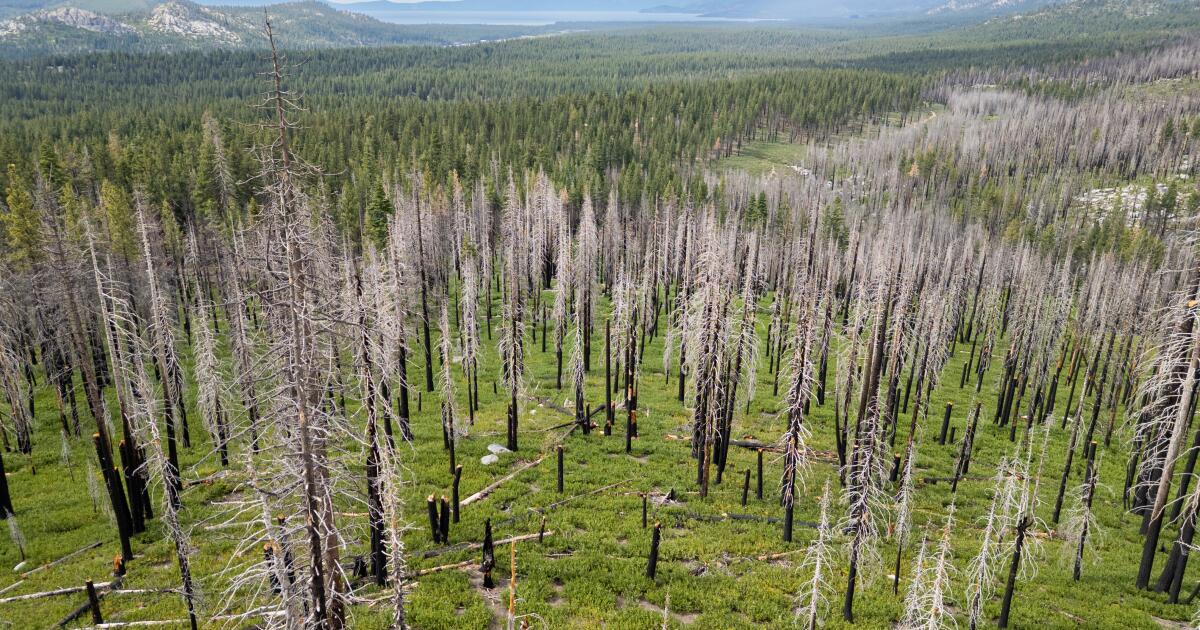
SOUTH LAKE TAHOE, Calif. — For years, Reid Reichardt walked the forest trails behind his Tahoe Basin cabin nearly every day with his dog Jasmine. Then in 2021, the Caldor fire swept through, incinerating it all.
“It was really a sense of mourning and grief to lose this,” Reichardt said, eyes fixed on the towering blackened sticks around him.
Since then, Reichardt has watched birds, flowers, a sea of green shrubs and baby conifers fill in the moonscape. It’s been a ray of hope for him, as Jasmine aged and eventually passed.
Reid Reichardt’s dog Jasmine.
(Reid Reichardt)
But two months ago, Reichardt got a text from a friend: The Forest Service had approved a plan to kill off shrubs it says are blocking the conifers from growing. It plans to use glyphosate, an herbicide California has determined causes cancer.
“I think many people, including me, would say, I’d rather my house burn down than get cancer,” he said.
Increasingly severe wildfires — fueled by climate change and more than a century of forest mismanagement — have forced an environmental reckoning on mountain towns nestled in California’s Sierra Nevada. Their residents face difficult questions: Will some kind of forest grow back? And, if not, should humans intervene to make that happen? Two communities, 100 miles apart, may be choosing different answers.
Many foresters and fire ecologists argue the plentiful baby conifers behind Reichardt’s home will struggle to compete with the fast-growing shrubs for sunlight, water and soil nutrients. Should another fire roll through, the seedlings are not yet tall enough to hold their branches above the flames.
But many Tahoe Basin residents say they are willing to live with whatever grows back, if it keeps glyphosate away.

Reid Reichardt stands next to Saxon Creek in the Caldor fire burn scar, near the area the Forest Service wants to use herbicide to kill the shrubs it says are crowding out the baby conifers.
(Scott Sady / For The Times)
“I’ll never see it like it was in my entire lifetime, and we need to be OK with that,” said Madeline Moritsch, who spent summers at her parents’ Tahoe cabin growing up and now lives in town. “It’s really sad … to lose connection to the forest, but then also, it is part of the forest life cycle. I have great trust that the forest is going to do what it’s going to do.”
In the Tahoe basin, opposition to the herbicide reached a fever pitch after an article chronicling the Forest Service’s use of the chemical across California appeared in Mother Jones magazine.
The agency had posted newspaper notices and sent emails mentioning herbicide use and seeking public input last year, but Tahoe residents said they had missed them or didn’t make much of them.
“We continue to welcome feedback from community members and appreciate the ongoing interest and involvement from the public,” the Forest Service said in a statement.
The controversy over reviving the forest is a shame, some say, because, done right, these projects can help restore the identity of forest towns and a feeling few have felt in decades: safety.
The stewards of the forest

Material to be burned is piled in an area the Konkow Valley Band of Maidu manage in the Dogwood District of Plumas National Forest.
(Sara Nevis / For The Times)
About 100 miles northwest of the Tahoe Basin, lower down in the foothills, survivors of the epic 2018 Camp fire that destroyed the town of Paradise have a very different relationship with forest stewards.
The Butte County Fire Safe Council — made up of three dozen foresters, former firefighters and local fire survivors — has countless stories of working with local landowners to heal forests and reduce wildfire risk.
In a ride with four of them in one of the council’s heavy-duty white pick-ups, conversation is constantly interrupted as they point out areas across the county’s rugged wild lands that they’ve worked on.
More than a third of Butte County’s 1 million acres have burned over the past decade. That has made taking action and having tough conversations — including about herbicide — unavoidable.

A flag marks a Konkow Valley Band of Maidu cultural site.
(Sara Nevis / For The Times)
Connor Gilmartin, the Fire Safe Council’s director of development, sympathized with residents in the Tahoe Basin. “It’d be completely reasonable that people feel slighted if they were to have something happening in their proverbial backyard without knowing about it,” he said. “It’s a non-option for us.”
The Fire Safe Council and forestry herbicide experts stressed that when herbicide is used, crews take significant precautions to protect ecosystems and communities. They post signs along trails and mix in dye so residents can see where the chemical has been used. It can’t be applied near streams and lakes.
Experts also said it is extremely unlikely for people using trails to get accidentally exposed to glyphosate levels that scientists deem unsafe.
Why use glyphosate
For well over a century, the state and federal government aggressively suppressed all fire in California forests — many of which were adapted to low-severity flames that rolled through the understory every five to 20 years. These free-range “good” fires, set by lightning and Indigenous tribes, thinned out and rejuvenated forests for millennia.
Without them, parts of the Sierra Nevada have grown five to six times as dense as they were a few hundred years ago.
Combine that with increasingly hotter and drier weather due to climate change, and forests in the Sierra Nevada are left with a ton of stuff that’s ready to burst into flames.
Now when a fire ignites, it’s often high-intensity, devouring virtually everything in its path — including hundred-foot-tall trees.
After such a fire, shrubs that usually fight for scarce sunlight on the forest floor suddenly have it all day and take over.

One of many conifers seedlings among the shrubs the Forest Service would like to eradicate using herbicide.
(Scott Sady / For The Times)
It’s for this reason many experts say intervention is necessary if the forests are to grow back within the next several decades.
Without intervening, “the Forest Service is not getting a forest back. That’s pure and simple,” said Scott Stephens, UC Berkeley professor of fire science. Hoping fire stays out of the forest during its slow recovery process, “I would call that risky business,” he said.
To cut back on the shrubs and give the conifers a chance, Stephens said land managers have a few options: Goats, hand crews and herbicides.
Goats are great at munching up unwanted vegetation; however, if they aren’t introduced immediately, the goats are no match.
Land managers can also send in hand crews to take down shrubs with loppers, hoes and chainsaws. But that is labor intensive, and when a fire burns thousands of acres, the time and cost involved can be too high.
That leaves herbicides.
Of those, glyphosate is one of the few reasonably priced, effective and, many argue, comparatively safe herbicides that land managers can rely on for restoration work.

Reid Reichardt hikes a well-known mountain bike trail, Toad’s Wild Ride, behind his home near South Lake Tahoe. Reichardt and others worry that hikers and bikers will be exposed to herbicide applied under a Forest Service plan.
(Scott Sady / For The Times)
In the Tahoe Basin, the Caldor fire restoration plan outlines roughly 3,600 acres where the Forest Service could use ground crews to apply herbicide directly to shrubs — no aerial spraying.
“Even though it’s gotten a bad name because so much attention has been focused on it, it’s actually effective and comparatively benign,” Jon Souder, retired Oregon State University forestry professor, said of glyphosate.
Whether glyphosate causes cancer is still debated.
The U.S. Environmental Protection Agency determined it is not likely a human carcinogen. The cancer research arm of the World Health Organization says it probably is.
For many residents near Lake Tahoe, it’s not a risk worth taking.
Teaching the land to trust
Matthew Williford Sr., tribal chairperson of the Konkow Valley Band of Maidu, shook his head as he stood on a dirt road overlooking the fire-ravaged Concow Basin, separated from Paradise by just one canyon.
“Nature needs help too, just like we need help from nature,” he said. “We don’t understand that because we went another way. We lost connection with the land. That’s why.”
“This is 3A,” he said, referring to the Forest Service’s name for this plot. “We have a tribal name for it — it’s called the Place of the Grasshoppers.”
Growing up, Williford heard stories of ancestors catching giant grasshoppers, wrapping them in a maple leaf, adding a berry, then roasting them in fire and eating them like popcorn.
But those grasshoppers were long gone.

Matthew Williford Sr., tribal chairperson of the Konkow Valley Band of Maidu, stands in front of a hand-made burn pile in the Dogwood District of Plumas National Forest.
(Sara Nevis / For The Times)
California outlawed cultural fire in 1850, the year it became a state. The forests grew dense. Conifers took over the oaks. The plants and animals Williford’s ancestors held relationships with became strangers.
Then everything burned.
The Forest Service began increasingly approaching the tribe for help.
With the blessing and support of the Forest Service, the tribe began working to restore parts of its homeland — not as a shrubland, or thick conifer forest, but an open and free tapestry anchored by oaks.
For the work, the tribe has sometimes leaned on herbicide — particularly to kill ornamental French and Spanish broom, which are invasive. The alternative, digging it up, risks damaging cultural sites.

Matthew Williford Sr. points out a native plant in the Concow Basin.
(Sara Nevis / For The Times)
On plot 3A, the tribe worked with the Forest Service to grow oaks and bring back good fire.
One day, Williford stopped by 3A.
As he hopped back into his truck, a loud buzzing startled him. His truck was covered in giant grasshoppers.
“It’s just getting the land to trust us and to see that we’re here to help it — like we used to,” he said. “The land will respond. There’s no doubt about it.”
-

 Los Angeles, Ca60 minutes ago
Knee irritation forces Shohei Ohtani out of Friday start, All‑Star game
-

 Detroit, MI1 hour ago
Detroit Evening Report: Waymo cars blocking first responders – WDET 101.9 FM
-

 San Francisco, CA1 hour ago
San Francisco Mayor Daniel Lurie Blocks Vacant Grocery Store Tax Proposal | KQED
-

 Miami, FL2 hours ago
Oregon Battling Miami, Mario Cristobal for Four-Star EDGE Recruit
-

 Dallas, TX2 hours ago
FC Dallas Forward Logan Farrington Inks Contract Extension
-

 Boston, MA2 hours ago
Red Sox face lengthy travel issues ahead of series vs. Mets
-

 Denver, CO2 hours ago
What’s going on with the Nuggets? Unpacking an NBA offseason on hold
-

 Seattle, WA2 hours ago
Seattle Kraken Sign Goaltender Victor Östman and Defenseman Ville Ottavainen to One-Year Deals | Seattle Kraken

