Science
Newsom tells world leaders Trump’s retreat on the environment will mean economic harm


SACRAMENTO — Gov. Gavin Newsom told world leaders Friday that President Trump’s retreat from efforts to combat climate change would decimate the U.S. automobile industry and surrender the future economic viability to China and other nations embracing the transition to renewable energy.
Newsom, appearing at the Munich Security Conference in Germany, urged diplomats, business leaders and policy advocates to forcefully stand up to Trump’s global bullying and loyalty to the oil and coal industry. The California governor said the Trump administration’s massive rollbacks on environmental protection will be short-lived.
“Donald Trump is temporary. He’ll be gone in three years,” Newsom said during a Friday morning panel discussion on climate action. “California is a stable and reliable partner in this space.”
Newsom’s comments came in the wake of the Trump administration’s repeal of the endangerment finding and all federal vehicle emissions regulations. The endangerment finding is the U.S. government’s 2009 affirmation that planet-heating pollution poses a threat to human health and the environment.
Environmental Protection Agency administrator Lee Zeldin said the finding has been regulatory overreach, placing heavy burdens on auto manufacturers, restricting consumer choice and resulting in higher costs for Americans. Its repeal marked the “single largest act of deregulation in the history of the United States of America,” he said.
Scientists and experts were quick to condemn the action, saying it contradicts established science and will put more people in harm’s way. Independent researchers around the world have long concluded that greenhouse gases released by the burning of gasoline, diesel and other fossil fuels are warming the planet and worsening weather disasters.
The move will also threaten the U.S.’s position as a leader in the global clean energy transition, with nations such as China pulling ahead on electric vehicle production and investments in renewables such as solar, batteries and wind, experts said.
Newsom’s trip to Germany is just his latest international jaunt in recent months as he positions himself to lead the Democratic Party’s opposition to Trump and the Republican-led Congress, and to seed a possible run for the White House in 2028. Last month Newsom traveled to the World Economic Forum in Davos, Switzerland, and in November to the U.N. climate summit in Belém, Brazil — mocking and condemning Trump’s policies on Greenland, international trade and the environment.
When asked how he would restore the world’s confidence in the United States if he were to become president, Newsom sidestepped. Instead he offered a campaign-like soliloquy on California’s success on fostering Tesla and the nation’s other top electric vehicle manufacturers as well as being a magnet for industries spending billions of dollars on research and development for the global transition away from carbon-based economies.
The purpose of the Munich conference was to open a dialogue among world leaders on global security, military, economic and environmental issues. Along with Friday’s discussion on climate action, Newsom is scheduled to appear at a livestreamed forum on transatlantic cooperation Saturday.
Andrew Forrest, executive chairman of the Australia-based mining company giant Fortescue, said during a panel Friday his company is proof that even the largest energy-consuming companies in the world can thrive without relying on the carbon-based fuels that have driven industries for more than a century. Fortescue, which buys diesel fuel from countries across the world, will transition to a “green grid” this decade, saving the company a billion dollars a year, he said.
“The science is absolutely clear, but so is the economics. I am, and my company Fortescue is, the industrial-grade proof that going renewable is great economics, great business, and if you desert it, then in the end, you’ll be sorted out by your shareholders or by your voters at the ballot box,” Forrest said.
Newsom said California has also shown the world what can be done with innovative government policies that embrace electric vehicles and the transition to a non-carbon-based economy, and continues to do so despite the attacks and regressive mandates being imposed by the Trump administration.
“This is about economic prosperity and competitiveness, and that’s why I’m so infuriated with what Donald Trump has done,” Newsom said. “Remember, Tesla exists for one reason — California’s regulatory market, which created the incentives and the structure and the certainty that allowed Elon Musk and others to invest and build that capacity. We are not walking away from that.”
California has led the nation in the push toward EVs. For more than 50 years, the state enjoyed unique authority from the EPA to set stricter tailpipe emission standards than the federal government, considered critical to the state’s efforts to address its notorious smog and air-quality issues. The authority, which the Trump administration has moved to rescind, was also the basis for California’s plan to ban the sale of new gasoline-powered cars by 2035.
The administration again targeted electric vehicles in its announcement on Thursday.
“The forced transition to electric vehicles is eliminated,” Zeldin said. “No longer will automakers be pressured to shift their fleets toward electric vehicles, vehicles that are still sitting unsold on dealer lots all across America.”
But the efforts to shut down the energy transition may be too little, too late, said Hannah Safford, former director of transportation and resilience at the White House Climate Policy Office under the Biden administration.
“Electric cars make more economic sense for people, more models are becoming available, and the administration can’t necessarily stop that from happening,” said Safford, who is now associate director for climate and environment at the Federation of American Scientists.
Still, some automakers and trade groups supported the EPA’s decision, as did fossil fuel industry groups and those geared toward free markets and regulatory reform. Among them were the Independent Petroleum Assn. of America, which praised the administration for its “efforts to reform and streamline regulations governing greenhouse gas emissions.”
Ford, which has invested in electric vehicles and recently completed a prototype of a $30,000 electric truck, said in a statement to The Times that it appreciated EPA’s move “to address the imbalance between current emissions standards and consumer choice.”
Toyota, meanwhile, deferred to a statement from Alliance for Automotive Innovation president John Bozzella, who said similarly that “automotive emissions regulations finalized in the previous administration are extremely challenging for automakers to achieve given the current marketplace demand for EVs.”



Science
July Fourth fireworks may bring ‘hazardous’ air quality to Southern California. What you need to know

L.A.’s love of fireworks makes for a colorful Fourth of July, with dozens of official celebrations and countless illicit explosions expected for the holiday.
But as each sparkler, Roman candle, palm and peony dissipates, it leaves behind a cloud of noxious gases, soot and finely ground toxic metals — some of which ends up in the lungs of revelers and passersby below.
Hazardous levels of air pollution are expected across central and southern Los Angeles County, northern Orange County, and Riverside and San Bernardino counties from 5 p.m. Saturday evening through 3 p.m. Sunday, according to the South Coast Air Quality Management District. Unhealthy air quality is also expected in northern Los Angeles County and southern Orange County.
Pollution levels are expected to build from dusk onward Saturday, as light winds and increased firework activity lead to an increase in smoke, a South Coast AQMD advisory said. Soot and particulates will likely linger through Sunday afternoon before being dispersed by the wind.
Firework-related pollution can trigger coughs, breathing problems, asthma flares and heart attacks, according to Los Angeles County Public Health, and anyone experiencing severe or worsening cardiovascular symptoms like chest pain or difficulty breathing should seek medical attention immediately.
Pyrotechnics set off at home are even more likely to trigger cardiovascular problems, the American Lung Assn. says, as the burst of pollutants takes place closer to the ground.
July 4 and 5 are traditionally two of the worst days of the year for the region’s air quality, according to South Coast AQMD. This year’s celebration comes on the heels of a late June warehouse fire in Boyle Heights that released extraordinary amounts of soot and smoke across the county, on par with pollution generated by the previous year’s wildfires.
To limit negative health effects, the L.A. County public health department recommends avoiding strenuous physical activity and keeping doors and windows closed. As whole house fans and swamp coolers can suck additional pollutants inside, the department recommends using air purifiers or air conditioners as alternatives when possible.

Few substances are as deeply woven into everyday life as alcohol. It is a fixture at holiday celebrations, work-related social gatherings, sporting events, airports, and brunch or dinner tables. All demonstrate how deeply alcohol has become embedded in social customs and cultural traditions.
Yet alcohol contributes to millions of deaths globally each year and is linked to cancer, liver disease, unintentional accidents, violence and, importantly, dependence and addiction. Despite this, the disconnect between alcohol’s cultural role and its serious health burden is striking. An estimated 2.3 billion people worldwide consume alcohol.
As a physician working in addiction medicine, I regularly care for patients whose alcohol use affects nearly every organ system. It is often not until these patients end up admitted to the hospital that they learn the effects of alcohol on various parts of their body besides their liver.
Newer evidence challenges assumptions about what was long considered “safe drinking.” Even moderate drinking carries risk and is not as harmless as people, including experts, once thought.
Many people associate alcohol risk primarily with addiction or dangerous behaviors such as driving while intoxicated. However, its effects extend far beyond this, into nearly every aspect of a person’s well-being.
While alcohol may transiently improve mood and ease social anxiety, long-term alcohol use can lead to a worsening of mood, cognition and sleep, which can further compound use.
A 2021 literature review found that consuming approximately two standard drinks roughly doubles the odds of sustaining injuries — with or without a vehicle involved. The review also found that heavy episodic (binge) drinking can increase the risk of injury by 50-fold, depending on the amount of alcohol consumed and the type of injury. While alcohol’s effects on the liver are well known, it can also lead to gastrointestinal complications and heart disease
The World Health Organization estimates that 2.6 million deaths each year are attributable to alcohol, accounting for nearly 1 in every 20 deaths worldwide.
While many people recognize the risks of alcohol addiction, people are generally much less aware of the links between alcohol use and cancer risk.
The World Health Organization classifies alcohol as a Group 1 carcinogen — the same category as tobacco and asbestos. In 2025, the U.S. surgeon general emphasized that alcohol increases the risk of at least seven cancers, including cancers of the breast, colorectal, liver, oral, esophagus and larynx. An advisory called for updated warning labels.
Yet fewer than half of Americans recognize alcohol as a risk factor for cancer, particularly for cancers such as breast cancer that are not commonly associated with alcohol use.
Throughout the 1990s and early 2000s, observational studies suggested that moderate alcohol consumption might offer cardiovascular benefits. Over the past decade, however, higher-quality studies have challenged these findings, suggesting that much of the apparent benefit may have reflected differences in the health and lifestyles of moderate drinkers rather than a protective effect of alcohol itself.
Current evidence increasingly suggests that even low levels of alcohol may increase cancer risk.
Federal guidelines acknowledge that adults should “consume less alcohol for better overall health.” However, the most recent version of the “Dietary Guidelines for Americans,” updated in January, removed the previous recommendation to limit intake to no more than one drink per day for women and two for men. It also omitted explicit discussion of alcohol’s links to cancer.
These changes have drawn criticism from public health experts, who argue that the revised language plays down the growing evidence of alcohol-related harms and provides less specific guidance to consumers. The current administrator of the Centers for Medicare & Medicaid Services characterized alcohol as a “social lubricant” that brings people together, rather than emphasizing its well-established health risks.
This may be true physiologically, at least temporarily, but obscures the fact that relying on it as a social lubricant can lead to chemical and psychological dependency. In my view, statements to that effect are shortsighted, prioritizing short-term social effects over more insidious and long-term issues, including addiction.
While many dangerous mind-altering substances are hidden from public perception, alcohol is often placed at the center of it – a trend that shows no sign of changing imminently.
Further, large companies often profit from ads that appeal to young people.
Looking back at the history of tobacco smoking provides some helpful insights. In 1965, 42.4% of the U.S. population smoked. By 2022, that figure had dropped to 11.6%.
This steep decline did not happen because of a single intervention, but through decades of accumulating scientific evidence, public education campaigns, warning labels, restrictions on advertising, smoke-free policies, higher tobacco taxes and shifts in social norms. Together, these efforts transformed smoking from a widely accepted social behavior into one broadly recognized as a major health risk and correspondingly, less socially accepted.
Although alcohol consumption has modestly declined in recent years, it remains deeply embedded in social life in ways cigarette smoking no longer is.
People often assume that if a substance is legal, common and widely socially accepted — even encouraged — it must also be safe. But public health history suggests those assumptions can and should change.
Emma Fenske is an addiction medicine fellow and internal medicine physician at Oregon Health & Science University. This article was produced in partnership with the Conversation.
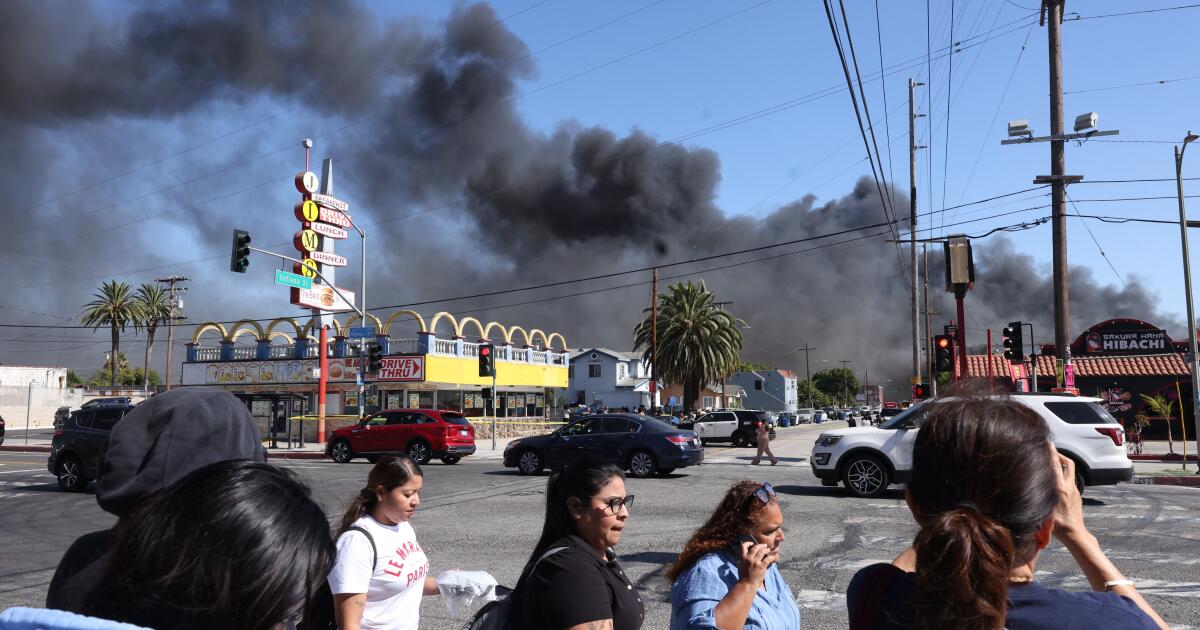
The air near the Lineage refrigerated warehouse fire in Boyle Heights carried astronomically high levels of smoke and soot, surpassing some of the worst air pollution during the Los Angeles County fires in January 2025, according to preliminary data from air officials.
The fire spewed thick black smoke for days. From downtown Los Angeles to the San Gabriel Valley, tens of thousands were enveloped in unhealthful levels of smoke, even as some local officials told residents that the air posed no danger.
As the days wore on, worst off were communities nearest the blaze. On June 19, three days after the facility ignited, a temporary air quality monitoring station at Eastman Elementary in unincorporated East Los Angeles measured an extremely hazardous 755 micrograms per cubic meter of fine particles for more than an hour, according to the South Coast Air Quality Management District.
For comparison, a Caltech air monitor in Pasadena recorded about 650 micrograms per cubic meter during the Eaton fire.
These high levels of fine particles, known as PM 2.5, probably resulted in the surge of residents into local emergency rooms during the fire, according to local health officials. But even now with the smoke gone, people still have not been told what chemicals they were breathing in during the weeklong ordeal.
Michael Jerrett, an environmental health professor at the UCLA Fielding School of Public Health, said his concern is the composition of materials emitted when the building burned.
“These contain many particularly toxic components,” Jerrett said, “and we know little about how these mixtures affect health.”
There is no completely safe level of fine particulate pollution, he noted, meaning higher concentrations are always worse.
During the 2025 L.A. County fires, local air officials announced that several monitors downwind had detected elevated levels of brain-damaging lead and cancer-causing arsenic from toxic paint and construction materials used in older homes.
The Lineage warehouse, built in 2018, is likely to contain different materials of concern. Thick insulation foam required for a massive refrigeration operation, solar panels and refrigerants were burned, leaving many residents on edge.
Even though three public agencies conducted air monitoring, the picture is still murky.
“[Public officials] are speaking with a lot of confidence but not a lot of information,” said mark! Lopez, a community organizer with East Yard Communities for Environmental Justice. “We’ve gotten in the room with folks to discuss where the gaps lie and where assumptions are being made. And I think they are realizing these agencies supposed to protect our air and our health aren’t as reliable as they thought they were.”
In response to the Boyle Heights fire, the South Coast air district deployed a mobile monitoring vehicle to screen for toxic substances in the community near the fire, according to Nahal Mogharabi, a spokesperson for the air district. It found increased levels of bromine, a chemical commonly found in fire retardant, and chlorine, often released from burning plastic. Both were below short-term health-based exposure thresholds.
Toxic metals, including lead and arsenic, were not elevated, according to air district data.
“That was the reassuring piece, that they were not picking up any of the metals,” said Dr. Nichole Quick, chief medical advisor for the Los Angeles County Department of Public Health. “But … that smoke is unhealthy. “You don’t want to be breathing it, regardless.”
The U.S. Environmental Protection Agency set up air monitors around the perimeter of the facility to test for toxic air contaminants, has the results and has not made them public. Julia Giarmoleo, an EPA spokesperson, said the monitors did not detect elevated metals, but would not provide a copy of the data without a federal records request.
The Los Angeles Fire Department’s hazardous material team also tested for ammonia, which is used in refrigeration, and hydrogen fluoride, a toxic chemical that could be released by burning lithium-ion batteries and solar panels.
Fire officials previously said they measured low levels of hydrogen fluoride on the second day of the fire. But the department would not answer questions about its air monitoring. It also told a reporter to submit a public records request.
It remains unclear whether any agency has tested for hydrogen cyanide or isocyanates, highly toxic gases that could be released from burning chemical-laden insulating foam inside the building.
“The real issue is what monitoring has not been done to protect the fence-line community from the air toxics,” said Jane Williams, executive director of California Communities Against Toxics.
Without the EPA or LAFD data, what is known of the smoke’s toxicity rests on the air district’s mobile monitoring.
Jerrett, the UCLA researcher, said that is not ideal for understanding the kind of plume released by the Boyle Heights fire, which rapidly changed direction with the wind.
“This can in some instances lead to levels that look low, but they are resulting from a mismatch between the location of the vehicle and the plume,” he said.
The Boyle Heights blaze, similar to the Eaton and Palisades fires, has revealed the region’s air monitoring can’t always tell people what they’ve been exposed to in a disaster.
“We do need a better monitoring system in place,” he said.
Local officials are now shifting their focus to the rancid odors from millions of pounds of rotting food in the ruined wing of the warehouse. Decomposing food can release hydrogen sulfide, a toxic gas synonymous with landfills and garbage. Lineage hired contractors who are measuring this noxious gas and other pollution. Their data indicate they have not detected hydrogen sulfide.
As Lineage workers haul the rotting food to local landfills, they are using deodorizing mist and have discussed using shrink wrapping to suppress the stench and minimize issues for nearby homes.
At this point, the odors are believed to be an inconvenience rather than a public health threat, according to Quick, the county medical advisor. She said running air purifiers may help to reduce odors indoors.
“It’s very important for folks to understand that the odors themselves do not indicate any dangerous levels of toxins, mold, bacteria, and so forth,” Quick said. “But the odors are a public nuisance.”
The air district is still encouraging residents to report odors to its online complaint system or by calling (800) 288-7664.
-

 Rhode Island3 minutes ago
New bilingual school blocked from opening under R.I.’s new charter school ban – The Boston Globe
-

 South-Carolina6 minutes ago
What triggers a heat advisory in South Carolina?
-

 South Dakota11 minutes ago
Water hampers growth near Sioux Falls but solution near
-
Tennessee18 minutes ago
Tennessee reduced training in IV placement in new lethal injection protocol
-
 Texas21 minutes ago
Texas abortion stories fail to sway Congress post-Dobbs
-

 Utah26 minutes ago
Chicago breaks Utah’s 10-game unbeaten streak – Equalizer Soccer
-
 Vermont33 minutes ago
The Velomont bike trail is getting more accessible – one trail at a time
-
.jpg?w=400&resize=400,240&ssl=1 "On Virginia’s Crooked Road, the Hills Are Alive—With Bluegrass, Old-Time, and Country Jams")
.jpg?w=80&resize=80,80&ssl=1 "On Virginia’s Crooked Road, the Hills Are Alive—With Bluegrass, Old-Time, and Country Jams") Virginia36 minutes ago
Virginia36 minutes agoOn Virginia’s Crooked Road, the Hills Are Alive—With Bluegrass, Old-Time, and Country Jams

