Science
Majestic wild horses are trampling Mono Lake’s otherworldly landscape. The feds plan a roundup


Several dozen horses calmly graze along the shores of Mono Lake, a sparkling saline expanse spread out before the jagged Sierra Nevada. The September sun is blazing. A pair of brown horses come up side by side and stare intensely at an approaching visitor.
These wild equines soon may disappear from beside the ancient lake. The prospect is stirring emotional disagreement over the future of the herd, which has surged to more than three times what federal officials say the land can support.
-
Share via
“These horses deserve a place to roam and be free, but around Mono Lake is not the place,” said Bartshe Miller of the Mono Lake Committee, an environmental nonprofit.
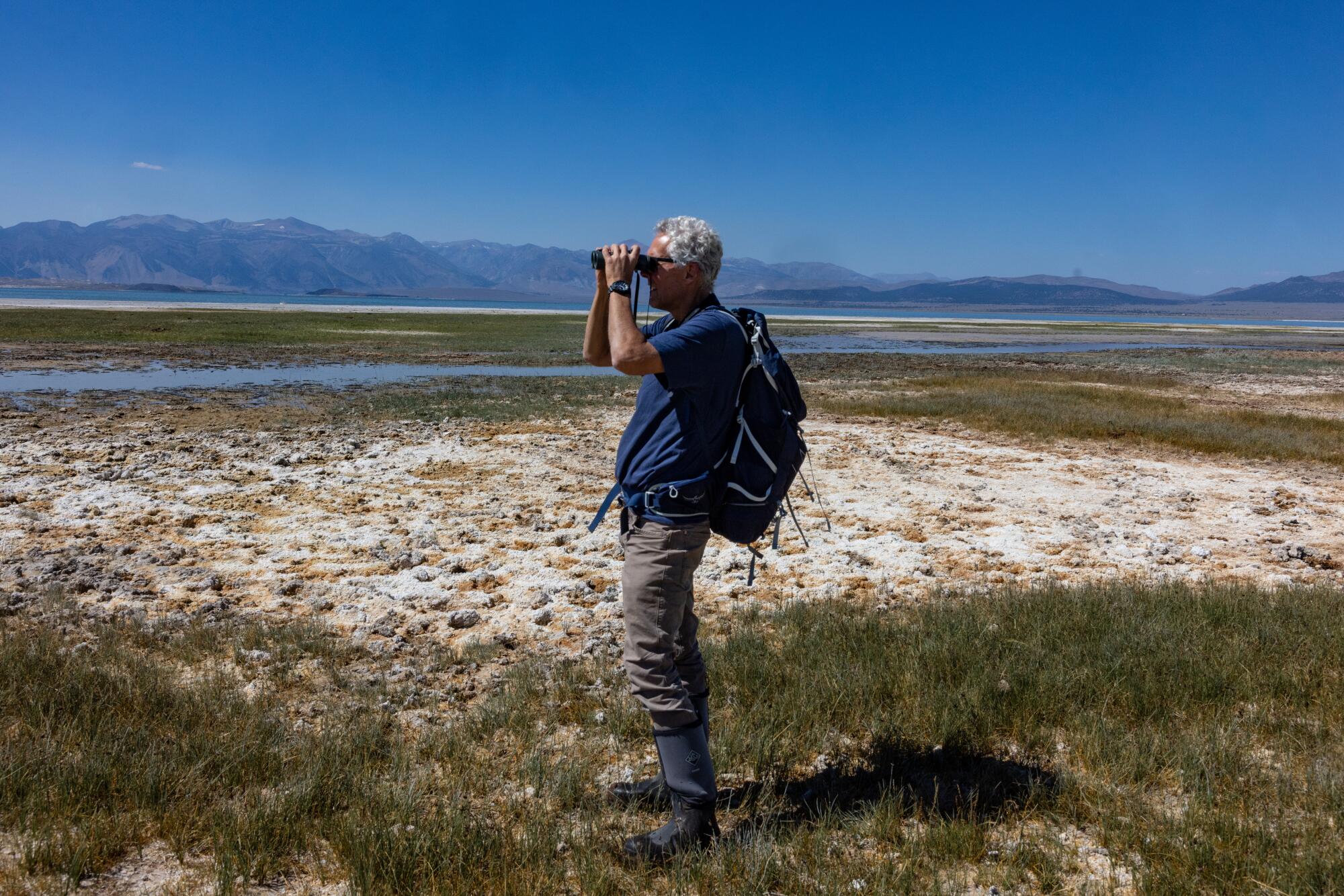
Bartshe Miller, Eastern Sierra policy director for the Mono Lake Committee, looks out onto the landscape at Warm Springs, a remote area on the east side of Mono Lake.
This year, the U.S. Forest Service and Bureau of Land Management approved a plan to round up and remove hundreds of wild horses roaming beyond the roughly 200,000 acres designated for them along the California and Nevada border. No date has been set, but it could be as soon as this fall.
It would be a relief for some. Environmentalists say the horses are degrading the otherworldly landscape at Mono Lake, including bird habitat and its famed tufa — textured rock columns that would look at home on Mars. Ranchers say the animals are gobbling down plants needed to sustain their cattle. Federal officials highlight the safety hazard posed by horses that have wandered onto highways.
Others see the move as a travesty. One method to oust the horses would use helicopters to drive them into a trap, which animal welfare groups say creates dangerous, even deadly, situations for horses. A pending federal bill would ban the practice.
Local tribes and nonprofits have partnered to fight the roundup plan, arguing that the Indigenous community should be tapped to manage the animals that roam their ancestral lands. A separate group of plaintiffs has sued the government, claiming it’s reneging on its duty to protect the horses.
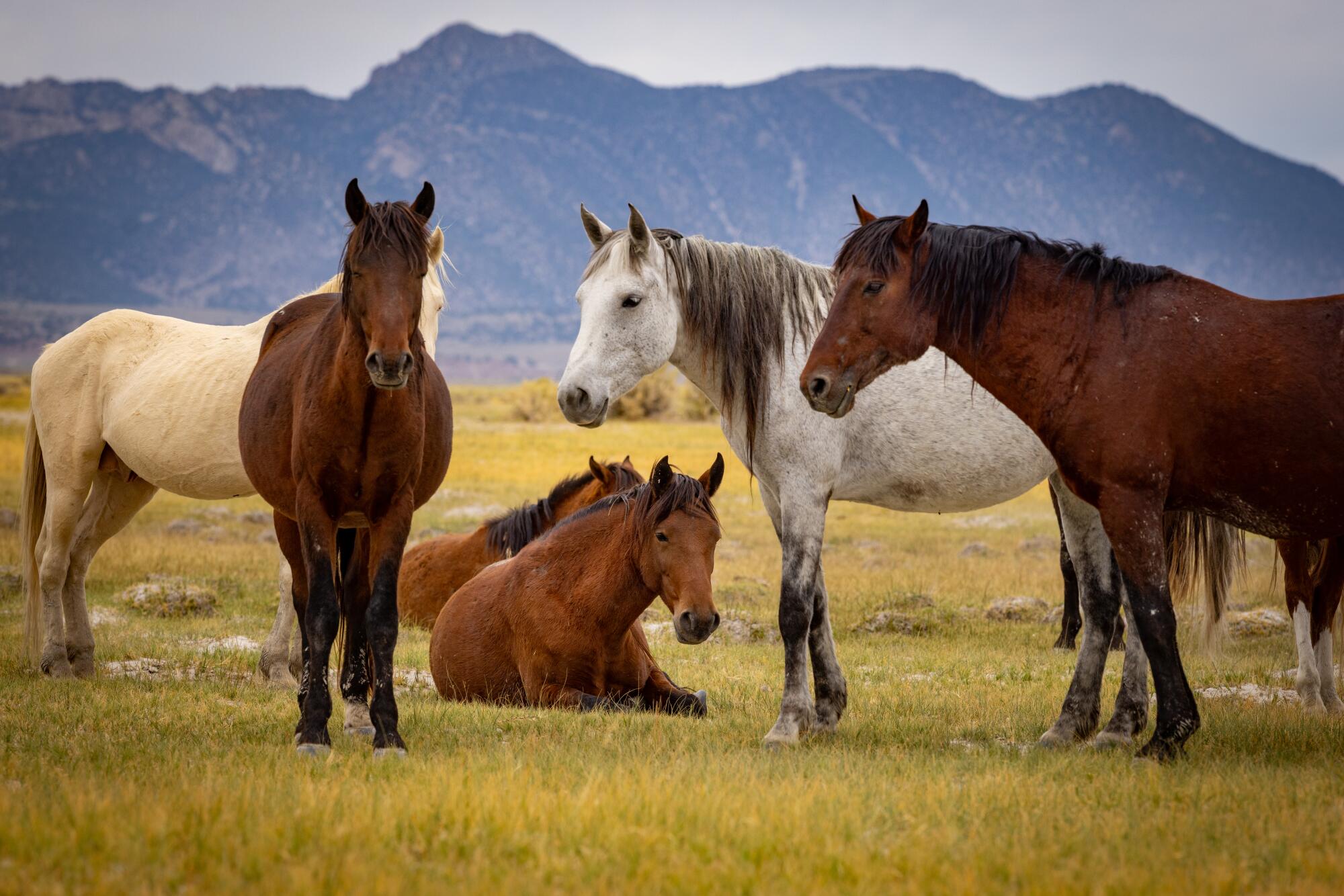
A group of horses roams near the community of Benton, Calif., not far from the Nevada border.
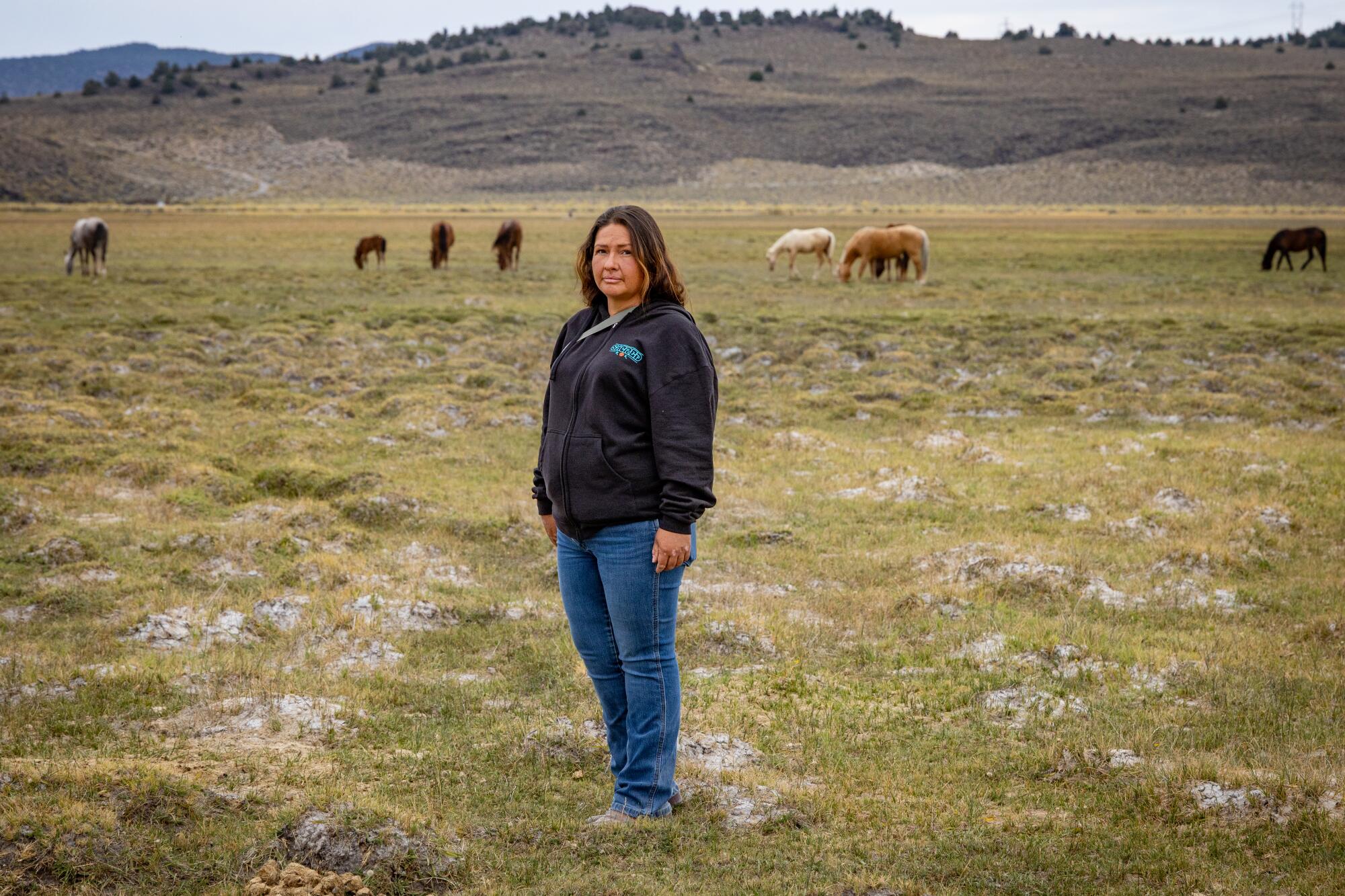
Ronda Kauk, of the Mono Lake Kootzaduka’a tribe, stands near wild horses.
“We’re all living spirits,” said Ronda Kauk, a member of the Mono Lake Kootzaduka’a tribe. “And it’s sad that people just don’t care about another living thing because they think it doesn’t belong there.”
Unseen evolution
For 36 years, Dave Marquart was part of a small team that monitored wetlands rimming Mono Lake, places so inaccessible even four-wheel drives can get stuck. Flung out far on the landscape, only wildlife could enjoy them. The area was a major nesting site for yellow-headed black birds, red-winged black birds, marsh wrens, soras and Virginia rails.
“There weren’t a lot of people that saw the transition that I saw, from healthy wetlands to completely trampled and devastated wetlands,” said Marquart, who was an interpretive naturalist for the Mono Lake Tufa State Natural Reserve until he retired in 2019. “It was quite a drastic change.”
Marquart recalled a time when he’d encounter fewer than 50 horses. They’d bolt when they saw his vehicle coming. That fear faded and their ranks grew. Over time, he said, they stamped ponds and urinated and defecated in the water. The birds stopped showing up.

Bartshe Miller holds grass he said was pulled up by the roots by wild horses roaming near Mono Lake. According to Miller, horses started arriving near the lake around 2015.
Before retiring, Marquart said, he helped organize a field trip involving the Forest Service, BLM and State Parks to showcase the impacts.
“Everybody saw that it was an issue and felt that something needed to be done,” he said.
Today, sizable mounds of horse manure dot Warm Springs, a remote area along the eastern edge of Mono Lake that Marquart had raised the alarm about during his tenure. White bones of fallen equines rest in the alkaline meadows. Chestnut fur gleamed on a hoof attached to a leg bone.
Miller, the Mono Lake Committee’s Eastern Sierra policy director, and Geoff McQuilkin, its executive director, led the way to a burbling spring rimmed by innumerable hoof prints. Surrounding vegetation was nibbled to nubs. Wildlife compete for the limited water here.

The bleached bones of a wild horse lie in vegetation near the shores of Mono Lake.
“The birds that would have a safe haven in that spring or be hidden away from raptors and predators overhead don’t have that opportunity anymore,” McQuilkin said.
The pair first remembered the horses showing up in remote areas around the lake in 2015, as the state was gripped by drought. By 2021, as they pushed west, they landed at South Tufa, where tourists congregate to gaze at the limestone columns. In the spring of 2023, horse carcasses emerged along the shores of South Tufa and nearby Navy Beach as the snow from a winter of biblical proportions melted.
“The recent deaths of these horses provide further evidence that the size of this herd cannot be supported by the landscape which they are expanding onto,” Lisa Cox, a spokesperson for the Inyo National Forest, said at the time.
‘They’re medicine’

Rana Saulque, vice chairwoman of the Utu Utu Gwaitu Paiute tribe, walks near a natural spring in an area where wild horses gather near the community of Benton, Calif.
On a pleasantly cool day in September, Rana Saulque stared transfixed at a group of roughly 50 wild horses in the River Spring Lakes Ecological Reserve, not far from her tribe’s reservation near the town of Benton.
Saulque, vice chairwoman for the Utu Utu Gwaitu Paiute tribe, draws a parallel between ousting the horses and the historical persecution of her people by the government.
“They’re going to run them down with helicopters and genocide them, just like they ran down us,” she said through tears.
A striking cremello horse stood out from the rest — a beloved subject for photographers who sojourn here. A brown foal with a white stripe on its muzzle teetered on toothpick legs. Several babies hugged close to their moms.
Mostly, the horses peacefully graze, but two rear up momentarily. “That’s horsing around,” Saulque said. Then they begin galloping and suddenly they look powerful and sleek. Epic, like a poster for a classic western film.

Dozens of wild horses graze on the River Spring Lakes Ecological Reserve.
“They’re so magical,” the vice chairwoman said. “They’re medicine for people.”
Federal officials stress that they have precautions in place to ensure safety during helicopter roundups. That includes avoiding peak foaling periods and hot weather that would stress the horses.
The Utu Utu Gwaitu Paiute are among a coalition that wants to pause the planned roundups for two years and ultimately secure land back to set aside a sanctuary for the horses to roam. As envisioned, local tribes would help manage the herd, including darting horses with a birth control vaccine to limit population growth. Horses could be put to work at pack stations, equine therapy and rodeo schools for kids, the group says.
The proposal could also help revive horse culture that runs deep in the tribal communities, Saulque said. Jim Walker, her great-great-grandfather and a respected medicine man, rode mustangs all the way to Florida, visiting tribes along the way to exchange medicine and horses.
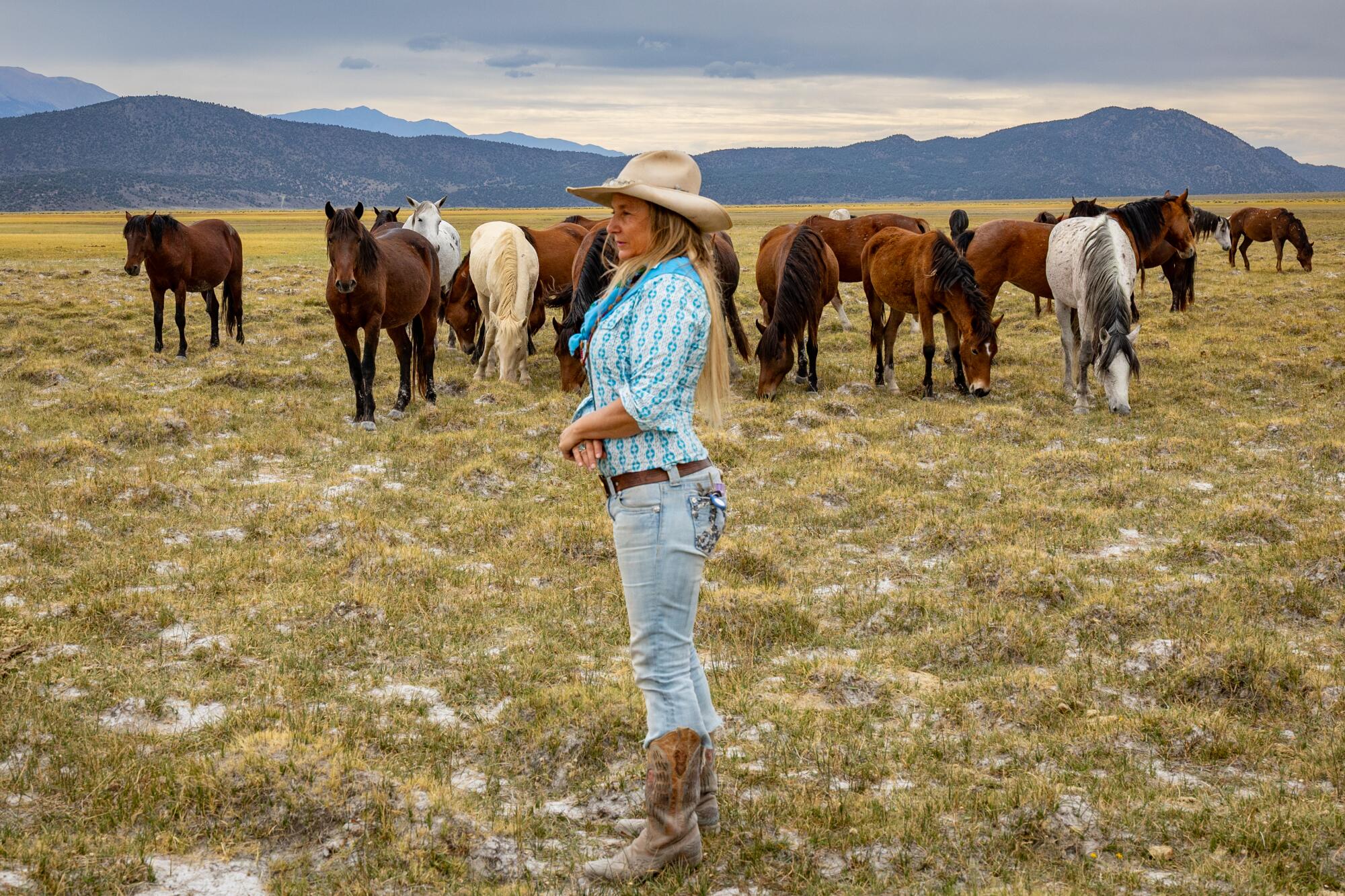
Maya Jamal Kasberg, founder of nonprofit Made by Mother Earth, is part of the coalition that wants to scrap the current plan to round up Montgomery Pass horses.
Kauk’s tribe historically rode the horses from Lee Vining into Yosemite to gather basket-making materials, among other activities. Mustangs were tapped for Native American rodeos and relay races, she added.
According to the coalition that includes the nonprofit American Wild Horse Conservation, federal officials and groups like the Mono Lake Committee have the science all wrong. The herbivores chomp down invasive cheatgrass that poses wildfire risk, and their poop — maligned by many — actually spreads native seeds, they say.
Wild and free — for now
At the heart of the emotional battle playing out in the Eastern Sierra is the Montgomery Pass wild horse herd. According to the U.S. Forest Service, its origin is unknown. But there’s speculation that it’s linked to mustang drives between the Owens Valley and Nevada.
A 1971 law declared wild horses and burros “living symbols of the historic and pioneer spirit of the West,” and made it illegal to harass, capture or kill them on public lands. But the Forest Service and BLM, which became responsible for managing them, can remove “excess animals” to preserve the health of the range.
The way this often plays out is that horses are rounded up and offered for adoption or sale. Those that aren’t taken in by a private owner are shipped to pastures where they often live out their remaining days.
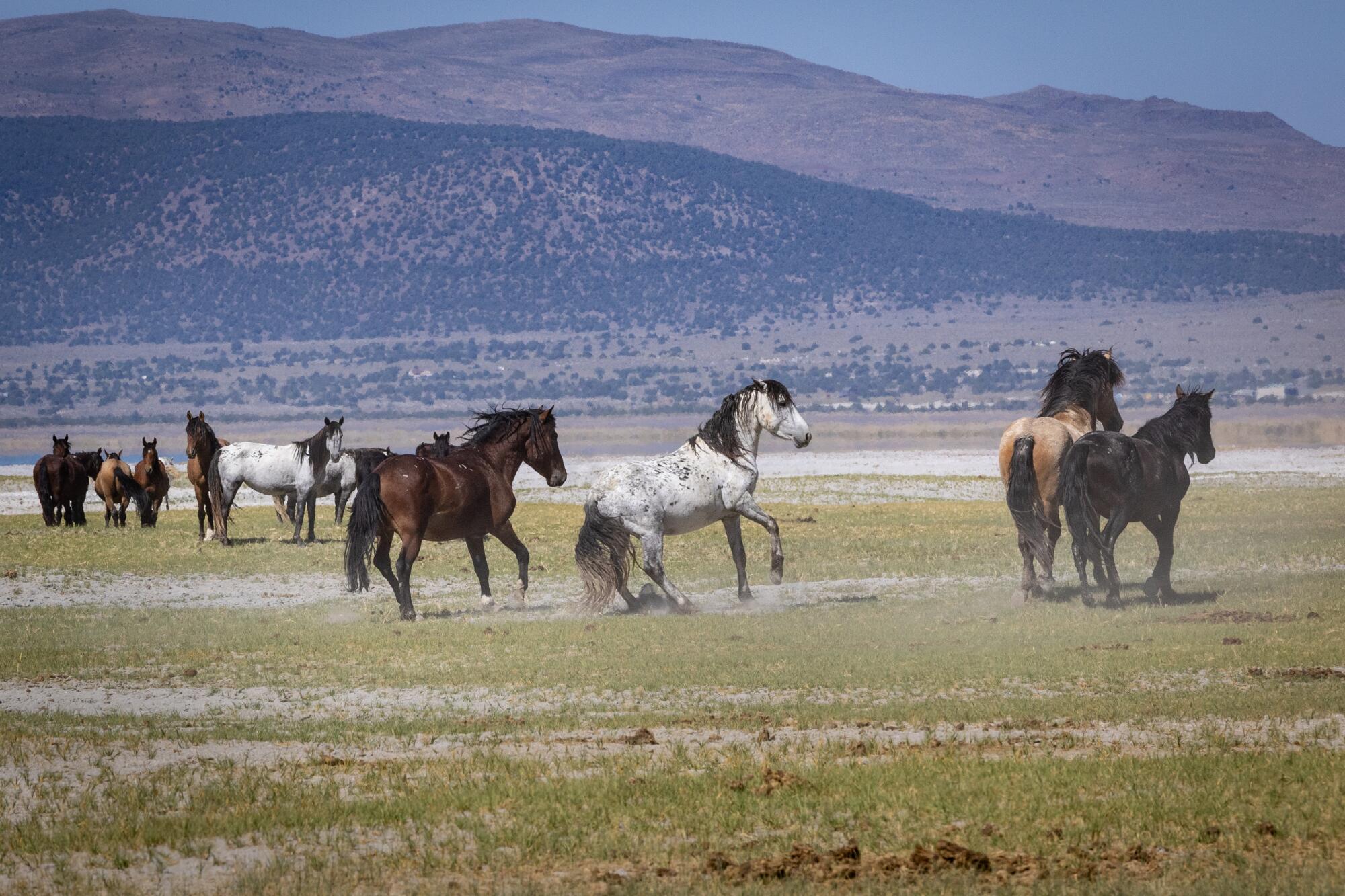
A census last year found that there are now about 700 horses in the Montgomery Pass herd.
Federal officials designated the Montgomery Pass Wild Horse Territory, a remote area spanning sagebrush steppe and pinyon pine forest east of Mono Lake. They say the land can sustainably support 138 to 230 horses.
As of last year, nearly 700 were documented in an aerial survey, with most ranging outside the territory, according to the agencies.
Now under a plan approved in March, up to 500 horses could be ousted, with the Forest Service leading the effort and BLM assisting.
Both agencies declined requests for interviews for this article, citing pending litigation. In August, a documentary filmmaker, primary care physician and wildlife ecologist sued the government authorities overseeing the agencies, claiming the roundups will decimate the herd to the point where long-term survival is unlikely.
“This case represents yet another attempt by the agencies to evade their statutory duties to protect, preserve and manage the herd,” the suit reads.
The government has agreed not to round up horses before Oct. 20, according to court documents.
When multiple uses collide
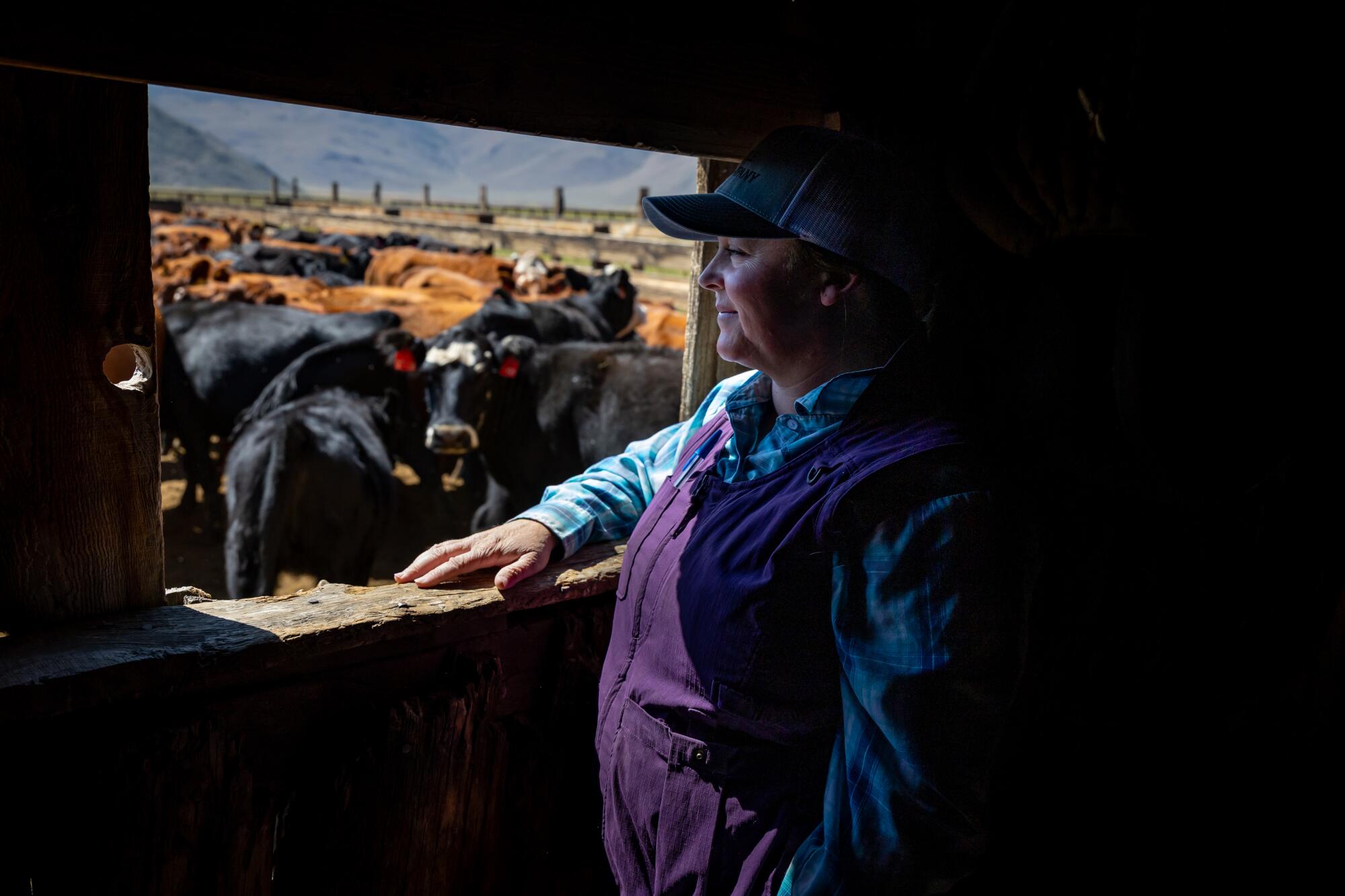
Rancher Leslie Hunewill looks at calves and their moms at her family’s historic ranch in Bridgeport.
Leslie Hunewill’s cattle ranching family sees quite a bit of “horse activity” on grazing lands in an area called the Mono Sand Flats, to the east and north of the lake. Since purchasing the right to use the public land, her outfit has been able to graze there for only about five weeks in the last two years — and not consecutively. The culprit? “A huge number of horses,” she said.
“Our cattle have not been out there,” she said. “There’s nothing for them to eat.”
Cows aren’t allowed on the roughly 50,000-acre expanse during the growing season. But the horses, facing no fences, go for what’s green and pushing up, she said.
“It doesn’t make sense for us to overuse or overgraze the land when we need to come back to it,” she said. “So when we are doing our part to manage the portion of it that we can, which is, say, our use of the cattle on that land, that’s all well and good. But who is taking charge of the horses and saying, this is too heavy use?”

The Hunewills, who have deep roots in the Eastern Sierra, operate a guest ranch in Bridgeport.
The law directs agencies to manage horse populations to maintain a “thriving natural ecological balance.” BLM and the Forest Service have to consider mustangs alongside grazing, wildlife and what’s good for the land. Some say the agencies have kicked the can down the road on management of the Montgomery Pass herd.
Hunewill’s family has deep roots in the Eastern Sierra. Her great-great-great-grandfather came to California in the 1860s as a gold miner. He struck it rich and got into the lumber business. When that stopped paying out, he used his oxen to feed the town of Bodie.
Her family is still in the beef business, with the meat generally staying on the West Coast.
They employ quite a few mustangs at their guest ranch operation in the town of Bridgeport, including Jethro, a friendly brown fella with a splash of white on his forehead. They’re hardy horses and can be enlisted as pack animals high up in the mountains. Some don’t need shoes because of their “great feet.”
But their robustness means “everybody’s already got their mustang,” she said, stymieing the prospect of mass adoptions.
Shifting dynamics
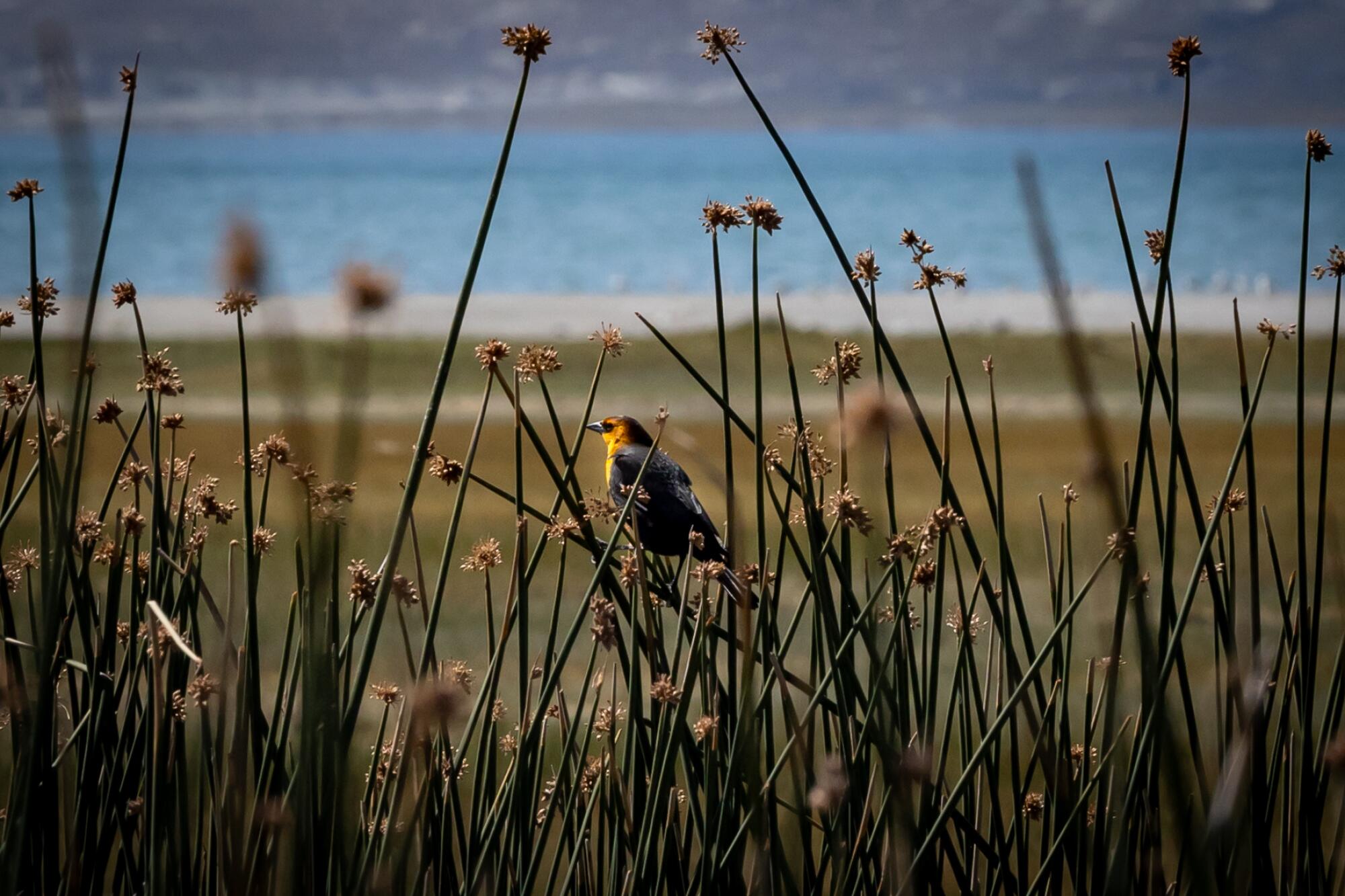
A bird perches in vegetation near Mono Lake.
Wild horse populations can increase as much as 20% a year. Montgomery Pass horses used to summer in the high country and were once kept in check by mountain lions that preyed on foals, according to John Turner, a professor at the University of Toledo College of Medicine, who studied the herd for decades.
That changed around 2008 or 2009, when the horses began lingering at lower elevations, where the open country makes it difficult for lions to hunt.
The herd’s population surged.
Turner sees the government’s current system of rounding up horses and holding them as unsustainable. And costly.
“The gathers are successful at that time, but the reproductive rate of the animals is greater than the capacity to remove them,” he said.


new video loaded: NASA Announces Artemis III Crew
transcript
transcript
NASA Announces Artemis III Crew
NASA announced the crew of Artemis III mission, which will fly to low-Earth orbit to test rendezvous and docking maneuvers with one or two lunar landers.
-
“I am excited to welcome you as the next crew in the Artemis journey to successfully return to the moon — this time to stay.” “I’m honored by the role that I’ve been given. I’m also very humbled by the task in front of us. But first and foremost, I’m grateful.” “So with that, the Artemis II crew, comrade, hands you the baton. You got the controls.” “As you know, we had a significant anomaly at our Launch Complex 36A on May 28. We’ve redoubled our efforts and are moving forward.”
By Alisa Shodiyev Kaff
June 9, 2026
Science
Santa Monica Mountains’ last steelhead trout survived the Palisades fire — and even had babies

Scientists feared the Santa Monica Mountains’ last remaining steelhead trout were dead, smothered by debris flows unleashed by the Palisades fire.
But the endangered fish surprised them: A team of biologists recently spotted 30 of the rare trout — and 21 babies — in Topanga Creek.
“There was a lot of happy dancing in the creek,” said Rosi Dagit, principal conservation biologist for the Resource Conservation District of the Santa Monica Mountains, which works with public and private landowners to conserve natural resources.
That’s because the steelhead here are endangered, at both the state and federal levels. Once, they swam in most streams of the Santa Monicas, but their numbers plummeted amid overfishing and coastal development. Increasingly frequent wildfire has further stressed their habitat. Topanga Creek, a biodiversity hot spot, is home to their last known population in the mountains that stretch from the Hollywood Hills to Point Mugu in Ventura County.
The trout that were spotted, including this one, are part of a distinct Southern California population that’s listed as endangered at the state and federal levels.
(RCDSMM Stream Team)
The California Department of Fish and Wildlife spearheaded a complex mission to rescue trout threatened by the Palisades fire that sparked in January 2025.
Time was of the essence. The fire hadn’t yet been fully contained. But rain was on the way, which would sweep massive amounts of sediment from the denuded hillsides into the water. Fish are often killed this way.
Crews stunned the fish with electricity, scooped them up in buckets, trucked them to a hatchery and ultimately moved them to Arroyo Hondo Creek in Santa Barbara County.
Within days, Topanga Creek was choked with mud. Some assumed the fish left behind were goners.
But in March, the conservation district’s team found four. The following month, when water conditions were clearer, they saw more.
“These fish continue to amaze me,” said Kyle Evans, environmental program manager for the state Department of Fish and Wildlife, who had seen the damage to the creek. “I had seen populations get wiped out in similar situations. So when I heard, I was thrilled.”
Evans surmises the fish that survived were in an area of the creek where less charred material and sediment were swept in.
“These fish likely hunkered down, were hiding under some rocks or places to try to get away from the main concentration of flow,” he said. “And luckily they weren’t buried.”
The ones that were spotted were fairly small, around 6 to 14 inches. Rainbow trout and steelhead trout are the same species, but with different lifestyles. If the fish remain in freshwater, they’ll be considered rainbows. However, they can migrate to the ocean and become steelhead, where they typically grow larger before returning to their natal waters to spawn.
Topanga Creek hasn’t fully recovered from the damage it sustained, but scientists say it’s looking better. Surveys last year were “so depressing,” Dagit said, with very few animals, and stretches that were essentially transformed into flat roads from all the sediment buildup. Some of the riparian canopy burned right down to the creek.
Then came 32 inches of rain over the last nine months, scouring out and moving sediment, creating deeper pools. Dagit said they recently found newt egg masses for the first time in years, as well as a few adult newts and many frogs. Plants that provide cover are starting to recover.
She provided photos comparing certain pools last year and this year, some dramatically transformed. In September 2025, the Shrine Pool could have been an overgrown hiking trail. This April, it was filled with shallow water.

The Shrine Pool in September 2025, left, and the same location in April 2026, right, with RCDSMM’s Isaac Yelchin donning a wetsuit.
(RCDSMM Stream Team)
Topanga Creek is home to another endangered fish, the small but hardy northern tidewater goby, often described as cute. Not long before the trout operation, Dagit led a rescue of hundreds of these fish too. Many were repatriated to the lagoon at the mouth of the creek in a moving ceremony last June.
There’s still the matter of what to do with the trout that were moved to Santa Barbara County last year. Evans would like to bring them home to the Santa Monicas at some point, but isn’t sure if it will happen. On one hand, they could bolster the small, genetically isolated surviving population. On the other, they might inadvertently bring in a disease or bacteria. There is some time to decide. Evans estimates the creek still needs to recover for two to three more years.
For now, the fish are functioning fine in their adopted creek. Experts worried the trauma wrought by the move would disrupt their spawning process, but they had babies that spring. This year, they spawned again.

The Pacifica Municipal Pier was shut down and taped off Thursday after city workers noticed cracks running through the landmark structure and concrete chunks falling into the ocean.
It’s just one of many coastal California structures that have recently crumbled under pressure from a rising and relentless ocean.
Officials from the small, beach city south of San Francisco said the pier was closed due to “cracking, separation, and displacement of the concrete walkway and structural elements.”
It will stay closed while structural engineers asses its safety.
Photos taken by city employees show a wide crack that runs from top to bottom and across the structure as well. Other photos show a large horizontal crack under the foundation of a small restaurant on the pier, the Chit Chat Cafe.
The cafe was also shut down.
This is not the first time the 53-year-old pier has shown signs of stress. In 2021, part of it was shut down after handrails along the edge collapsed. And in 2023, after a series of storms pummeled the Central California coast, damaging parts of the pier, the structure was partially closed for more than year.
Those same storms caused extensive damage in Aptos and Capitola, 70 miles south, where piers and waterfront infrastructure were swept away or damaged.
In 2024, a 150- to 180- foot section of the Santa Cruz wharf was ripped off by powerful waves.
At least 10 of the state’s dozens of coastal public piers were closed for part or all of 2024 due to structural damage sustained in winter storms since 2022. At least five others have longer-term upgrades planned to address structural issues.
“These things are costly to maintain,” said Zach Plopper, senior environmental director at Surfrider. “They are a part of our California coastal culture in many ways, but we’re going to need to reckon with, one, the state that they’re in, and two, the continuous and worsening threats they’re going to experience,”
He said most of the piers were constructed in the early 1900s, and they weren’t built to withstand decades of rough seas, storms and rising sea level.
“With this incoming El Niño, which is forecasted to be significant, and this marine heat wave we’re in the midst of, we’re kind of in uncharted waters as far as what this winter could bring in terms of storms and swells to the California coast, and we’re likely going to see a lot more damage,” he said. “Not just piers, but roads and other coastal infrastructure up and down the state.”
There was no storm in Pacifica earlier this week, so no single event could be blamed for the destruction.
However, a 2025 report from an outside engineering firm, GHD, found that several sections of the pier were in “poor” or “serious” condition, and they recommended closure before anticipated storms or events that could “subject the piles to high winds, swells and large waves.”
The firm found several areas of the pier where concrete was missing and rebar was exposed and corroding.
“The pier has continued to experience high winds and large waves in a harsh marine environment,” the engineers wrote in the report, noting that continuous exposure to seawater or marine spray was “detrimental” to the structure.
A 2023 city report estimated it would cost $19 million to repair.
That same year, a state law was enacted to require local governments along the California coast to plan for sea level rise in the coming decades.
Sea level has risen some 8 inches, on average, along the coast in the past 150 years, Plopper said, and researchers anticipate another foot in the next 25 years.
“We’re going to see profound shifts on our coastline, none that we have ever experienced before, and building static structures on the coast just doesn’t work all that well,” he said. “We’re going to have to make some really hard decisions.”
-

 Austin, TX4 minutes ago
Karmelo Anthony sentenced to 35 years in fatal stabbing of Austin Metcalf at Frisco track meet | Houston Public Media
-
 Alabama7 minutes ago
Alabama now making push for in-state 6-foot-5 offensive lineman
-

 Alaska12 minutes ago
Land transfer to Alaska Native corporation preserves stretch of Nome River
-

 Arizona19 minutes ago
Texas-based Buc-ee’s reveals opening date for first Arizona store
-

 Arkansas22 minutes ago
Arkansas lands grant to battle deadly cattle tick disease
-

 California27 minutes ago
Operation Hands Down disrupts Central California gangs – Inside CDCR
-

 Colorado34 minutes ago
$25.7M Colorado private ski mountain property heads to auction
-

 Connecticut37 minutes ago
Connecticut driver spots snake in car while driving, police say

