Science
'Like someone put a blanket over the ocean': Kelp could be among fires' casualties


The boat bobbed gently off Malibu’s Big Rock Beach as a trio of scientific divers wriggled into wetsuits and double-checked tanks and regulators.
Behind them unfurled a panorama of devastation from the Palisades fire a month earlier. Blackened vegetation dotted the hillsides rising above Pacific Coast Highway. Rubble and lonely chimneys littered the shore where beachfront homes once stood.
One by one, the three divers slipped beneath the surface, nets and knives at the ready. They were seeking evidence of the fire’s underwater toll, particularly its effect on a vital anchor of the coastal ecosystem: kelp.
Boat captain Joey Broyles, center, discusses the plan for the day during a kelp collection dive by Kelp Ark off the the coast of Malibu.
(William Liang / For The Times)
The divers were with Kelp Ark, a San Pedro-based nonprofit seed bank that preserves and stores genetic material from West Coast kelp species. The Feb. 10 dive was their second since fire and subsequent rains injected tons of ash and debris into the ocean ecosystem.
“When we think about wildfires, we think a lot about how that impacts the terrestrial realm, how destructive it can be to the land,” said Lori Berberian, a second-year PhD student in geography at UCLA who studies the effects of wildfire on kelp abundance and habitat distribution. “But there are huge implications for the coast.”
Forests of kelp, a fast-growing brown algae, provide food and habitat for hundreds of marine species and absorb greenhouse gases that might otherwise hasten climate change.
Yet kelp is also highly sensitive to environmental changes. Fluctuations in temperature, light availability, nutrients and pollutants can have surprisingly swift consequences on kelp populations, which have waxed and waned along the California coast in recent decades.
And few things have shocked L.A.’s ecology like January’s Palisades and Eaton fires, which burned more than 40,000 acres, destroyed at least 12,000 buildings and drained tons of ash, debris and toxic residue into the ocean.
No one yet knows how sea life will respond to an urban fire of this magnitude. Kelp may be one of the first species to tell us.
“They’re a big sentinel species that are indicators of how our coastal ecosystems are thriving,” said Erin Hestir, a remote sensing specialist and associate professor at UC Merced.
Hestir is the principal investigator of KelpFire, a NASA-funded research project that uses remote sensing and on-the-ground observations to track the effects of wildfire runoff on kelp populations.
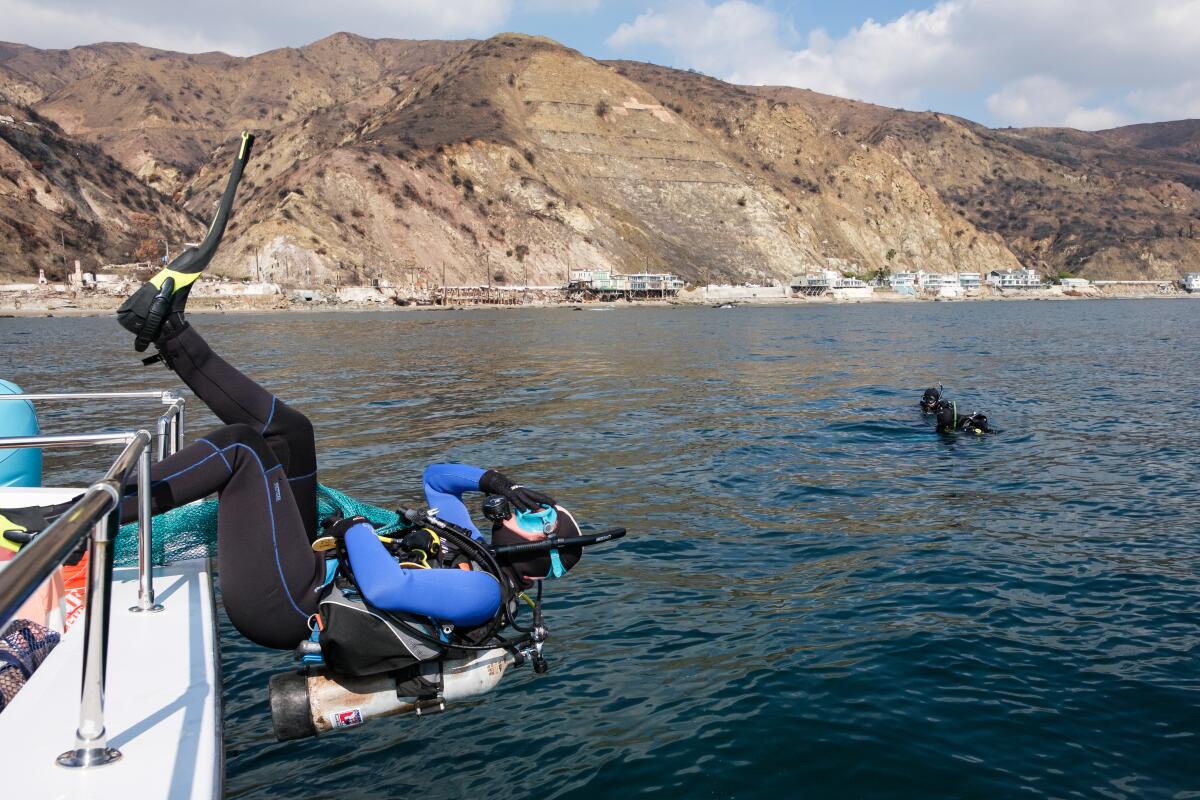
Sedona Silva enters the water during a kelp collection dive by Kelp Ark off the coast of Malibu.
(William Liang / For The Times)
While every rainfall washes dirt and urban gunk into the ocean, that process is turbocharged after a wildfire. Fire consumes vegetation that would otherwise hold soil in place and alters soil chemistry so that it absorbs less water.
This massive infusion of sediment disrupts kelp’s access to two things it needs to survive: rocks and sunlight.
A glut of dirt and pollutants can interfere with kelp spores’ ability to securely attach to rocks and reefs, either by binding to the spores themselves or by littering rock surfaces.
And when ash and debris fall upon the ocean’s surface, it reduces the amount of sunlight that filters through the water and provides the light kelp needs to photosynthesize.
Kelp isn’t the only marine species that suffers when deprived of light or pumped with pollution. But the prominent role it plays makes it an important bellwether for broader problems spurred by a changing climate.
Berberian, the UCLA doctoral student, is also a member of the research team. She developed a Post-Fire Kelp Recovery Index to compare kelp canopy extent after a fire to its historical average.
The team found that mature giant kelp beds shrank after the 2016 Soberanes fire in Monterey County, the 2017 Thomas fire in Ventura and Santa Barbara counties, and the 2018 Woolsey fire in the Santa Monica Mountains. They still haven’t returned to pre-fire levels, Hestir said.
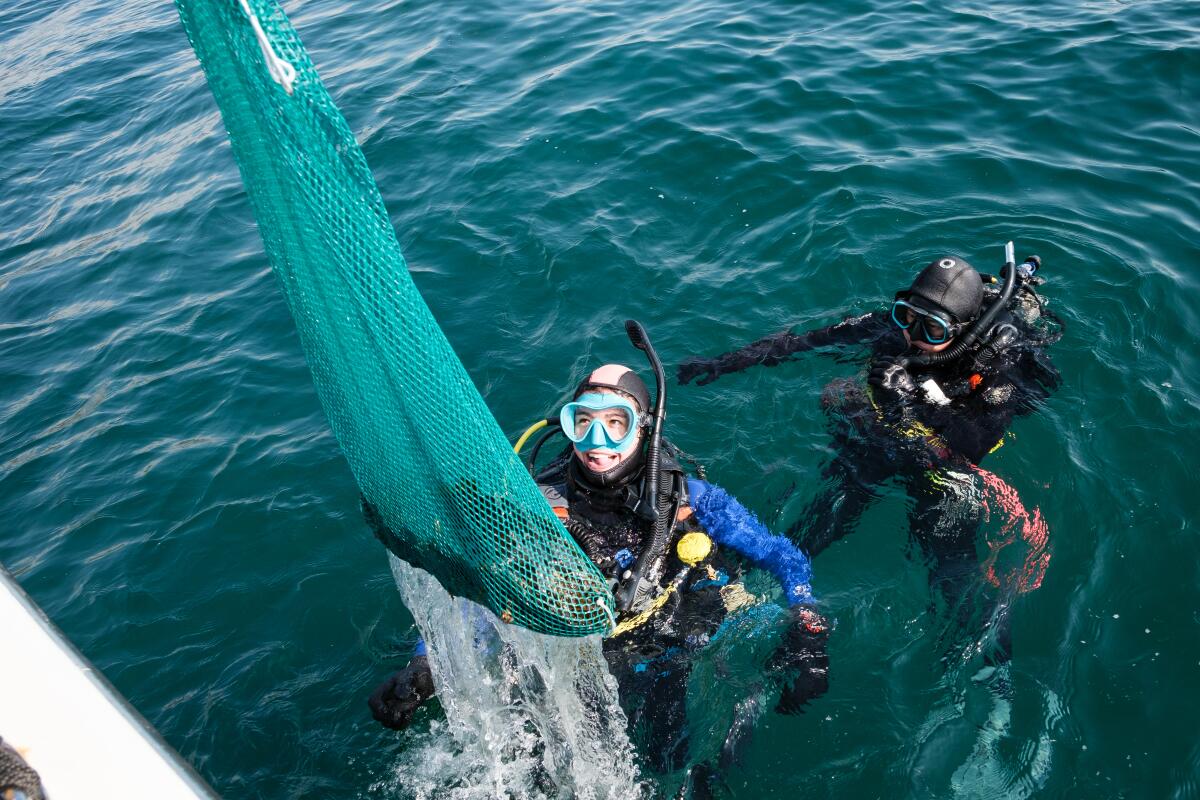
Sedona Silva, left, hands off her kelp during a collection dive by Kelp Ark off Malibu. The seed bank is concerned about the health of Southern California’s kelp populations after debris from the recent wildfires was found in the area.
(William Liang / For The Times)
Recovery rates varied widely by location. Using satellite data, Berberian found that the median recovery rate of kelp beds near Malibu was a mere 7% in the two years after the Woolsey fire. In the same time period, beds off of Palos Verdes rebounded 61%, with some areas recovering almost completely.
All of those fires dumped sediment into the ocean. But January’s infernos introduced a new variable, said Kyle Cavanaugh, a coastal geographer and UCLA professor who is also on the KelpFire team.
Previous wildfires burned mostly brush, trees and other organic material. The Palisades and Eaton fires incinerated homes, cars and everything in them: plastics, electronics, batteries, asbestos, lead pipes and household chemicals. No one knows yet what effect this will have on sea life.
“There’s certainly evidence that certain types of hydrocarbons and metals are toxic to early life stages of giant kelp, and you might expect that would be a bigger issue with all of the urban structures that burnt,” Cavanaugh said. “That’s something somewhat unique about this.”

Declan Bulwa carries kelp he collected during the collection dive. Forests of kelp, a fast-growing brown algae, provide food and habitat for hundreds of marine species and absorb greenhouse gases that might otherwise hasten climate change.
(William Liang / For The Times)
California’s giant kelp faces a number of different threats, and Hestir cautioned between drawing a direct line between any single disturbance — fire included — and decline of visible canopy.
Yet as the environmental disruptions pile up — prolonged marine heat waves, changing ocean chemistry, stronger and more frequent storms — so does the worry that the next disturbance could be a tipping point.
“What we’re concerned about is that these kelp are already under these stressors . . . and then you end up with a wildfire event, and maybe that’s what really tips it over the edge and doesn’t allow it to recover,” Hestir said.
Kelp Ark’s divers observed these challenging conditions firsthand during an initial post-fire collection trip on Jan. 27.
Days earlier, the first significant rains since May sent contaminants surging into the ocean.
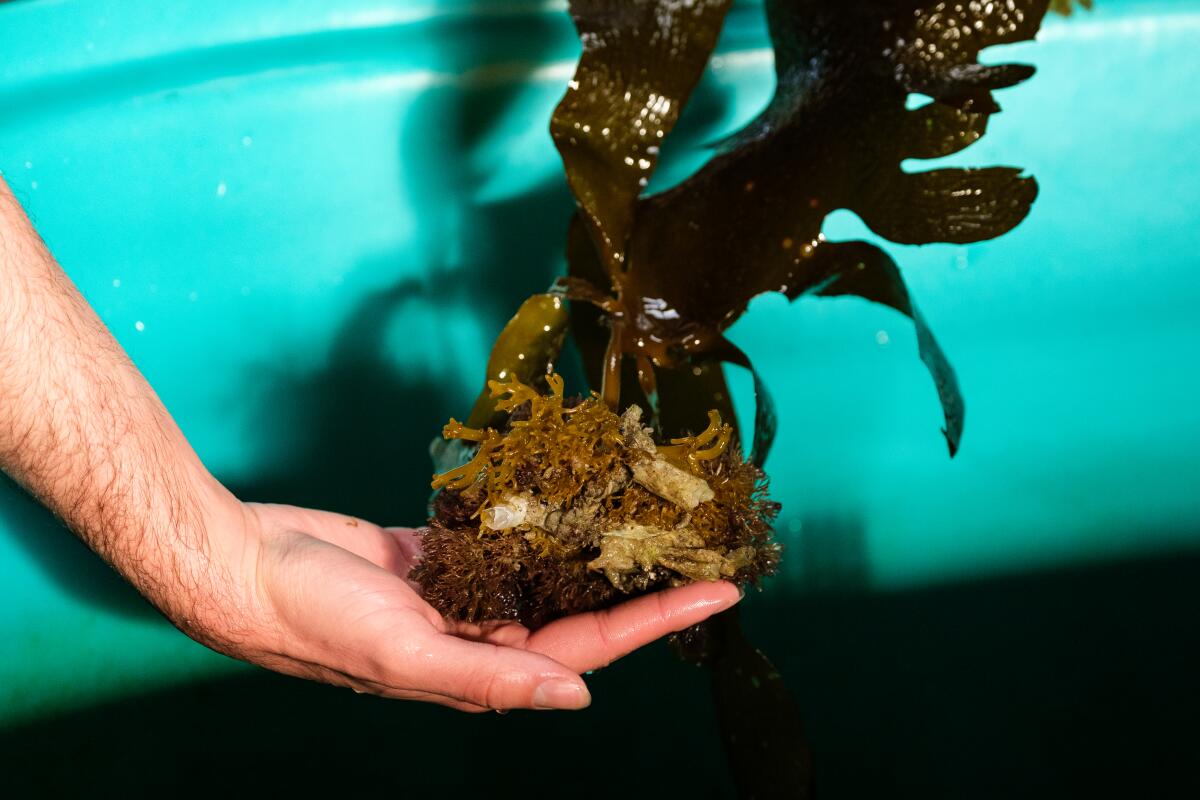
Kelp is shown at Kelp Ark’s laboratory where they store kelp seeds.
(William Liang / For The Times)
The ship’s wake was the color of chocolate milk. The ocean seemed to reek of burnt trash, said crew member Taylor Collins. The anchor chain, which on a typical day is visible for about 10 feet into the water, disappeared into opaque murk mere inches below the surface.
Before the divers rolled in, captain Joey Broyles let down a waterproof camera to assess conditions below.
The first 3 feet of seawater were choked with soot, dirt and pollution, said Bernadeth Tolentino, lead scientific diver and a graduate student in the USC lab of Kelp Ark founder Sergey Nuzhdin.
Visibility beneath the layer of soot was close to zero, she said. Divers held hands to keep track of one another underwater before calling it quits.
“It was almost like someone put a blanket over the ocean,” Tolentino said.

Hayden Schneider examines kelp at the San Pedro-based nonprofit Kelp Ark, which preserves and stores genetic material from West Coast kelp species.
(William Liang / For The Times)
Two weeks after that murky dive near Malibu Creek, the Kelp Ark team set out again to collect kelp samples to take back to their facility at AltaSea in the Port of Los Angeles for analysis and spore harvesting.
For this outing they chose a spot popular with recreational divers, where kelp was frequently recorded prior to the fires.
Two hours after plunging into the ocean, Tolentino and colleagues Declan Bulwa and Sedona Silva climbed wet and winded back into the boat.
They’d seen all the animals a diver would expect to see in a kelp forest, such as garibaldi fish and kelp bass.
But the only signs of the big brown algae were a few loose floating pieces and some decaying holdfasts on rocks near the shore — a sign that kelp had been there in the recent past, but no longer.



Three months after his son was born, Kevin Maguire felt alone.
It was 2019. He had recently moved to Barcelona with his wife and daughter and was working on marketing projects for Fortune 500 companies. The birth of his son, Bodhi, should have been a joyous event. But Maguire, now 43, became sad and irritable, and didn’t want to be around his newborn. He withdrew from family and friends, often playing video games late into the night or finding excuses to get out of the house.
“I would take the dog out for a walk,” Maguire said. “I wanted to get far away enough that I wouldn’t bump into anyone I knew and I would just sit and cry.”
Desperate for answers, he entered his symptoms online. Maguire, author of the recently published book “The New Fatherhood: Why Everything They Told You About Being a Dad Is Wrong, and How Embracing It Will Transform Your Life,” knew to look for signs of the “baby blues” in his wife. But he was surprised by articles that said men could experience postpartum depression too. The diagnosis resonated and he began writing about his condition and the trials of fatherhood on Substack.
New dads face psychological pressures, from sleepless nights to sky-high bills, which can contribute to postpartum depression. So can shifting hormone levels.
“One thing I found in my lab’s research is that when new dads have really low levels of testosterone, they might report more symptoms of postpartum depression,” said Darby Saxbe, a professor of psychology at USC and author of the recently published “Dad Brain: The New Science of Fatherhood and How It Shapes Men’s Lives.”
While hormonal shifts can create challenges, they also help men adapt to fatherhood, Saxbe explained. Several hormones can spike in men when they become dads, including oxytocin, linked to better relationship quality; vasopressin, associated with emotional bonding; and prolactin, which promotes lactation in women and caregiving behavior in guys.
New dads can also experience a decline in testosterone. According to a 2011 paper from University of Notre Dame professor Lee Gettler, part of the largest study on fatherhood and testosterone ever conducted, men averaged around a 25% drop in testosterone after becoming fathers.
While dads have reasons to be concerned by plummeting levels of testosterone, a modest dip isn’t necessarily a disaster — in fact, it can make men better parents and partners.
“We often get invested in the idea that men should always have the highest possible levels of testosterone,” Saxbe said. “What the research tells us is a little more nuanced. You really want flexibility. You want a hormonal system that can adapt to the different demands of your life.”
The prospect of a decline might scare soon-to-be fathers, especially those on TikTok and Instagram, where accounts push the idea that having “high T” is the key to being a “real man,” according to a recent study in the journal Social Science & Medicine.
Influencers stand to profit persuading men there’s a widespread “masculinity crisis,” the researchers found, noting that 72% of the accounts they analyzed had a stake in testosterone supplements and treatments.
But studies show more testosterone isn’t always better. “We found that when dads have higher testosterone, even before birth, they’re less invested [than men with lower testosterone] in co-parenting a few months after birth,” Saxbe said. High T fathers were more stressed from parenting than their lower T counterparts, and had partners who were less satisfied in their romantic relationships.
This jibes with the challenge hypothesis, which says, in multiple species, testosterone levels rise when males battle for attention from potential mates and go down when it’s time to take care of the young.
While a small decline can be adaptive, dads face mental health risks when their testosterone drops too low.
There is no “normal” level of testosterone, said Dr. Jesse Mills, director of the Men’s Clinic at UCLA Health. Experts recommend that men should consider treatment if their levels dip below 300 nanograms per deciliter (ng/dL). But men metabolize testosterone in different ways, meaning a healthy level for one might be low for another.
“If a new dad comes to me and his testosterone is 298 [ng/dL], he’s below the threshold,” Mills said. “But if he has zero symptoms and everything else is going great — he’s over the moon with his new child, he’s so happy — that’s not somebody I’m going to treat with testosterone.”
He notes that the drop in testosterone fathers experience can partly be attributed to the stresses that come with a new kid: less sleep, a poor diet and fewer trips to the gym. That means there are precautions that expectant fathers can take that don’t involve testosterone replacement therapy (TRT).
Still, while some guys with low testosterone levels might not need TRT, others in the “normal” range could benefit from treatment. (Dads who want another kid soon, beware. Mills notes that testosterone replacement therapy can take a man’s sperm count to zero.)
Both Mills and Saxbe stress that men should be paying attention to symptoms of low testosterone — such as depression and low libido — rather than trying to reach or maintain an ideal number. They also agree that tending to mental health concerns is hugely important for new fathers.
Eventually, after Maguire researched his condition, he recovered after time spent meditating, exercising and bonding with his son.
“A lot of new dads don’t realize how much they’re struggling because they feel ashamed or because they don’t realize it’s common shortly after the birth of a baby,” Saxbe said.
When they struggle, fathers can fixate on testosterone because that’s what modern culture tells them will make them feel better. And sometimes testosterone replacement therapy works. But Saxbe stresses a lot of men could use psychotherapy or support groups that bring dads together, as well as more time bonding with loved ones in general.
“The thing that predicts a man’s well-being and longevity is the quality of his relationships with other people,” said Saxbe. “You can be the world’s best weightlifter. You can have a low body-fat percentage. You can be killing it at work. Those things don’t predict how happy you’re going to be at 80.”

new video loaded: NASA Announces Artemis III Crew
transcript
transcript
NASA Announces Artemis III Crew
NASA announced the crew of Artemis III mission, which will fly to low-Earth orbit to test rendezvous and docking maneuvers with one or two lunar landers.
-
“I am excited to welcome you as the next crew in the Artemis journey to successfully return to the moon — this time to stay.” “I’m honored by the role that I’ve been given. I’m also very humbled by the task in front of us. But first and foremost, I’m grateful.” “So with that, the Artemis II crew, comrade, hands you the baton. You got the controls.” “As you know, we had a significant anomaly at our Launch Complex 36A on May 28. We’ve redoubled our efforts and are moving forward.”
By Alisa Shodiyev Kaff
June 9, 2026
Science
Santa Monica Mountains’ last steelhead trout survived the Palisades fire — and even had babies

Scientists feared the Santa Monica Mountains’ last remaining steelhead trout were dead, smothered by debris flows unleashed by the Palisades fire.
But the endangered fish surprised them: A team of biologists recently spotted 30 of the rare trout — and 21 babies — in Topanga Creek.
“There was a lot of happy dancing in the creek,” said Rosi Dagit, principal conservation biologist for the Resource Conservation District of the Santa Monica Mountains, which works with public and private landowners to conserve natural resources.
That’s because the steelhead here are endangered, at both the state and federal levels. Once, they swam in most streams of the Santa Monicas, but their numbers plummeted amid overfishing and coastal development. Increasingly frequent wildfire has further stressed their habitat. Topanga Creek, a biodiversity hot spot, is home to their last known population in the mountains that stretch from the Hollywood Hills to Point Mugu in Ventura County.
The trout that were spotted, including this one, are part of a distinct Southern California population that’s listed as endangered at the state and federal levels.
(RCDSMM Stream Team)
The California Department of Fish and Wildlife spearheaded a complex mission to rescue trout threatened by the Palisades fire that sparked in January 2025.
Time was of the essence. The fire hadn’t yet been fully contained. But rain was on the way, which would sweep massive amounts of sediment from the denuded hillsides into the water. Fish are often killed this way.
Crews stunned the fish with electricity, scooped them up in buckets, trucked them to a hatchery and ultimately moved them to Arroyo Hondo Creek in Santa Barbara County.
Within days, Topanga Creek was choked with mud. Some assumed the fish left behind were goners.
But in March, the conservation district’s team found four. The following month, when water conditions were clearer, they saw more.
“These fish continue to amaze me,” said Kyle Evans, environmental program manager for the state Department of Fish and Wildlife, who had seen the damage to the creek. “I had seen populations get wiped out in similar situations. So when I heard, I was thrilled.”
Evans surmises the fish that survived were in an area of the creek where less charred material and sediment were swept in.
“These fish likely hunkered down, were hiding under some rocks or places to try to get away from the main concentration of flow,” he said. “And luckily they weren’t buried.”
The ones that were spotted were fairly small, around 6 to 14 inches. Rainbow trout and steelhead trout are the same species, but with different lifestyles. If the fish remain in freshwater, they’ll be considered rainbows. However, they can migrate to the ocean and become steelhead, where they typically grow larger before returning to their natal waters to spawn.
Topanga Creek hasn’t fully recovered from the damage it sustained, but scientists say it’s looking better. Surveys last year were “so depressing,” Dagit said, with very few animals, and stretches that were essentially transformed into flat roads from all the sediment buildup. Some of the riparian canopy burned right down to the creek.
Then came 32 inches of rain over the last nine months, scouring out and moving sediment, creating deeper pools. Dagit said they recently found newt egg masses for the first time in years, as well as a few adult newts and many frogs. Plants that provide cover are starting to recover.
She provided photos comparing certain pools last year and this year, some dramatically transformed. In September 2025, the Shrine Pool could have been an overgrown hiking trail. This April, it was filled with shallow water.

The Shrine Pool in September 2025, left, and the same location in April 2026, right, with RCDSMM’s Isaac Yelchin donning a wetsuit.
(RCDSMM Stream Team)
Topanga Creek is home to another endangered fish, the small but hardy northern tidewater goby, often described as cute. Not long before the trout operation, Dagit led a rescue of hundreds of these fish too. Many were repatriated to the lagoon at the mouth of the creek in a moving ceremony last June.
There’s still the matter of what to do with the trout that were moved to Santa Barbara County last year. Evans would like to bring them home to the Santa Monicas at some point, but isn’t sure if it will happen. On one hand, they could bolster the small, genetically isolated surviving population. On the other, they might inadvertently bring in a disease or bacteria. There is some time to decide. Evans estimates the creek still needs to recover for two to three more years.
For now, the fish are functioning fine in their adopted creek. Experts worried the trauma wrought by the move would disrupt their spawning process, but they had babies that spring. This year, they spawned again.
-

 New Hampshire56 seconds ago
Man With Warrants Chased Through Bow, Concord: New Hampshire State Police Roundup
-

 New Jersey4 minutes ago
New Jersey beach report: Where is it safe to swim?
-

 New Mexico9 minutes ago
Gregg Hull: Trump endorsement would be a “pretty cool thing” – New Mexico Political Report
-
North Carolina16 minutes ago
NC lawmakers renew push to regulate where homeless people can sleep
-

 North Dakota19 minutes ago
Capstone Academy of Fargo and nonprofit sue North Dakota over teacher licensing requirements
-

 Ohio24 minutes ago
Ohio State Shares Behind-the-Scenes Look at the Creation of Its New Buckeye Stripe Uniforms
-
 Oklahoma31 minutes ago
2026 Hemmings Great Race at Will Rogers Memorial Museum
-

 Oregon34 minutes ago
Oregon EDGE commit Rashad Streets earns 5th star

