Science
David Baltimore, Nobel Prize-winning scientist and former Caltech president, dies at 87


In 2003, the Nobel Prize winner David Baltimore, then president of Caltech, paused to reflect on his role as one of the world’s most decorated scientists.
“People keep e-mailing me to ask, ‘What is the meaning of life?’” Baltimore told an interviewer, with amusement. “And they want me to e-mail them back quickly with an answer!”
Baltimore was then 65, an age when many people are retired from public life, yet he was still actively leading one of the world’s top research universities. Others, he said, found their meaning “in friends, in dogs, in religion, in the self-reflectiveness of writing, etc. But Caltech people largely find it in the continual contest with nature.”
It was a contest that Baltimore waged right to the end of his life as a scientist, businessman and internationally respected conscience of the new world of biological engineering. He died Saturday at his home in Woods Hole, Mass., according to his wife, as reported by the New York Times. Baltimore was 87.
His death concludes one of the most illustrious careers in 20th century science. The bearded scientist with the penetrating blue eyes played a role, usually a leading one, in virtually every important national debate over the use and potential misuse of the science of genetic engineering, whether it was gene-splicing and the search for an AIDS vaccine, or the dangers of tinkering with the human genome.
But it was as a working scientist that he made his most enduring contributions, the role he was most proud of.
“When you are a scientist, and you are trying to prove or disprove a notion, you work at the bench doing the dullest, most routine things over and over and over again,” Baltimore once explained.
“I can’t tell you how many ways things go wrong. All the time you are doing this because there is an idea behind it.”
In a statement, Caltech President Thomas Rosenbaum said Baltimore’s “contributions as a virologist, discerning fundamental mechanisms and applying those insights to immunology, to cancer, to AIDS, have transformed biology and medicine.”
“David’s profound influence as a mentor to generations of students and postdocs, his generosity as a colleague, his leadership of great scientific institutions, and his deep involvement in international efforts to define ethical boundaries for biological advances, fill out an extraordinary intellectual life,” he added.
David Baltimore was born March 7, 1938, in New York City, the son of a garment industry merchant, Richard Baltimore, and Gertrude Lipschitz-Baltimore.
Richard’s family was Orthodox Jewish, from Lithuania, and though the Baltimores in America were not overtly religious, the family communicated a moral code that influenced their son’s concern for the underprivileged.
This led him to take public stands on social issues, such as the AIDS epidemic and nuclear proliferation, that other scientists shunned. In 1970, while performing experiments that would win him the Nobel Prize, he shut down his lab for a week and joined demonstrators in Boston against the Vietnam War-era invasion of Cambodia.
In high school, Baltimore enrolled in a summer program at the prestigious Jackson Laboratory at Bar Harbor, Maine, where he made a discovery that altered his life and set him on the path to science.
“It was the process of research. I discovered that I could investigate the unknown as a high school student, that the frontier of knowledge was actually very close and very accessible,” he said, many years later.
After graduating from Swarthmore College, Baltimore earned his doctorate from the Rockefeller Institute (now University), before doing three years of research at the Salk Institute in La Jolla, where he met his future wife, Alice Shih Huang. His postdoctoral student, Huang collaborated in his research on animal viruses, later becoming a full professor at Harvard Medical School. At this time, Baltimore was particularly interested in the poliovirus, which attacks the RNA (ribonucleic acid) in cells.
“He was on the cutting edge of molecular biology,” said science historian Daniel Kevles, his friend and colleague. “There was no molecular biology to speak of and very little virology. … It was a brave field of work.”
At the time, it was an ironclad rule in molecular biology that genetic information was a one-way street, flowing from the double-helix structure of DNA to the single-stranded RNA, which the cell’s machinery uses to make proteins. But some biologists were beginning to question that assumption, and Baltimore joined the hunt for evidence that genetic information might flow in both directions, which, if true, held enormous potential for understanding the spread of viruses.
After leaving the Salk, Baltimore returned to Boston and became an associate professor of microbiology at MIT. As it became apparent that not all viruses behaved alike, Baltimore launched a new classification system, one that is still in use, grouping them by families according to their genomes and replication systems.
It was during this work that he discovered an enzyme that enabled a virus made of RNA to be copied into DNA, a process known as reverse transcription. The discovery of reverse transcriptase was greeted with overheated predictions that science had at last found a cure for cancer. The thinking went, if one could use RNA to code DNA, scientists could seize control of the body’s defenses.
Baltimore knew his work did not augur a cure for cancer, but the discovery of reverse transcriptase was nonetheless important because it led to an understanding of how genes can modify cells, turning normal cells into cancer cells. Reverse transcriptase is also used by a unique family of viruses, known as retroviruses, to replicate themselves. This finding would be critical to understanding the AIDS virus, HIV, which is a retrovirus, and devising anti-HIV treatments.
Baltimore’s discovery was attended by great fanfare and led to his promotion to full professor at MIT. In 1973, he was awarded a lifetime research professorship by the American Cancer Society, and a year later was elected to the National Academy of Sciences and the American Academy of Arts and Sciences. Finally, in 1975, with Howard Temin, a friend and colleague who had discovered reverse transcriptase around the same time, Baltimore was awarded the Nobel Prize for physiology or medicine.
With the prize came fame; people began referring to Baltimore as the most influential biologist of his generation. To the general public, who did not necessarily understand what he had done, only that it was important, he became, at the age of 37, a full-fledged savant.
The award had a profound effect on colleagues.
“I don’t see it as a burden, but you can’t get away from it,” Baltimore said. “I know that when I talk to young scientists, they are looking at me and saying, ‘God, I am talking to a Nobel Prize winner.’ I try to break that down. It gets harder every year.”
His new celebrity status gave him a platform to address issues of broad cultural and scientific importance, a role Baltimore embraced.
In the 1970s, when people became concerned that gene-splicing techniques could lead to the production of super viruses, Baltimore organized a conference at Asilomar near Monterey to design a self-regulating system to monitor those experiments. In the early 1980s, he led the fight against a crash program to map all human genes, fearing, once again, unknown consequences. In each case, when it was shown the dangers had been overestimated, he then led the effort to relax federal restrictions. He became an early champion of federal AIDS research and chaired a national commission that concluded the federal government’s response to the epidemic was dangerously inadequate.
As his reputation grew, he took leadership roles on political issues. When Pope John Paul II wanted to warn President Reagan of the danger of nuclear weapons, Baltimore was one of four scientists the pontiff appointed to carry his message.
In 1984, Baltimore was chosen founding director of the new Whitehead Institute for Biomedical Research, molding it into one of the world’s leading institutions of its kind. Following that success, he was appointed president of the Rockefeller University.
Along the way, he became not only a respected link between the government and scientists but also a key player in the burgeoning biotechnology industry. His early involvement in the industry made him a “relatively wealthy man,” according to a 1997 Times magazine profile.
The profile described a man in the fullness of middle age, harvesting the benefits he had earned, drinking the best wines and single-malt scotch, driving appropriately luxurious but not ostentatious vehicles. “With his wife, Dr. Alice Huang, he shares a luxury duplex condominium on Union Wharf, which has a commanding view of Boston Harbor,” it said.
In person, “Baltimore’s practiced elegance frames a fierce pride and a sometimes brutal intellect, softened only by his insistence that professional criticism be leavened by personal respect.”
And then, the entire edifice crumbled as Baltimore became the focus and fall guy for one of the more infamous investigations of scientific misconduct in the last half of the 20th century. A colleague wrote a paper claiming sensational results. When others could not reproduce those results, allegations of fraud were aired, causing Congress to get involved. With the decline of the space program, biology had emerged as the preeminent science, and Congress was becoming skeptical about how millions of dollars in federal research grants were being spent.
The whiff of scandal was attached to Baltimore himself, even though his work was never questioned. Still, his refusal to admit error, or to abandon his problematic colleague, came to symbolize for many the arrogance of the new mandarins of the biological sciences.
“The Baltimore case is reminiscent of the Watergate scandal,” the New York Times wrote.
Four federal investigations and a grand jury probe later, Baltimore’s colleague, and Baltimore himself, were exonerated. The ordeal had consumed a decade of his life. Then, within months, everything changed. He was chosen to coordinate the federal effort to develop an AIDS vaccine and then appointed president of Caltech. It was a breathtaking reversal of fortune.
“It is even more breathtaking,” Baltimore said in 1997, shortly after taking the Caltech job, “to live through it.”
Kevles, a professor at Caltech at the time, recalled that when Baltimore’s name was announced to the assembled faculty, “the room erupted in cheers. I had never seen the biologists look so ecstatic. It legitimized their field.”
In his eight years as president, Baltimore raised the university’s profile, both as a place where cutting-edge biology is done and as a respected voice on pressing national scientific debates. Under his leadership, Caltech raised more than $1.1 billion. He cited the gift of $600 million to the school by Intel Corp. co-founder Gordon Moore and his wife, Betty, as the “decisive moment” of his presidency.
“Caltech is a wonderful place, the best place to do science I have ever seen,” Baltimore said in 2005, when he announced his resignation. “I will have done what I can do [as president], and it is time for somebody else to be thinking about it.”
As for what would come next, Baltimore said, “I have a fairly extensive life in science and in business that I will pursue.”
If he thought his return to the laboratory would be a placid coda to his career, he was soon proved wrong, by yet another advance in genetic engineering, this one called CRISPR. “I’ve seen revolution after revolution in biology,” Baltimore said in 2016. “This one is a big deal.”
As one writer noted, if the gene-splicing technology of the 1970s spurred images of laboratory-hatched plagues from the “Andromeda Strain” novel and movie, CRISPR inspired comparisons to “Brave New World.” MIT’s Technology Review wrote of labs in which “man rebuilds creation to suit himself” and warned of “a path toward a dystopia of superpeople.”
Just as he did decades earlier, Baltimore took a leadership role in starting a public discussion about how to manage the powerful new tool. “At Asilomar, we had identified the genetic modification of humans as the biggest coming issue,” Baltimore said. “We just didn’t know when it would come.”
A statement drafted by participants at a meeting in Napa in early 2015 spoke of the promise of “curing genetic disease” but also warned of “unknown risks to human health and well-being.”
The statement listed 18 authors, with Baltimore at the top. Though he wrote an op-ed for the Wall Street Journal entitled, “Let’s Hit ‘Pause’ Before Altering Humankind,” Baltimore admitted later that genome-editing would in all probability take place sooner rather than later.
After retiring as president of Caltech, he remained on staff in an emeritus capacity, and was appointed the Robert Andrews Millikan professor of biology. He finally shuttered his lab in 2019 but remained active in business. He helped found a number of companies, including Calimmune and Immune Design, which carried on the work he began in immunology and virology. Though he was most visible for his public advocacy of cancer and AIDS research, it was his work as a “lab-based, working biologist” that gave him the most pleasure, and for which he hoped to be remembered.
Besides the Nobel Prize, he received the National Medal of Science in 1999, and the Warren Alpert Foundation Prize in 2000. He was the 1999 recipient of the National Medal of Science and published more than 700 peer-reviewed articles.
He was also a member of numerous scientific advisory boards, including Amgen, the Broad Institute, Ragon Institute, and Regulus. Baltimore was past-president and chair of the American Assn. of the Advancement of Science.
He is survived by his wife, Alice, and daughter, T.K. Baltimore.
Johnson is a former Times staff writer. City News Service contributed to this report.


Few substances are as deeply woven into everyday life as alcohol. It is a fixture at holiday celebrations, work-related social gatherings, sporting events, airports, and brunch or dinner tables. All demonstrate how deeply alcohol has become embedded in social customs and cultural traditions.
Yet alcohol contributes to millions of deaths globally each year and is linked to cancer, liver disease, unintentional accidents, violence and, importantly, dependence and addiction. Despite this, the disconnect between alcohol’s cultural role and its serious health burden is striking. An estimated 2.3 billion people worldwide consume alcohol.
As a physician working in addiction medicine, I regularly care for patients whose alcohol use affects nearly every organ system. It is often not until these patients end up admitted to the hospital that they learn the effects of alcohol on various parts of their body besides their liver.
Newer evidence challenges assumptions about what was long considered “safe drinking.” Even moderate drinking carries risk and is not as harmless as people, including experts, once thought.
Many people associate alcohol risk primarily with addiction or dangerous behaviors such as driving while intoxicated. However, its effects extend far beyond this, into nearly every aspect of a person’s well-being.
While alcohol may transiently improve mood and ease social anxiety, long-term alcohol use can lead to a worsening of mood, cognition and sleep, which can further compound use.
A 2021 literature review found that consuming approximately two standard drinks roughly doubles the odds of sustaining injuries — with or without a vehicle involved. The review also found that heavy episodic (binge) drinking can increase the risk of injury by 50-fold, depending on the amount of alcohol consumed and the type of injury. While alcohol’s effects on the liver are well known, it can also lead to gastrointestinal complications and heart disease
The World Health Organization estimates that 2.6 million deaths each year are attributable to alcohol, accounting for nearly 1 in every 20 deaths worldwide.
While many people recognize the risks of alcohol addiction, people are generally much less aware of the links between alcohol use and cancer risk.
The World Health Organization classifies alcohol as a Group 1 carcinogen — the same category as tobacco and asbestos. In 2025, the U.S. surgeon general emphasized that alcohol increases the risk of at least seven cancers, including cancers of the breast, colorectal, liver, oral, esophagus and larynx. An advisory called for updated warning labels.
Yet fewer than half of Americans recognize alcohol as a risk factor for cancer, particularly for cancers such as breast cancer that are not commonly associated with alcohol use.
Throughout the 1990s and early 2000s, observational studies suggested that moderate alcohol consumption might offer cardiovascular benefits. Over the past decade, however, higher-quality studies have challenged these findings, suggesting that much of the apparent benefit may have reflected differences in the health and lifestyles of moderate drinkers rather than a protective effect of alcohol itself.
Current evidence increasingly suggests that even low levels of alcohol may increase cancer risk.
Federal guidelines acknowledge that adults should “consume less alcohol for better overall health.” However, the most recent version of the “Dietary Guidelines for Americans,” updated in January, removed the previous recommendation to limit intake to no more than one drink per day for women and two for men. It also omitted explicit discussion of alcohol’s links to cancer.
These changes have drawn criticism from public health experts, who argue that the revised language plays down the growing evidence of alcohol-related harms and provides less specific guidance to consumers. The current administrator of the Centers for Medicare & Medicaid Services characterized alcohol as a “social lubricant” that brings people together, rather than emphasizing its well-established health risks.
This may be true physiologically, at least temporarily, but obscures the fact that relying on it as a social lubricant can lead to chemical and psychological dependency. In my view, statements to that effect are shortsighted, prioritizing short-term social effects over more insidious and long-term issues, including addiction.
While many dangerous mind-altering substances are hidden from public perception, alcohol is often placed at the center of it – a trend that shows no sign of changing imminently.
Further, large companies often profit from ads that appeal to young people.
Looking back at the history of tobacco smoking provides some helpful insights. In 1965, 42.4% of the U.S. population smoked. By 2022, that figure had dropped to 11.6%.
This steep decline did not happen because of a single intervention, but through decades of accumulating scientific evidence, public education campaigns, warning labels, restrictions on advertising, smoke-free policies, higher tobacco taxes and shifts in social norms. Together, these efforts transformed smoking from a widely accepted social behavior into one broadly recognized as a major health risk and correspondingly, less socially accepted.
Although alcohol consumption has modestly declined in recent years, it remains deeply embedded in social life in ways cigarette smoking no longer is.
People often assume that if a substance is legal, common and widely socially accepted — even encouraged — it must also be safe. But public health history suggests those assumptions can and should change.
Emma Fenske is an addiction medicine fellow and internal medicine physician at Oregon Health & Science University. This article was produced in partnership with the Conversation.
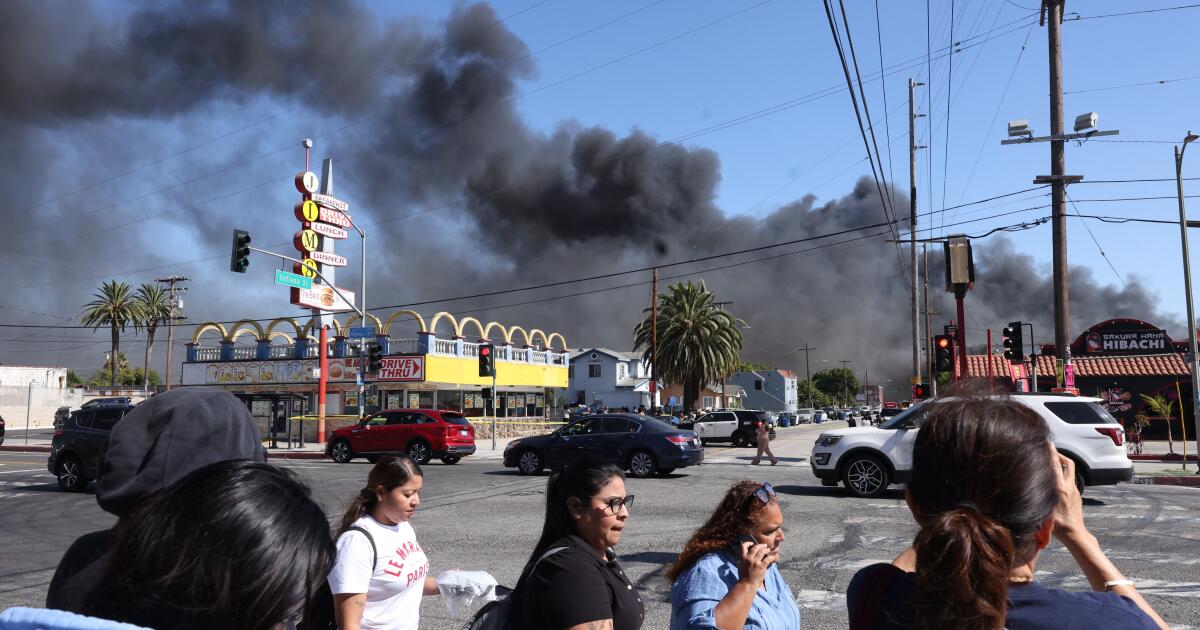
The air near the Lineage refrigerated warehouse fire in Boyle Heights carried astronomically high levels of smoke and soot, surpassing some of the worst air pollution during the Los Angeles County fires in January 2025, according to preliminary data from air officials.
The fire spewed thick black smoke for days. From downtown Los Angeles to the San Gabriel Valley, tens of thousands were enveloped in unhealthful levels of smoke, even as some local officials told residents that the air posed no danger.
As the days wore on, worst off were communities nearest the blaze. On June 19, three days after the facility ignited, a temporary air quality monitoring station at Eastman Elementary in unincorporated East Los Angeles measured an extremely hazardous 755 micrograms per cubic meter of fine particles for more than an hour, according to the South Coast Air Quality Management District.
For comparison, a Caltech air monitor in Pasadena recorded about 650 micrograms per cubic meter during the Eaton fire.
These high levels of fine particles, known as PM 2.5, probably resulted in the surge of residents into local emergency rooms during the fire, according to local health officials. But even now with the smoke gone, people still have not been told what chemicals they were breathing in during the weeklong ordeal.
Michael Jerrett, an environmental health professor at the UCLA Fielding School of Public Health, said his concern is the composition of materials emitted when the building burned.
“These contain many particularly toxic components,” Jerrett said, “and we know little about how these mixtures affect health.”
There is no completely safe level of fine particulate pollution, he noted, meaning higher concentrations are always worse.
During the 2025 L.A. County fires, local air officials announced that several monitors downwind had detected elevated levels of brain-damaging lead and cancer-causing arsenic from toxic paint and construction materials used in older homes.
The Lineage warehouse, built in 2018, is likely to contain different materials of concern. Thick insulation foam required for a massive refrigeration operation, solar panels and refrigerants were burned, leaving many residents on edge.
Even though three public agencies conducted air monitoring, the picture is still murky.
“[Public officials] are speaking with a lot of confidence but not a lot of information,” said mark! Lopez, a community organizer with East Yard Communities for Environmental Justice. “We’ve gotten in the room with folks to discuss where the gaps lie and where assumptions are being made. And I think they are realizing these agencies supposed to protect our air and our health aren’t as reliable as they thought they were.”
In response to the Boyle Heights fire, the South Coast air district deployed a mobile monitoring vehicle to screen for toxic substances in the community near the fire, according to Nahal Mogharabi, a spokesperson for the air district. It found increased levels of bromine, a chemical commonly found in fire retardant, and chlorine, often released from burning plastic. Both were below short-term health-based exposure thresholds.
Toxic metals, including lead and arsenic, were not elevated, according to air district data.
“That was the reassuring piece, that they were not picking up any of the metals,” said Dr. Nichole Quick, chief medical advisor for the Los Angeles County Department of Public Health. “But … that smoke is unhealthy. “You don’t want to be breathing it, regardless.”
The U.S. Environmental Protection Agency set up air monitors around the perimeter of the facility to test for toxic air contaminants, has the results and has not made them public. Julia Giarmoleo, an EPA spokesperson, said the monitors did not detect elevated metals, but would not provide a copy of the data without a federal records request.
The Los Angeles Fire Department’s hazardous material team also tested for ammonia, which is used in refrigeration, and hydrogen fluoride, a toxic chemical that could be released by burning lithium-ion batteries and solar panels.
Fire officials previously said they measured low levels of hydrogen fluoride on the second day of the fire. But the department would not answer questions about its air monitoring. It also told a reporter to submit a public records request.
It remains unclear whether any agency has tested for hydrogen cyanide or isocyanates, highly toxic gases that could be released from burning chemical-laden insulating foam inside the building.
“The real issue is what monitoring has not been done to protect the fence-line community from the air toxics,” said Jane Williams, executive director of California Communities Against Toxics.
Without the EPA or LAFD data, what is known of the smoke’s toxicity rests on the air district’s mobile monitoring.
Jerrett, the UCLA researcher, said that is not ideal for understanding the kind of plume released by the Boyle Heights fire, which rapidly changed direction with the wind.
“This can in some instances lead to levels that look low, but they are resulting from a mismatch between the location of the vehicle and the plume,” he said.
The Boyle Heights blaze, similar to the Eaton and Palisades fires, has revealed the region’s air monitoring can’t always tell people what they’ve been exposed to in a disaster.
“We do need a better monitoring system in place,” he said.
Local officials are now shifting their focus to the rancid odors from millions of pounds of rotting food in the ruined wing of the warehouse. Decomposing food can release hydrogen sulfide, a toxic gas synonymous with landfills and garbage. Lineage hired contractors who are measuring this noxious gas and other pollution. Their data indicate they have not detected hydrogen sulfide.
As Lineage workers haul the rotting food to local landfills, they are using deodorizing mist and have discussed using shrink wrapping to suppress the stench and minimize issues for nearby homes.
At this point, the odors are believed to be an inconvenience rather than a public health threat, according to Quick, the county medical advisor. She said running air purifiers may help to reduce odors indoors.
“It’s very important for folks to understand that the odors themselves do not indicate any dangerous levels of toxins, mold, bacteria, and so forth,” Quick said. “But the odors are a public nuisance.”
The air district is still encouraging residents to report odors to its online complaint system or by calling (800) 288-7664.

Federal employees who were axed during waves of cuts by the Trump administration have fought back against the dismantling of a key climate science website, Climate.gov, and put up a new site, Climate.us, that can now do everything the original did.
The site, with millions of users each year, was known for colorful charts that anyone could freely download and that simplified giant sets of data, such as temperature readings. Now it refers to another page and is no longer being updated.
Daniel Swain, a UC Agriculture & Natural Resources climate scientist, called the resources available at Climate.gov “the most efficacious dollars spent by NOAA on public-facing science, possibly ever.” He has used graphics from the former website on his popular weather blog.
“I am a terrible artist or illustrator. It would be very bad if I had to create those on my own.” Swain said. The website didn’t just make graphics that were beautiful, he said, they were accurate and reliable because of the network of researchers who fact-checked them.
Rebecca Lindsey was the editorial lead and program manager for Climate.gov until February 2025, when her position at the National Oceanic and Atmospheric Administration was eliminated by the Elon Musk-led Department of Government Efficiency, or DOGE. She explained that the online resource was “a bridge between scientists, data and the public.”
Lindsey and her team have now rebuilt the bridge piece by piece, if just a bit further downstream.
The team is made of the same editorial and technical staff that ran Climate.gov. It’s paid for through a crowdfunding campaign and one large, anonymous donation.
The group has raised some $380,000, about $100,000 of which came in the last week. They also have recruited 80 scientists who are willing to volunteer as subject matter experts and fact checkers. It’s enough to keep the work going through February while they seek more long-term funding.
The first iteration of Climate.us went online in 2025 to keep the last 15 years of work from the government website available. The newest version restores the full function of the previous website.
For Californians, the timing could be important.
“We’re headed for a very strong El Niño event that will have significant implications for Southern California,” Swain said. “Climate.gov and the scientists behind it did a great job walking people through the last one, and I would expect that’s the case this time as well.”
Climate.gov excelled at tapping into a pool of academic experts to explain what was happening in nearly real time. This allowed the public to see how events such as wildfire, drought or large weather patterns such as El Niño were shaping their lives when they needed the information most. Research from academic institutions, by contrast, can take years to publish results from major natural disasters.
Swain emphasized that cuts to resources that give context to hard-to-interpret data is not just a loss for the research community.
“It’s getting more and more difficult for the American public to access the science and the scientists that their tax dollars have supported for over half a century,” he said.
With the revival of Climate.us, Swain said he plans to directly use the site and its graphics to keep Californians connected to the world of climate science.
-

 Cleveland, OH6 minutes ago
Lakewood power outage: Day two leaves businesses, residents scrambling
-

 Austin, TX9 minutes ago
City of Austin covers iconic murals, sparking backlash over cultural loss
-

 Alabama14 minutes ago
Thousands attend Alabama concert at West Virginia America 250 celebration – WV MetroNews
-

 Alaska21 minutes ago
Seward pilot helps rescue harbour seal pups from remote Alaska location – Homer News
-

 Arizona24 minutes ago
Arizona boy named Disneyland’s one billionth guest on his 8th birthday in memorable ceremony
-
Arkansas29 minutes ago
Arkansas Lottery Mega Millions, Cash 3 winning numbers for July 3, 2026
-

 Colorado39 minutes ago
Where to watch San Francisco Giants vs Colorado Rockies: TV channel, start time, streaming for July 4
-

 Connecticut44 minutes ago
Several state parks, beaches close Friday due to capacity

