Science
Can you survive a wildfire sheltering at home? For one community, L.A. County Fire says it may be the only option

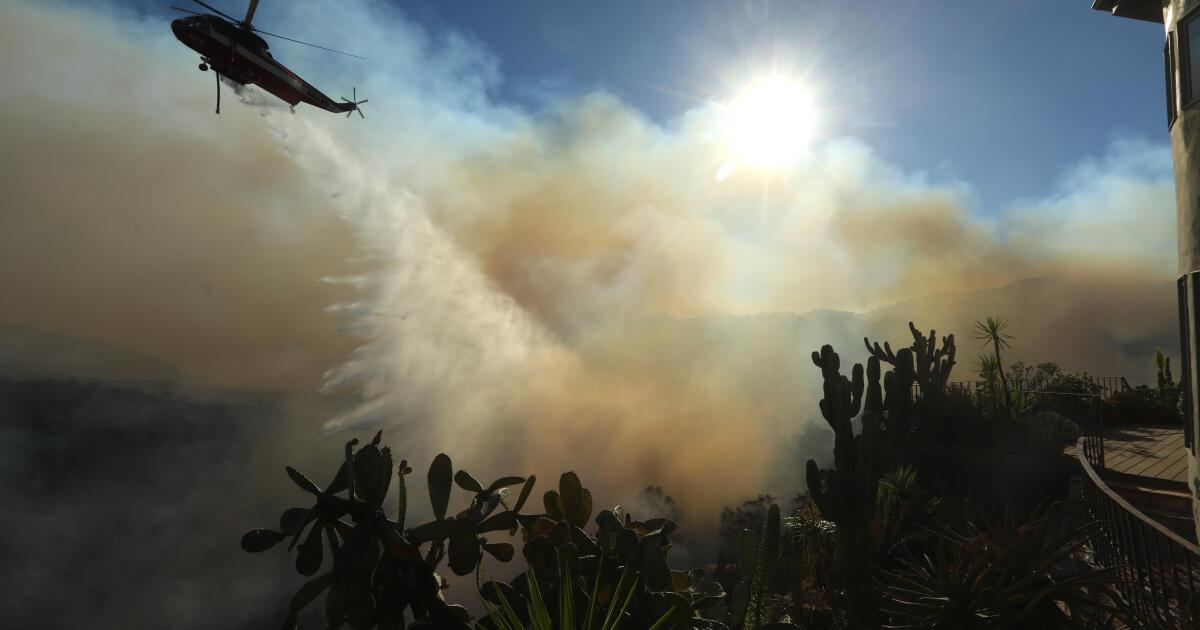
Dozens of Topanga residents gathered in the town’s Community House to hear Assistant Fire Chief Drew Smith discuss how the Los Angeles County Fire Department plans to keep Topangans alive in a fierce firestorm.
In the red-brick atrium, adorned with exposed wood and a gothic chandelier, Smith explained that if a fire explodes next to the town and flames will reach homes within minutes, orchestrating a multi-hour evacuation through winding mountain roads for Topanga’s more than 8,000 residents will just not be a viable option. In such cases, Smith told attendees at the town’s Oct. 4 ReadyFest wildfire preparedness event, the department now plans to order residents to shelter in their homes.
“Your structure may catch on fire,” Smith said. “You’re going to have religious moments, I guarantee it. But that’s your safest option.”
Wildfire emergency response leaders and experts have described such an approach as concerning and point to Australia as an example: After the nation adopted a similar policy, a series of brush fires in 2009 now known as Black Saturday killed 173 people, many sheltering in their homes.
-
Share via
Some in the bohemian community of nature lovers, creatives and free spirits — who often pride themselves on their rugged, risky lifestyle navigating floods, mudslides, wildfires and the road closures and power outages they entail — are left with the sinking realization that the wildfire risk in Topanga may be too big to bear.

Water tanks called “pumpkins” are available to helicopters to be used during a fire at 69 Bravo, an LAFD Command Center along Saddle Peak Road in Topanga.
They see the shelter-in-place plan as a perilous wager, with no comprehensive plan to help residents harden their homes against fire and no clear, fire-tested guidance on what residents should do if they’re stuck in a burning home.
“Do we need to have some way of communicating with first responders while we are sheltering in place? Would the fire front be approaching us and we’re just on our own?” asked Connie Najah, a Topanga resident who attended ReadyFest and was unsettled by the proposal. “What are the plans for helping people through this season and the next season while we’re waiting to have widespread defensible space implementation?”
No fire chief wants to face the scenario of a vulnerable town with no time to evacuate. But it is a real possibility for Topanga. Smith, speaking to The Times, stressed that the new guidelines only apply to situations where the Fire Department has deemed evacuations infeasible.
“If we have time to evacuate, we will evacuate you,” Smith said.
Emergency operations experts say not enough has been done in their field to address the very grim possibility that evacuating may not always be possible — in part because it’s a hard reality to confront. It’s not a small problem, either: Cal Fire has identified more than 2,400 developments around the state with at least 30 residences that have significant fire risk and only a single evacuation route. Topanga is home to nine of them.
“We’re pretty isolated. We’re densely populated. Fuel and homes are intermixed. It’s an extremely dangerous area.”
— James Grasso, president of the Topanga Coalition for Emergency Preparedness
Recent fires, including the 2018 Camp fire in Paradise and Woolsey fire in Malibu, have made the issue too hard to ignore.
In Topanga, Najah has a ham radio license so she can stay informed when power and cell service inevitably go down. The elementary school relocates out of town during red-flag days. A task force including the Topanga Coalition for Emergency Preparedness, the Fire Department and other emergency operations agencies publishes a Disaster Survival Guide and distributes it to every household.

“The survival guide was born out of necessity,” said James Grasso, president of TCEP, who also serves as a call firefighter for the county Fire Department. “We’re pretty isolated. We’re densely populated. Fuel and homes are intermixed. It’s an extremely dangerous area, particularly during Santa Ana wind conditions.”
The guide had instructed residents to flock to predetermined “public safe refuges” in town, such as the baseball field at the Community House or the large parking lot at the state park, to wait out fires. If residents couldn’t make it to these, there were predetermined “public temporary refuge areas” within each neighborhood, such as street intersections and homes with large cleared backyards, that provide some increased chance of survival.
But when the Fire Department determined the spaces were not capable of protecting the town’s entire population from the extreme radiant heat, it pivoted to sheltering in place — the last and most dangerous option listed in the old guide.

Connie Najah, a 16-year resident of Topanga, points out photographs from the Topanga Disaster Survival Guide of places that were once considered “public safe refuges” to be used during a fire.
The survival guide’s old plan was consistent with what emergency response experts and officials have argued across the globe, but it failed to meet typical safety standards for such an approach.
In a March report from the National Institute of Standards and Technology, researchers who spent years investigating the response to the Camp fire recommended a network of safety zones and temporary fire refuge areas as a strategy to keep residents alive.
The report argued that, due to tightly packed combustible structures amid an accumulation of flammable vegetation, “nearly all” communities are “unsuitable” for sheltering in place.
David Shew, a trained architect and firefighter who spent more than 30 years at Cal Fire, said that for a shelter-in-place policy to be viable, a community would need to undertake significant work to harden their homes and create defensible space — work that has not been done in most California communities.
It’s “not really safe for people to just think, ‘OK, I’ve done nothing but they told me to just jump in my house,’” he said.
And once a house ignites, suggestions that Smith offered up at ReadyFest like sheltering in a bathroom are of little use, said Mark Ghilarducci, a former director of the California Governor’s Office of Emergency Services.
“Under certain circumstances, your home could potentially provide a buffer,” he said. But if a house is burning and surrounded by fire in the wildlands, “you’re in a position where you are essentially trapped, and your bathroom’s not going to save you.”
Smith said, however, that the Fire Department had done its own analysis of the Topanga area and determined that the fire dynamics in the area are too extreme for Topanga’s proposed public shelter spaces to be effective.
“There is no way that we can 100% eliminate the fire risk and death potential if you live in a fire-prone area.”
— Drew Smith, assistant fire chief at the Los Angeles County Fire Department
During hot, aggressive fires like the Woolsey, Franklin and Palisades fires, Smith said, “for 30 to 100 people, you need a minimum of clear land that’s 14 acres, which is 14 football fields.” Many of the safety areas in the survival guide, such as an L.A. County Public Works water tank facility, are barely larger than 1 acre.
The department argues sheltering in place, although far from guaranteeing survival, eliminates the risk of residents getting trapped on roadways, unable to see, with almost no protection.
“There is no way that we can 100% eliminate the fire risk and death potential if you live in a fire-prone area,” Smith said.
1

2

1. Topanga resident James Grasso, president of Topanga Coalition for Emergency Preparedness, walks toward a baseball field that was once declared a public safe refuge to escape to during a fire at the Topanga Community Center. 2. Connie Najah stands on a portion of Peak Trail that was at one time considered a public temporary refuge area during fires in Topanga.
Regardless of what residents (or emergency response experts) think of the department’s approach, the safest thing residents can do, experts say, is to always, always, always follow the department’s orders, whether that’s to evacuate, find a safety zone or shelter in their homes. The department’s plan to keep residents alive depends on it.
Still, the history of shelter-in-place policies — and their more aggressive companion, “stay and defend,” which involves attempting to actively combat the blaze at home — looms heavy.
After more than 100 bush fires swept through southeast Australia in 1983, killing 75 people in what became known as Ash Wednesday, Australian fire officials adopted a “stay or go” policy: Either leave well before a fire reaches you, or prepare to stay and fend for yourself. If you’re living in a high fire hazard area, the philosophy goes, it is your responsibility to defend your property and keep yourself alive amid strained fire resources.
Around the same time, California considered the policy for itself after dangerous fires ripped through the Santa Monica Mountains, Ghilarducci said. State officials ultimately decided against it, choosing instead to prioritize early evacuations. Cal Fire’s “Ready, Set, Go!” public awareness campaign became the face of those efforts.
In 2009, an explosive suite of brush fires broke out, yet again, in southeast Australia and seemed to confirm California’s worst nightmare: 173 people lost their lives in the Black Saturday tragedy. Of those, 40% died during or after an attempt to defend their property, and nearly 30% died sheltering in their homes without attempting to defend them. About 20% died while attempting to evacuate.
Afterward, Australia significantly overhauled the policy, placing a much greater emphasis on evacuating early and developing fire shelter building standards.
Nearly a decade later, California confronted its own stress test. The Camp fire ripped through Paradise in the early morning on Nov. 8, 2018. The time between the first sighting of the fire and it reaching the edge of town: one hourand 39 minutes. The time it took to evacuate: seven hours.
Among the miraculous stories of survival in Paradise were the many individuals who found refuge areas in town: a predetermined safety zone in a large, open meadow; the parking lots of stores, churches and schools; a local fire station; roadways and intersections with a little buffer from the burning trees.
But the same day, the intensity of the Woolsey fire in the Santa Monica Mountains — similarly plagued with evacuation challenges — unsettled fire officials. It’s in these conditions that Smith doubted Topanga’s refuge sites could protect residents.
Stuck without many options, the Fire Department began slowly thinking about refining the policies that proved disastrous for Australia. The Palisades fire brought a renewed urgency.
Just a month before ReadyFest, L.A. County Fire Chief Anthony Marrone stirred anxiety among emergency response officials when he appeared to endorse a stay-and-defend policy, telling KCAL-TV, “We’ve always told people that when the evacuation order comes, you must leave. We’ve departed from that narrative. With the proper training, with the proper equipment and with the proper home hardening and defensible space, you can stay behind and prevent your house from burning down.”
The department later clarified the statement, saying the change only applies to individuals in the Santa Monica Mountains’ community brigade who have received significant training from the department and operate under the department’s command. (The brigade is not intended as a means for members to protect their own homes but instead serve the larger community.)
Now, residents worry the policy to shelter in place is coming without enough preparation.

A worker stops traffic that has been reduced to one lane on a portion of Topanga Canyon Boulevard for underground cable installation Nov. 19.
A Times analysis of L.A. County property records found that roughly 98% of residential properties in Topanga were built before the state adopted home-hardening building codes in 2008 to protect homes against wildfires.
However, a significant number of Topangans have opted to complete the requirements regardless. Various fire safety organizations in the Santa Monica Mountains have visited more than 470 of Topanga’s roughly 3,000 residential properties to help residents learn how to harden their homes. These efforts are, in part, why the National Fire Protection Assn. designated the mountain town as a Firewise Community in 2022.
There are some relatively simple steps homeowners can take, such as covering vents with mesh, that can slightly reduce the chance of a home burning. But undertaking a comprehensive renovation — to remove wood decks, install noncombustible siding and roofing, replace windows with multipaned tempered glass, hardscape the land near the house and trim down trees — is expensive.
A report from the community development research nonprofit Headwaters Economics found a complete home retrofit using affordable materials costs between $23,000 and $40,000. With high-end materials that provide the best protection, it can cost upward of $100,000.
“We’re not the only rural community. All over the state, people are having to deal with this.”
— Connie Najah, 16-year resident of Topanga
Many Topangans have taken up the challenge, anyway. Grasso, who lost his home in the 1993 Old Topanga fire, has slowly been hardening his property since the rebuild. He’s even built a concrete fire shelter against a hillside with two steel escape doors and porthole windows.
Researchers have found comprehensive home hardening and defensible space can reduce the risk of a home burning by about a third, but not bring it down to zero. (Albeit, none have tested Grasso’s elaborate setup.)
1

2

3

1. Nancy Helms stands on top of “dwarf carpet of stars,” a succulent plant that surrounds a large area of her home as a fire prevention method on Rocky Ledge Road in Topanga. 2. Ryan Ulyate uses metal sculptures of plants and cactus outside his home in Topanga. He has eliminated any brush or flammable plants near his home and surrounds it in gravel to prevent his home from catching fire. 3. Ryan Ulyate shows a vent opening that he covered with metal filters to prevent embers from entering his home if a fire occurs in Topanga.
Wildfire safety experts hope the state someday adopts building standards for truly fire-proof structures that could withstand even the most extreme conditions and come equipped with life-support systems. But any such standards are years away, and the L.A. County Fire Department has to have a plan if a fire breaks out tomorrow.
For Grasso, fire risk is a risk like any other, like the choice to drive a car every day. In exchange for the beauty of living life in Topanga, some folks will learn to accept the risk and do what they can to mitigate it: Harden a home, fasten a seat belt. Others — especially those unable to take the drastic steps Grasso has been able to — will deem the beauty of life in Topanga not worth the risk of getting trapped by flames.
“The amount of money it takes to get to this point is too cost-prohibitive for us at this moment,” Najah said. “It’s really a tough place to be in. … It’s not going to be easy, and we’re not the only rural community. All over the state, people are having to deal with this.”
Times assistant data and graphics editor Sean Greene contributed to this report.



Science
Commentary: My toothache led to a painful discovery: The dental care system is full of cavities as you age
I had a nagging toothache recently, and it led to an even more painful revelation.
If you X-rayed the state of oral health care in the United States, particularly for people 65 and older, the picture would be full of cavities.
“It’s probably worse than you can even imagine,” said Elizabeth Mertz, a UC San Francisco professor and Healthforce Center researcher who studies barriers to dental care for seniors.
Mertz once referred to the snaggletoothed, gap-filled oral health care system — which isn’t really a system at all — as “a mess.”
But let me get back to my toothache, while I reach for some painkiller. It had been bothering me for a couple of weeks, so I went to see my dentist, hoping for the best and preparing for the worst, having had two extractions in less than two years.
Let’s make it a trifecta.
My dentist said a molar needed to be yanked because of a cellular breakdown called resorption, and a periodontist in his office recommended a bone graft and probably an implant. The whole process would take several months and cost roughly the price of a swell vacation.
I’m lucky to have a great dentist and dental coverage through my employer, but as anyone with a private plan knows, dental insurance can barely be called insurance. It’s fine for cleanings and basic preventive routines. But for more complicated and expensive procedures — which multiply as you age — you can be on the hook for half the cost, if you’re covered at all, with annual payout caps in the $1,500 range.
“The No. 1 reason for delayed dental care,” said Mertz, “is out-of-pocket costs.”
So I wondered if cost-wise, it would be better to dump my medical and dental coverage and switch to a Medicare plan that costs extra — Medicare Advantage — but includes dental care options. Almost in unison, my two dentists advised against that because Medicare supplemental plans can be so limited.
Sorting it all out can be confusing and time-consuming, and nobody warns you in advance that aging itself is a job, the benefits are lousy, and the specialty care you’ll need most — dental, vision, hearing and long-term care — are not covered in the basic package. It’s as if Medicare was designed by pranksters, and we’re paying the price now as the percentage of the 65-and-up population explodes.
So what are people supposed to do as they get older and their teeth get looser?
A retired friend told me that she and her husband don’t have dental insurance because it costs too much and covers too little, and it turns out they’re not alone. By some estimates, half of U.S. residents 65 and older have no dental insurance.
That’s actually not a bad option, said Mertz, given the cost of insurance premiums and co-pays, along with the caps. And even if you’ve got insurance, a lot of dentists don’t accept it because the reimbursements have stagnated as their costs have spiked.
But without insurance, a lot of people simply don’t go to the dentist until they have to, and that can be dangerous.
“Dental problems are very clearly associated with diabetes,” as well as heart problems and other health issues, said Paul Glassman, associate dean of the California Northstate University dentistry school.
There is one other option, and Mertz referred to it as dental tourism, saying that Mexico and Costa Rica are popular destinations for U.S. residents.
“You can get a week’s vacation and dental work and still come out ahead of what you’d be paying in the U.S.,” she said.
Tijuana dentist Dr. Oscar Ceballos told me that roughly 80% of his patients are from north of the border, and come from as far away as Florida, Wisconsin and Alaska. He has patients in their 80s and 90s who have been returning for years because in the U.S. their insurance was expensive, the coverage was limited and out-of-pocket expenses were unaffordable.
“For example, a dental implant in California is around $3,000-$5,000,” Ceballos said. At his office, depending on the specifics, the same service “is like $1,500 to $2,500.” The cost is lower because personnel, office rent and other overhead costs are cheaper than in the U.S., Ceballos said.
As we spoke by phone, Ceballos peeked into his waiting room and said three patients were from the U.S. He handed his cellphone to one of them, San Diegan John Lane, who said he’s been going south of the border for nine years.
“The primary reason is the quality of the care,” said Lane, who told me he refers to himself as 39, “with almost 40 years of additional” time on the clock.
Ceballos is “conscientious and he has facilities that are as clean and sterile and as medically up to date as anything you’d find in the U.S.,” said Lane, who had driven his wife down from San Diego for a new crown.
“The cost is 50% less than what it would be in the U.S.,” said Lane, and sometimes the savings is even greater than that.
Come this summer, Lane may be seeing even more Californians in Ceballos’ waiting room.
“Proposed funding cuts to the Medi-Cal Dental program would have devastating impacts on our state’s most vulnerable residents,” said dentist Robert Hanlon, president of the California Dental Assn.
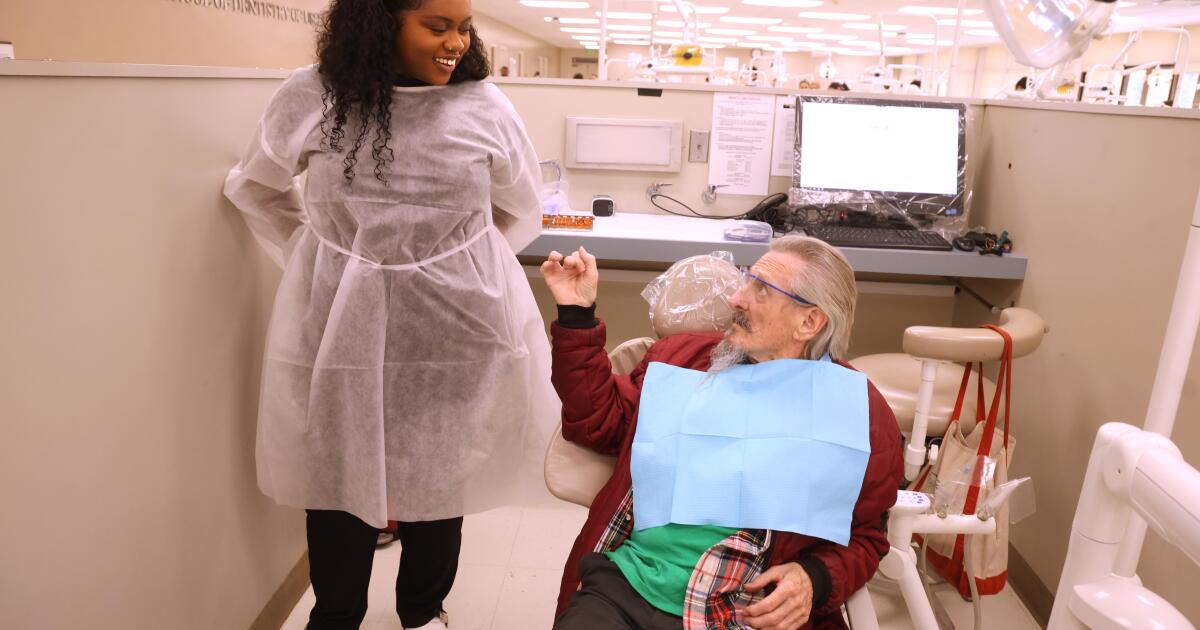
Dental student Somkene Okwuego smiles after completing her work on patient Jimmy Stewart, 83, who receives affordable dental work at the Ostrow School of Dentistry of USC on the USC campus in Los Angeles on February 26, 2026.
(Genaro Molina / Los Angeles Times)
Under Proposition 56’s tobacco tax in 2016, supplemental reimbursements to dentists have been in place, but those increases could be wiped out under a budget-cutting proposal. Only about 40% of the state’s dentists accept Medi-Cal payments as it is, and Hanlon told me a CDA survey indicates that half would stop accepting Medi-Cal patients and many others will accept fewer patients.
“It’s appalling that when the cost of providing healthcare is at an all-time high, the state is considering cutting program funding back to 1990s levels,” Hanlon said. “These cuts … will force patients to forgo or delay basic dental care, driving completely preventable emergencies into already overcrowded emergency departments.”
Somkene Okwuego, who as a child in South L.A. was occasionally a patient at USC’s Herman Ostrow School of Dentistry clinic, will graduate from the school in just a few months.
I first wrote about Okwuego three years ago, after she got an undergrad degree in gerontology, and she told me a few days ago that many of her dental patients are elderly and have Medi-Cal or no insurance at all. She has also worked at a Skid Row dental clinic, and plans after graduation to work at a clinic where dental care is free or discounted.
Okwuego said “fixing the smiles” of her patients is a privilege and boosts their self-image, which can help “when they’re trying to get jobs.” When I dropped by to see her Thursday, she was with 83-year-old patient Jimmy Stewart.
Stewart, an Army veteran, told me he had trouble getting dental care at the VA and had gone years without seeing a dentist before a friend recommended the Ostrow clinic. He said he’s had extractions and top-quality restorative care at USC, with the work covered by his Medi-Cal insurance.
I told Stewart there could be some Medi-Cal cuts in the works this summer.
“I’d be screwed,” he said.
Him and a lot of other people.
steve.lopez@latimes.com

Central Coast Water authorities approved waste discharge permits for Diablo Canyon nuclear plant Thursday, making it nearly certain it will remain running through 2030, and potentially through 2045.
The Pacific Gas & Electric-owned plant was originally supposed to shut down in 2025, but lawmakers extended that deadline by five years in 2022, fearing power shortages if a plant that provides about 9 percent the state’s electricity were to shut off.
In December, Diablo Canyon received a key permit from the California Coastal Commission through an agreement that involved PG&E giving up about 12,000 acres of nearby land for conservation in exchange for the loss of marine life caused by the plant’s operations.
Today’s 6-0 vote by the Central Coast Regional Water Board approved PG&E’s plans to limit discharges of pollutants into the water and continue to run its “once-through cooling system.” The cooling technology flushes ocean water through the plant to absorb heat and discharges it, killing what the Coastal Commission estimated to be two billion fish each year.
The board also granted the plant a certification under the Clean Water Act, the last state regulatory hurdle the facility needed to clear before the federal Nuclear Regulatory Commission (NRC) is allowed to renew its permit through 2045.
The new regional water board permit made several changes since the last one was issued in 1990. One was a first-time limit on the chemical tributyltin-10, a toxic, internationally-banned compound added to paint to prevent organisms from growing on ship hulls.
Additional changes stemmed from a 2025 Supreme Court ruling that said if pollutant permits like this one impose specific water quality requirements, they must also specify how to meet them.
The plant’s biggest water quality impact is the heated water it discharges into the ocean, and that part of the permit remains unchanged. Radioactive waste from the plant is regulated not by the state but by the NRC.
California state law only allows the plant to remain open to 2030, but some lawmakers and regulators have already expressed interest in another extension given growing electricity demand and the plant’s role in providing carbon-free power to the grid.
Some board members raised concerns about granting a certification that would allow the NRC to reauthorize the plant’s permits through 2045.
“There’s every reason to think the California entities responsible for making the decision about continuing operation, namely the California [Independent System Operator] and the Energy Commission, all of them are sort of leaning toward continuing to operate this facility,” said boardmember Dominic Roques. “I’d like us to be consistent with state law at least, and imply that we are consistent with ending operation at five years.”
Other board members noted that regulators could revisit the permits in five years or sooner if state and federal laws changes, and the board ultimately approved the permit.
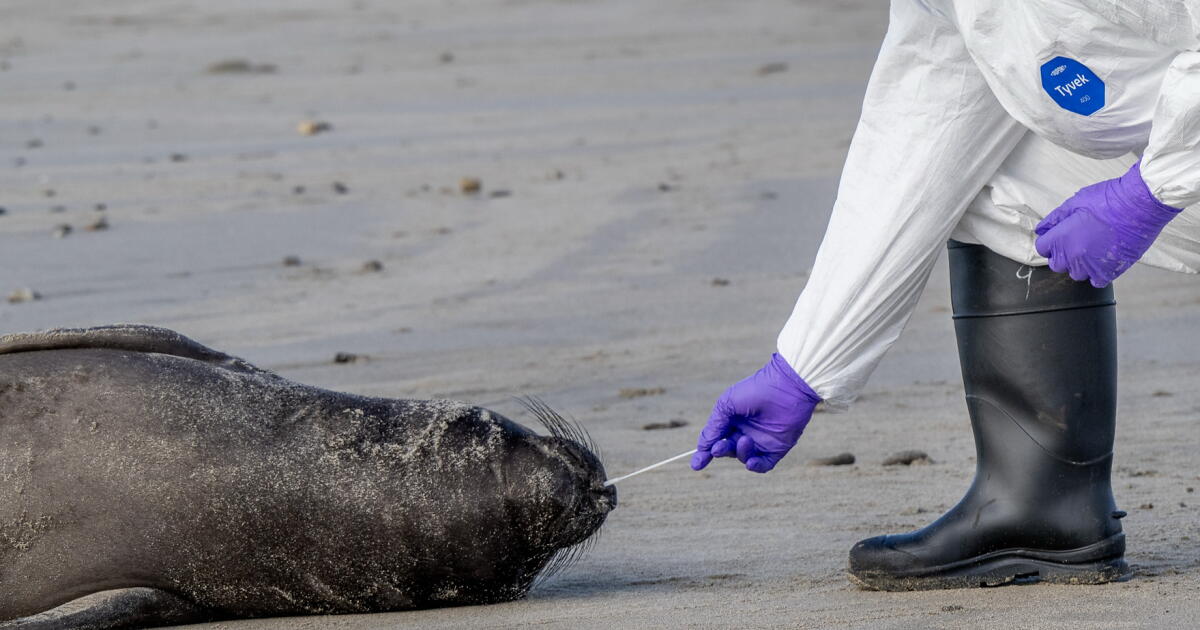
The H5N1 bird flu virus that devastated South American elephant seal populations has been confirmed in seals at California’s Año Nuevo State Park, researchers from UC Davis and UC Santa Cruz announced Wednesday.
The virus has ravaged wild, commercial and domestic animals across the globe and was found last week in seven weaned pups. The confirmation came from the U.S. Department of Agriculture’s National Veterinary Services Laboratory in Ames, Iowa.
“This is exceptionally rapid detection of an outbreak in free-ranging marine mammals,” said Professor Christine Johnson, director of the Institute for Pandemic Insights at UC Davis’ Weill School of Veterinary Medicine. “We have most likely identified the very first cases here because of coordinated teams that have been on high alert with active surveillance for this disease for some time.”
Since last week, when researchers began noticing neurological and respoiratory signs of the disease in some animals, 30 seals have died, said Roxanne Beltran, a professor of ecology and evolutionary biology at UC Santa Cruz. Twenty-nine were weaned pups and the other was an adult male. The team has so far confirmed the virus in only seven of the dead pups.
Infected animals often have tremors convulsions, seizures and muscle weakness, Johnson said.
Beltran said teams from UC Santa Cruz, UC Davis and California State Parks monitor the animals 260 days of the year, “including every day from December 15 to March 1” when the animals typically come ashore to breed, give birth and nurse.
The concerning behavior and deaths were first noticed Feb. 19.
“This is one of the most well-studied elephant seal colonies on the planet,” she said. “We know the seals so well that it’s very obvious to us when something is abnormal. And so my team was out that morning and we observed abnormal behaviors in seals and increased mortality that we had not seen the day before in those exact same locations. So we were very confident that we caught the beginning of this outbreak.”
In late 2022, the virus decimated southern elephant seal populations in South America and several sub-Antarctic Islands. At some colonies in Argentina, 97% of pups died, while on South Georgia Island, researchers reported a 47% decline in breeding females between 2022 and 2024. Researchers believe tens of thousands of animals died.
More than 30,000 sea lions in Peru and Chile died between 2022 and 2024. In Argentina, roughly 1,300 sea lions and fur seals perished.
At the time, researchers were not sure why northern Pacific populations were not infected, but suspected previous or milder strains of the virus conferred some immunity.
The virus is better known in the U.S. for sweeping through the nation’s dairy herds, where it infected dozens of dairy workers, millions of cows and thousands of wild, feral and domestic mammals. It’s also been found in wild birds and killed millions of commercial chickens, geese and ducks.
Two Americans have died from the virus since 2024, and 71 have been infected. The vast majority were dairy or commercial poultry workers. One death was that of a Louisiana man who had underlying conditions and was believed to have been exposed via backyard poultry or wild birds.
Scientists at UC Santa Cruz and UC Davis increased their surveillance of the elephant seals in Año Nuevo in recent years. The catastrophic effect of the disease prompted worry that it would spread to California elephant seals, said Beltran, whose lab leads UC Santa Cruz’s northern elephant seal research program at Año Nuevo.
Johnson, the UC Davis researcher, said the team has been working with stranding networks across the Pacific region for several years — sampling the tissue of birds, elephant seals and other marine mammals. They have not seen the virus in other California marine mammals. Two previous outbreaks of bird flu in U.S. marine mammals occurred in Maine in 2022 and Washington in 2023, affecting gray and harbor seals.
The virus in the animals has not yet been fully sequenced, so it’s unclear how the animals were exposed.
“We think the transmission is actually from dead and dying sea birds” living among the sea lions, Johnson said. “But we’ll certainly be investigating if there’s any mammal-to-mammal transmission.”
Genetic sequencing from southern elephant seal populations in Argentina suggested that version of the virus had acquired mutations that allowed it to pass between mammals.
The H5N1 virus was first detected in geese in China in 1996. Since then it has spread across the globe, reaching North America in 2021. The only continent where it has not been detected is Oceania.
Año Nuevo State Park, just north of Santa Cruz, is home to a colony of some 5,000 elephant seals during the winter breeding season. About 1,350 seals were on the beach when the outbreak began. Other large California colonies are located at Piedras Blancas and Point Reyes National Sea Shore. Most of those animals — roughly 900 — are weaned pups.
It’s “important to keep this in context. So far, avian influenza has affected only a small proportion of the weaned at this time, and there are still thousands of apparently healthy animals in the population,” Beltran said in a press conference.
Public access to the park has been closed and guided elephant seal tours canceled.
Health and wildlife officials urge beachgoers to keep a safe distance from wildlife and keep dogs leashed because the virus is contagious.

Arkansas Division of Higher Education on continuing your education after high school

Rep. Kevin Kiley announces run in California’s redrawn 6th Congressional District

How the Colorado Rockies Are Actually Building Its Opening Day Roster

Lawmakers again push to restore Shore Line East service to 2019 levels

Delaware Supreme Court upholds reforms to curb ‘DExit’ concerns

Florida High School Football Rankings: Top 25 teams – Oct. 21

Cleary's 21 help Le Moyne down Central Connecticut State 69-64 in OT

How old is Bo Nix? What to know about Oregon quarterback ahead of 2024 NFL Draft

99th annual Pony Swim held in Virginia

Indiana Members Credit Union announced as new anchor tenant at Bottleworks District

Map: Earthquake Shakes Central California

Gas prices could jump as Middle East tensions threaten global oil supply

Pakistan calls troops, orders 3-day curfew as 24 killed in pro-Iran rallies

US says Kuwait accidentally shot down 3 American jets

House Republicans push Johnson to go to war with Senate over SAVE Act
-

 World5 days ago
Exclusive: DeepSeek withholds latest AI model from US chipmakers including Nvidia, sources say
-

 Massachusetts5 days ago
Mother and daughter injured in Taunton house explosion
-

 Denver, CO5 days ago
10 acres charred, 5 injured in Thornton grass fire, evacuation orders lifted
-

 Louisiana1 week ago
Wildfire near Gum Swamp Road in Livingston Parish now under control; more than 200 acres burned
-

 Technology1 week ago
YouTube TV billing scam emails are hitting inboxes
-

 Politics1 week ago
OpenAI didn’t contact police despite employees flagging mass shooter’s concerning chatbot interactions: REPORT
-

 Technology1 week ago
Stellantis is in a crisis of its own making
-

 News1 week ago
World reacts as US top court limits Trump’s tariff powers