Politics
We set a big chunk of California wilderness on fire. You're welcome


HOPLAND, Calif. — On a sun-kissed hillside in remote Northern California, I watched in awe as a crackling fire I’d helped ignite engulfed a hillside covered in tall, golden grass. Then the wind shifted slightly, and the dense gray smoke that had been billowing harmlessly up the slope turned and engulfed me.
Within seconds, I was blind and coughing. The most intense heat I’d ever felt seemed like it would sear the only exposed skin on my body: my face. As the flames inched closer, to within a few feet, I backed up until I was trapped against a tall fence with nowhere left to go.
Alone in that situation, I would have panicked. But I was with Len Nielson, chief of prescribed burns for the California Department of Forestry and Fire Protection, who stayed as cool as the other side of the pillow.
Like a pilot calmly instructing passengers to fasten their seat belts, Nielson suggested I wrap the fire-resistant “shroud” hanging from my bright yellow helmet around my face. Then he told me to take a few steps to the left.
And, just like that, we were out of the choking smoke and into the gentle morning sunlight. The temperature seemed to have dropped a few hundred degrees.
“It became uncomfortable, but it was tolerable, right?” Nielson asked with a reassuring grin. “Prescribed fires are a lot about trust.”
Dripping gasoline onto dry grass and deliberately setting it ablaze in the California countryside felt wildly reckless, especially for someone whose job involves interviewing survivors of the state’s all too frequent, catastrophic wildfires. But “good fire,” as Nielson called it, is essential for reducing the fuel available for bad fire, the kind that makes the headlines. The principle is as ancient as it is simple.
Before European settlers arrived in California and insisted on suppressing fire at every turn, the landscape burned regularly. Sometimes lightning ignited the flames; sometimes it was Indigenous people using fire as an obvious, and remarkably effective, tool to clear unwanted vegetation from their fields. Whatever the cause, it was common for much of the land in California to burn about once a decade.
“So it was relatively calm,” Nielson said, as the flames we’d set danced and swirled just a few feet behind him. “There wasn’t this big fuel load, so there wasn’t a chance of it becoming really intense.”
With that in mind, the state set an ambitious goal in the early 2020s to deliberately burn at least 400,000 acres of wilderness each year. The majority of that would have to be managed by the federal government, since agencies including the U.S. Forest Service, the Bureau of Land Management and the National Park Service own nearly half of the state’s total land. And they own more than half of the state’s forests.
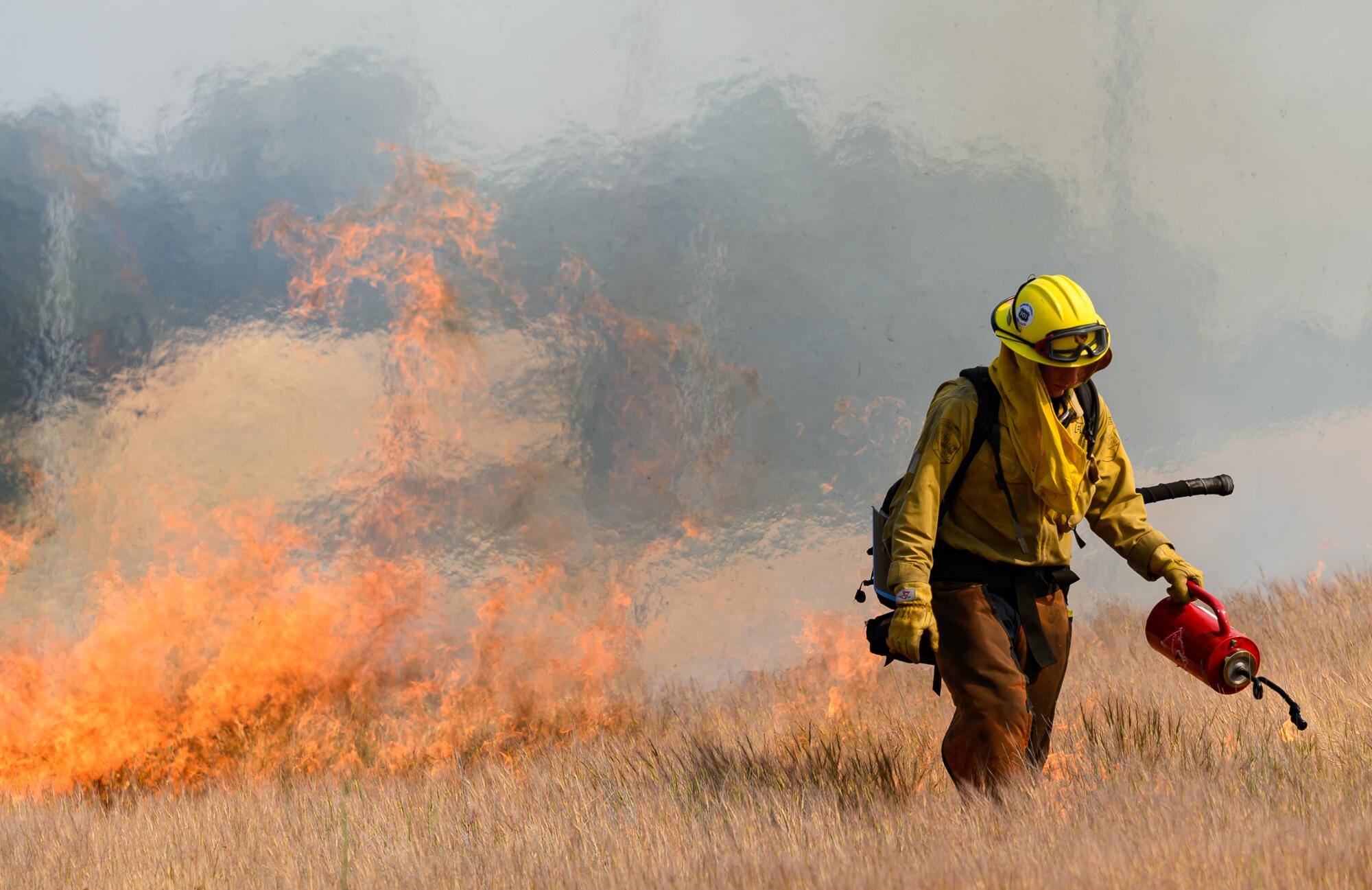
Cal Fire crew members set a prescribed burn near Hopland in Mendocino County.
(Josh Edelson / For The Times)
But California officials worry their ambitious goals are likely to be thwarted by deep cuts to those federal agencies by Elon Musk’s budget-whacking White House advisory team, dubbed the Department of Government Efficiency, or DOGE. In recent months, the Forest Service has lost about 10% of its workforce to mass layoffs and firings. While firefighters were exempt from the DOGE-ordered staffing cuts, employees who handle the logistics and clear the myriad regulatory hurdles to secure permission for prescribed burns were not.
“To me, it’s an objective fact that these cuts mean California will be less safe from wildfire,” said Wade Crowfoot, California’s secretary of natural resources. He recalled how President Trump, in his first term, erroneously blamed the state’s wildfires on state officials who, Trump said, had failed to adequately “rake” the forests.
“Fifty-seven percent of our forests are owned and managed by the federal government,” Crowfoot said. If anybody failed, it was the president, he argued.
Larry Moore, a spokesman for the U.S. Department of Agriculture, which oversees the Forest Service, said the job cuts won’t affect the agency’s fire prevention efforts.
The Forest Service “continues to ensure it has the strongest and most prepared wildland firefighting force in the world,” Moore wrote in an email. The agency’s leaders are “committed to preserving essential safety positions and will ensure that critical services remain uninterrupted.”
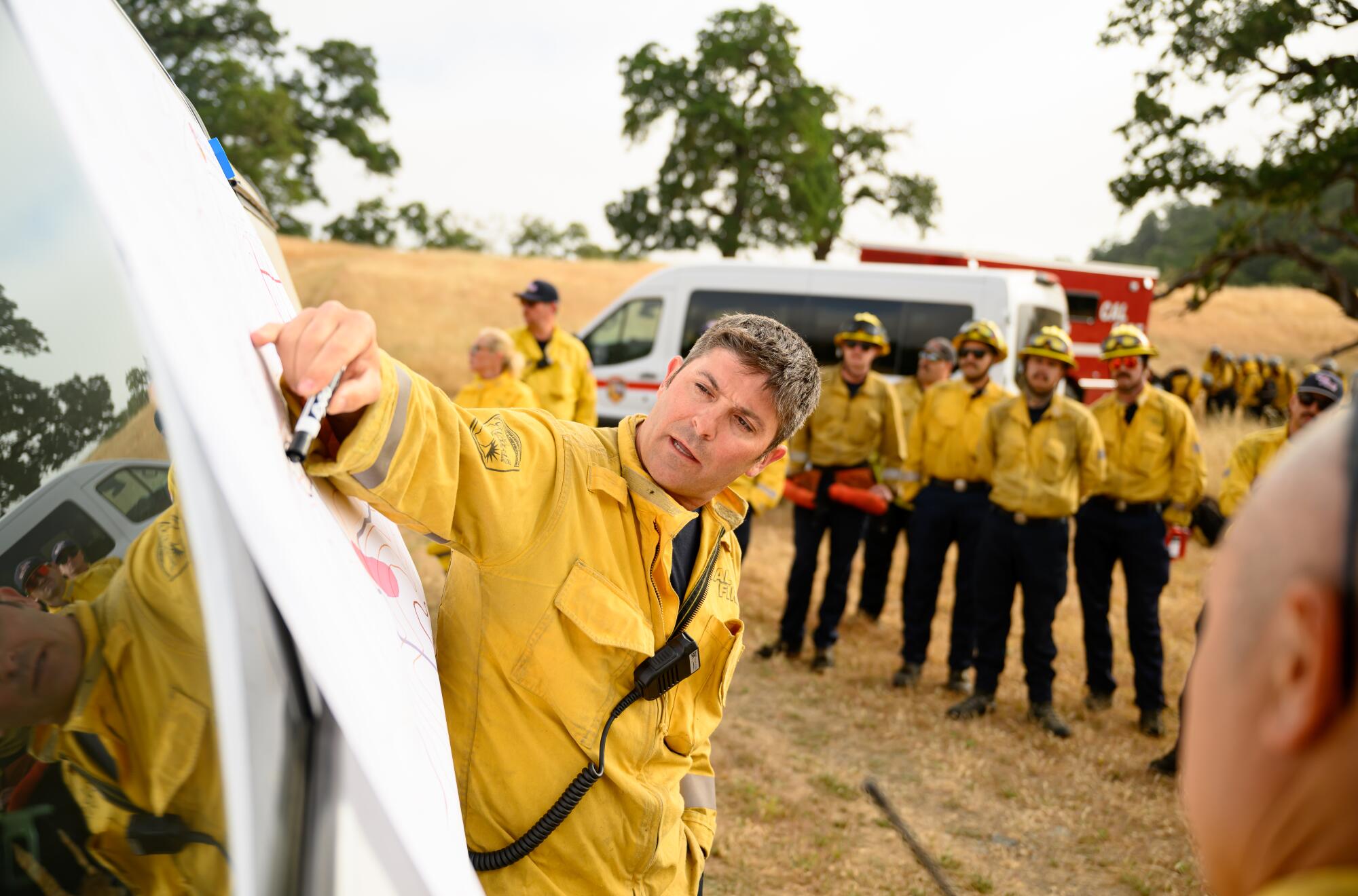
Cal Fire crew members plot out the direction and scope of a prescribed burn in Mendocino County.
(Josh Edelson / For The Times)
Nevertheless, last month, Gov. Gavin Newsom added $72 million to the state’s forest management budget to bridge some of the gap expected to be left by federal agencies. But wildfire experts say that’s just a drop in the bucket. Doing prescribed burns safely takes a lot of boots on the ground and behind-the-scenes cajoling to make sure local residents, and regulators, are on board.
Because people get pretty testy when you accidentally smoke out an elementary school or old folks home, burn plans have to clear substantial hurdles presented by the California Environmental Quality Act and air quality regulators.
It took three years to get all the required permissions for the 50-acre Hopland burn in Mendocino County, where vineyard owners worried their world-class grapes might get a little too “smoky” for most wine lovers. When the big day finally arrived in early June, more than 60 firefighters showed up with multiple fire engines, at least one bulldozer and a firefighting helicopter on standby in case anything went wrong.
They gathered at the University of California’s Hopland Research and Extension Center, where students learn about ranching and wilderness ecology.
But this was no school project. A fire that began in the surrounding hills a couple of years ago threatened to trap people in the center, so the area being burned was along the only two roads that could be used to escape.
“We’re trying to create a buffer to get out, if we need to,” said John Bailey, the center’s director. “But we’re also trying to create a buffer to prevent wildfire from coming into the center.”
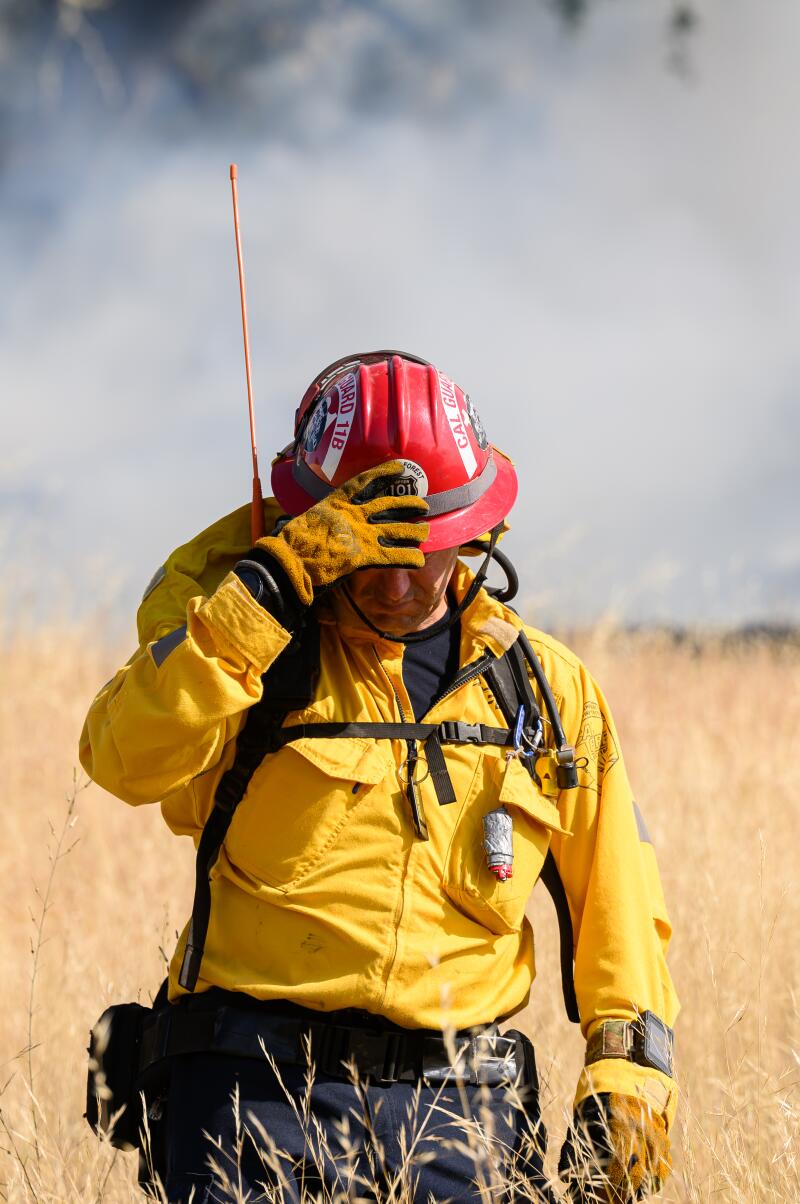

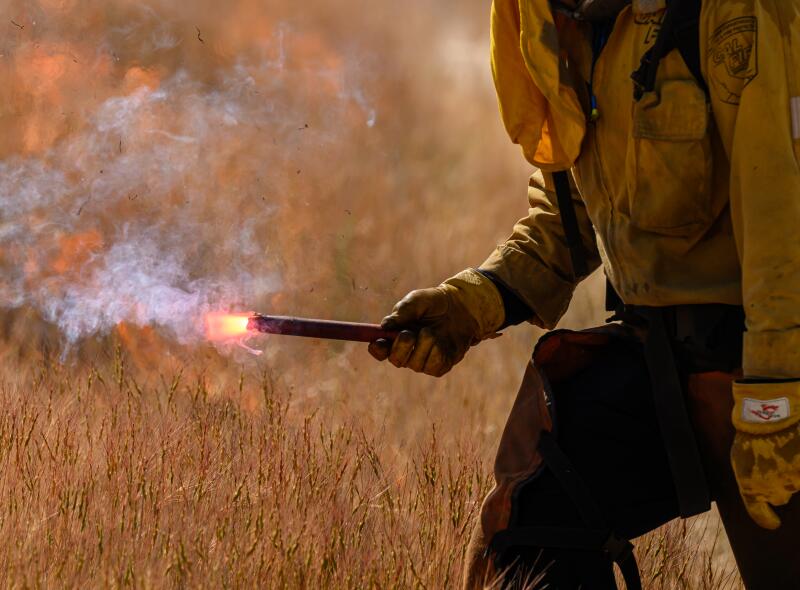
Smoke emanates from a prescribed burn in Mendocino County. (Josh Edelson / For The Times)
As the firefighters pulled on their protective yellow jackets and pants, and filled their drip torches with a mixture of diesel and gasoline, Nielson bent down and grabbed a fistful of the yellow grass. Running it through his fingers, he showed it to his deputies and they all shook their heads in disappointment — too moist.
Thick marine-layer clouds filled the sky at 7 a.m, keeping the relative humidity too high for a good scorching. In many years of covering wildfires, it was the first time I had seen firefighters looking bored and disappointed because nothing would burn.
By 8:45 a.m., the clouds cleared, the sun came out, and the grass in Nielson’s fist began to crinkle and snap. It was time to go to work.
The fire that would fill the sky and drift north that afternoon, blanketing the town of Ukiah with the familiar orange haze of fire season, began with a single firefighter walking along the edge of a cleared dirt path. As he moved, he made little dots of flame with his drip torch, drawing a line like a kid working the edges of a picture in a coloring book.
Additional firefighters worked the other edges of the field until it was encircled by strips of burned black grass. That way, no matter which direction the fire went when they set the center of the field alight, the flames would not — in most circumstances — escape the relatively small test patch.
On the uphill edge of the patch, along the top of a ridge, firefighters in full protective gear leaned against a wooden fence with their backs to the smoke and flames climbing the hill behind them. They’d all done this before, and they trusted those black strips of pre-burned grass to stop the fire before it got to them.
Their job was to keep their eyes on the downward slope on the other side of the ridge, which wasn’t supposed to burn. If they saw any embers drift past them into the “green” zone, they would immediately move to extinguish those flames.
Nielson and I were standing along the fence, too. In addition to the circle of pre-burned grass protecting us, we were on a dirt path about four feet wide. For someone with experience, that was an enormous buffer. I was the only one who even flinched when the smoke and flames came our way.
Afterward, when I confessed how panicked I had felt, Nielson said it happens to a lot of people the first time they are engulfed in smoke. It’s particularly dangerous in grass fires, because they move so fast. People can get completely disoriented, run the wrong way and “get cooked,” he said.

Grass fires are particularly dangerous, because they move so fast, says Cal Fire Staff Chief Len Nielson. People can get disoriented in the smoke, run the wrong way and “get cooked.”
(Josh Edelson / For The Times)
But that test patch was just the warmup act. Nielson and his crew were checking to make sure the fire would behave the way they expected — pushed in the right direction by the gentle breeze and following the slope uphill.
“If you’re wondering where fire will go and how fast it will move, think of water,” he said. Water barely moves on flat ground, but it picks up speed when it goes downhill. If it gets into a steep section, where the walls close in like a funnel, it becomes a waterfall.
“Fire does the same thing, but it’s a gas, so it goes the opposite direction,” Nielson said.
With that and a few other pointers — we watched as three guys drew a line of fire around the base of a big, beautiful oak tree in the middle of the hillside to shield it from what was about to happen — Nielson led me to the bottom of the hill and handed me a drip torch.
Once everybody was in position, and all of the safety measures had been put in place, he wanted me to help set the “head fire,” a 6-foot wall of flame that would roar up the hill and consume dozens of acres in a matter of minutes.
“It’s gonna get a little warm right here,” Nielson said, “but it’s gonna get warm for only a second.”
As I leaned in with the torch and set the grass ablaze, the heat was overwhelming. While everyone else working the fire seemed nonchalant, I was tentative and terrified. My right hand stretched forward to make the dots and dashes where Nielson instructed, but my butt was sticking as far back into the road as it could get.
I asked Nielson how hot he thought the flames in front of us were. “I used to know that,” he said with a shrug. “I want to say it’s probably between 800 and 1,200 degrees.”
With the hillside still burning, I peeled off all of the protective gear, hopped in a car and followed the smoke north along the 101 Freeway. By lunchtime, Ukiah, a town of 16,000 that bills itself as the gateway to the redwoods, was shrouded in haze.
Everybody smelled the smoke, but prescribed burns are becoming so common in the region, nobody seemed alarmed.
“Do it!” said Judy Hyler, as she and two friends walked out of Stan’s Maple Cafe. A veteran of the rampant destruction of wildfires from years past, she didn’t hesitate when asked how she felt about the effort. “I would rather it be prescribed, controlled and managed than what we’ve seen before.”

Politics
WATCH: Trump’s Energy chief reveals what escalating Iran tensions could mean for gas prices

NEWYou can now listen to Fox News articles!
Energy Secretary Chris Wright is telling Americans not to be concerned about the possibility of another surge of sharp increases in gasoline prices as tensions with Iran have started to escalate once again.
Asked whether Americans should worry about higher prices at the pump and how the Trump administration is preparing to keep the economy stable if the conflict continues to worsen, Wright told Fox News Digital: “It has not been any good behavior from Iran that’s allowed oil to flow. It’s been the United States military.”
“That’s not changing,” he assured, speaking from the Great American State Fair on the National Mall this week.
US CLAWS BACK KEY CONCESSION TO IRAN AFTER FRESH ATTACKS ON COMMERCIAL SHIPS IN STRAIT OF HORMUZ
(Mario Tama/Getty Images) (Mario Tama/Getty Images)
With Iran striking three commercial vessels transiting the Strait of Hormuz on Monday and Tuesday, Wright doubled down in urging citizens to not credit Iran for the U.S. military’s work to ensure oil shipments continue flowing through the strait.
“Look, the U.S. Military has been the key asset here,” he said. “They have assured the flow of oil and gas through the Strait of Hormuz throughout. Not at the beginning of this conflict, but through the last six weeks.”
Wright said the administration is closely monitoring global oil supplies as the tentative ceasefire with Iran seemingly came to come to a halt, with President Donald Trump telling Secretary-General Mark Rutte the call for peace with Iran is “over” at the NATO Summit in Turkey on Wednesday.
But, he pointed to the continued shipping through the Strait as evidence that markets should remain stable.
TRUMP SAYS IRAN CEASEFIRE IS ‘OVER’ AFTER IRANIAN ATTACKS TRIGGER MASSIVE US RESPONSE
President Donald Trump speaks at the White House on Tuesday, April 22. (AP/Alex Brandon)
“We’re of course constantly watching the supply of oil, the supply of refined products and what’s going on there,” Wright said. “And I think still all positive trends.”
Beyond geopolitical concerns, Wright also praised the new chain of discounted gas stations across Pennsylvania and New Jersey, Freedom Fuel, which promises customers prices below the national average.
The Trump administration, though not involved with the network, has heavily endorsed the new chain and its 25 locations.
“We love it,” Wright said when asked about Freedom Fuel. “I mean, look, any mechanism we can to lower energy costs for Americans of all kinds, we’re all in on.”
“With Freedom Fuels, they’re just lowering it down to their wholesale price of gasoline,” Wright said. “So they’re not making any money selling gasoline, but they’ve got convenience stores. That’s how most gas stations make money.”
NEWSOM UNDER FIRE AS CALIFORNIA GAS TAX HIKE SENDS PUMP PRICES EVEN HIGHER
Gasoline costs are a known concern for many Americans, and amid surging prices there has been a considerable increase in those opting to purchase electric vehicles to save money long-term at the pump — with Tesla dominating the market for these types of models.
Wright argued one of the benefits to living in America is having the option to choose what type of vehicle you drive.
CLICK HERE TO DOWNLOAD THE FOX NEWS APP
“We just want people to buy what they would prefer,” he told Fox News Digital when asked his thoughts on increasing calls for support of the electrification of cars. “Consumer choice — you wanna buy an electric car, you wanna buy a gas powered car, diesel powered car, buy a big truck. That’s the choice.”
“That’s why you live in America. You get the choice of all those.”

In 2023, California regulators levied more than $100,000 in fines against the private operator of a federal immigration facility, kicking off a three-year battle over whether detainees who do work at the facilities should be considered employees.
The question went beyond semantics: If considered employees, the detainees would be subject to state worker protection laws.
A legal settlement announced this week now affirms that private immigrant detention facilities are subject to California’s workplace safety and health requirements.
“Every worker deserves a safe and healthy workplace and should be able to report workplace hazards without fear of retaliation,” said Denisse Gómez, spokesperson for the California Division of Occupational Safety and Health or Cal/OSHA.
“Individuals who perform work in these facilities are entitled to workplace safety protections, and this settlement reinforces Cal/OSHA’s commitment to enforcing those protections and safeguarding vulnerable workers,” she added.
Under the settlement between California and the GEO Group, a Florida-based private prison company, the company recently withdrew its legal challenges and agreed to pay more than $100,000 in the fines.
The GEO Group did not respond to requests for comment.
Back in 2023, Cal/OSHA issued $104,510 in fines against the GEO Group. The agency had found six violations of state code by the company after detainees complained about a lack of protective equipment and proper training while cleaning the facility for $1 per day.
Detainees alleged they routinely wiped black mold off shower walls at the facility, saw black dust spew from air vents and used cleaning solutions that lacked instructions during the COVID-19 pandemic.
The biggest fine levied against the GEO Group was for failure to establish and maintain “effective written procedures to reduce employee risk of exposure to aerosol transmissible disease.”
Advocates viewed Cal/OSHA’S recognition of the detainees as workers as a victory that could pave the way for future labor rights fights at other detention centers in the state.
But the GEO Group appealed, arguing that detainees participating in ICE’s voluntary work program make their own schedules and aren’t employees, so hazard exposure couldn’t be “as a result of assigned duties,” as California law states. Plus, the company argued, there wasn’t enough evidence that detainees were exposed to any hazard.
Early last year, the state’s Occupational Safety and Health Appeals Board rejected the GEO Group’s argument and found that detainees should be considered “affected employees.”
The GEO Group sued, but three days before a California Superior Court hearing in May, the company and Cal/OSHA reached the settlement.
Along with paying the fines, the GEO Group agreed to draft plans for avoiding aerosol transmissions at 12 secure and reentry facilities in California, including five detention centers that hold immigrants.
“GEO ensures detainees are afforded the necessary tools, equipment, and personal protective equipment … to safely and effectively perform any necessary tasks,” the settlement states.
Gómez said the settlement also leaves intact the appeals board’s ruling that civil immigration detainees who participate in work programs can participate in proceedings anonymously, “acknowledging the potential for retaliation when individuals raise workplace safety concerns.”
But the question of whether detainees are employees and deserve certain protections isn’t entirely resolved — at least not for the federal government.
Last month, U.S. Immigration and Customs Enforcement released new standards for detention facilities across the country. The revised guidelines “emphasize that detainee volunteers participating in the voluntary work program are not considered facility and/or government employees” and thus not entitled to labor regulations.
Attorney Mariel Villarreal said the timing of the new detention standards made her question whether the GEO Group had asked ICE to specify in its standards that detainees are not workers in response to its battle with Cal/OSHA.
“To me, it’s a reaction to this very settlement,” she said. Villarreal works for the California Collaborative for Immigrant Justice, which filed the original complaint on behalf of detainees who said they worked in unsafe conditions.
Villarreal pointed to a Washington Post report that GEO Group executives privately asked ICE to specify that detainees are not employees of the facilities where they work. Two top Trump administration officials, border czar Tom Homan and acting ICE director David Venturella, previously worked for the GEO Group.
New versions of ICE detention standards take effect as contracts are established or modified, so this year’s rules won’t immediately apply to every facility.
An ICE spokesperson did not comment about the settlement. The spokesperson, who did not provide their name in an emailed statement Wednesday, said the agency has begun transitioning detention facilities to meet the 2026 standards, “building on its longstanding commitment to safe, secure, and professional detention operations.”
“ICE has consistently implemented many of these best practices independently, reinforcing its role as the leader in detention operations,” the spokesperson added.
The GEO Group and other immigrant detention center operators have faced other legal battles over workers’ rights, including lawsuits in Washington, Colorado and California over the $1-per-day payment.
Villarreal said she’s confident that the Cal/OSHA settlement would continue to hold even if California facilities incorporated the new standards. But she said she believes the statements are an attempt by the GEO Group to “sidestep responsibility” and avoid the possibility of being fined under similar circumstances in other states.
“These statements in the new standards are a way for them to try and preserve profits as much as possible,” she said. “GEO and ICE are so intertwined at this point that they have the same motives.”
Politics
Israel shares intelligence warning Iran plotted new assassination attempt against Trump: report

NEWYou can now listen to Fox News articles!
Israel recently shared intelligence with the United States indicating Iran had developed a fresh plan to assassinate President Donald Trump, according to a Wall Street Journal report Thursday citing people familiar with the matter.
The reported intelligence would mark an escalation in the longstanding threats against Trump, who Iran has repeatedly vowed to retaliate against over the 2020 U.S. strike that killed Islamic Revolutionary Guard Corps Gen. Qassem Soleimani.
The White House referred Fox News Digital to Trump’s remarks Wednesday when asked about the report.
TRUMP FACES UNPRECEDENTED THIRD ASSASSINATION ATTEMPT
President Donald Trump speaks during a news conference at the NATO Summit in Ankara, Turkey, July 8, 2026. Trump addressed threats against his life after a report said Israel shared intelligence with the United States about an alleged new Iranian assassination plot. (Kerem Uzel/Bloomberg via Getty Images)
“They want to take out the U.S. leader — me. I’m on whatever list. I saw this morning I’m on every single one of their lists,” Trump said. “And, so far, I guess I’ve been a bit lucky, but maybe that doesn’t last very long. These are evil, sick people. And we have to root out that cancer. That cancer. You know what you do? You’ve got to cut out cancer early. And that’s the way I feel.”
Fox News Digital has also reached out to Israel’s Embassy in Washington and Iran’s Mission to the United Nations for comment.
The Journal reported the intelligence surfaced as Trump and Israeli Prime Minister Benjamin Netanyahu have diverged in recent weeks over how to proceed after last month’s conflict with Iran. Netanyahu has advocated for continuing military pressure on Tehran, while Trump has sought to preserve a fragile ceasefire after U.S. strikes on Iranian nuclear sites.
NETANYAHU REJECTS REPORTS OF A RIFT WITH PRESIDENT TRUMP, SAYS THE TWO REMAIN ALIGNED ON IRAN
President Donald Trump, left, and Israeli Prime Minister Benjamin Netanyahu at the White House March 25, 2019. The leaders spoke Thursday after The Wall Street Journal reported Israel had shared intelligence with the United States about an alleged new Iranian plot targeting Trump. (AP Photo/Susan Walsh, File)
Trump and Netanyahu spoke Thursday and agreed to continue coordination between the two countries, according to a statement from Netanyahu’s office, which said Trump also updated the Israeli leader on recent U.S. activity in the Gulf.
Prime Minister Benjamin Netanyahu during his conversation with U.S. President Donald Trump. (Avi Ohayon/GPO)
CLICK HERE TO DOWNLOAD THE FOX NEWS APP
Iranian mourners at the funeral for Supreme Leader Ali Khamenei chanted for Trump’s death and displayed a banner that said, “We Will Kill Trump,” according to the Journal.
Iran has publicly vowed for years to retaliate against Trump over the U.S. operation that killed Soleimani, the former commander of the Islamic Revolutionary Guard Corps’ Quds Force, in Baghdad in January 2020.
-

 Health3 minutes ago
GLP-1 Users’ Guide to Protein Snacks: Here’s What a Dietitian Actually Recommends
-
 Lifestyle18 minutes ago
‘The Invite’ is a marriage comedy with sex and heart
-

 Technology30 minutes ago
I spent a week using the Trump phone — it sucks
-

 World33 minutes ago
With US unleashing attacks, Iranian official threatens that the Islamic Republic will deliver a ‘hard slap’
-

 Politics38 minutes ago
WATCH: Trump’s Energy chief reveals what escalating Iran tensions could mean for gas prices
-

 Health45 minutes ago
Coffee may have powerful effect on liver health, major study suggests
-

 Sports48 minutes ago
Oba Femi vs Brock Lesnar at SummerSlam is a ‘generational matchup,’ WWE legend JBL says
-
 Business1 hour ago
Billionaire exodus? California drew 10 times more venture capital than any other state this year

