Politics
Trump’s Ballroom Design Has Barely Been Scrutinized


The National Capital Planning Commission is scheduled on Thursday to take a final vote approving President Trump’s ballroom, clearing the last review for a major addition to the White House that was publicly unveiled in detail only in January. Last month, another panel led by the president’s allies, the Commission of Fine Arts, discussed the ballroom for 12 minutes before unanimously approving it.
The hurried reviews, with construction cranes already swiveling above the White House grounds, are an abrupt departure from how new monuments, museums and even modest renovations have been designed and refined in the capital for decades. And the ballroom will be worse off for it, architects warn.
Take the White House fence, a far more modest part of the complex that received more probing attention from both commissions when it was rebuilt during Mr. Trump’s first term.
Such details affect how people passing by experience these iconic places, and how each structure fits into a capital city that has been planned around civic symbols and sightlines since the 1790s. The deliberation is also an expression of democracy, said Carol Quillen, the president and chief executive of the National Trust for Historic Preservation, which has sued the administration over the ballroom.
“Even if we are slow and we make mistakes and we fight, that process has meaning to us,” Ms. Quillen said. No project belonging to the public should be the vision of just one man, she said.
That is, however, how the ballroom has often been described.
“President Trump is the best builder and developer in the entire world, and the American people can rest well knowing that this project is in his hands,” Davis Ingle, a White House spokesman, said in a statement. Past administrations and presidents have wanted a ballroom for more than 150 years, he said, and Mr. Trump will accomplish it.
But in the sprint to complete it before the end of his term, the addition appears to have compressed the normal design evolution for any project.
As recently as October, the president was still increasing the ballroom’s capacity, the kind of decision needed at the concept stage. And the White House has said it plans to begin building in the spring, a timeline that would mean construction documents would have to be prepared even as the design was still under review. (Before a judge demanded in December that the project seek review by these two commissions, the administration appeared poised to skip them entirely.)
“The timeline never made any sense to me,” said Thomas Gallas, a former member of the planning commission and an architect. A building on this scale might take its architects and engineers 18 months to two years from initial concept to completed construction documents, he said.
Reviews by the planning commission generally follow similar steps, with major projects seeking feedback on initial concepts, then approval of preliminary plans, and then final approval. The public process for the Fed renovations took two years, the African American history museum even longer:
Planning Reviews Typically Require Many Months and Meetings
For the ballroom, the planning commission never had a say on the concept design. And this week, it will vote on a combined preliminary and final review, a move more common for antenna replacements or new security bollards. The Commission of Fine Arts did something similar in February.
Rodney Mims Cook Jr., the Trump-appointed chair of the arts panel, countered that the group had significant input, including in unofficial meetings with Mr. Trump and in feedback objecting to a large pediment previously planned for the top of the ballroom’s south portico. “We asked him to tone down the porch,” he said. “We asked him to remove the pediments. We asked him for landscape. All of that he did.”
Will Scharf, the chair of the planning commission and the White House staff secretary, said his commission had handled the ballroom with the same deliberative pace it has other analogous projects, like an overhaul of the Capital One Arena and the plan for a new R.F.K. Stadium. Those projects, he said, share the ballroom’s sense of urgency and ready funding (characteristics a memorial or museum may not have).
“If not for President Trump, his desire to move quickly, and his raising the money to fund this, a project like this could languish for years with no decision or action,” Mr. Scharf said. “And we could still be debating it at N.C.P.C. meetings 20 years from now.”
Some big projects in Washington have been bogged down for years. And it’s certainly possible that the White House fence would have been just fine with five inches between the pickets, and that the African American history museum would have looked nice with a Custom Artisan #4 finish instead.
But it’s harder to argue that a major addition to the White House needs swifter public scrutiny than its fence (these commissions have meanwhile continued to push back on projects that are not the president’s personal priorities). Many concerns about the ballroom are also not minor ones. And without further work, the details provoking those concerns will become lasting features of the capital.
For starters, the ballroom is set to become the dominant anchor at the end of Pennsylvania Avenue, a link planned by Pierre Charles L’Enfant to connect the Capitol and the White House.
“The ballroom is literally an imposition between two branches of our government,” said David Scott Parker, an architect on the board of the National Trust for Historic Preservation, and one of more than 30,000 people who wrote to the planning commission objecting to the building.
The proposed East Wing is about 60 percent larger than the White House residence by floor area. But by cubic volume, and including the porticos, it’s more than three times as large because of the ballroom’s vast ceiling height. Viewed from the south, the ballroom’s size will make it the dominant building of the White House complex, with a portico bigger than that of the residence and a lopsided appearance disrupting any symmetry with the West Wing.
The south portico, which was not part of the addition’s initial design, also has no doors into the ballroom. And all of the columns will block views and daylight from inside.
During the planning commission review earlier this month, the project’s architect, Shalom Baranes, acknowledged that the south portico was more ornamental than functional.
“Is it an absolutely essential part of the program? I would say no, it’s not,” he said. “Really it’s an aesthetic decision to have it there.”
That decision, however, is part of the reason the White House driveway planned by the famed landscape architect Frederick Law Olmsted must be rerouted, breaking its symmetry (the kind of detail the planning commission might have dwelled on in the past).
Inside the East Wing, the ballroom itself is far larger than industry standards suggest is necessary for 1,000 guests (by that standard, it might fit 1,500 people). Mr. Baranes said the extra space was needed to accommodate TV cameras, journalists, security and ceremonial processions. But one result is that events with fewer than 1,000 people could feel empty.
The commercial kitchen and first lady’s office suite on the lower level are likewise supersized. And on the second-floor colonnade connecting the ballroom to the executive residence, a blank wall of faux windows will face the north (the direction from which most tourists get a glimpse of the White House). Behind them is a row of bathroom stalls.
Many criticisms of the building, Mr. Scharf said, fail to acknowledge that the White House has continually evolved since its beginning. “As our country’s developed, so too has the White House complex,” he said, adding that he would vote on the project this week after having read every one of the letters the commission received. “I see the ballroom project as a natural extension of that history.”
Most of the concerns that have been raised touch not on how the building will be used inside, but on how it will face the public. That makes seemingly prosaic matters — the height of the roofline, the jog in the road, the square footage of the ballroom — also symbolic ones.
“This is the People’s House, this is not Donald Trump’s, or Joe Biden’s or the next president’s,” said Phil Mendelson, who sits on the planning commission in his role as the chairman of the D.C. Council. He has been a lone objector trying to raise these questions before the commission.
Now, barring intervention by the courts, time is apparently up to resolve them.
“I still don’t understand,” Mr. Mendelson said, “why the ceiling height has to be 40 feet.”



NEWYou can now listen to Fox News articles!
While discussing the mystery surrounding UFOs, Vice President JD Vance, who is Catholic, said he believes what people think of as aliens are actually “demons.”
While interviewing Vance, conservative commentator Benny Johnson asked the vice president, “You gonna release all the UFO files?”
“Ah, we’re workin’ on it,” Vance said.
He explained that when he took office he “was obsessed with the UFO files” but ended up being busy with other issues.
Vance asserted that he will “get to the bottom” of the matter.
JD VANCE SAYS UFOS, ALIENS COULD BE ‘SPIRITUAL FORCES’ AS VP VOWS TO ‘GET TO THE BOTTOM’ OF MYSTERY IN SKIES
Vice President JD Vance boards Air Force Two on March 18, 2026, at Joint Base Andrews, Md. (Elizabeth Frantz-Pool/Getty Images)
“I don’t think they’re aliens. I think they’re demons anyway,” Vance noted.
Prompted by Johnson, Vance later elaborated on his view.
“Well, look, I, I think that celestial beings who fly around, who do weird things to people — I think that the desire to describe everything celestial… to describe it as aliens — I mean every great world religion, including Christianity, the one that I believe in, has understood that there are weird things out there, and there are things that are very difficult to explain,” he said.
“And I naturally go — when I hear about, sort of, extra-natural phenomenon — that’s where I go to is the Christian understanding that, you know, there’s a lotta good out there, but there’s also some evil out there,” he continued.
UFO SECRET FILES, DRONE SWARMS AND NUCLEAR-LINKED SIGHTINGS STUN EXPERTS IN 2025
Vice President JD Vance and President Donald Trump attend the inaugural meeting of the Board of Peace at the Donald J. Trump Institute of Peace on Feb. 19, 2026, in Washington, D.C. (Chip Somodevilla/Getty Images)
He added that he believes that among “the devil’s great tricks is to convince people he never existed.”
Last month, President Donald Trump said he would order the release of files pertaining to the issue of aliens and UFOs.
EXPLOSIVE NEW DOCUMENTARY PROBES ‘80-YEAR GLOBAL COVERUP’ OF UFO SECRETS
Vice President JD Vance speaks onstage at Engineering Design Services, Inc. on March 18, 2026, in Auburn Hills, Mich. (Bill Pugliano/Getty Images)
CLICK HERE TO DOWNLOAD THE FOX NEWS APP
“Based on the tremendous interest shown, I will be directing the Secretary of War, and other relevant Departments and Agencies, to begin the process of identifying and releasing Government files related to alien and extraterrestrial life, unidentified aerial phenomena (UAP), and unidentified flying objects (UFOs), and any and all other information connected to these highly complex, but extremely interesting and important, matters. GOD BLESS AMERICA!” the president declared in a February Truth Social post.

How would you feel about getting a dream gig only to see it end in disgrace because of, well, you?
That’s what Gregory Bovino gets to think about for the rest of his life. Friday is the Border Patrol lifer’s last day on the job after 30 years — and he ain’t leaving because he wants to.
For the last year, the self-described “hillbilly” was the personification of the Trump administration’s xenophobic deportation deluge. Helicopter invasions of apartment complexes, tear gas canisters thrown into large crowds, defying court orders, glamorous photo shoots: There was no municipality too big, no tactic too crazy, no quote too incendiary for Bovino to take on while he treated immigrant neighborhoods like the shores of Normandy.
The North Carolina native’s caravan of cruelty quickly earned him a promotion from El Centro sector chief to Border Patrol commander at large, a new position crafted just for him. He embraced the role of migra bogeyman like a tween boy scarfing down a bowl of Warheads, always promising more deportations, more chaos, more more.
Not anymore.
In January, Border Patrol agents shot and killed ICU nurse Alex Pretti during a protest against them a few weeks after an Immigration and Customs Enforcement officer did the same to Renée Good, a mother of three. Bovino threw napalm on the matter by claiming Pretti wanted to “massacre law enforcement” without offering any evidence. The incidents so soured the public on immigration agents that a Public Religion Research Institute poll released this week showed only 35% of Americans surveyed approved of how Trump is handling immigration, compared with 48% a year ago.
Bovino was sent back down to El Centro and lost his privileges on social media, where he had long posted cringe-inducing videos about what a swell guy he was. Even Trump turned on his migra man, telling Fox News that Bovino was “a pretty out-there kind of a guy … and in some cases that’s good. Maybe it wasn’t good [in Minneapolis].”
I should’ve warned Bovino the one time we met that failure was his fate.
The setting: the Fox 11 Los Angeles studios in July. Bovino and I were in to do separate interviews with the station’s former anchor Elex Michaelson. Bovino was in the middle of his Los Angeles invasion, which saw immigration agents lay siege to MacArthur Park, storm Home Depots and car washes and show up outside the Japanese American National Museum while politicians inside were decrying Trump.
Dressed in full Border Patrol uniform, complete with a clipped-on walkie-talkie on his shoulder, the guy was billing himself as a modern-day Charles Martel defending the homeland from invading infidels. The nasal-voiced Bovino rambled to Michaelson about how “Ma and Pa America” deserved a country free from undocumented immigrants and vowed to remain in Los Angeles “until the operation is over.”
Then-U.S. Border Patrol commander at large Gregory Bovino, center, marches with Border Patrol agents toward the Edward R. Roybal Federal Building in downtown Los Angeles after a show of force outside the Japanese American National Museum on Aug. 14.
(Carlin Stiehl / Los Angeles Times)
After his interview, Bovino and three Border Patrol agents strolled into the greenroom to grab some homemade cookies while I sat on a couch. He looked me in the eye while bending down to sign Michaelson’s guest book, as if he expected me to not only recognize him but say something.
It was like staring at someone doing an impersonation that was one part Lt. Col. Kilgore from “Apocalypse Now” and two parts Henery Hawk, the short, brash Looney Tunes character that was always trying to capture the much larger Foghorn Leghorn. He really thought that his scorched-earth assault on L.A. would defeat the city and persuade other communities to offer no pushback once Bovino’s self-titled “Green Machine” trolled into town.
The opposite happened.
People who had never bothered with politics — even some who voted for Trump or at least agreed with deporting immigrants with criminal convictions — rose up to resist. Everywhere became a front — social media, the streets, courtrooms — and activists across Southern California began to share notes among themselves and with communities nationwide to prepare them for la migra. Bovino flailed back at every affront instead of focusing on his mission, not realizing his recklessness was eroding public support for his cause and threatening it altogether.
Really, Bovino lost the day he has long claimed as a victory: the Battle of MacArthur Park.
That’s when he persuaded the Trump administration to send a skeptical National Guard alongside his men to surround the historic L.A. green space in the ludicrously named Operation Excalibur. Armed vehicles parked on Wilshire Boulevard. A grinning Bovino strutted around with media in tow. A wannabe cavalry unit, anchored in the center by an agent on a white horse, swept through a soccer field where children were attending day camp just minutes before.
No one was arrested or detained that day. Instead, Bovino left to a chorus of cuss words and boo birds. The exercise allowed Americans to see the folly of burning millions of taxpayer dollars just so someone could star in a TikTok reel. It also broke the spell Bovino had cast over many critics — myself included — who had feared he truly was an unstoppable Punisher.
Nah, he was just a spiky-haired pendejo.
If Bovino was as smart as he thinks he is, he would’ve followed the longtime strategy of another longtime immigration enforcer. Trump border czar Tom Homan executed a years-long roundup under the Obama administration with numbers Trump has yet to reach and with nowhere near as much public rancor. Homan, who loves the camera almost as much as Bovino, knew then and now that an issue as explosive as deportations must be approached quietly if it’s to be done successfully.
Instead, not only does he have to clean up Bovino’s mess, there’s now a real chance that the Republicans will lose the midterms because Latinos who voted for Trump in 2024 are now furious at his administration. That’s why even Trump is now telling Republicans to tone down their anti-immigrant rhetoric, stat.
Gracias, Bovino!
You thought you would go down in U.S. history as a domestic Patton, a borderlands Sherman. Instead, your last week coincided with the publication of a New York Times profile of you railing at enemies while downing coffee at a burger bar in El Centro.
You called Customs and Border Protection Commissioner Rodney Scott “weak-kneed,” mocked Homan and said you could’ve deported 100 million people — a radically racist number considering that even the Center for Immigration Studies, which has long pushed for reduced immigration of all kinds, estimated a record 15.4 million illegal immigrants were in this country at the start of Trump’s second term.
Instead, you’re heading off to the Tar Heel State to spend your days hunting … coyotes.
“Maybe I get me some dogs and we go hard,” you told the New York Times. “I’ll take it in my own hands.”
Which reminds me of another hapless cartoon character who thought himself a genius but who kept screwing things up in ceaseless pursuit of his quarry: Wile E. Coyote.

As anyone who has ever seen his buildings knows, Donald Trump has always liked to see his name displayed prominently. It’s become a hallmark of his presidency, to the point that the Treasury Department announced on Thursday that President Trump’s signature will appear on U.S. dollars later this year, a first for a sitting U.S. president.
The move is the latest reflecting a push to imprint his personal brand on Washington and the nation in ways that could outlast his presidency.
In total, since the start of Mr. Trump’s second term, there have been more than a dozen instances of his name, image or signature emblazoned on a variety of American initiatives and institutions. Some changes seem as if they could be lasting, some are caught up in the courts, and others may never get off the ground.
Here is a look at that ever-growing list.
Already approved uses
Joseph Eid/AFP via Getty Images, Stephen Crowley/The New York Times

U.S. Treasury
Eric Lee/The New York Times
Eric Lee/The New York Times
Trump Card
TrumpRX
Dr. Mehmet Oz, who runs Medicare and Medicaid, has said that Mr. Trump was not involved in picking the name. “We thought it had a catchy element to it,” he said.
Trump Accounts
Department of Interior, via Center for Biological Diversity
U.S. Navy
U.S. Air Force
Proposed uses
Johnny Milano/The New York Times
Todd Heisler/The New York Times
Shawn Thew/EPA, via Shutterstock
Washington Commanders
Ruth Fremson/The New York Times
Joseph Eid/AFP via Getty Images
Chip Somodevilla/Getty Images

Monroe High ace Miguel Gonzalez preparing for future as a father

Republican US lawmaker demands Congress vote on any Iran troop deployment

So you went to a No Kings protest. Now what?

The onlookers who stumble upon a No Kings Day protest in Michigan

Get out of the house with these SF events

Florida High School Football Rankings: Top 25 teams – Oct. 21

How old is Bo Nix? What to know about Oregon quarterback ahead of 2024 NFL Draft

Cleary's 21 help Le Moyne down Central Connecticut State 69-64 in OT

99th annual Pony Swim held in Virginia

Indiana Members Credit Union announced as new anchor tenant at Bottleworks District
Republican US lawmaker demands Congress vote on any Iran troop deployment
So you went to a No Kings protest. Now what?

JD Vance says he was ‘obsessed’ with UFOs, believes aliens are actually ‘demons’
The EU's recipe for trade deals : easy on beef, tough on wine
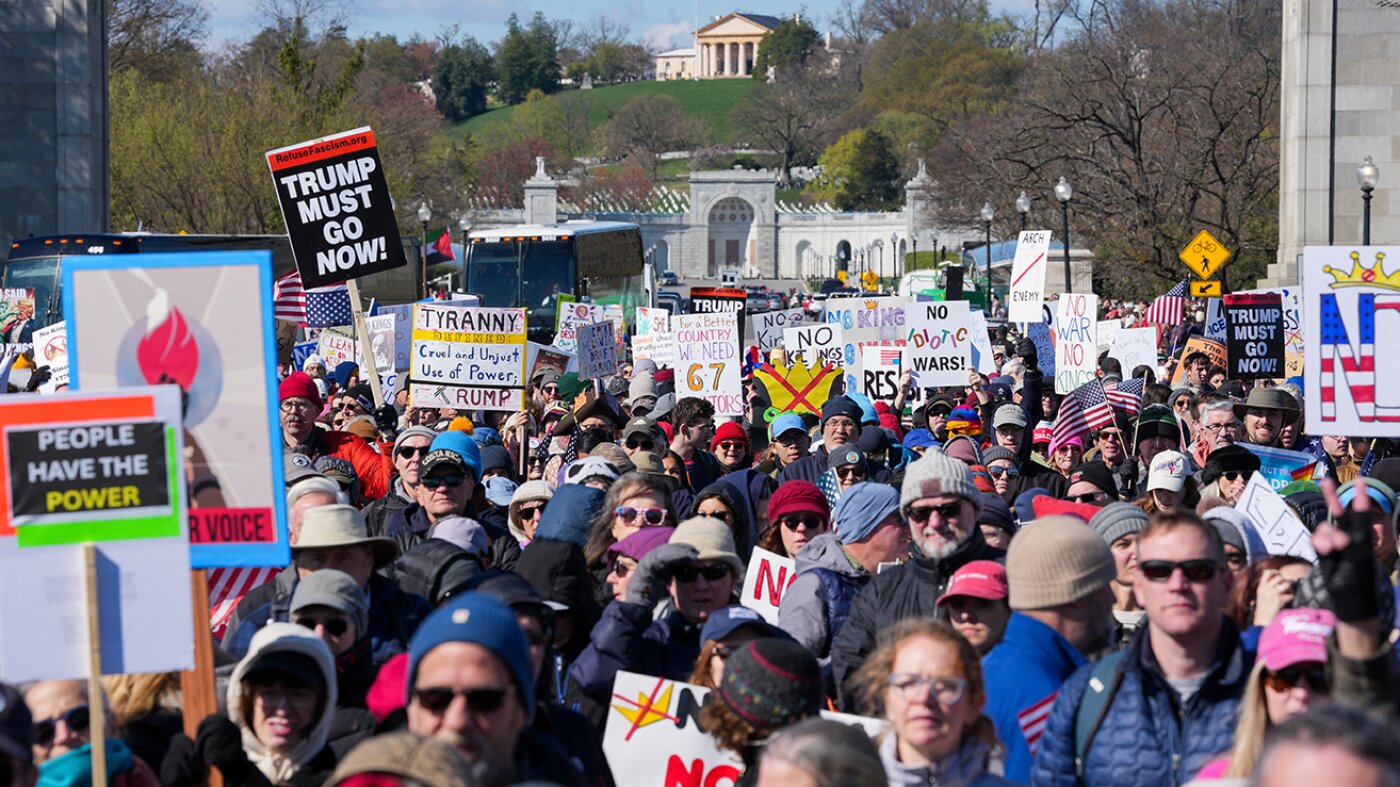
Photos: ‘No Kings’ protests across the country
-

 Sports1 week ago
IOC addresses execution of 19-year-old Iranian wrestler Saleh Mohammadi
-

 New Mexico7 days ago
Clovis shooting leaves one dead, four injured
-

 Miami, FL3 days ago
Jannik Sinner’s Girlfriend Laila Hasanovic Stuns in Ab-Revealing Post Amid Miami Open
-

 Tennessee6 days ago
Tennessee Police Investigating Alleged Assault Involving ‘Reacher’ Star Alan Ritchson
-

 Minneapolis, MN3 days ago
Boy who shielded classmate during school shooting receives Medal of Honor
-

 Technology1 week ago
YouTube job scam text: How to spot it fast
-

 Politics1 week ago
Schumer gambit fails as DHS shutdown hits 36 days and airport lines grow
-

 Science1 week ago
Record Heat Meets a Major Snow Drought Across the West