Politics
Trump wants to upend California water policy. State officials say it could do harm

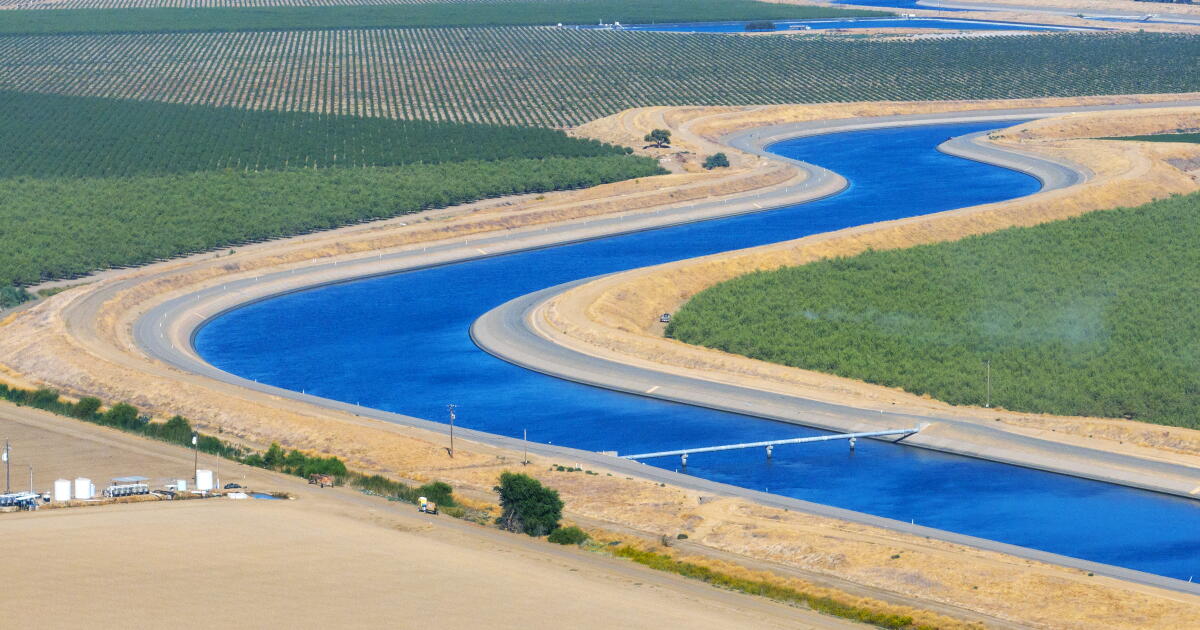
In one of the first acts of his second term, President Trump is seeking to put his stamp on California water policy by directing the federal government to put “people over fish” and send more water from Northern California to the Central Valley’s farms and Southern California cities.
Trump issued a memorandum Monday ordering federal agencies to restart work to “route more water” from the Sacramento-San Joaquin River Delta to other parts of the state “for use by the people there who desperately need a reliable water supply.”
Trump directed his Interior and Commerce secretaries to report back on their efforts to implement the new policy by April 20. His order left unclear precisely how his administration will seek to carry out that objective.
President Trump speaks in the Roosevelt Room of the White House on Tuesday.
(Julia Demaree Nikhinson / Associated Press)
Karla Nemeth, director of the California Department of Water Resources, said the approach outlined by the president could do substantial harm by putting water supplies at risk as well as protections for vulnerable fish species.
Nemeth said Trump’s order, on its own, does not change anything and that the current rules for operating California’s water delivery systems in the Central Valley — which were supported by the state and adopted by the Biden administration in December — remain in effect.
Presumably, the president is directing the agencies to again start the lengthy process of revising the framework that governs how the two main water delivery systems, the State Water Project and the federal Central Valley Project, are operated.
“The process just completed in December 2024 took over three years, using the best available science to ensure the projects are operating in concert to balance the needs of tens of millions of Californians, businesses and agriculture while protecting the environment,” Nemeth said. “To abandon these new frameworks would harm California water users and the protection of native fish species.”
Trump similarly tried to alter California water regulations and policies during his first term. But when his administration adopted water rules that weakened environmental protections in the Delta, the state and conservation groups successfully challenged the changes in court.
That cleared the way for the Biden administration, working together with Gov. Gavin Newsom’s administration, to develop the current plan and the supporting biological opinions, which determine how much water can be pumped and how river flows are managed in the Sacramento-San Joaquin River Delta.
The rules govern the operations of dams, aqueducts and pumping plants in the Central Valley Project and the State Water Project, two of the world’s largest water systems, which deliver supplies to millions of acres of farmland and about 30 million people.
Pumping to supply farms and cities has contributed to the ecological degradation of the Delta, where the fish species that are listed as threatened or endangered include steelhead trout, two types of Chinook salmon, longfin smelt, Delta smelt and green sturgeon.
Trump said in his memorandum that his administration’s plan in his first term would have delivered “enormous amounts of water” but that because the state lawsuit led to a “catastrophic halt,” the additional water “flows wastefully into the Pacific Ocean.”
Trump has repeatedly claimed that the ongoing wildfires in Southern California underscore why the state should be delivering more water south from the Delta.
In an interview with Fox News this week, Trump threatened to tie federal aid for wildfire recovery to whether California accepts changes in water policy. “I don’t think we should give California anything until they let water flow down,” he said.
In a press briefing Tuesday, Trump said his administration will “take care of Los Angeles,” and he criticized the state for what he described as a lack of water flow.
“Los Angeles has massive amounts of water available to it. All they have to do is turn on the valve,” Trump said during a press briefing Tuesday. “They created an inferno.”
But water managers and experts have said Southern California’s cities are not currently short of water, pointing out that the region’s reservoirs are at record high levels following plentiful deliveries of supplies in 2023 and 2024.
Newsom has said a change in water management in Northern California would not have affected the fire response. The governor’s office said on social media that California “pumps as much water now as it could under prior Trump-era policies,” and that “there is no shortage of water in Southern California.”
Even with ample supplies in reservoirs, local water systems were pushed to their limits in places as the fires rapidly spread, driven by strong winds.
When the L.A. water system lost pressure in parts of Pacific Palisades, some fire hydrants ran dry in high-elevation areas, hindering the firefighting effort. Newsom last week ordered an investigation into the loss of water pressure to hydrants, and the lack of water available from a reservoir in Pacific Palisades that was out of commission for repairs.
“While water supplies from local fire hydrants are not designed to extinguish wildfires over large areas, losing supplies from fire hydrants likely impaired the effort to protect some homes and evacuation corridors,” Newsom said. “We need answers to how that happened.”
State officials have stressed that what Trump is proposing would do nothing to improve current water supplies in the Los Angeles Basin.
But Nemeth said if the Trump administration rejects the current water delivery rules and reverts to the earlier 2019 framework, that “has the potential to harm Central Valley farms and Southern California communities that depend upon water delivered from the Delta.”
The current rules and biological opinions provide additional flexibility that allows operators of the pumping facilities to the Delta to “respond more nimbly to real-time conditions,” Nemeth said. “Farms and cities have the potential to gain additional water supply, while endangered species are protected.”
Trump has indicated he intends to try to weaken environmental protection measures, and has questioned why the state should keep certain flows in rivers to help species such as the Delta smelt, “a little tiny fish.”
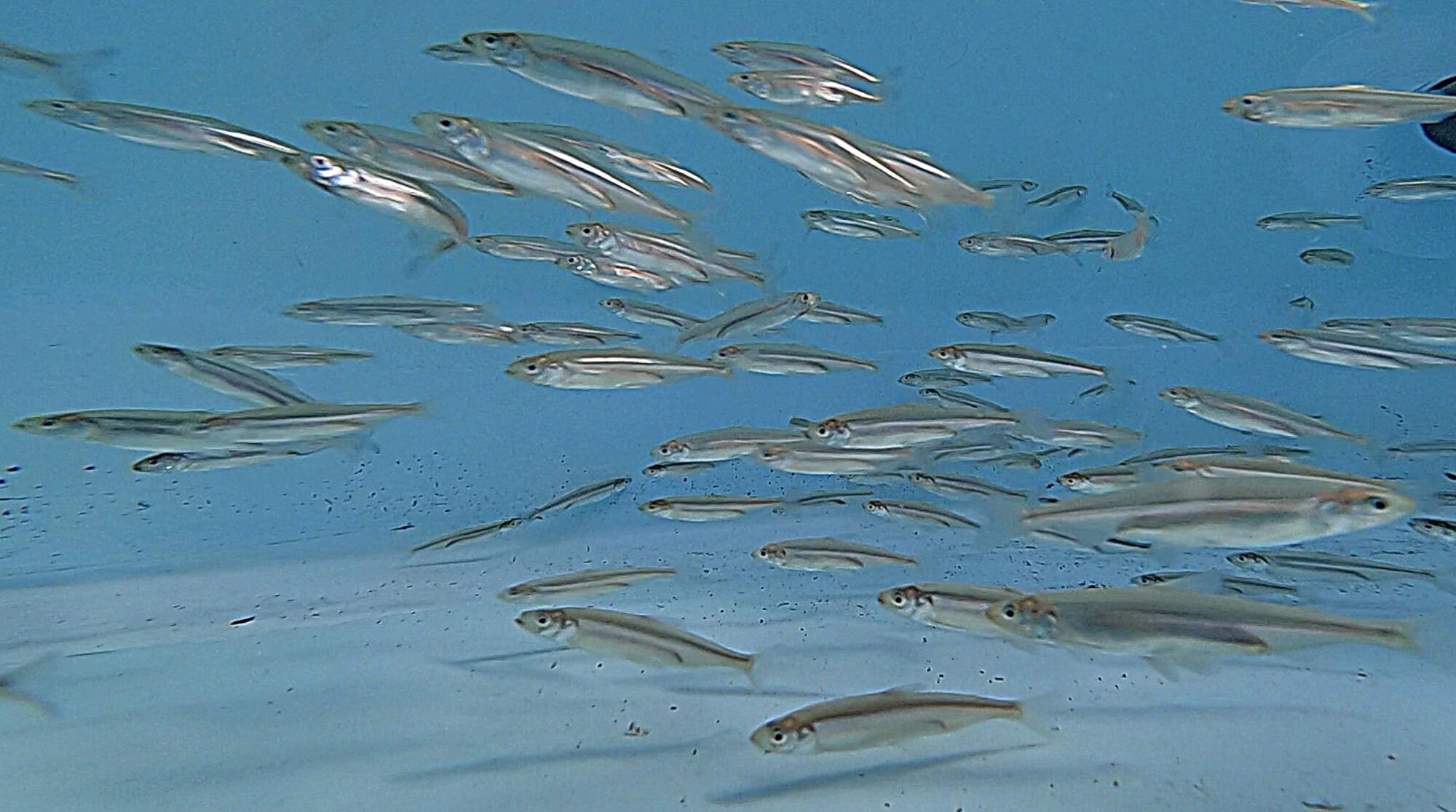
Federally endangered Delta smelt that were hatched at the UC Davis Fish Conservation & Culture Lab swim around a holding tank after being transferred from the lab to the Aquarium of the Pacific in Long Beach in 2019.
(Allen Schaben / Los Angeles Times)
“It’s a fish that’s doing poorly anyway,” Trump said this week.
Peter Gleick, a leading water and climate scientist, said Trump’s order on California water policy “is what you get when you mix bluster, ignorance, and disinformation.”
“There are no ‘enormous amounts of water’ that can be redirected legally, economically, or environmentally to different users in California, but perhaps this executive order will make some of Trump’s supporters feel like he’s doing something,” said Gleick, co-founder and senior fellow of the Pacific Institute, a water think tank in Oakland.
“He doesn’t really have a clue how California water systems work,” Gleick said. “If he cared about California water, which he doesn’t really, he would pay attention to climate change.”
Recent scientific research has shown that global warming, driven by fossil fuel burning and rising levels of greenhouse gases, has become a dominant driver of worsening droughts in the western U.S.
Examining the mix of factors behind the devastating wildfires, UCLA scientists said in an analysis last week that higher temperatures linked to climate change have contributed to the extreme dryness of vegetation in Southern California, one of the ingredients that is making the fires so intense.
“He doesn’t really have a clue how California water systems work. If he cared about California water, which he doesn’t really, he would pay attention to climate change.”
— Peter Gleick, co-founder and senior fellow of the Pacific Institute
Gleick said more than what the president says in “badly written executive orders,” people should watch what his appointees do — and how those actions affect efforts to improve water management.
“It remains to be seen just how disruptive Trump’s environmental appointments will be,” Gleick said. “The biggest risk is that it’s just going to delay or derail efforts underway to solve these problems.”
Trump’s call for delivering more supplies to farming areas and cities adds a layer of complication to arguments over water management in the Delta that have long pitted agricultural water districts against environmental groups, fishing advocates and Native tribes.
In recent years, fish populations have suffered major declines in the Delta and San Francisco Bay.
The numbers of spring-run Chinook salmon have plummeted. And with fall-run salmon populations struggling, officials shut down the commercial and recreational fishing seasons the last two years.
The longfin smelt, a species that once was abundant, was listed as endangered last year under the federal Endangered Species Act.
Environmental and fishing groups strongly criticized Trump’s water order.
Scott Artis, executive director of the Golden State Salmon Assn., said the previous rewriting of the rules during Trump’s first administration amounted to a “salmon extinction plan” because it deprived fish of critical flows they need to survive.
The closure of the salmon fishing season the last two years has already led to the loss of tens of thousands of fishing jobs, Artis said, and another weakening of protections “could further devastate fishing businesses, families, and communities.”
The group Save California Salmon said Trump’s directive continues a pattern of prioritizing the agriculture industry above the needs of other water users and the health of waterways and fish. The group also objected to the title of Trump’s memorandum, “Putting People over Fish: Stopping Radical Environmentalism to Provide Water to Southern California.”
“Protecting water quality, Delta smelt, salmon, and other species is not ‘radical environmentalism,’ ” said Josa Talley, a spokesperson for Save California Salmon.
“It is a matter of protecting water supplies and economies. Rivers must have enough water to sustain businesses, prevent toxic algae blooms, and ensure clean water for downstream communities,” Talley said. “Salmon survival is tied to our health and the health of our rivers.”
Times staff writer Colleen Shalby contributed to this report.





NEWYou can now listen to Fox News articles!
President Donald Trump on Monday sent an official notification to Congress about the U.S. strikes against Iran, in which he attempted to justify the military action in the now expanding conflict in the Middle East.
In a letter obtained by FOX News, Trump told Senate President Pro Tempore Chuck Grassley, R-Iowa, that “no U.S. ground forces were used in these strikes” and that the mission “was planned and executed in a manner designed to minimize civilian casualties, deter future attacks, and neutralize Iran’s malign activities.”
This comes after joint U.S.-Israeli strikes against Iran on Saturday as part of Operation Epic Fury, triggering a response from Tehran and a wider conflict in the region. The strikes killed the Islamic Republic’s Supreme Leader Ali Khamenei and other military leaders.
President Donald Trump on Monday sent an official notification to Congress about the U.S. strikes against Iran. (AP Photo/Alex Brandon)
Trump wrote that it is not yet possible to know the full scope of military operations against Iran and that U.S. forces are prepared to take potential further action.
“Although the United States desires a quick and enduring peace, not possible at this time to know the full scope and duration of military operations that may be necessary,” Trump wrote. “As such, United States forces remain postured to take further action, as necessary and appropriate, to address further threats and attacks upon the United States or its allies and partners, and ensure the Government of the Islamic Republic of Iran ceases being a threat to the United States, its allies, and the international community.”
“I directed this military action consistent with my responsibility to protect Americans and United States interests both at home and abroad and in furtherance of United States national security and foreign policy interests,” he added. “I acted pursuant to my constitutional authority as Commander in Chief and Chief Executive to conduct United States foreign relations.”
A general view of Tehran with smoke visible in the distance after explosions were reported in the city, on March 2, 2026, in Tehran, Iran. (Contributor/Getty Images)
Trump said he was “providing this report as part of my efforts to keep the Congress fully informed, consistent with the War Powers Resolution,” as some Republican and Democrat lawmakers attempt to restrain the president’s military action, which they affirm is unconstitutional without congressional approval.
The president also accused Iran of being among the largest state sponsors of terrorism in the world and purported that the “Iranian regime continues to seek the means to possess and employ nuclear weapons,” even after the White House said in June that precision strikes at the time “obliterated” Iran’s nuclear enrichment facilities.
US SURGES FORCES TO MIDDLE EAST AS PENTAGON WARNS IRAN FIGHT ‘WILL TAKE SOME TIME’
A person holds an image of Iran’s Supreme Leader Ayatollah Ali Khamenei as Iranian demonstrators protest against the U.S.-Israeli strikes, in Tehran, Iran, Feb. 28, 2026. (Majid Asgaripour/WANA (West Asia News Agency) via Reuters)
CLICK HERE TO DOWNLOAD THE FOX NEWS APP
“As I previously communicated to the Congress, Iran remains one of the largest, if not the largest, state-sponsors of terrorism in the world,” Trump said in the letter on Monday. “Despite the success of Operation MIDNIGHT HAMMER, the Iranian regime continues to seek the means to possess and employ nuclear weapons. Its array of ballistic, cruise, anti-ship, and other missiles pose a direct threat to and are attacking United States forces, commercial vessels, and civilians, as well as those of our allies and partners.”
“Despite my Administration’s repeated efforts to achieve a diplomatic solution to Iran’s malign behavior, the threat to the United States and its allies and partners became untenable,” he continued.
Fox News’ Tyler Olson contributed to this report.
Related Article


Northern California Rep. Kevin Kiley (R-Rocklin), whose congressional district was carved up in the redistricting ballot measures approved by voters last year, announced Monday that he would not challenge fellow Republican Rep. Tom McClintock of Elk Grove. Instead, he plans to run in the Democratic-leaning district where he resides.
“It’s true that I was fully prepared to run in [McClintock’s district], having tested the waters and with polls showing a favorable outlook in a ‘safe’ district. But doing what’s easy and what’s right are often not the same,” Kiley posted on the social media site X. “And at the end of the day, as much as I love the communities in [that] District that I represent now – and as excited as I was about the new ones – seeking office in a district that doesn’t include my hometown didn’t feel right.”
Kiley, 41, currently represents a congressional district that spans Lake Tahoe to Sacramento. He did not respond to requests for comment.
But after California voters in November passed Proposition 50 — a ballot measure to redraw the state’s congressional districts in an effort to counter Trump’s moves to increase the numbers of Republicans in Congress — Kiley’s district was sliced up into other districts.
As the filing deadline approaches, Kiley pondered his path forward in a decision that was compared by political insiders to the reality television show “The Bachelor.” Who would receive the final rose? McClintock’s new sprawling congressional district includes swaths of gold country, the Central Valley and Death Valley. The district Kiley opted to run in includes the city of Sacramento and the suburbs of Roseville and Rocklin in Placer County.
Kiley was facing headwinds because of the Republican institutional support that lined up behind McClintock, 69, who has been in Congress since 2009 and served in the state Legislature for 26 years previously. President Trump, the California Republican Party and the Club for Growth’s political action committee are among the people and groups who have endorsed McClintock.
Conservative strategist Jon Fleischman, a former executive director of the state GOP, said he was thrilled by Kiley’s decision, which avoids a divisive intraparty battle.
“If you open up the dictionary and look for the word conservative, it’s a photo of Tom McClintock. He is the ideological leader of conservatives, not only in California but in Congress for many, many years,” Fleischman said, adding that the endorsements for McClintock purposefully came because Kiley was considering challenging him.
Kiley, who grew up near Sacramento, attended Harvard University and Yale Law School. A former Teach for America member, he served in the state Assembly for six years before being elected to Congress in 2022 with Trump’s backing. But he has bucked the president, notably on tariffs. He also unsuccessfully ran to replace Gov. Gavin Newsom during the 2021 recall, and has been a constant critic of the governor.
Kiley is now running in a Sacramento-area district represented by Rep. Ami Bera (D-Elk Grove). Democrats in the newly drawn district had a nearly 9-point voter registration edge in 2024. Bera is now running in the new version of Kiley’s district.
In Kiley’s new race, his top rival is Dr. Richard Pan of Sacramento, a former state senator and staunch supporter of vaccinations.
“Kevin Kiley can try to rebrand himself, but voters know his extreme record,” Pan said in a statement. “He has stood with Donald Trump 98% of the time and was named a ‘MAGA Champion.’ The people of this district deserve better than political opportunism disguised as moderation. This race is about who will actually fight for healthcare, public health, and working families. I’ve done that my entire career. Kevin Kiley has not.”

new video loaded: Defense Officials Give No Timeline for War in Iran as U.S. Boosts Forces
transcript
transcript
Defense Officials Give No Timeline for War in Iran as U.S. Boosts Forces
At a Pentagon news conference, top defense officials said that the U.S. military was sending more forces to the Middle East and expects to “take additional losses.” Earlier, President Trump said that the U.S. could continue striking Iran for the next four to five weeks.
-
“We didn’t start this war, but under President Trump, we are finishing it. This operation is a clear, devastating, decisive mission. Destroy the missile threat. Destroy the navy. No nukes. President Trump has all the latitude in the world to talk about how long it may or may not take. Four weeks. Two weeks, six weeks. It could move up. It could move back. We’re going to execute at his command the objectives we’ve set out to achieve.” “We expect to take additional losses. And as always, we will work to minimize U.S. losses. But as the secretary said, this is major combat operations.” Reporter: “Are there currently any American boots on the ground in Iran?” “No, but we’re not going to go into the exercise of what we will or will not do. I think — it’s one of those fallacies for a long time that this department or presidents or others should tell the American people. This — and our enemies by the way — here’s exactly what we’ll do. Why in the world would we tell you, you, the enemy, anybody, what we will or will not do in pursuit of an objective?”
By Christina Kelso
March 2, 2026

Trump sends official notification to Congress on strikes against Iran

Punch the monkey, viral star, experiences dramatic breakthrough among zoo mates

NBA player calls for Hawks to cancel their ‘Magic City’ strip club promotional night out of respect for women

Why the Microsoft 365 Copilot bug matters for data security
California gas is pricey already. The Iran war could cost you even more

Florida High School Football Rankings: Top 25 teams – Oct. 21

Cleary's 21 help Le Moyne down Central Connecticut State 69-64 in OT

How old is Bo Nix? What to know about Oregon quarterback ahead of 2024 NFL Draft

99th annual Pony Swim held in Virginia

Indiana Members Credit Union announced as new anchor tenant at Bottleworks District
Trump sends official notification to Congress on strikes against Iran

Unexpected birth brings hope to near-extinct Amazon tribe

Supreme Court blocks redrawing of New York congressional map, dealing a win for GOP

Map: Earthquake Shakes Central California

Gas prices could jump as Middle East tensions threaten global oil supply
-

 World5 days ago
Exclusive: DeepSeek withholds latest AI model from US chipmakers including Nvidia, sources say
-

 Massachusetts5 days ago
Mother and daughter injured in Taunton house explosion
-

 Denver, CO5 days ago
10 acres charred, 5 injured in Thornton grass fire, evacuation orders lifted
-

 Louisiana1 week ago
Wildfire near Gum Swamp Road in Livingston Parish now under control; more than 200 acres burned
-

 Technology1 week ago
YouTube TV billing scam emails are hitting inboxes
-

 Politics1 week ago
OpenAI didn’t contact police despite employees flagging mass shooter’s concerning chatbot interactions: REPORT
-

 Technology1 week ago
Stellantis is in a crisis of its own making
-

 News1 week ago
World reacts as US top court limits Trump’s tariff powers