Politics
Trump signs executive order to ‘preempt’ permitting process for fire-destroyed homes in L.A.

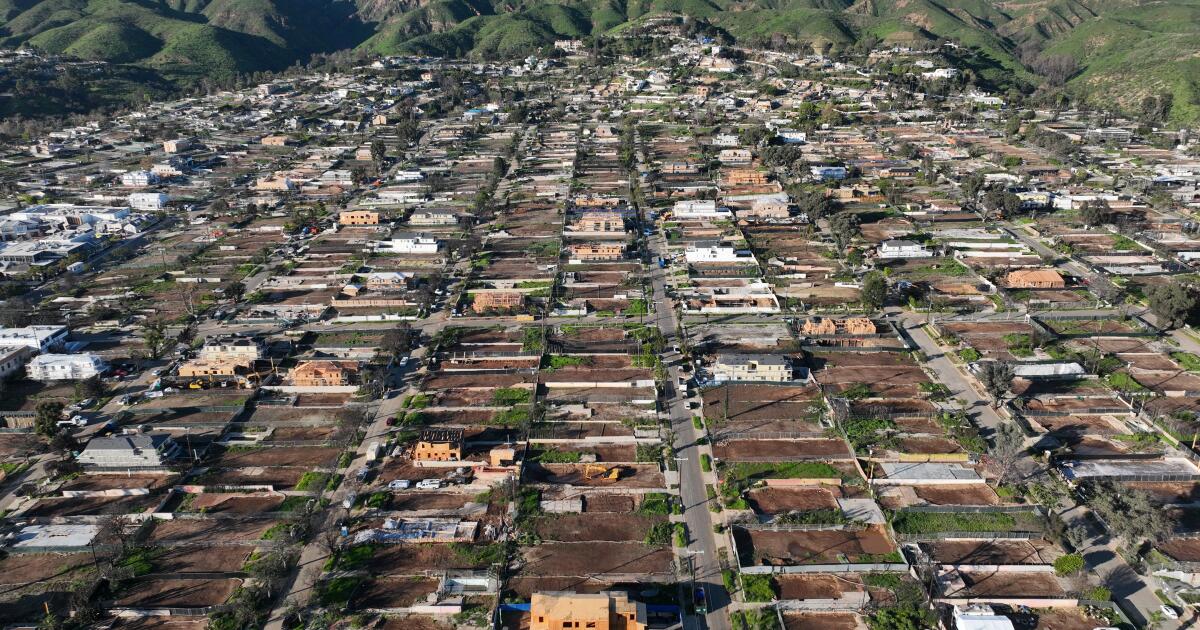
President Trump has announced an executive order to allow victims of the Los Angeles wildfires to rebuild without dealing with “unnecessary, dupicative, or obstructive” permitting requirements.
The order, which is likely to be challenged by the city and state, claimed that local governments have failed to adequately process permits and were slowing down residents who are desperate to rebuild in the Palisades and Altadena.
“American families and small businesses affected by the wildfires have been forced to continue living in a nightmare of delay, uncertainty, and bureaucratic malaise as they remain displaced from their homes, often without a source of income, while state and local governments delay or prevent reconstruction by approving only a fraction of the permits needed to rebuild,” Trump wrote in the executive order, which he signed Friday.
The order called on the Secretary of Homeland Security and the Federal Emergency Management Agency to “preempt” state and local permitting authorities.
Instead of going through the usual approval process, residents using federal emergency funds to rebuild would need to self-certify to federal authorities that they have complied with local health and safety standards.
The order comes as the city and county approach 3,000 permits issued for rebuilding. A December review by The Times found that the permitting process in Altadena and Pacific Palisades was moving at a moderate rate compared to other major fires in California. As of Dec. 14, the county had issued rebuilding permits for about 16% of the homes destroyed in the Eaton fire and the city had issued just under 14% for those destroyed in the Palisades fire.
While Mayor Karen Bass did not immediately provide comment, the executive order drew intense pushback from Gov. Gavin Newsom.
A spokesperson for Newsom, Tara Gallegos, called Trump a “clueless idiot” for believing the federal government could issue local rebuilding permits.
“With 1625+ home permits issued, hundreds of homes under construction, and permitting timelines at least 2x faster than before the fires, an executive order to rebuild Mars would do just as useful,” Gov. Gavin Newsom wrote in a post on X, citing the number of permits issued solely by the city of Los Angeles.
Newsom said that the federal government needed to release funding, not take over control of the permitting process. The governor said that what communities really lack is money, not permits.
“Please actually help us. We are begging you,” Newsom wrote.
Instead of descending into the permitting process, Newsom called on the president to send a recovery package to congress to help families rebuild, citing a letter from a bipartisan delegation of California legislators that called for federal funding.
“As the recovery process continues, additional federal support is needed, and our entire delegation looks forward to working cooperatively with your administration to ensure the communities of Southern California receive their fair share of federal disaster assistance,” wrote the California legislators on Jan 7.
Los Angeles City Councilwoman Traci Park, who represents Pacific Palisades, responded in a statement that read: “If the federal government is interested in expediting recovery from the most expensive disaster in this country’s history, they can start by committing to real financial support — to close insurance gaps, to repair critical infrastructure damaged in both the fire and the debris removal process, to help this region rebuild two entire communities from the ground up.”
Park also said that “dangling SBA loans and hazard mitigation funding in front of victims while summarily denying FEMA claim and other support to municipalities behind the scenes is subterfuge, not support. The City can only approve permits that have been submitted and the reality is that many disaster victims are still not ready to move forward with their rebuilds. This federal government can fix that by allowing desperately needed financial assistance to flow down to the Los Angeles region and let us get to work.”
Los Angeles County Supervisor Kathryn Barger, who represents Altadena, said she would “welcome any effort to responsibly accelerate rebuilding.”
Barger said permits take 30 days to move through the county’s plan check, but often encounter delays due to “complex multi-party work of architects, engineers, and builders.”
She also called for more federal funding and long-term disaster aid.
“The most urgent need in the Altadena region is financially driven,” she said in a statement to The Times.
Some in the Palisades agreed that money was a bigger issue than permitting.
“When I talk to people it seems to have more to do with their insurance payout or whether they have enough money to complete construction,” said Maryam Zar, a Palisades resident who runs the Palisades Recovery Coalition.
Zar called the executive order “interesting” and said that it was fair of the president to call the recovery pace slow and unacceptable.
Jonathan Zasloff, a UCLA Law professor who focuses on land use, called the executive order “childish and irresponsible policy.”
Zasloff, who lost his Palisades home in the fire, said that the president does not have the authority to get rid of state and local law just because he doesn’t like them. Instead, Zasloff said, the president should focus on fully funding disaster recovery so that the city and county can have adequate staff to process permit applications.
“My house burned down in the Palisades. Getting rid of the building codes would make it easier to rebuild something, but it could also make things a lot more dangerous,” he said.


NEWYou can now listen to Fox News articles!
Secretary of State Marco Rubio announced Saturday that the Trump administration is sanctioning a senior Nicaraguan official over alleged human rights violations.
Rubio said the U.S. is designating Vice Minister of the Interior Luis Roberto Cañas Novoa for his role in “gross violations of human rights” under the government of President Daniel Ortega and Vice President Rosario Murillo, marking what he said was the latest effort to hold the regime accountable.
“The Trump administration continues to hold the Murillo-Ortega dictatorship accountable for brutal human rights violations against Nicaraguans,” Rubio said in a post on X. “I’m designating Nicaraguan Vice Minister of the Interior Luis Roberto Cañas Novoa for his role in human rights violations.”
RUBIO TESTIFIES IN TRIAL OF EX-FLORIDA CONGRESSMAN ALLEGEDLY HIRED BY MADURO GOVERNMENT TO LOBBY FOR VENEZUELA
Secretary of State Marco Rubio speaks at the State Department, April 14, 2026. The U.S. announced sanctions on a Nicaraguan official tied to alleged human rights abuses under the Ortega-Murillo government. (Andrew Harnik/Getty Images)
The designation was made under Section 7031(c), which allows the State Department to bar foreign officials and their immediate family members from entering the United States due to involvement in significant corruption or human rights abuses.
The State Department has said the Ortega-Murillo government has engaged in arbitrary arrests, torture and extrajudicial killings following mass protests that began in April 2018.
“Nearly eight years ago, the Rosario Murillo and Daniel Ortega dictatorship unleashed a brutal wave of repression against Nicaraguans who courageously stood against the regime’s increased tyranny, corruption, and abuse,” the statement reads.
The State Department said that the sanction marked the anniversary of the 2018 protests, after which more than 325 protesters were murdered in the aftermath.
A panel of U.N.-backed human rights experts previously accused Nicaragua’s government of systematic abuses “tantamount to crimes against humanity,” following an investigation into the country’s crackdown on political dissent, according to The Associated Press.
The experts said the repression intensified after mass protests in 2018 and has since expanded across large parts of society, targeting perceived opponents of the government.
TRUMP ADMIN ANNOUNCES EXPANSION OF VISA RESTRICTION POLICY IN WESTERN HEMISPHERE
Nicaragua President Daniel Ortega delivers a speech during a ceremony to mark the 199th Independence Day anniversary, in Managua, Nicaragua Sept. 15, 2020. (Nicaragua’s Presidency/Cesar Perez/Handout via Reuters)
Nicaragua’s government has rejected those findings.
The designation follows a series of recent U.S. actions targeting the Ortega-Murillo government. In February, the State Department sanctioned five senior Nicaraguan officials tied to repression, citing arbitrary detention, torture, killings and the targeting of clergy, media and civil society.
Earlier this week, the department also announced sanctions on individuals and companies linked to Nicaragua’s gold sector, including two of Ortega and Murillo’s sons, accusing the regime of using the industry to generate foreign currency, launder assets and consolidate power within the ruling family.
The State Department said the move is part of ongoing efforts to hold the Nicaraguan government accountable for its actions.
Fox News Digital reached out to the Nicaraguan government and its embassy in Washington for comment but did not immediately receive a response.
CLICK HERE TO DOWNLOAD THE FOX NEWS APP
A man waves a Nicaraguan flag during a demonstration to commemorate Nicaragua’s national Day of Peace, which is celebrated in the country on April 19, and to protest against the government of Nicaraguan President Daniel Ortega in San Jose, Costa Rica on April 16, 2023. (Jose Cordero/AFP)
The Trump administration has taken an increasingly aggressive posture in the Western Hemisphere in recent months, including a Jan. 3, 2026, operation that resulted in the capture of Venezuelan leader Nicolás Maduro and his wife, Cilia Flores.
The U.S. has also carried out a series of strikes targeting suspected drug-trafficking vessels in the region, part of a broader crackdown tied to regional security and narcotics enforcement efforts.

WASHINGTON — Upbeat claims from President Trump over an imminent peace deal to end the war with Iran were met with deep skepticism Friday across the Middle East, where Iranian and Israeli officials questioned the prospects for a lasting agreement that would satisfy all parties.
The outlines of an agreement began to emerge that would provide Iran with a major strategic victory — and a potential financial windfall — allowing the Islamic Republic to leverage its control over the Strait of Hormuz to exact significant concessions from the United States and its ally Israel as Trump presses for a swift end to the conflict.
In a series of social media posts and interviews with reporters, Trump announced that the strait was “fully open,” vowing Tehran would never again attempt to control it. But Iranian officials and state media said that conditions remained on passage through the waterway, including the imposition of tolls and coordination with the Islamic Revolutionary Guard Corps.
Iranian diplomats posted threats that its closure could resume at any time of their choosing, and warned that restrictions would return unless the United States agreed to lift a blockade of its ports. Trump had said Friday that the blockade would remain in place.
“The conditional and limited reopening of a portion of the Strait of Hormuz is solely an Iranian initiative, one that creates responsibility and serves to test the firm commitments of the opposing side,” said a top aide to Iran’s president, dismissing Trump’s statements on the contours of a deal as “baseless.”
“If they renege on their promises,” he added, “they will face dire consequences.”
In an overture to Iran, Trump said Israel would be “prohibited” from conducting additional military strikes in Lebanon, where the Israeli government of Prime Minister Benjamin Netanyahu seeks to prevent Hezbollah, an Iranian proxy militia, from rearming, a potential threat to communities in the Israeli north.
But in a speech delivered in Hebrew, Netanyahu would say only that Israel had agreed to a temporary ceasefire, while members of his Cabinet warned that Israel Defense Forces operations in southern Lebanon were not yet finished. A top ally of the prime minister at a right-wing Israeli news outlet warned that Trump was “surrendering” to Iran in the talks.
It was a day of public messaging from a president eager to end a war that has proved historically unpopular with the American public, and has driven a rise in gas prices that could weigh on his party entering this year’s midterm elections.
Yet, Republican allies of the president have begun warning him that an agreement skewed heavily in Tehran’s favor could carry political costs of its own.
Trump was forced to deny an Axios report Friday that his negotiating team had offered to release $20 billion in frozen Iranian assets in exchange for Tehran agreeing to hand over its fissile material, buried under rubble from a U.S. bombing raid last year.
That sum would amount to more than 10 times what President Obama released to Iran under a 2015 nuclear deal, called the Joint Comprehensive Plan of Action, that was the subject of fierce Republican criticism in the decade since.
“I have every confidence that President Trump will not allow Iran to be enriched by tens of billions of dollars for holding the world hostage and creating mayhem in the region,” said Sen. Lindsey Graham (R-S.C.), a strong supporter of the war. “No JCPOAs on President Trump’s watch.”
Still, Trump said in a round of interviews that a deal could be reached in a matter of days, ending less than two weeks of negotiations.
He claimed that Tehran had agreed to permanently end its enrichment of uranium — a development that, if true, would mark a dramatic reversal for the Islamic Republic from decades developing its nuclear program, and from just 10 days ago, when Iranian diplomats rejected a U.S. proposal of a 20-year pause on domestic enrichment in favor of a five-year moratorium.
He said Iran had agreed never to build nuclear weapons — a pledge Tehran has made repeatedly, including under the Nuclear Nonproliferation Treaty, in a religious decree from then-Supreme Leader Ayatollah Ali Khamenei, and in the 2015 agreement — while continuing nuclear activities viewed by the international community as exceeding civilian needs.
And he repeatedly stated that Iran had agreed to the removal of its enriched uranium from the country, either to the United States or to a third party. Iranian state media stated Friday afternoon that a proposal to remove the country’s highly enriched uranium had been “rejected.”
Iran’s agreement to allow safe passage for commercial vessels through the Strait of Hormuz is linked to a ceasefire in Lebanon that the Israeli Cabinet approved for only a 10-day period. Regardless of whether it holds or is extended, Israeli officials said their military would not retreat from its current positions in southern Lebanon — opening up Israeli forces to potential attack by Hezbollah militants unbound by a truce brokered by the Lebanese government.
The Lebanese people, Hezbollah officials said, have “the right to resist” Israeli occupation of their land. Whether the fighting resumes, the group added, “will be determined based on how developments unfold.”
An Iranian official threw cold water on the prospects of reaching a comprehensive peace deal in the coming days, telling Reuters that a temporary extension of the current ceasefire, set to expire Tuesday, would “create space for more talks on lifting sanctions on Iran and securing compensation for war damages.”
“In exchange, Iran will provide assurances to the international community about the peaceful nature of its nuclear program,” the official said, adding that “any other narrative about the ongoing talks is a misrepresentation of the situation.”
Trump told reporters Friday that the talks will continue through the weekend.
While Trump claimed there aren’t “too many significant differences” remaining, he said the United States would continue the blockade until negotiations are finalized and formalized.
“When the agreement is signed, the blockade ends,” the president told reporters in Phoenix.
Times staff writer Ana Ceballos contributed to this report.


CHAMBERS OF
JUSTICE ELENA KAGAN
Supreme Court of the United States Washington, D. C. 20343
February 7, 2016
Memorandum to the Conference
Re: 15A773 West Virginia, et al. v. EPA, et al.
15A776 Basin Elec. Power Cooperative, et al. v. EPA, et al. 15A787 Chamber of Commerce, et al. v. EPA, et al.
15A778 Murray Energy Corp., et al. v. EPA, et al.
-
15A793 North Dakota v. EPA, et al.
I agree with Steve that we should direct the States to seek an extension from the EPA before asking this Court to intervene. We could also include, at the end of such an order, language along the lines of the following, to encourage the D. C. Circuit to act expeditiously in its resolution of this matter: “In light of that court’s agreement to consider this case on an expedited schedule, we are confident that it will [or even: we urge it to] render a decision with appropriate dispatch.” See Doe v. Gonzales, 546 U. S. 1301, 1308 (2005) (GINSBURG, J., in chambers); Kemp v. Smith, 463 U. S. 1344, 1345 (1983) (Powell, J., in chambers); Holtzman v. Schlesinger, 414 U. S. 1304, 1305, n. 2 (1973) (Marshall, J., in chambers).
The unique nature of the relief sought in these applications gives me real pause. The applicants ask us to enjoin a regulation pending initial review in the court of appeals. As we often say, “we are a court of review, not of first view.” See Cutter v. Wilkinson, 544 U. S. 709, 718 n. 7 (2005); cf. Doe, 546 U. S., at 1308 (“Re- spect for the assessment of the Court of Appeals is especially warranted when that court is proceeding to adjudication on the merits with due expedition.”). As far as I can tell, it would be unprecedented for us to second-guess the D. C. Circuit’s deci sion that a stay is not warranted, without the benefit of full briefing or a prior judi- cial decision.
On the merits, this is a difficult case involving a complex statutory and regu- latory regime. Although the parties’ abbreviated discussion of the issues at stake here makes it difficult for me to determine with any confidence which side is likely to ultimately prevail, it seems to me that at this stage the government has the bet- ter of the arguments. The Chief’s memo focuses on the applicants’ argument that the “best system of emission reduction” refers “solely [to] installation of control technologies (e.g., scrubbers).” 2/5 Memo, at 2. The ordinary meaning of “system” is in fact quite broad, appearing to encompass what EPA has done here. Of course, we would want to consider this term in the larger context of the Clean Air Act’s regula-
-
 News16 minutes ago
Real estate investors are buying up long-term care facilities. Residents can suffer
-

 Detroit, MI2 hours ago
Former Piston shows Detroit what they’re missing as he dominates next to LeBron
-

 San Francisco, CA2 hours ago
Eastbound I-80 closure in San Francisco snarls traffic, slows business
-

 Videos2 hours ago
Can Keir Starmer survive the latest Mandelson revelations? | BBC News
-

 Dallas, TX3 hours ago
Petar Musa’s Brace Not Enough as FC Dallas Draws LA Galaxy 2-2
-

 Miami, FL3 hours ago
MLS: Messi double helps Inter Miami slay Rapids in front of huge crowd
-

 Boston, MA3 hours ago
From across Boston they flock to play for Latin Academy boys’ tennis, a co-op of 29 schools – The Boston Globe
-

 Denver, CO3 hours ago
Dale Kistler Obituary | The Denver Post