Politics
Trump, California and the multi-front war over the next election


In recent weeks, Marin County Registrar Natalie Adona has been largely focused on the many mundane tasks of local elections administrators in the months before a midterm: finalizing voting locations, ordering supplies, facilitating candidate filings.
But in the wake of unprecedented efforts by the Trump administration to intervene in state-run elections, Adona said she has also been preparing her staff for far less ordinary scenarios — such as federal officials showing up and demanding ballots, as they recently did in Georgia, or immigration agents staging around polling stations on election day, as some in President Trump’s orbit have suggested.
“Part of my job is making sure that the plans are developed and then tested and then socialized with the staff so if those situations were to ever come up, we would not be figuring it out right then and there. We would know what to do,” Adona said. “Doing those sort of exercises and that level of planning in a way is kind of grounding, and makes things feel less chaotic.”
Natalie Adona faced harassment from election deniers and COVID anti-maskers when she served as the registrar of voters in Nevada County. She now serves Marin County and is preparing her staff for potential scenarios this upcoming election, including what to do if immigration agents are present.
(Jess Lynn Goss / For The Times)
Across California, local elections administrators say they have been running similar exercises to prepare for once unthinkable threats — not from local rabble-rousers, remote cyberattackers or foreign adversaries, but their own federal government.
State officials, too, are writing new contingency plans for unprecedented intrusions by Trump and other administration officials, who in recent days have repeated baseless 2020 election conspiracies, raided and taken ballots from a local election center in Fulton County, Ga., pushed both litigation and legislation that would radically alter local voting rules, and called for Republicans to seize control of elections nationwide.
California’s local and state officials — many of whom are Democrats — are walking a fine line, telling their constituents that elections remain fair and safe, but also that Trump’s talk of federal intervention must be taken seriously.
Their concerns are vastly different than the concerns voiced by Trump and other Republicans, who for years have alleged without evidence that U.S. elections are compromised by widespread fraud involving noncitizen voters, including in California.
But they have nonetheless added to a long-simmering sense of fear and doubt among voters — who this year have the potential to radically alter the nation’s political trajectory by flipping control of Congress to Democrats.

An election worker moves ballots to be sorted at the Orange County Registrar of Voters in Santa Ana on Nov. 5, 2024.
(Allen J. Schaben / Los Angeles Times)
Trump has said he will accept Republican losses only if the elections are “honest.” A White House spokesperson said Trump is pushing for stricter rules for voting and voter registration because he “cares deeply about the safety and security of our elections.”
Rick Hasen, an election law expert and director of the Safeguarding Democracy Project at UCLA Law, said some of what Trump says about elections “is nonsensical and some is bluster,” but recent actions — especially the election center raid in Georgia — have brought home the reality of his threats.
“Some worry that this is a test run for trying to seize ballot boxes in 2026 and prevent a fair count of the votes, and given Trump’s track record, I don’t think that is something we can dismiss out of hand,” Hasen said. “States need to be making contingency plans to make sure that those kinds of things don’t happen.”
The White House dismissed such concerns, pointing to isolated incidents of noncitizens being charged with illegally voting, and to examples of duplicate registrations, voters remaining on rolls after death and people stealing ballots to vote multiple times.
“These so-called experts are ignoring the plentiful examples of noncitizens charged with voter fraud and of ineligible voters on voter rolls,” said Abigail Jackson, the White House spokesperson.
Experts said fraudulent votes are rare, most registration and roll issues do not translate into fraudulent votes being cast, and there is no evidence such issues swing elections.
A swirl of activity
Early in his term, Trump issued an executive order calling for voters nationwide to be required to show proof of U.S. citizenship, and for states to be required to disregard mail ballots received after election day. California and other states sued, and courts have so far blocked the order.
This past week, Trump said outright that Republicans should “take over” elections nationwide.
The Justice Department has sued California Secretary of State Shirley Weber and her counterparts in other states for refusing to hand over state voter rolls — the lawsuit against Weber was tossed — and raided and seized ballots from the election office of Fulton County, long a target of right-wing conspiracy theories over Trump’s 2020 election loss.
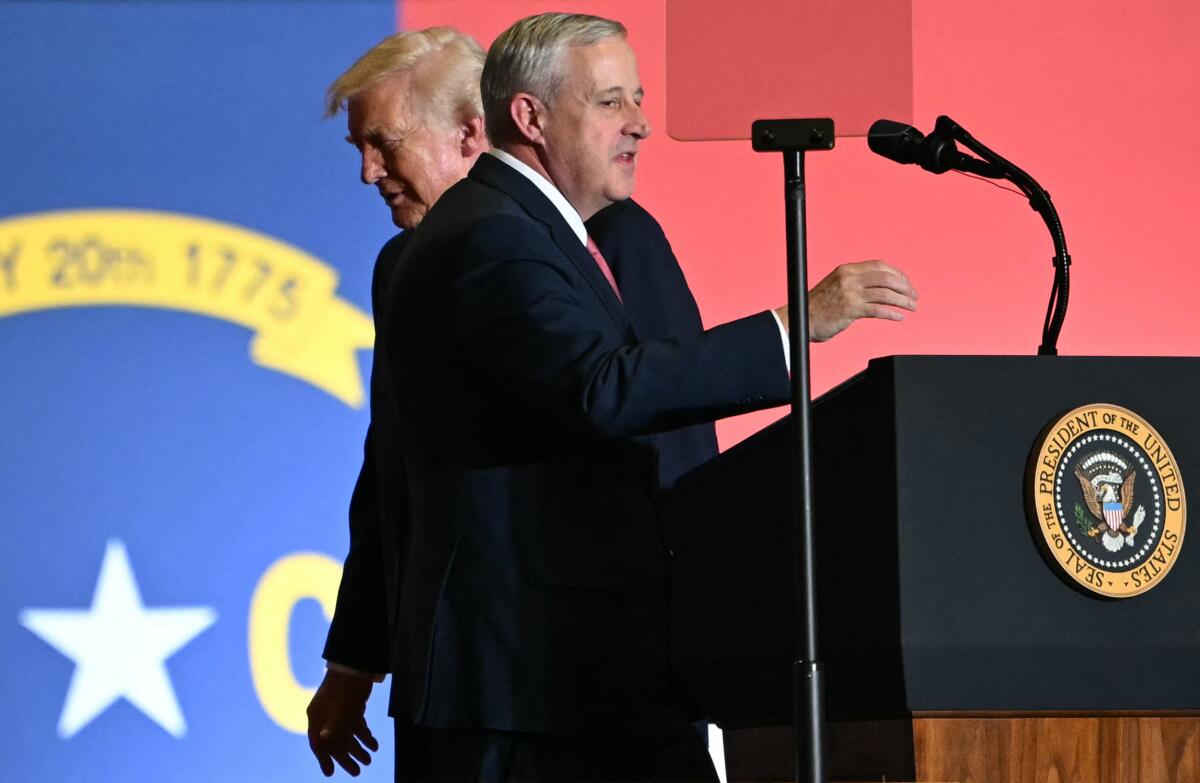
President Trump walks behind former chairperson of the Republican National Committee Michael Whatley as he prepares to speak during a political rally in Rocky Mount, N.C., on Dec. 19.
(Andrew Caballero-Reynolds / AFP via Getty Images)
Longtime Trump advisor and ally Stephen K. Bannon suggested U.S. Immigration and Customs Enforcement agents will be dispatched to polling locations in November, reprising old fears about voter intimidation. White House Press Secretary Karoline Leavitt said she couldn’t rule that out, despite it being illegal.
Democrats have raised concerns about the U.S. Postal Service mishandling mail ballots in the upcoming elections, following rule changes for how such mail is processed. Republicans have continued pushing the SAVE America Act, which would create new proof of citizenship requirements for voters. The U.S. Supreme Court is considering multiple voting rights cases, including one out of Louisiana that challenges Voting Rights Act protections for Black representation.
Charles H. Stewart, director of the MIT Election Data + Science Lab, said the series of events has created an “environment where chaos is being threatened,” and where “people who are concerned about the state of democracy are alarmed and very concerned,” and rightfully so.
But he said there are also “a number of guardrails” in place — what he called “the kind of mundane mechanics that are involved in running elections” — that will help prevent harm.
California prepares
California leaders have been vociferous in their defense of state elections, and said they’re prepared to fight any attempted takeover.
“The President regularly spews outright lies when it comes to elections in this country, particularly ones he and his party lose,” Gov. Gavin Newsom said in a statement. “We will continue to correct those lies, rebuild much-needed trust in our democratic institutions and civic duties, and defend the U.S. Constitution’s grant to the states authority over elections.”
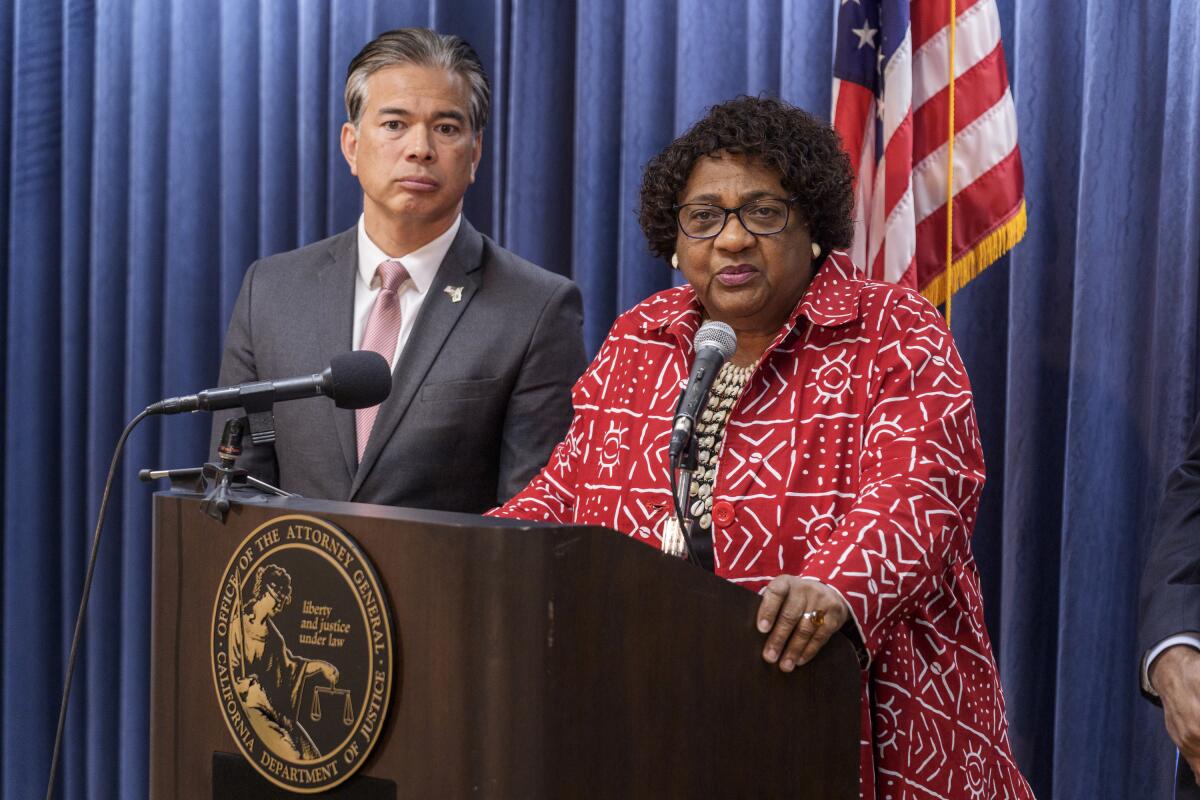
California Atty. Gen. Rob Bonta and Secretary of State Shirley Weber take questions after announcing a lawsuit to protect voter rights in 2024.
(Damian Dovarganes / Associated Press)
California Atty. Gen. Rob Bonta said in an interview that his office “would go into court and we would get a restraining order within hours” if the Trump administration tries to intervene in California elections, “because the U.S. Constitution says that states predominantly determine the time, place and manner of elections, not the president.”
Weber told The Times that the state has “a cadre of attorneys” standing by to defend its election system, but also “absolutely amazing” county elections officials who “take their job very seriously” and serve as the first line of defense against any disruptions, from the Trump administration or otherwise.
Dean Logan, Los Angeles County’s chief elections official, said his office has been doing “contingency planning and tabletop exercises” for traditional disruptions, such as wildfires and earthquakes, and novel ones, such as federal immigration agents massing near voting locations and last-minute policy changes by the U.S. Postal Service or the courts.
“Those are the things that keep us up at night,” he said.
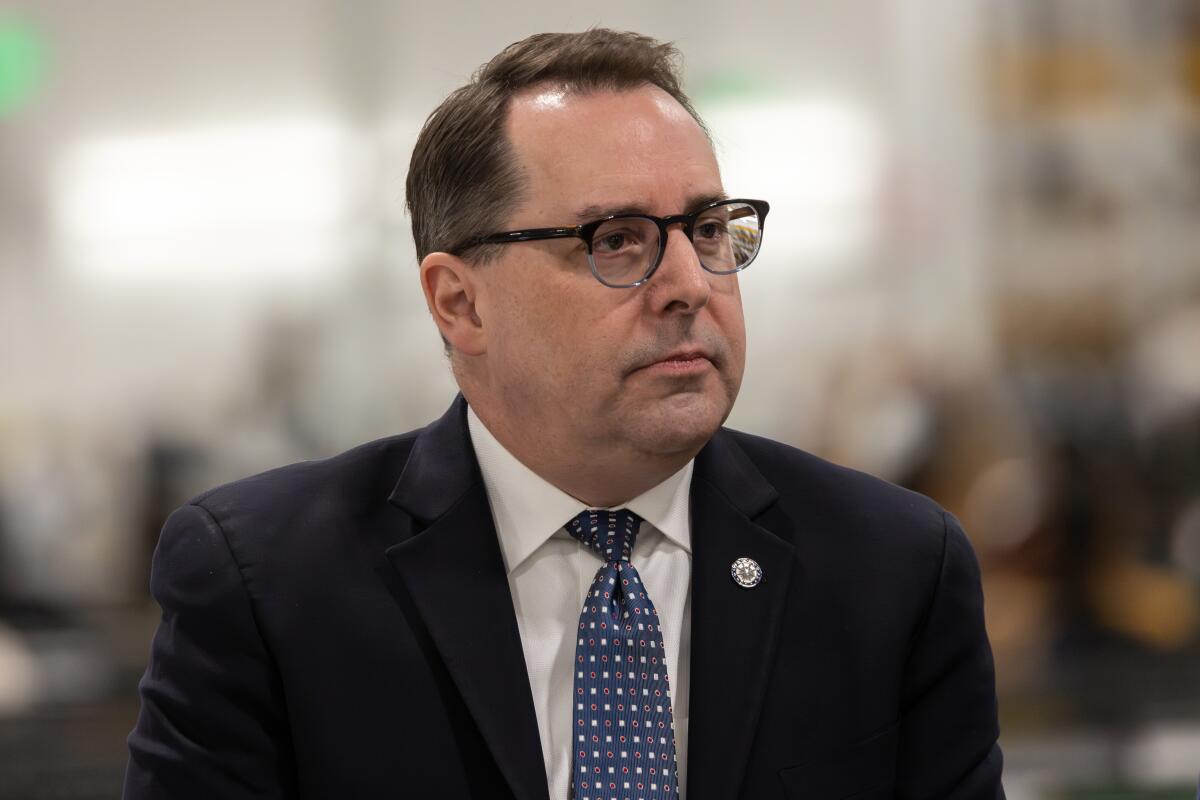
Los Angeles County Registrar-Recorder Dean Logan said the county no longer has ballots from the 2020 election.
(Irfan Khan / Los Angeles Times)
Logan said he is not currently concerned about the FBI raiding L.A. County elections offices because, while Fulton County still had its 2020 ballots on hand due to ongoing litigation, that is not the case for L.A. County, which is “beyond the retention period” for holding, and no longer has, its 2020 ballots.
However, Logan said he does consider what happened in Georgia a warning that the Trump administration “will utilize the federal government to go in and be disruptive in an elections operation.”
“What we don’t know is, would they do that during the conduct of an election, before an election is certified?” Logan said.
Kristin Connelly, chief elections officer for Contra Costa County, said she’s been working hard to make sure voters have confidence in the election process, including by giving speeches to concerned voters, expanding the county’s certified election observer program, and, in the lead-up to the 2024 election, running a grant-funded awareness campaign around election security.
Connelly — who joined local elections officials nationwide in challenging Trump’s executive order on elections in court — said she also has been running tabletop exercises and coordinating with local law enforcement, all with the goal of ensuring her constituents can vote.
“How the federal government is behaving is different from how it used to behave, but at the end of the day, what we have to do is run a mistake-free, perfect election, and to open our offices and operation to everybody — especially the people who ask hard questions,” she said.
Lessons from the past
Several officials in California said that as they prepare, they have been buoyed by lessons from the past.
Before being hired by the deep-blue county of Marin in May, Adona was the elected voting chief in rural Nevada County in the Sierra foothills.
In 2022, Adona affirmed that Trump’s 2020 election loss to Democrat Joe Biden was legitimate and enforced a pandemic mask mandate in her office. That enraged a coalition of anti-mask, anti-vaccine, pro-Trump protesters, who pushed their way into the locked election office.
Protesters confronted Adona and her staffers, with one worker getting pushed down. They stationed themselves in the hallway, leaving Adona’s staff too terrified to leave their office to use the hallway bathroom, as local, state and federal authorities declined to step in.
“At this point, and for months afterwards, I felt isolated and depressed. I had panic attacks every few days. I felt that no one had our back. I focused all my attention on my staff’s safety, because they were clearly nervous about the unknown,” Adona said during subsequent testimony before the Senate Judiciary Committee.
In part because she knows what can go wrong, Adona said her focus now is on preparing her new staff for whatever may come, while following the news out of Georgia and trying to maintain a cool head.
“I would rather have a plan and not use it than need a plan and not have one,” she said.
Clint Curtis, the clerk and registrar of voters in Shasta County — which ditched its voting machines in 2023 amid unfounded fraud allegations by Trump — said his biggest task ahead of the midterms is to increase both ballot security and transparency.
Since being appointed to lead the county office last spring, the conservative Republican from Florida has added more cameras and more space for election observers — which, during the recent special election on Proposition 50, California’s redistricting measure, included observers from Bonta’s and Weber’s offices.
He has also reduced the number of ballot drop boxes in the vast county from more than a dozen to four. Curtis told The Times he did not trust the security of ballots in the hands of “these little old ladies running all over the county” to pick them up, and noted there are dozens of other county locations where they can be dropped off. He said he invited Justice Department officials to observe voting on Proposition 50, though they didn’t show, and welcomes them again for the midterms.
“If they can make voting safer for everybody, I’m perfectly fine with that,” he said. “It always makes me nervous when people don’t want to cooperate. Whatcha hiding? It should be: ‘Come on in.’”
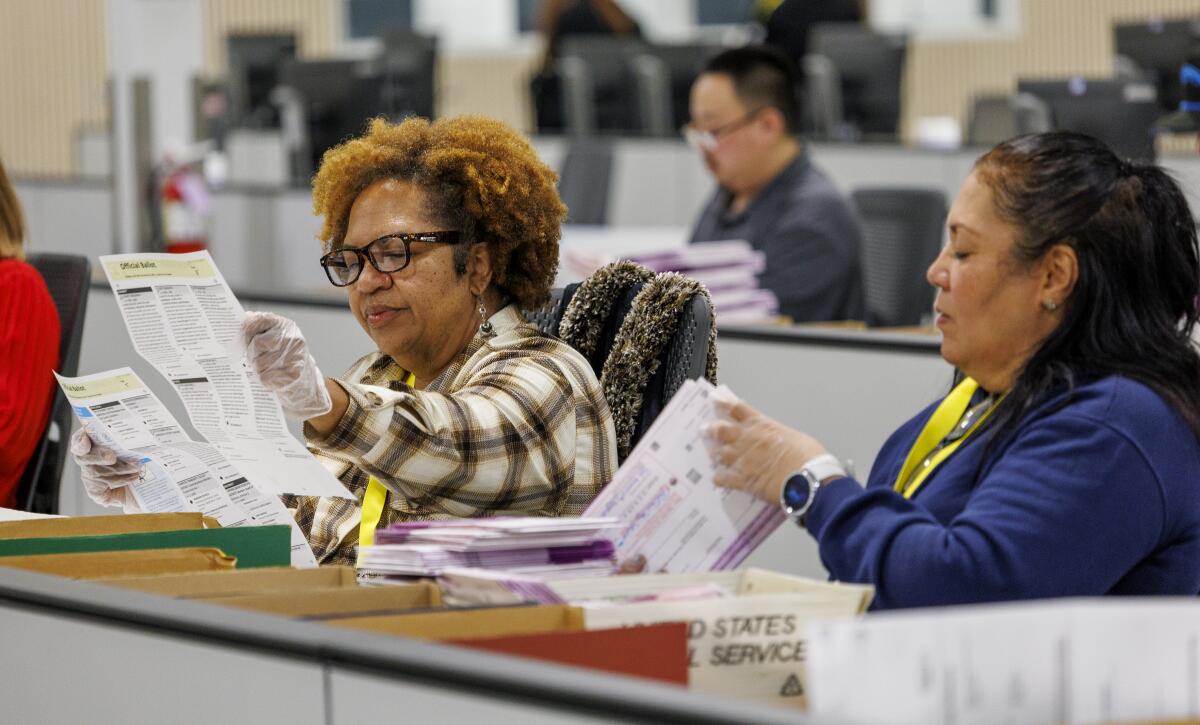
Election workers inspect ballots after extracting them from envelopes on election night at the Los Angeles County Ballot Processing Center on Nov. 5, 2024, in the City of Industry.
(Gina Ferazzi / Los Angeles Times)
Weber, 77 and the daughter of an Arkansas sharecropper whose family fled Southern racism and threats of violence to reach California, said that while many people in the U.S. are confronting intense fear and doubt about the election for the first time, and understandably so, that is simply not the case for her or many other Black people.
“African Americans have always been under attack for voting, and not allowed to vote, and had new rules created for them about literacy and poll taxes and all those other kinds of things, and many folks lost their lives just trying to register to vote,” Weber said.
Weber said she still recalls her mother, who had never voted in Arkansas, setting up a polling location in their home in South L.A. each election when Weber was young, and today draws courage from those memories.
“I tell folks there’s no alternative to it. You have to fight for this right to vote. And you have to be aware of the fact that all these strategies that people are trying to use [to suppress voting] are not new strategies. They’re old strategies,” Weber said. “And we just have to be smarter and fight harder.”


NEWYou can now listen to Fox News articles!
Secretary of State Marco Rubio announced Saturday that the Trump administration is sanctioning a senior Nicaraguan official over alleged human rights violations.
Rubio said the U.S. is designating Vice Minister of the Interior Luis Roberto Cañas Novoa for his role in “gross violations of human rights” under the government of President Daniel Ortega and Vice President Rosario Murillo, marking what he said was the latest effort to hold the regime accountable.
“The Trump administration continues to hold the Murillo-Ortega dictatorship accountable for brutal human rights violations against Nicaraguans,” Rubio said in a post on X. “I’m designating Nicaraguan Vice Minister of the Interior Luis Roberto Cañas Novoa for his role in human rights violations.”
RUBIO TESTIFIES IN TRIAL OF EX-FLORIDA CONGRESSMAN ALLEGEDLY HIRED BY MADURO GOVERNMENT TO LOBBY FOR VENEZUELA
Secretary of State Marco Rubio speaks at the State Department, April 14, 2026. The U.S. announced sanctions on a Nicaraguan official tied to alleged human rights abuses under the Ortega-Murillo government. (Andrew Harnik/Getty Images)
The designation was made under Section 7031(c), which allows the State Department to bar foreign officials and their immediate family members from entering the United States due to involvement in significant corruption or human rights abuses.
The State Department has said the Ortega-Murillo government has engaged in arbitrary arrests, torture and extrajudicial killings following mass protests that began in April 2018.
“Nearly eight years ago, the Rosario Murillo and Daniel Ortega dictatorship unleashed a brutal wave of repression against Nicaraguans who courageously stood against the regime’s increased tyranny, corruption, and abuse,” the statement reads.
The State Department said that the sanction marked the anniversary of the 2018 protests, after which more than 325 protesters were murdered in the aftermath.
A panel of U.N.-backed human rights experts previously accused Nicaragua’s government of systematic abuses “tantamount to crimes against humanity,” following an investigation into the country’s crackdown on political dissent, according to The Associated Press.
The experts said the repression intensified after mass protests in 2018 and has since expanded across large parts of society, targeting perceived opponents of the government.
TRUMP ADMIN ANNOUNCES EXPANSION OF VISA RESTRICTION POLICY IN WESTERN HEMISPHERE
Nicaragua President Daniel Ortega delivers a speech during a ceremony to mark the 199th Independence Day anniversary, in Managua, Nicaragua Sept. 15, 2020. (Nicaragua’s Presidency/Cesar Perez/Handout via Reuters)
Nicaragua’s government has rejected those findings.
The designation follows a series of recent U.S. actions targeting the Ortega-Murillo government. In February, the State Department sanctioned five senior Nicaraguan officials tied to repression, citing arbitrary detention, torture, killings and the targeting of clergy, media and civil society.
Earlier this week, the department also announced sanctions on individuals and companies linked to Nicaragua’s gold sector, including two of Ortega and Murillo’s sons, accusing the regime of using the industry to generate foreign currency, launder assets and consolidate power within the ruling family.
The State Department said the move is part of ongoing efforts to hold the Nicaraguan government accountable for its actions.
Fox News Digital reached out to the Nicaraguan government and its embassy in Washington for comment but did not immediately receive a response.
CLICK HERE TO DOWNLOAD THE FOX NEWS APP
A man waves a Nicaraguan flag during a demonstration to commemorate Nicaragua’s national Day of Peace, which is celebrated in the country on April 19, and to protest against the government of Nicaraguan President Daniel Ortega in San Jose, Costa Rica on April 16, 2023. (Jose Cordero/AFP)
The Trump administration has taken an increasingly aggressive posture in the Western Hemisphere in recent months, including a Jan. 3, 2026, operation that resulted in the capture of Venezuelan leader Nicolás Maduro and his wife, Cilia Flores.
The U.S. has also carried out a series of strikes targeting suspected drug-trafficking vessels in the region, part of a broader crackdown tied to regional security and narcotics enforcement efforts.

WASHINGTON — Upbeat claims from President Trump over an imminent peace deal to end the war with Iran were met with deep skepticism Friday across the Middle East, where Iranian and Israeli officials questioned the prospects for a lasting agreement that would satisfy all parties.
The outlines of an agreement began to emerge that would provide Iran with a major strategic victory — and a potential financial windfall — allowing the Islamic Republic to leverage its control over the Strait of Hormuz to exact significant concessions from the United States and its ally Israel as Trump presses for a swift end to the conflict.
In a series of social media posts and interviews with reporters, Trump announced that the strait was “fully open,” vowing Tehran would never again attempt to control it. But Iranian officials and state media said that conditions remained on passage through the waterway, including the imposition of tolls and coordination with the Islamic Revolutionary Guard Corps.
Iranian diplomats posted threats that its closure could resume at any time of their choosing, and warned that restrictions would return unless the United States agreed to lift a blockade of its ports. Trump had said Friday that the blockade would remain in place.
“The conditional and limited reopening of a portion of the Strait of Hormuz is solely an Iranian initiative, one that creates responsibility and serves to test the firm commitments of the opposing side,” said a top aide to Iran’s president, dismissing Trump’s statements on the contours of a deal as “baseless.”
“If they renege on their promises,” he added, “they will face dire consequences.”
In an overture to Iran, Trump said Israel would be “prohibited” from conducting additional military strikes in Lebanon, where the Israeli government of Prime Minister Benjamin Netanyahu seeks to prevent Hezbollah, an Iranian proxy militia, from rearming, a potential threat to communities in the Israeli north.
But in a speech delivered in Hebrew, Netanyahu would say only that Israel had agreed to a temporary ceasefire, while members of his Cabinet warned that Israel Defense Forces operations in southern Lebanon were not yet finished. A top ally of the prime minister at a right-wing Israeli news outlet warned that Trump was “surrendering” to Iran in the talks.
It was a day of public messaging from a president eager to end a war that has proved historically unpopular with the American public, and has driven a rise in gas prices that could weigh on his party entering this year’s midterm elections.
Yet, Republican allies of the president have begun warning him that an agreement skewed heavily in Tehran’s favor could carry political costs of its own.
Trump was forced to deny an Axios report Friday that his negotiating team had offered to release $20 billion in frozen Iranian assets in exchange for Tehran agreeing to hand over its fissile material, buried under rubble from a U.S. bombing raid last year.
That sum would amount to more than 10 times what President Obama released to Iran under a 2015 nuclear deal, called the Joint Comprehensive Plan of Action, that was the subject of fierce Republican criticism in the decade since.
“I have every confidence that President Trump will not allow Iran to be enriched by tens of billions of dollars for holding the world hostage and creating mayhem in the region,” said Sen. Lindsey Graham (R-S.C.), a strong supporter of the war. “No JCPOAs on President Trump’s watch.”
Still, Trump said in a round of interviews that a deal could be reached in a matter of days, ending less than two weeks of negotiations.
He claimed that Tehran had agreed to permanently end its enrichment of uranium — a development that, if true, would mark a dramatic reversal for the Islamic Republic from decades developing its nuclear program, and from just 10 days ago, when Iranian diplomats rejected a U.S. proposal of a 20-year pause on domestic enrichment in favor of a five-year moratorium.
He said Iran had agreed never to build nuclear weapons — a pledge Tehran has made repeatedly, including under the Nuclear Nonproliferation Treaty, in a religious decree from then-Supreme Leader Ayatollah Ali Khamenei, and in the 2015 agreement — while continuing nuclear activities viewed by the international community as exceeding civilian needs.
And he repeatedly stated that Iran had agreed to the removal of its enriched uranium from the country, either to the United States or to a third party. Iranian state media stated Friday afternoon that a proposal to remove the country’s highly enriched uranium had been “rejected.”
Iran’s agreement to allow safe passage for commercial vessels through the Strait of Hormuz is linked to a ceasefire in Lebanon that the Israeli Cabinet approved for only a 10-day period. Regardless of whether it holds or is extended, Israeli officials said their military would not retreat from its current positions in southern Lebanon — opening up Israeli forces to potential attack by Hezbollah militants unbound by a truce brokered by the Lebanese government.
The Lebanese people, Hezbollah officials said, have “the right to resist” Israeli occupation of their land. Whether the fighting resumes, the group added, “will be determined based on how developments unfold.”
An Iranian official threw cold water on the prospects of reaching a comprehensive peace deal in the coming days, telling Reuters that a temporary extension of the current ceasefire, set to expire Tuesday, would “create space for more talks on lifting sanctions on Iran and securing compensation for war damages.”
“In exchange, Iran will provide assurances to the international community about the peaceful nature of its nuclear program,” the official said, adding that “any other narrative about the ongoing talks is a misrepresentation of the situation.”
Trump told reporters Friday that the talks will continue through the weekend.
While Trump claimed there aren’t “too many significant differences” remaining, he said the United States would continue the blockade until negotiations are finalized and formalized.
“When the agreement is signed, the blockade ends,” the president told reporters in Phoenix.
Times staff writer Ana Ceballos contributed to this report.


CHAMBERS OF
JUSTICE ELENA KAGAN
Supreme Court of the United States Washington, D. C. 20343
February 7, 2016
Memorandum to the Conference
Re: 15A773 West Virginia, et al. v. EPA, et al.
15A776 Basin Elec. Power Cooperative, et al. v. EPA, et al. 15A787 Chamber of Commerce, et al. v. EPA, et al.
15A778 Murray Energy Corp., et al. v. EPA, et al.
-
15A793 North Dakota v. EPA, et al.
I agree with Steve that we should direct the States to seek an extension from the EPA before asking this Court to intervene. We could also include, at the end of such an order, language along the lines of the following, to encourage the D. C. Circuit to act expeditiously in its resolution of this matter: “In light of that court’s agreement to consider this case on an expedited schedule, we are confident that it will [or even: we urge it to] render a decision with appropriate dispatch.” See Doe v. Gonzales, 546 U. S. 1301, 1308 (2005) (GINSBURG, J., in chambers); Kemp v. Smith, 463 U. S. 1344, 1345 (1983) (Powell, J., in chambers); Holtzman v. Schlesinger, 414 U. S. 1304, 1305, n. 2 (1973) (Marshall, J., in chambers).
The unique nature of the relief sought in these applications gives me real pause. The applicants ask us to enjoin a regulation pending initial review in the court of appeals. As we often say, “we are a court of review, not of first view.” See Cutter v. Wilkinson, 544 U. S. 709, 718 n. 7 (2005); cf. Doe, 546 U. S., at 1308 (“Re- spect for the assessment of the Court of Appeals is especially warranted when that court is proceeding to adjudication on the merits with due expedition.”). As far as I can tell, it would be unprecedented for us to second-guess the D. C. Circuit’s deci sion that a stay is not warranted, without the benefit of full briefing or a prior judi- cial decision.
On the merits, this is a difficult case involving a complex statutory and regu- latory regime. Although the parties’ abbreviated discussion of the issues at stake here makes it difficult for me to determine with any confidence which side is likely to ultimately prevail, it seems to me that at this stage the government has the bet- ter of the arguments. The Chief’s memo focuses on the applicants’ argument that the “best system of emission reduction” refers “solely [to] installation of control technologies (e.g., scrubbers).” 2/5 Memo, at 2. The ordinary meaning of “system” is in fact quite broad, appearing to encompass what EPA has done here. Of course, we would want to consider this term in the larger context of the Clean Air Act’s regula-
-

 Nebraska31 seconds ago
Gallery: Huskers Run-Rule No. 12 USC to Take Series
-

 Nevada7 minutes ago
IN RESPONSE: Cortez Masto lands bill would keep the proceeds in Nevada
-
 New Hampshire13 minutes ago
New Hampshire grapples with nuclear waste storage – Valley News
-

 New Jersey19 minutes ago
Nearby shooting interrupts 13-year-old’s birthday party in Paterson; 1 killed, 3 injured
-

 New Mexico24 minutes ago
Calm and warmer conditions move into New Mexico
-

 North Carolina30 minutes ago
Memorial service held for former Miss North Carolina Carrie Everett
-
North Dakota36 minutes ago
Richard D. Langowski Obituary April 16, 2026 – Tollefson Funeral Home
-

 Ohio43 minutes ago
Three Buckeyes Who Proved They Belong at Ohio State Spring Game

