Politics
The first female vice president is from California. Could she help elect the state's first woman governor?

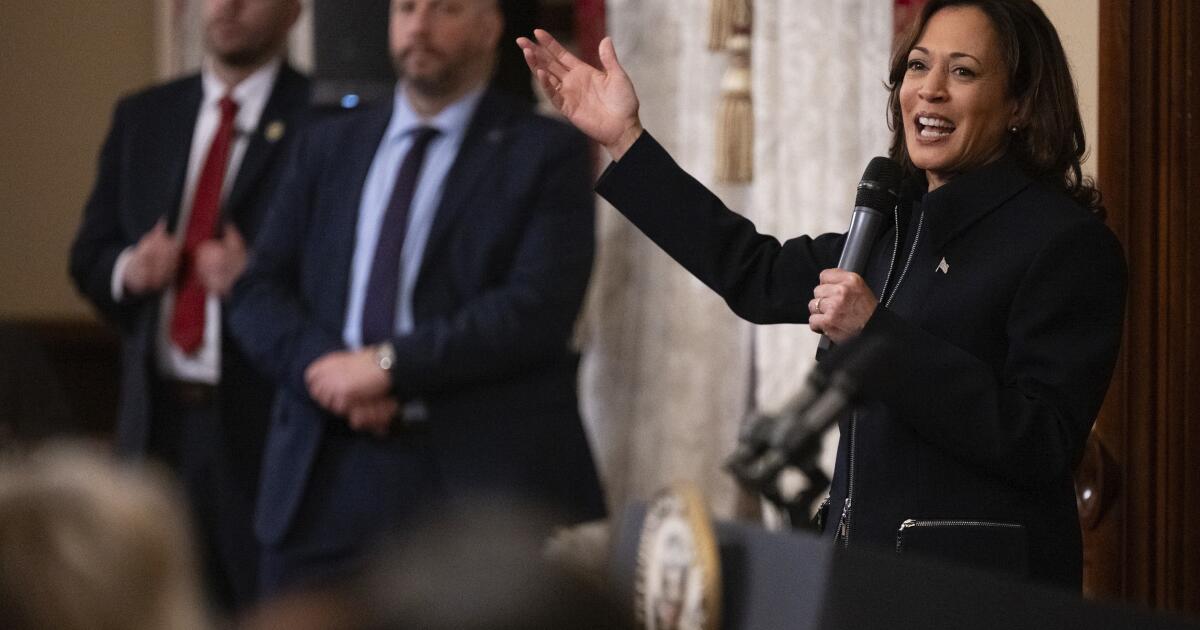
It’s too soon to know whether California’s next governor will be a woman, with the race still two years away. But Vice President Kamala Harris’ visit to Sacramento on Thursday highlighted the possibility after the nation’s first female vice president spent time with two women aiming to become California’s first female governor.
At a historic mansion near the state Capitol, Harris met with Democratic state lawmakers, where she was introduced by Senate leader Toni Atkins (D-San Diego), the first woman to hold that post. Then Harris attended a fundraiser hosted by another female first — Democratic Lt. Gov. Eleni Kounalakis, the first woman elected to that office.
Atkins and Kounalakis have already launched campaigns to run for governor in 2026 in what is expected to be a crowded field that will include at least one other woman — Betty Yee, vice chair of the California Democratic Party.
Neither of them was the focus of Harris’ visit. The vice president’s message Thursday to a friendly home-state audience was trained on rallying Democrats to reelect President Biden. She called this year’s election a “binary” choice between “a former president who openly talks about his admiration for dictators” and Biden, whose administration “is about lifting up the condition of the people.”
“The split screen could not be more stark. And the stakes could not be higher,” Harris said to donors gathered at the sprawling Sacramento home of Kounalakis’ parents, which featured marble columns, crystal chandeliers and golden candelabras.
Guests included Democratic Reps. Robert Garcia of Long Beach and Doris Matsui of Sacramento; Jodi Hicks, president of Planned Parenthood Affiliates of California; and numerous lobbyists who do business at the state Capitol. Donors were asked to give between $5,000 and $50,000 to attend, according to the invitation, and Kounalakis said the event raised $648,000 for Biden’s reelection.
Ties between the vice president and the lieutenant governor go back about 20 years, Kounalakis said, to when Harris was first elected San Francisco district attorney. Kounalakis was running her family’s home-building business at the time and routinely helped raise money for Democratic politicians.
“We started having regular lunches together… around San Francisco, and just check in on what it was like to be a woman professional, some of the challenges that we had,” Kounalakis said in an interview. “We would often compare notes on shoes and suits, and where to get the best ones.”
Kounalakis said she once set Harris up on a date, but “it was not a love match.”
California Lt. Gov. Eleni Kounalakis signing a bill into law while acting as governor in 2022 when Gov. Gavin Newsom was on vacation. State Senate leader Toni Atkins stands behind her.
(Rich Pedroncelli / Associated Press)
They remained connected as Harris’ career advanced. Kounalakis and her family donated at least $29,000 to support Harris’ campaigns for California attorney general in 2010 and 2014, campaign finance records show. When Kounalakis ran for lieutenant governor in 2018, Harris provided a critical endorsement “that built credibility for my campaign early in the race,” Kounalakis said.
Two years later, when Joe Biden was searching for a running mate, Kounalakis lobbied his campaign to choose Harris as his vice president.
“I felt that there was a lack of appreciation for her skills and her talents and her capabilities. A lot of us in California felt that way,” Kounalakis said.
She set up a Zoom meeting with Biden’s selection committee and invited elected officials and labor leaders from around California. Each one got two minutes to give a testimonial about Harris.
“Dolores Huerta’s was the most memorable to me because she stared down the selection committee and said, ‘We should be telling our daughters that being ambitious is a strength, not a weakness,’” Kounalakis recalled.
In Sacramento on Thursday, Harris described her visit as a homecoming of sorts, having spent six years working in state government as attorney general.
“She has close ties with so many members of our caucus. It was great to welcome her,” said Democratic Assembly Speaker Robert Rivas.
Harris talked to lawmakers about benefits California is getting from Biden’s initiatives, such as the federal infrastructure bill and the CHIPS and Science Act, which directs billions of dollars toward domestic semiconductor research and development, and told them that California plays an important role in pushing a Democratic policy agenda that can wind up shaping the nation.
“The message she sent was a great reminder of how important the work is that we do as a state Legislature,” Rivas said.
Republicans, unsurprisingly, saw it differently.
“Californians are worse off today because of Joe Biden and Kamala Harris,” California Republican Party Chairwoman Jessica Millan Patterson said in a statement that criticized “their disastrous policies” at the southern border, on the economy and on crime.
Atkins said she appreciated Harris talking with lawmakers about reproductive rights and abortion access, a key theme Democrats will push in races up and down the ballot in this year’s election. Harris’ reelection message was inspiring, Atkins said, and Democratic lawmakers feel a sense of pride that the nation’s first female vice president is a Californian.
What that will mean for the women seeking to break the glass ceiling in the California governor’s office remains to be seen.
“We all have these relationships,” with Harris, Atkins said. “She knows Betty Yee, she knows Eleni, she knows me.”
Atkins said “there was no jostling or jockeying” Thursday to shift Harris’ attention to California’s gubernatorial race in 2026.
“That day will come, I am sure,” she said. “But that was not today.”

Politics
Emotion and feelings: How Democratic Socialists’ congressional insurgency could come back to bite them

NEWYou can now listen to Fox News articles!
Democratic Socialists of America are on the charge, running hot off their wins in the New York Democratic primaries last week. Their victories in multiple Congressional seats – felling both Reps. Adriano Espaillat, D-N.Y., and Dan Goldman, D-N.Y. – signals that the party is ready to move on from the same old, same old.
Espaillat chaired the Congressional Hispanic Caucus. Goldman was a key House staffer during the first impeachment of President Donald Trump.
“Even Dan Goldman’s not good enough for them,” said House Judiciary Committee Chairman Jim Jordan, R-Ohio, on Fox. “That is how radical it’s become.”
Some moderate Democrats are trying to distance themselves from the left.
MAMDANI-BACKED SOCIALISTS LOOK TO TAKE NEW YORK PLAYBOOK NATIONWIDE AFTER PRIMARY VICTORIES
The left flank of the Democratic Party has surged to the top of the nation’s most hotly-contested primaries. (Michael M. Santiago/Getty Images)
“That’s not the same brand of politics that we have. We’re not those type of Democrats,” said Rep. Tom Suozzi, D-N.Y., who represents a battleground district.
“There’s a new group of Democratic Socialists who are socialists who are not commonsense Democrats. Who are not interested in getting things done. They’re interested in throwing bombs. Not actually solving problems,” said Rep. Josh Gottheimer, D-N.J.
LURCHING LEFT: MAMDANI-BACKED CANDIDATES OUST ESTABLISHMENT DEMOCRATS
Some Democrats are worried how far left candidates command more attention than those in the middle. Rep. Kristen McDonald Rivet, D-Mich., worries that the outsized attention garnered by the left sends the wrong impression to voters.
“What they don’t want is divisiveness. They don’t want screaming and yelling,” said McDonald Rivet.
Mainstream Democrats feel trapped in the middle as the left – specifically the New York City left – wields an outsized media and political megaphone.
“Those candidates would not have won in Virginia where I live,” said Rep. Suhas Subramanyam, D-Va.
Rep. Tom Suozzi, D-N.Y., is among the moderate Democrats trying to distance themselves from the party’s insurgent wing. (Nathan Posner/Anadolu via Getty Images)
Republicans believe they are primed to nationalize the midterms. Republicans can do that by highlighting the extreme views of Democratic Socialists who captured primary victories in New York City. The GOP wants to portray their opponents as veering left.
“These are board-certified communists, right?” asked Sen. Roger Marshall, R-Kan. “They want no police. They want no private property.”
President Trump capitalized on the Democratic outcomes in his home city.
“The Democrat party is in big trouble because this isn’t stopping with New York,” he forecast.
VICTORIES BY MAMDANI-BACKED CONGRESSIONAL CANDIDATES SPOTLIGHTS GROWING RIFT IN DEMOCRATIC PARTY
This shakeup has progressive leaders demanding transformation at the top.
“You’re going to see, I think, people voting for new leadership and to change their representation,” said Rep. Alexandria Ocasio-Cortez, D-N.Y.
The Democratic Party tapped Sen. Elissa Slotkin, D-Mich., to deliver their official response to President Trump’s 2025 State of the Union speech. Slotkin is a moderate who won in a battleground race in 2024 – even as the President prevailed in the Wolverine State. But during an appearance on SiriusXM, Slotkin insists on a Democratic Party management switch.
“If people can’t understand that the game has fundamentally changed and they can’t adapt, then they need to let others,” said Slotkin. “The old models do not work for people.”
House Minority Leader Hakeem Jeffries, D-N.Y., is perceived by Republicans as vulnerable after his preferred candidates failed in their congressional primaries. (Roberto Schmidt/Getty Images)
Republicans believe House Minority Leader Hakeem Jeffries, D-N.Y., is vulnerable after the DSA elected their candidates over his preferred picks in New York City.
“I think Hakeem Jeffries’ friends and neighbors gave him a big middle finger,” said House Oversight Chairman James Comer, R-Ky. “If you lose three elections in your hometown, that’s a pretty big slap in the face.”
He added that Democrats “are going further and further to the left to the point where they are full-blown, card-carrying socialists.”
And then there is the anti-Israel, anti-Jewish, and in some cases, antisemitic take by some of these candidates. Rep. Greg Landsman, D-Ohio, is a moderate Democrat from a swing district. He’s Jewish and one of the most pro-Israel Democrats in the House.
“There are some on the left who use Israel the way that some on the right use immigrants or trans kids as a way to divide. And I think it’s terrible. It’s also just not what voters want us talking about,” said Landsman.
HOUSE DEMOCRAT LASHES OUT WHEN GRILLED ON WHETHER SOCIALIST VICTORIES WOULD THREATEN DEM UNITY
Yours truly tangled with Rep. John Larson, D-Conn. – who once chaired the House Democratic Caucus. I pressed him about what the party would do about some candidates “who are too far to the left.”
“What does that mean? That’s your statement. Did the people of New York vote?” queried Larson.
I assured him that they did.
“Is that democracy?” asked Larson.
“But if some of them are antisemitic,” I countered.
“Is that a democracy?” continued Larson.
“Will you stand by people if they have antisemitic views?” I followed up.
Larson finally addressed my inquiry. His answer crystallized the schism the Democratic Party now faces.
“I’m against antisemitism, if that’s your question,” Larson declared.
Rep. John Larson, D-Conn., got into a heated exchange with Fox News’ Chad Pergram over the views of some likely members of his party’s next freshman class. (Bill Clark/CQ-Roll Call, Inc via Getty Images)
The fact that Democrats are now facing this debate robs them of valuable time on economic issues.
Landsman argued that voters would prefer candidates to stick to groceries and the price of gas.
Gottheimer echoed Landsman on kitchen table subjects.
“We should be focused on ways to actually solve problems like that. Not coming in here and using tea party tactics and trying to divide up the country and pray to socialist ideals,” said Gottheimer.
So what is the party to do?
DEMOCRACY ’26: STAY UP TO DATE WITH THE FOX NEWS ELECTION HUB
“They’re our nominees. We’re going to support them. We’re going to welcome them. They’re going to be part of our caucus and we’re going to unite behind Leader Jeffries,” said Rep. Robert Garcia, D-Calif., the top Democrat on the Oversight panel.
But that doesn’t address the fissures. It doesn’t address how voters may perceive the party. And it doesn’t establish if these new Democratic nominees will work on behalf of the party to raise money and advocate for Democrats across the board. Or, will they become professional bomb throwers – ala what the right has endured for a while.
“It’s going to be a lot harder to get things done when you get more and more extreme candidates who are here because they’re interested in political celebrity. They are interested in fighting. They’re interested in making points,” asserted Rep. Dusty Johnson, R-S.D.
Republicans have had an abysmal week themselves – President Donald Trump and Sen. Bill Cassidy, R-La., for instance, got into a shouting match over Iran. (Chip Somodevilla/Getty Images; Tyler Kaufman/Getty Images)
Republicans suffered through an absolutely abysmal week. House GOP leaders had to yank multiple bills off the floor and send lawmakers home early because of internal disputes. President Trump and Sen. Bill Cassidy, R-La., got into a shouting match about Iran. And the president even threatened to veto a bipartisan housing bill. President Trump then refused to sign the bill at the Capitol, despite his aides touting the bill and House Republicans tricking out Statuary Hall for a signing ceremony.
The President characterized the housing bill as “a yawn.”
But the Democrats’ internal fractures may have superseded any internecine fighting among Republicans.
“While it’s not been a great week for Republicans, I think it’s been a much worse week for Democrats because of these primary elections,” observed Rep. Mario Diaz-Balart, R-Fla.
CLICK HERE TO DOWNLOAD THE FOX NEWS APP
Democrats will certainly run on economic issues and capitalize on statements by the President about basic issues like housing. But will a genuine policy debate outweigh fears about progressives nationwide?
Emotion and feelings rule in politics. And it could be a problem for Democrats if Republicans appropriate what happened in New York and Xerox it onto battleground districts across the country.

Anthropic teamed up with California to get more state workers to use its artificial intelligence assistant Claude as part of an effort to leverage technology to make the government more efficient.
Gov. Gavin Newsom, who announced the partnership on Monday, said state agencies will be able to access Claude at a 50% discount. Free training and other assistance will also be available to the workers. California’s local governments will also get the same discount under the agreement.
Government workers can use Claude to draft and summarize documents, analyze information and do other tasks.
Anthropic, an AI company based in San Francisco, has a version of its AI assistant for government clients that provides more security than what it provides other consumers.
The new partnership shows how AI is playing a bigger role at work as tech companies market their tools as ways to complete tasks more quickly. Last year, San Francisco made Microsoft 365 Copilot Chat, which is powered by OpenAI’s model, available to nearly 30,000 city employees.
Still, the rise of automation at work has heightened concerns that people will lose their jobs. There are also worries that there are not yet adequate guardrails in place to mitigate data privacy and security risks.
Anthropic and the governor said that they’re focused on the responsible use of AI.
“AI should not replace the human work of government; it should help our workers move faster, solve problems more effectively, and deliver better results for Californians,” Newsom said in a statement.
The remarks didn’t appear to comfort union leaders.
“Wow. Look local government, the Gov is giving you a 50% off coupon to give up your residents’ private data, outsource your jobs to big tech. Isn’t that cool? Because California basically invented AI slop!” said Lorena Gonzalez Fletcher, president of the California Federation of Labor Unions, AFL-CIO, in a post on X.
Anthropic has faced political hurdles as it pushes to get more companies and government agencies to use its products.
Most notable, it’s sparred publicly with the Trump administration, which ordered the company to cut off foreign access to its most powerful AI systems this month.
The Trump administration cited potential national security risks, but Anthropic disagreed with the findings. Last week, tensions decreased after the U.S. government gave Anthropic permission to restore access to its AI model Mythos to certain clients.
Valued at nearly $1 trillion, Anthropic has also signaled it plans to become a publicly traded company.
California has already started using Claude more in state government to develop tools to get the public to engage more in AI policy discussions and assist state workers, the governor’s office said in its news release.
State agencies, including the Department of Motor Vehicles, are also using AI to reduce wait times and improve customer service.
“As state employees, our goal is to provide our fellow Californians with the best possible service,” Government Operations Agency Secretary Nick Maduros said in a statement. “To do that, we need to make sure our teams have access to the best modern tools, including Claude and other emerging technologies.”
Politics
DOJ launches grand jury probe into Marxist mogul Neville Roy Singham’s funding of leftist groups

NEWYou can now listen to Fox News articles!
FIRST ON FOX: A federal grand jury is investigating alleged financial crimes by Neville Roy Singham, the China-based tech tycoon whose fortune has funded a sprawling network of socialist, communist and Marxist organizations across the U.S. over the last decade.
According to sources familiar with the matter, the grand jury in Manhattan has issued subpoenas as part of a probe launched by U.S. Attorney Jay Clayton for the Southern District of New York, one of the country’s most powerful districts for federal prosecutions. Acting U.S. Attorney General Todd Blanche authorized the investigation as the Trump administration seeks to crack down on fraud, money laundering and other financial crimes in the multibillion-dollar nonprofit industry.
The grand jury action follows a Fox News Digital investigation published in mid-March, documenting how Singham pumped $285 million from his base in Shanghai into a Goldman Sachs philanthropy fund and two shell corporations that then fed the money into a constellation of nonprofit organizations, media operations and activist groups pushing sectarian division, identity politics and support for socialist politicians.
The investigation is examining the movement of the money in Singham’s financial network and attempting to determine if Singham, the organizations he funded or their leaders committed wire fraud, bank fraud, money laundering or other financial crimes, according to sources familiar with the matter.
HOUSE OF SINGHAM: READ FOX NEWS DIGITAL’S 5-PART INVESTIGATION
On Feb. 14, 2018, Jodie Evans, co-founder founder of CodePink, and Neville Roy Singham, founder of Thoughtworks, attend V20: The Red Party, a 20th anniversary celebration of V-Day and The Vagina Monologues, featuring a performance by playwright Eve Ensler and an after-party at Carnegie Hall in New York City. (Dave Kotinsky/Getty Images)
Prosecutors have presented evidence to the grand jury, which has issued subpoenas seeking bank records and other financial documents from organizations in Singham’s network. Federal prosecutors use grand jury subpoenas as an investigative tool to compel the production of documents and testimony as they determine whether sufficient evidence exists to pursue criminal charges.
Nicholas Biase, spokesman for the U.S. Attorney’s Office for the Southern District of New York, declined to comment.
Showdown with Goldman Sachs
According to sources, Treasury Secretary Scott Bessent traveled to New York City earlier this year for a meeting with Goldman Sachs Chairman and CEO David Solomon. The men discussed the role of a Goldman Sachs philanthropic arm — GS Donor Advised Philanthropy Fund For Wealth Management Inc. — that facilitated the movement by Singham of millions of dollars into a network of U.S. nonprofits.
A Treasury Department spokesman declined to comment. A person familiar with the meeting confirmed that it occurred, saying that Bessent has regular meetings with business leaders, and declined to comment further on the substance of the meeting.
At that meeting, sources said, Bessent delivered a blunt ultimatum: Goldman Sachs could face scrutiny for alleged conspiracy in the funneling of the Singham money and urged Solomon to cooperate with federal investigators.
Like many U.S. companies, Goldman Sachs has had a long business relationship with the Chinese Communist Party, with Solomon participating in a meeting, for example, on Nov. 4, 2025, with He Lifeng, a member of the Political Bureau of the Communist Party of China Central Committee and director of the Office of the Central Commission for Financial and Economic Affairs.
Solomon pledged his cooperation, according to sources.
WALL STREET BANKS HELPED CHINESE MILITARY-LINKED FIRM RAISE BILLIONS DESPITE RED FLAGS, LAWMAKERS FIND
By mid-May, with the Southern District of New York investigation in full throttle, Solomon joined a delegation of powerful American business leaders who accompanied President Donald Trump, Bessent and other administration officials to China to meet with Chinese President Xi Jinping and other leaders of the Chinese Communist Party.
On Nov. 4, 2025, He Lifeng, a member of the Political Bureau of the Communist Party of China Central Committee and director of the Office of the Central Commission for Financial and Economic Affairs, meets in Beijing with David Solomon, chairman and CEO of Goldman Sachs Group. (Cai Yang/Xinhua News Agency via Getty Images)
In a five-part investigative series published earlier this year, Fox News Digital unearthed a four-minute-13-second speech in which Singham stood on a stage at the Golden Tulip Hotel on Nov. 13, 2025, for a conference of the “Global South Academic Forum,” coincidentally just days after the Goldman Sachs’ chief was in Beijing. Tricontinental Ltd., a Singham-funded nonprofit, co-sponsored the event with academic institutions administered by the Chinese Communist Party.
On stage, Singham openly supported a “new world order” promoted by Chinese President Jinping and the Chinese Communist Party. During the speech, he called the United States a “fascist” nation, echoing the propaganda of the Chinese Communist Party now also parroted on the streets by communist, socialist and Democratic Party activists.
WATCH THE NOVEMBER 2025 SINGHAM SPEECH:
The series revealed a 172-page report in which Singham outlined his theory of change, invoking 20th century Chinese communist leader Mao Zedong’s battle plan to wage a “people’s war” to spread communism. Mao was inspired by communist leaders Karl Marx and Vladimir Lenin.
LAWMAKERS RAISE ALARM OVER NEVILLE ROY SINGHAM’S $278M NETWORK SPREADING CCP PROPAGANDA IN THE U.S.
Singham’s rise as a global political financier accelerated after his February 2017 marriage to Jodie Evans, the co-founder of Code Pink, a far-left activist group that has aligned itself with authoritarian regimes including the Islamic Republic of Iran, the Communist Party of Cuba and the Chinese Communist Party. According to sources, Evans is also a target of the investigation, emerging as a board member in the U.S. on many of the organizations that Singham funded.
That same year, Singham sold his company, ThoughtWorks, for an estimated $785 million to a London-based private equity firm, Apax Partners. A spokeswoman for Apax Partners said the company wouldn’t disclose the names of the investors who pumped money into that sale, but sources told Fox News Digital that federal investigators are looking for potential ties to the Chinese Communist Party.
After that sale, Fox News Digital found, Singham began directing large sums of money into a network of organizations that now form part of a broader activist infrastructure in the United States and abroad.
In its investigation, Fox News Digital mapped 223 transactions from 2017 through 2025 that moved $591 million across five continents through 67 core groups in the Singham network. They partner with hundreds of groups worldwide, resulting in a network of about 2,000 groups, amplifying anti-U.S., pro-China messages.
Of that money, Fox News Digital established a documented $278 million flowed directly from Singham into organizations that “sow discord” in the U.S., as House Ways and Means Chair Jason Smith put it earlier this year at a hearing a dynamics called “foreign malign influence.”
Following the Money
In money-laundering investigations, prosecutors typically examine three stages of alleged impropriety called “placement,” “layering” and “integration.” Placement refers to the introduction of funds into the financial system. Layering involves moving money through multiple entities or transactions to allegedly obscure its origin. Integration is the point at which the money reemerges as apparently legitimate funding, grants, payments or organizational support.
Step 1: Alleged Placement
Singham allegedly funneled $278 million from Shanghai into the United States through three key channels — the philanthropic arm of Goldman Sachs and two shell corporations that have since gone defunct.
- $164,040,000 to Mutod LLC, a now-defunct shell corporation established in 2017, based in Chicago.
- $110,376,701 to GS Donor Advised Philanthropy Fund For Wealth Management Inc., a philanthropy arm of Goldman Sachs, based in New York City.
- $3,500,000 to Likewise Conceptions LLC, a now-defunct shell corporation established in 2017, based in Crystal Lake, Ill.
Step. 2: Alleged Layering
The three entities then pumped the $278 million into six nonprofits:
- $167,540,000 to People’s Support Foundation Ltd., a 501(c)(3) nonprofit established with a hotel address in 2017 in Chicago and Singham’s wife, Evans, on the board.
- $68,748,701 to Justice and Education Fund Inc., a 501(c)(3) established with a UPS Store address in 2018 in New York City with self-avowed communists, including Manola De Los Santos, on the board.
- $22,440,000 to People’s Forum Inc., a 501(c)(3) established in 2017 on W. 37th Street in New York City with Evans and De Los Santos on the board.
- $16,760,000 to Tricontinental Ltd., a 501(c)(3) established in North Hampton, Mass., in 2017 by Singham friend and fellow Marxist ideologue Vijay Prashad.
- $1,330,000 to CodePink Women For Peace, a 501(c)(3) established in 2009 in Marina Del Ray, Calif., by Singham’s wife, Evans, and her friend, Susan Medea Benjamin.
- $1,098,000 to Breakthrough BT Media Inc., a 501(c)(3) established in New York City in 2020 at the People’s Forum headquarters with longtime American communist leader Brian Becker’s son, Ben Becker, as editor-in-chief of its pro-communist propaganda outlet, Breakthrough News.
Step 3: Alleged Integration
The six nonprofits then funneled at least $223 million and other forms of support into a global network of organizations including:
- People’s Welfare Association, a 501(c)(4) established in 2019 with the address of a UPS store in Madison, Wisc., today reporting about $12 million in revenues transformed into grants to undisclosed groups around the world.
- Countless unidentified organizations in six regions around the world, including Subsaharan Africa, Central America and even North America, receiving tens of millions of dollars.
- The ANSWER Coalition, a communist organization whose Chicago address has been listed as the location of the Green Mill Restaurant, a regular haunt for 20th century gangster Al Capone, whom federal prosecutor Elliott Ness prosecuted and convicted for tax evasion.
- The Party for Socialism and Liberation, a loosely-structured organization with shared leadership from the House of Singham, like the Becker father-son duo.
FLASHBACK: INSIDE THE POLITICAL MOVEMENT THAT PUT A SOCIALIST IN CHARGE OF NEW YORK CITY
Socialist New York congressional nominees Darializa Avila Chevalier (L), Claire Valdez (C) and Brad Lander. (Michael M. Santiago/Getty Images; Michael Nagle/Bloomberg via Getty Images; Adam Gray/Bloomberg via Getty Images)
Singham and Evans haven’t responded to repeated requests for comment from Fox News Digital. In January, Becker and De Los Santos refused to respond to questions by Fox News Digital outside the People’s Forum headquarters. Benjamin refused to respond to questions during a protest in May.
The ANSWER Coalition, Breakthrough BT Media Inc., CodePink Women for Peace, Justice and Education Fund Inc., Party for Socialism and Liberation, People’s Forum Inc., People’s Welfare Association and Tricontinental Ltd. also haven’t responded to repeated requests for comment. Representatives for Mutod Ltd. and Likewise Conceptions LLC couldn’t be located.
CLICK HERE TO DOWNLOAD THE FOX NEWS APP
-

 Technology7 minutes ago
T-Mobile is booting customers from its oldest plans
-

 World12 minutes ago
Gunman kills 6 at youth welfare facility in suspected child custody dispute: reports
-

 Politics19 minutes ago
Emotion and feelings: How Democratic Socialists’ congressional insurgency could come back to bite them
-

 Health22 minutes ago
Rare tick-borne virus turns deadly fast as US cases reach record high, experts warn
-

 Sports27 minutes ago
Lions release Terrion Arnold after bond set at $1 million in armed robbery, kidnapping case
-

 Technology34 minutes ago
Texas data breach hits 3M license customers
-
 Business37 minutes ago
Rocket Lab enters satellite communications market with $8-billion deal
-
 Entertainment42 minutes ago
Jesús Ortiz Paz and Jimmy Humilde took their legal dispute to Instagram. Here’s the breakdown

