Politics
Supreme Court rules against Los Angeles couple denied visa in part over husband's tattoos

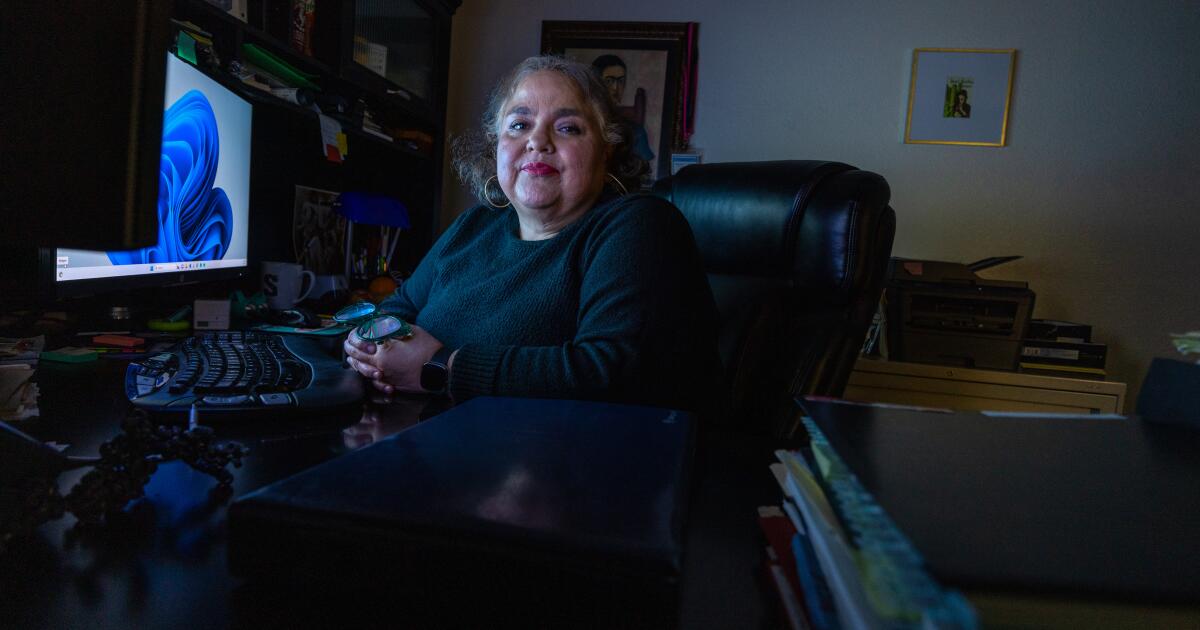
The Supreme Court on Friday ruled 6-3 against a Los Angeles woman who argued her constitutional rights were violated when the federal government denied a visa to her Salvadoran husband, in part because they viewed his tattoos as gang-related.
The broad ruling is a major setback for Americans with foreign spouses because it explicitly rejects the idea that a citizen has a constitutional right to attempt to bring their noncitizen spouse into the country.
The majority, led by Justice Amy Coney Barrett, said that while the plaintiff, L.A. civil rights attorney Sandra Muñoz, does have a fundamental right to marriage, she failed to establish that right extends to living with her husband in the U.S.
“In fact, Congress’s longstanding regulation of spousal immigration — including through bars on admissibility — cuts the other way,” Barrett said, concluding that “a citizen does not have a fundamental liberty interest in her noncitizen spouse being admitted to the country.”
Luis Asencio Cordero, who lived in the U.S. until 2015, has been separated from Muñoz since his visa was denied during a consular interview in El Salvador.
The couple sought to file a new visa application with evidence refuting his alleged membership in the MS-13 gang, and wanting assurance that the federal government would review it.
The government said it denied the visa due to concerns that Asencio Cordero would be likely to engage in unlawful activity if he were allowed back into the U.S.
Muñoz argued the government violated her rights to marriage and due process by failing to provide a timely explanation for her husband’s visa denial. After the couple sued, they learned through their lawsuit that the government believed he was an MS-13 gang member, based on his tattoos, an interview and a background check including “confidential law enforcement information.” Asencio Cordero had no criminal history in the U.S. or in El Salvador.
Asencio Cordero’s tattoos depict the comedy and tragedy theater masks, La Virgen de Guadalupe and a tribal design with a paw print. He denies they are affiliated with a gang, and a court-approved gang expert agreed.
A long-established judicial policy — the doctrine of consular nonreviewability — prevents court reviews of visa determinations except in limited cases.
The 9th Circuit Court of Appeals ruled in favor of the couple in 2022. The Biden administration asked the Supreme Court to reverse the ruling, arguing that because Muñoz and Asencio Cordero could choose to live outside the U.S., her right to marriage has not been violated.
Immigration officers have broad discretion about whom to admit into the country, administration lawyers said. They also said that requiring the government to disclose specific details about the evidence and intelligence used in such decisions would slow processing, pose a risk to public safety and could chill future information-sharing with foreign partners.
But the dispute over tattoos and what role they played in Munoz’s denial was not at issue. Instead, the majority agreed with the State Department’s concern that Muñoz’s claims could have “unsettling collateral consequences.” They questioned whether a wife could then challenge her husband’s assignment to a remote prison or overseas military deployment, or whether a citizen could challenge their immigrant spouse’s deportation proceedings.
Muñoz’s position would “usher in a new strain of constitutional law,” Barrett wrote, because the Constitution doesn’t prevent the government from taking actions that indirectly burden a citizen’s legal rights.
Barrett wrote that while Congress can use its authority over immigration to prioritize family unity, that is “a matter of legislative grace.” She said the 9th Circuit Court based in San Francisco stood alone in having embraced that as an “asserted right.”
“Muñoz has suffered harm from the denial of Asencio-Cordero’s visa application, but that harm does not give her a constitutional right to participate in his consular process,” Barrett said.
Justices Sonia Sotomayor, Elena Kagan and Ketanji Brown Jackson dissented. Writing for the dissent, Sotomayor said the majority’s fear that the case could result in a slippery slope of constitutional challenges is groundless.
Sotomayor said she agreed with Justice Neil M. Gorsuch, who wrote in an opinion concurring with the majority that because the factual basis for the government’s denial of Asencio Cordero’s visa has been revealed, Muñoz has already received the process she was due.
“There is no question that excluding a citizen’s spouse burdens her right to marriage, and that burden requires the Government to provide at least a factual basis for its decision,” Sotomayor wrote.
That simple resolution should have ended the case, Sotomayor said, but instead “the majority swings for the fences,” limits the court’s longstanding precedent about the fundamental right to marriage, “and gravely undervalues the right to marriage in the immigration context.”
Just because a married couple could move their home elsewhere does not suddenly remove the burden on their constitutional rights for not being able to live together in the U.S., Sotomayor wrote. She cited Loving vs. Virginia, which struck down state laws banning interracial marriage.
The court “did not tell Richard and Mildred Loving to stay in the District of Columbia,” she said. “It upheld their ability to exercise their right to marriage wherever they sought to make their home.”
Sotomayor continued: “The majority’s holding will also extend to those couples who… depend on American law for their marriages’ validity. Same-sex couples may be forced to relocate to countries that do not recognize same-sex marriage, or even those that criminalize homosexuality.”
Immigrant advocates slammed the decision, calling it another form of family separation.
The National Immigrant Justice Center said the decision will make litigation by families in similar situations all but impossible moving forward. So, while Muñoz and Asencio Cordero eventually got a basic explanation for his visa denial, others might never access such information.
The couple’s attorney Eric Lee said he worries the decision opens the door to justifying the dismantling of other rights that are not explicitly spelled out in the Constitution, such as gay marriage.
“It’s hard to overstate how dangerous this decision is not only for our clients and for similarly situated mixed immigration families,” Lee said. “It sets the stage for taking the country back to a very dark period in its history.”
Separately this week, President Biden announced an executive order to protect immigrant spouses of U.S. citizens who have lived consecutively in the country for at least a decade. At the White House on Tuesday, Biden said it’s the right thing to do.
“There’s already a system in place for people we’re talking about today,” Biden said. “But the process is cumbersome, risky, and it separates families. From the current process, undocumented spouses of U.S. citizens must go back to their home country… to obtain long-term legal status. They have to leave their families in America, with no assurance they’ll be allowed back in the United States.”
Had he never left the country, Asencio Cordero could have qualified for protections. For Lee, the announcement was bittersweet. He implored Biden to extend similar protections to families who are already separated because of such visa denials.
“We hope the new relief applies to as many families as possible,” Lee said, “but it is hard not to ask: If these are the new criteria, then why did the administration fight Sandra and Luis’ case as hard as they did for so many years?”
Times staff writer David G. Savage contributed to this report.

Politics
Police rush to SCOTUS justice’s home amid rising threats against conservatives — but report quickly unravels

NEWYou can now listen to Fox News articles!
Police responded to a “swatting call” at the residence of Supreme Court Justice Amy Coney Barrett in Virginia on Wednesday evening, police confirmed, marking the latest security scare involving a conservative public figure.
“Yesterday evening at approximately 9:02 p.m., officers responded to a swatting call at the residence of U.S. Supreme Court Justice in Fairfax County,” a Fairfax County Police Department public information officer told Fox News Digital on Thursday when asked about reports concerning the incident at Coney Barrett’s home.
Fairfax police responded to Barrett’s home after they received a call through the department’s non-emergency line, then met with the justice’s security detail, who confirmed the report was “fictitious,” the officer told Fox News Digital.
The incident comes amid years of heightened threats against Supreme Court justices, including protests outside conservative justices’ homes after the leaked Dobbs draft opinion in 2022 showing the court was poised to overturn Roe v. Wade, and the arrest near Justice Brett Kavanaugh’s home of a California man who was later charged with attempted murder.
FBI INVESTIGATING RISE IN SWATTING INCIDENTS AFTER SEVERAL CONSERVATIVES TARGETED, KASH PATEL SAYS
Supreme Court Justice Amy Coney Barrett was targeted in a swatting incident at home Wednesday evening. (Jabin Botsford/The Washington Post via Getty Images)
“Officers immediately coordinated with Supreme Court Police personnel assigned to the residence and quickly determined that the report was fictitious. No additional police resources were utilized,” the police department said.
Swatting calls target an individual by calling in a false police report for crimes — such as a murder, a hostage situation, bomb threats or active shooters that would require a greater law enforcement response — to the home of the target.
A partial audio recording of the police audio surfaced on X on Thursday that reported a “call came in for sounds of gunshots.” Law enforcement can be heard saying there was a “suspicious noise” at a 24-hour security coverage for a “high-priority resident” of the county.
FROM RALLY GUNFIRE TO WHITE HOUSE SHOOTING, THREATS AGAINST PRESIDENT TRUMP CONTINUE TO MOUNT
Barrett was on the bench Thursday morning alongside her colleagues, and read aloud summaries of two opinions she authored. Barrett made no mention of the Wednesday incident in her bench remarks.
“Swatting is an attempt to get an innocent person killed—in this case, a sitting Supreme Court Justice,” posted Republican Utah Sen, Mike Lee on X as reports of the incident surfaced Thursday. “The proper response will be putting the offender in prison for many, many years.”
Police officers watch abortion-rights advocates demonstrate outside Supreme Court Justice Brett Kavanaugh’s home in Chevy Chase, Md., on May 18, 2022. (Bonnie Cash/Getty Images)
MIKE DAVIS: THE SUPREME COURT BETRAYED AGAIN — THIS TIME FROM THE BENCH
The leaked Dobbs draft opinion became a lightning rod for protests, with abortion-rights activists demonstrating outside the homes of Barrett, Kavanaugh and other members of the court’s conservative majority.
In June 2022, Californian Nicholas John Roske was charged with attempted murder for making violent threats against Kavanaugh while carrying a gun, knife and pepper spray near the justice’s home. He was later sentenced to eight years behind bars.
Attacks on conservative leaders have been on the rise, most recently targeting the commander in chief, including just in April at the White House Correspondents’ Association Dinner.
Protesters gathered near the home of Justice Barrett. (Fox News)
There were two public assassination attempts on Trump’s life in 2024, beginning in Butler, Pennsylvania, where a bullet grazed his ear after a gunman climbed onto a roof during a rally on July 13, 2024.
Earlier this month, a California Army veteran known for his display of “Make America Great Again” memorabilia and American flags outside his residence, dubbed the “Trump House,” was attacked and beaten to death.
CLICK HERE TO DOWNLOAD THE FOX NEWS APP
Fox News Digital reached out to the Supreme Court for comment.
Fox News’ Bill Mears contributed to this report.
Politics
Bari Weiss shakes up ‘60 Minutes’ with a new executive producer; Cecilia Vega and Sharyn Alfonsi exit

The venerable news magazine “60 Minutes” is undergoing a major overhaul under CBS News Editor in Chief Bari Weiss, who hired a new executive producer and ousted two correspondents.
Weiss announced Thursday the appointment of a new executive producer to replace Tanya Simon, a 26-year veteran of the program who took over the top job in July. She will be replaced by Nick Bilton, a former New York Times technology columnist and documentary filmmaker.
Weiss also fired “60 Minutes” correspondents Sharyn Alfonsi, who clashed with her boss over a segment on President Trump’s immigration policies, and Cecilia Vega, who joined the program in 2023.
Bilton will be the first executive producer in the 58-year history of “60 Minutes” to come from outside the tightly-knit organization. The program has only had four leaders in its history — Don Hewitt, Jeff Fager, Bill Owens and Simon — all of whom came up through the ranks of CBS News.
Weiss is said to have developed a solid relationship with Simon, whose late father Bob Simon was a highly respected correspondent for the program. But the connection apparently deteriorated after Weiss did not receive advance notice of Anderson Cooper’s sign-off from the program, ending his nearly 20-year run as a correspondent.
Cooper, who is also a full-time anchor at CNN, turned down a new “60 Minutes” deal from Weiss. During his final appearance, he expressed fears about the editorial independence of the program.
Tanya Simon is being replaced as executive producer of “60 Minutes.”
(Michele Crowe / CBS News)
“Things can always evolve and change, and I think that’s awesome, and things should evolve and change, but I hope the core of what ’60 Minutes’ is always remains,” Anderson told viewers. “I think the independence of ’60 Minutes’ has been critical.”
Speculation over changes at “60 Minutes,” the most-watched news program on television for 52 consecutive years, have been swirling for months since Paramount Chief Executive David Ellison installed Weiss to oversee editorial content at CBS News.
The program has been in turmoil since October 2024, when President Trump filed a $20-billion lawsuit against CBS over an interview conducted with then-Vice President Kamala Harris. That suit was settled to clear the regulatory path for Skydance Media’s acquisition of Paramount.
But from a business standpoint, “60 Minutes” is a curious target for a revamp. The program is one of the most profitable hours on the CBS prime-time schedule while retaining its status as television’s most prestigious journalism operation. While the ratings for “60 Minutes” get a boost from a lead-in from high-rated NFL late-afternoon games, it remains one of the few network shows that viewers make an appointment to watch.
The segment that doomed Alfonsi, “Inside CECOT,” detailed the Trump administration’s treatment of hundreds of Venezuelan migrants who were deported to an El Salvador prison known for its harsh conditions. The segment was scheduled to run Dec. 21 but was pulled the day before air by Weiss, who believed it needed more reporting, including a direct response from the administration, which did not participate.
Alfonsi, the “60 Minutes” correspondent who worked for months on the piece, protested the move by Weiss, calling it politically motivated in an email she sent to colleagues.
The story eventually ran on Jan. 18 without any substantial changes to its tone or reporting. Weiss acknowledged internally that pulling the segment after it had already been promoted was a mistake.
But Alfonsi said publicly that she fully expected to be let go from the program. Her contract ended with the recently concluded TV season.
Alfonsi first joined as a correspondent by CBS News in 2002. She left for ABC News in 2008 but returned to CBS in 2013 and joined the flagship edition of “60 Minutes” in 2015.
Politics
RFK Jr. responds to snake-handling critics with new video showing him wrangling a venomous rattlesnake

NEWYou can now listen to Fox News articles!
Health and Human Services Secretary Robert F. Kennedy Jr. shared another snake-handling video Wednesday after social media users raised concerns over his earlier encounter with a pair of black racer snakes.
Kennedy Jr. posted an Instagram video captioned, “In response to the many comments about venomous snakes, this video shows how Cheryl and I handled a recent rattlesnake rescue.”
The clip begins with Kennedy Jr. sitting in his home office before someone alerts him to a snake in the driveway.
“Hold on, guys. I’ll be back in a flash,” he says before grabbing a bucket and a small net and heading outside.
RFK JR BAREHANDS A PAIR OF SNAKES ON DR. OZ’S PATIO IN WILD VIDEO
RFK Jr. wrangles a Western Diamondback rattlesnake during a rescue video shared to Instagram Wednesday. (Instagram/RFKJr.)
The HHS secretary then carefully scoops up the rattlesnake as onlookers react in amazement.
After placing the snake in a bucket, Kennedy Jr. later pins it behind the head and lifts it toward the camera while explaining how to identify the reptile.
“His fangs are in there. I don’t want to touch them,” he said. “This is a beautiful snake. This is a Western Diamondback. You can tell by these rings at the end of his tail.”
Kennedy Jr. then asked his wife, actress Cheryl Hines, to bring him a pillowcase before transporting and releasing the snake back into the wild.
ACTRESS CHERYL HINES CLASHES WITH ‘THE VIEW’ OVER HER HUSBAND RFK JR’S RECORD SERVING AMERICANS
Health and Human Services (HHS) Secretary Robert F. Kennedy Jr. proudly displays a pair of black North American racer snakes he caught on Dr. Oz’s patio. (Robert F. Kennedy Jr.)
The Instagram post appeared to respond directly to criticism and concern sparked by another snake video Kennedy Jr. shared Tuesday on X.
In that clip, Kennedy Jr. grabbed two black North American racer snakes with his bare hands while visiting Dr. Mehmet Oz’s patio as Hines watched in apparent horror.
“Honey, honey … why?” Hines yelled as Kennedy Jr. cornered the snakes.
Kennedy Jr. then lunged at the reptiles and eventually lifted both by their tails as they repeatedly bit his hands.
CHERYL HINES SHARES HARROWING EVACUATION FROM WHITE HOUSE CORRESPONDENTS’ DINNER AS GUNSHOTS RANG OUT
U.S. Secretary of Health and Human Services Robert F. Kennedy Jr. and Cheryl Hines attend the 2026 White House Correspondents’ Dinner at the Washington Hilton in Washington, D.C., on April 25, 2026. (Taylor Hill/WireImage)
“Black snakes, they’re biting me,” Kennedy Jr. said with a smile.
The snakes continued striking at his hands as Hines pleaded, “Bobby, please! Bobby, Bobby, please,” before later telling him, “You are nuts.”
Kennedy Jr. later posted the video to X with the caption, “Cheryl cheerleads the removal of a pair of Black Racers from Dr Oz’s patio.”
According to the Florida Museum of Natural History, black racer snakes are nonvenomous and generally harmless to humans, though they will “readily bite to defend themselves.”
CLICK HERE TO DOWNLOAD THE FOX NEWS APP
The earlier video showed Kennedy Jr. handling nonvenomous snakes, while Wednesday’s Instagram clip focused on a venomous Western Diamondback rattlesnake, prompting some social media users to question whether the HHS secretary was taking unnecessary risks.
Fox News Digital’s Robert McGreevy contributed to this report.
-

 Culture8 minutes ago
Finding Wisdom in a Poem by Wendy Cope
-
 Lifestyle14 minutes ago
‘Look to your elders’: Alfre Woodard shares her secret to Hollywood longevity
-

 Technology26 minutes ago
Nintendo’s newest WarioWare is a weirdo smartphone app
-

 World32 minutes ago
Putin lands $16.5B nuclear win on Russia’s doorstep in massive Kazakhstan pact: reports
-

 Politics38 minutes ago
Police rush to SCOTUS justice’s home amid rising threats against conservatives — but report quickly unravels
-

 Health44 minutes ago
What to know about thyroid cancer prognosis following Pam Bondi’s diagnosis
-

 Sports50 minutes ago
Massimiliano Allegri Signs Two-Year Napoli Contract To Replace Antonio Conte
-

 Technology56 minutes ago
Fox News AI Newsletter: Chatbots’ left-wing bias

