Politics
Speaker Johnson launches bipartisan artificial intelligence ‘task force’


House Speaker Mike Johnson is putting together a formal “task force” to explore how the U.S. can stay competitive in the artificial intelligence (AI) sphere while also managing the rapidly evolving technology’s risks.
“Because advancements in artificial intelligence have the potential to rapidly transform our economy and our society, it is important for Congress to work in a bipartisan manner to understand and plan for both the promises and the complexities of this transformative technology,” Johnson, R-La., said in a Monday morning statement.
The new project is bipartisan, having been the product of discussions between Johnson and House Democratic Leader Hakeem Jeffries, D-N.Y.
HOW AI COULD MANIPULATE VOTERS AND UNDERMINE ELECTIONS THREATENING DEMOCRACY
House Speaker Mike Johnson is launching a new task force for Congress to study AI. (Photo by Kent Nishimura/Getty Images)
Johnson said the task force would be made up of House lawmakers who have “AI expertise and represent the relevant committees of jurisdiction.”
“Congress has a responsibility to facilitate the promising breakthroughs that artificial intelligence can bring to fruition and ensure that everyday Americans benefit from these advancements in an equitable manner,” Jeffries said. “The rise of artificial intelligence also presents a unique set of challenges and certain guardrails must be put in place to protect the American people.”
The group’s co-chairs are members who have been some of the most vocal about AI – Rep. Jay Obernolte, R-Calif., the oversight subcommittee chairman of the House Committee on Science, Space and Technology, and Rep. Ted Lieu, D-Calif., who sits on the House Judiciary Committee’s internet subcommittee.
WHAT IS ARTIFICIAL INTELLIGENCE (AI)?
House Democratic Leader Hakeem Jeffries co-led the effort alongside House Speaker Mike Johnson. (Getty Images)
Both Obernolte and Lieu are also members of the House’s AI Caucus.
Johnson has not yet laid out a clear strategy on how he wants to handle AI, but he has taken strides to wrap his head around the issue since taking the speaker’s gavel in October. That included a meeting with OpenAI CEO Sam Altman last month, after which Johnson told reporters they “talked about where we are with regard to the approach of Congress to AI.”
However, as Congress continues to learn about AI, there appears to be little movement – or agreement – in the legislative sphere.
OPINION: HERE’S HOW AI WILL DRIVE HEALTH CARE TO MEET CONSUMER EXPECTATIONS
Senate Majority Leader Chuck Schumer announced an AI framework last year, but little public progress has been made. (MANDEL NGAN/AFP via Getty Images)
A flurry of bills touching on AI issues like deepfakes and intellectual property rights have been introduced over the last year, but none have made it to the House floor for a vote.
In the Senate, Majority Leader Chuck Schumer’s promised AI legislative framework has made little public advancement beyond its announcement late last year.
There is also still disagreement within Congress about whether to even regulate AI at this stage, or whether regulatory burdens could stifle U.S. innovation in that sphere.



Politics
Campus Radicals Newsletter: Teacher who lost job over 2-word post breaks silence, Chicago ‘racial segregation’

Students walk to A. N. Pritzker elementary school (Scott Olson/Getty Images)
NEWYou can now listen to Fox News articles!
DEI EXPOSED: Illinois district where faculty celebrated Charlie Kirk’s death exposed over racial ‘segregation’ plan
ART AXED: University of North Texas cancels exhibit featuring anti-ICE art
CAMPUS CAUTION: Illinois university moves classes online after learning ICE is operating in the same building
SIGN UP TO GET THE CAMPUS RADICALS NEWSLETTER
Early morning fog surrounds a pond on a cold, snowy day on the Virginia Tech campus. (L) Photo of Virginia Tech professor Onwubiko Agozino taken on an unknown date. (istock; Virginia Tech)
ALLEGATIONS DISMISSED: White teens cleared of hate crime allegations levied by Black Virginia Tech professor
BOOK BATTLE: Nashville teacher allegedly threatened with termination for refusing to read LGBTQ book to first graders
DEPORTATION DENIED: Palestinian activist accused of expressing desire to ‘kill Jews’ wins deportation case
FACULTY REVOLT: Columbia pulls promotion for DHS career expo after faculty claims university is aiding ‘authoritarianism’
Harvard University is offering an “Immigrant Justice Lab” history course that allows undergraduates to earn credit by conducting research and writing for asylum applicants in partnership with a nonprofit legal group. (Sophie Park/Bloomberg)
HARVARD ACTIVISM: Harvard students earn course credit helping asylum seekers as critics calls school ‘bastion of woke activism’
CAREER DERAILED: Chicago-area teacher breaks silence after losing job over 2-word Facebook post supporting ICE: ‘Devastating’
TPUSA CONTROVERSY: Maryland woman says TPUSA high school event raised ‘serious concerns,’ says Child Protective Services notified
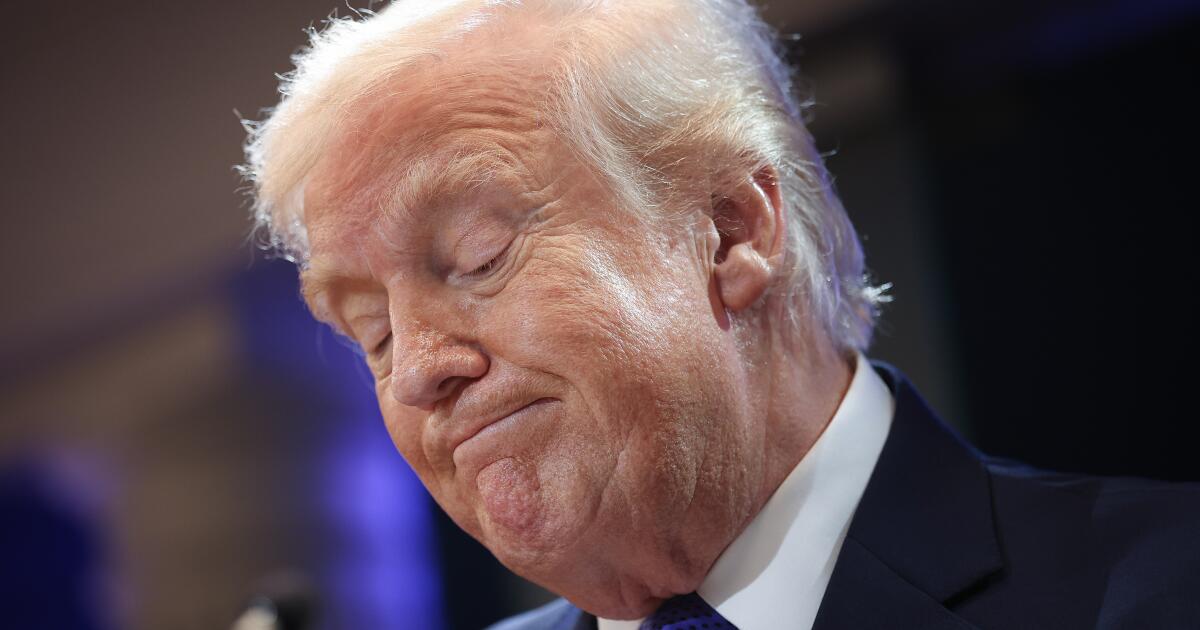
WASHINGTON — President Trump on Friday lashed out at Supreme Court justices who struck down a key part of his tariffs agenda, calling them “fools” who made a “terrible, defective decision” that he plans to circumvent by imposing new levies in a different way.
In a defiant appearance at the White House, Trump told reporters that his administration will impose new tariffs by using alternative legal means. He cast the ruling as a technical, not permanent, setback for his trade policy, insisting that the “end result is going to get us more money.”
The president late Friday signed an executive order imposing a new 10% tariff, citing a 1974 law. Under that law, the tariffs can last for only 150 days. An extension would require congressional approval.
Asked by a reporter whether he planned to issue the 10% global tariffs for 150 days or indefinitely, Trump said: “We have a right to do pretty much what we want to do.”
The sharp response underscores how central tariffs have been to Trump’s economic and political identity. He portrayed the ruling as another example of institutional resistance to his “America First” agenda and pledged to continue fighting to hold on to his trade authority despite the ruling from the nation’s highest court.
Trump said the ruling was “deeply disappointing” and called the justices who voted against his policy — including Justices Neil M. Gorsuch and Amy Coney Barrett, whom he nominated to the court — “fools,” “lapdogs” and a “disgrace to our nation.”
“I am ashamed of certain members of the court,” Trump told reporters. “Absolutely ashamed for not having the courage to do what’s right for our country.”
In a social media post, the president wrote that he believed the court opinion has been “swayed by Foreign Interests and a Political Movement,” though he did not provide any evidence for those claims.
“This was an important case to me, more as a symbol of Economic and National Security, than anything else,” Trump lamented in the post.
For years, Trump has insisted his tariffs policy is making the United States wealthier and giving his administration leverage to force better trade deals, even though the economic burden has mostly fallen on U.S. companies and consumers. On the campaign trail, he has turned to them again and again, casting sweeping levies as the economic engine for his administration’s second-term agenda.
Now, in the heat of an election year, the court’s decision scrambles that message.
The ruling from the nation’s highest court is a rude awakening for Trump at a time when his trade policies have already caused fractures among some Republicans and public polling shows a majority of Americans are increasingly concerned with the state of the economy.
But some of his top advisors maintain that his trade agenda, as promised, will continue in a different iteration.
“Despite the misplaced gloating from Democrats, ill-informed media outlets, and the very people who gutted our industrial base, the court did not rule against President Trump’s tariffs,” Treasury Secretary Scott Bessent said in a speech in Texas shortly after the ruling was issued.
Bessent said the court has simply ruled he could not impose levies on imports under the International Emergency Economic Powers Act, or IEEPA.
Ahead of the November elections, Republicans have urged Trump to stay focused on an economic message to help them keep control of Congress. The president tried to do that on Thursday, telling a crowd in northwest Georgia that “without tariffs, this country would be in so much trouble.”
As Trump attacked the court, Democrats across the country celebrated the ruling — with some arguing there should be a mechanism in place to allow Americans to recoup money lost through the president’s trade policy.
“No Supreme Court decision can undo the massive damage that Trump’s chaotic tariffs have caused,” Sen. Elizabeth Warren (D-Mass.) wrote in a post on X. “The American people paid for these tariffs and the American people should get their money back.”
California Gov. Gavin Newsom called the tariffs an illegal tax on consumers, ranchers and farmers and businesses, and said Trump is obligated to refund the $1,750 per family to make up for the cost increases driven by the tariffs.
“The rule of law won out,” Newsom said. “And what did Donald Trump do? He had a tantrum today, and he decided to tax you all again, across the board, 10% across the board, under some new authority. He’s unhinged.”
California Atty. General Rob Bonta said the ruling ends “months of chaos” that hurt farmers, manufacturers and other businesses in California.
While the Supreme Court ruling Friday centered on a lawsuit brought by a private party, Bonta and Newsom brought a separate lawsuit last year challenging the tariffs.
California’s large economy meant that the state bore the brunt of the unlawful tariffs, Bonta said, adding that it faced projected losses of more than $25 billion.
The president’s signature economic policy has long languished in the polls, and by a wide margin. Six in 10 Americans surveyed in a Pew Research poll this month said they do not support the tariff increases. Of that group, about 40% strongly disapproved. Just 37% surveyed said they supported the measures — 13% of whom expressed strong approval.
A majority of voters have opposed the policy since April, when Trump unveiled the far-reaching trade agenda, according to Pew.
The court decision lands as more than a policy setback to Trump’ s economic agenda.
It is also a rebuke of the governing style embraced by the president that has often treated Congress less as a partner and more as a body that can be bypassed by executive authority.
Trump has long tested the bounds of his executive authority, particularly on foreign policy, where he has heavily leaned on emergency and national security powers to impose tariffs and acts of war without congressional approval. In the court ruling, even some of his allies drew a bright line through that approach.
Gorsuch sided with the court’s liberals in striking down the tariffs policy. He wrote that while “it can be tempting to bypass Congress when some pressing problems arise,” the legislative branch should be taken into account with major policies, particularly those involving taxes and tariffs.
Despite the court ruling, Trump remained adamant that his trade policies will remain in effect. But now he is pivoting to plan B.
The strategy would allow the White House to impose tariffs up to 15% for 150 days on countries with a trade deficit with the U.S., according to legal analysts. He also invoked a section of the Trade Act of 1930, which could allow for additional levies of up to 50% with no time limit on countries that Trump deems has discriminated against U.S. trade or commerce.
“This means that Trump’s tariffs will continue to burden the U.S. economy, even if alternative instruments are not as agile or broad as the IEEPA tariffs,” UCLA economist Kimberly Clausing said in a statement.
The president argued that the court ruling will make his trade policies stronger.
“Now the court has given me the unquestioned right to ban all sort of things from coming into our country, to destroy foreign countries,” Trump said, as he lamented the court constraining his ability to “charge a fee.”
“How crazy is that?” Trump said.
Times staff writers Dakota Smith and Phil Willon contributed to this report.

NEWYou can now listen to Fox News articles!
The Pentagon is deploying USS Gerald R. Ford to the Middle East, creating a rare two-carrier presence in the region as tensions with Iran rise and questions swirl about possible U.S. military action.
The Ford will reinforce USS Abraham Lincoln already operating in the theater, significantly expanding American airpower at a moment of heightened regional uncertainty.
While officials have not announced imminent action, the dual-carrier presence increases the Pentagon’s flexibility — from deterrence patrols to sustained strike operations — should diplomacy falter.
The largest aircraft carrier in the world
The Gerald R. Ford is the largest and most advanced aircraft carrier ever built.
Commissioned in 2017, the nuclear-powered warship stretches more than 1,100 feet and displaces more than 100,000 tons of water. It serves as a floating air base that can operate in international waters without relying on host-nation approval — a key advantage in politically sensitive theaters.
Powered by two nuclear reactors, the ship has virtually unlimited range and endurance and is designed to serve for decades as the backbone of U.S. naval power projection.
The world’s largest aircraft carrier, USS Gerald R. Ford, steams alongside the replenishment oiler Laramie. (U.S. Naval Forces Central Command / U.S. 6th Fleet / Handout via Reuters)
WORLD’S LARGEST AIRCRAFT CARRIER HEADS TO MIDDLE EAST AS IRAN NUCLEAR TENSIONS SPIKE DRAMATICALLY
How much airpower does it carry?
A typical air wing aboard the Ford includes roughly 75 aircraft, though the exact mix depends on mission requirements.
Those aircraft can include F/A-18 Super Hornets, stealth F-35C Joint Strike Fighters, EA-18G Growler electronic warfare jets, E-2D Hawkeye early warning aircraft and MH-60 helicopters.
In a potential conflict with Iran, several of those platforms would be central.
The F-35C is designed to penetrate contested airspace and carry out precision strikes against heavily defended targets. The Growler specializes in jamming enemy radar and communications — a critical capability against Iran’s layered air defense systems.
The E-2D extends surveillance hundreds of miles, helping coordinate air and missile defense.
Together, they give commanders options ranging from deterrence patrols to sustained strike operations.
An F-18E fighter jet takes off from the aircraft carrier USS Gerald R. Ford as it sails during the NATO Neptune Strike 2025 exercise on Sept. 24, 2025, in the North Sea. (Jonathan Klein/AFP via Getty Images)
Built for higher combat tempo
What separates the Ford from earlier carriers is its ability to generate more sorties over time.
Instead of traditional steam catapults, it uses an electromagnetic aircraft launch system, or EMALS, allowing aircraft to launch more smoothly and at a faster pace. The system is designed to reduce stress on jets and increase operational tempo.
The ship also features advanced arresting gear and a redesigned flight deck that allows more aircraft to be staged and cycled efficiently.
In a high-intensity scenario — particularly one involving missile launches or rapid escalation — the ability to launch and recover aircraft quickly can be decisive.
How it compares to the Lincoln
While both the Ford and the Abraham Lincoln are 100,000-ton, nuclear-powered supercarriers capable of carrying roughly 60 aircraft to 75 aircraft, they represent different generations of naval design.
The Lincoln is a Nimitz-class carrier commissioned in 1989 and part of a fleet that has supported decades of operations in the Middle East. The Ford is the Navy’s next-generation carrier and the lead ship of its class.
The key differences are efficiency and output.
The Ford was built to generate a higher sustained sortie rate using its electromagnetic launch system, along with a redesigned flight deck and upgraded power systems. In practical terms, both ships bring substantial strike capability — but the Ford is designed to launch and recover aircraft faster over extended operations, giving commanders greater flexibility if tensions escalate.
USS Gerald R. Ford pictured in the Mediterranean Sea. (U.S. Naval Forces Central Command / U.S. 6th Fleet / Handout via Reuters)
IRAN SIGNALS NUCLEAR PROGRESS IN GENEVA AS TRUMP CALLS FOR FULL DISMANTLEMENT
How it defends itself
The Ford does not sail alone. It operates as the centerpiece of a carrier strike group that typically includes guided-missile destroyers, cruisers and attack submarines.
Those escort ships provide layered air and missile defense, anti-submarine protection and additional strike capability.
The carrier itself carries defensive systems including Evolved Sea Sparrow Missiles, Rolling Airframe Missiles and the Phalanx Close-In Weapon System — designed to intercept incoming threats at close range.
That defensive posture is especially relevant in the Middle East.
Iran has invested heavily in anti-ship ballistic missiles, cruise missiles, armed drones, naval mines and fast-attack craft operated by the Islamic Revolutionary Guard Corps. The Gulf region presents a dense and complex threat environment, even for advanced U.S. warships.
The world’s largest warship, U.S. aircraft carrier USS Gerald R. Ford, on its way out of the Oslofjord at Nesodden and Bygdoy, Norway, Sept. 17, 2025. (NTB/Lise Aserud via Reuters)
Why two carriers matter
With both the Ford and the Lincoln in theater, commanders gain more than just added firepower. Two carriers allow the U.S. to sustain a higher tempo of operations, distribute aircraft across multiple areas or maintain a continuous presence if one ship needs to reposition or resupply.
Dual-carrier deployments are relatively uncommon and typically coincide with periods of heightened regional tension.
CLICK HERE TO DOWNLOAD THE FOX NEWS APP
The timing — as negotiations with Tehran continue — underscores the strategic message. Carriers are often deployed not only to fight wars, but to prevent them.
By positioning both ships in the region, Washington is signaling that if diplomacy falters, military options will already be in place.

White House reverses, invites Maryland and Colorado governors back to annual breakfast

Michigan business owner reacts to Supreme Court’s ruling on Trump’s tariffs

11-year-old girl from Rochester, Massachusetts dies in Utah avalanche while on vacation

Boy, 15, injured after reportedly stolen car rolls at end of chase in Sherburne County

Mississippi Lottery Mississippi Match 5, Cash 3 results for Feb. 20, 2026

Florida High School Football Rankings: Top 25 teams – Oct. 21

Cleary's 21 help Le Moyne down Central Connecticut State 69-64 in OT

How old is Bo Nix? What to know about Oregon quarterback ahead of 2024 NFL Draft

99th annual Pony Swim held in Virginia

Indiana Members Credit Union announced as new anchor tenant at Bottleworks District

Campus Radicals Newsletter: Teacher who lost job over 2-word post breaks silence, Chicago ‘racial segregation’

EU Commission targets WTO’s key rule in push to rebalance China trade

NASA eyes March 6 to launch 4 astronauts to the moon on Artemis II mission

Video: Trump Says He’ll Release Alien and U.F.O. Files

What America’s most powerful warship brings to the Middle East as Iran tensions surge
-

 Oklahoma3 days ago
Wildfires rage in Oklahoma as thousands urged to evacuate a small city
-

 Health1 week ago
James Van Der Beek shared colorectal cancer warning sign months before his death
-

 Technology1 week ago
HP ZBook Ultra G1a review: a business-class workstation that’s got game
-
![“Redux Redux”: A Mind-Blowing Multiverse Movie That Will Make You Believe in Cinema Again [Review]](https://i1.wp.com/www.thathashtagshow.com/wp-content/uploads/2026/02/Redux-Redux-Review.png?w=400&resize=400,240&ssl=1 "“Redux Redux”: A Mind-Blowing Multiverse Movie That Will Make You Believe in Cinema Again [Review]")
![“Redux Redux”: A Mind-Blowing Multiverse Movie That Will Make You Believe in Cinema Again [Review]](https://i1.wp.com/www.thathashtagshow.com/wp-content/uploads/2026/02/Redux-Redux-Review.png?w=80&resize=80,80&ssl=1 "“Redux Redux”: A Mind-Blowing Multiverse Movie That Will Make You Believe in Cinema Again [Review]") Movie Reviews1 week ago
Movie Reviews1 week ago“Redux Redux”: A Mind-Blowing Multiverse Movie That Will Make You Believe in Cinema Again [Review]
-

 Culture1 week ago
Romance Glossary: An A-Z Guide of Tropes and Themes to Find Your Next Book
-

 Politics1 week ago
Tim Walz demands federal government ‘pay for what they broke’ after Homan announces Minnesota drawdown
-
 Science1 week ago
Contributor: Is there a duty to save wild animals from natural suffering?
-
 Politics1 week ago
Culver City, a crime haven? Bondi’s jab falls flat with locals