Politics
Richard Alatorre, pioneering Eastside politician, dies at 81

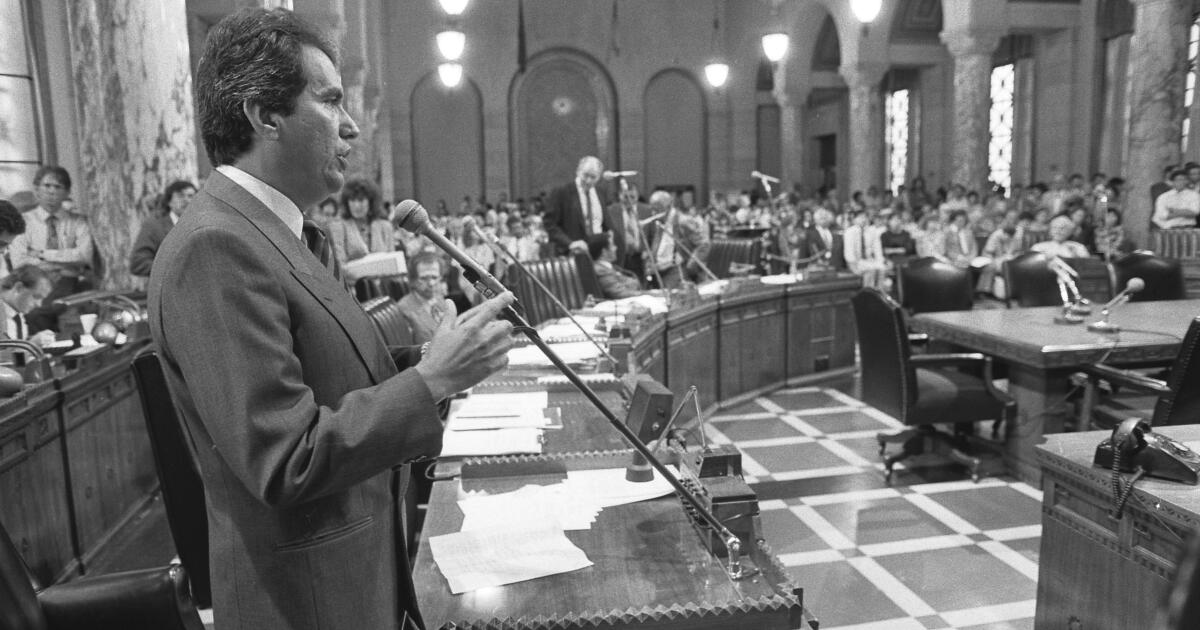
It was a meeting of two of the most powerful men in Los Angeles — and there was no way Richard Alatorre would lose.
Police Chief Darryl Gates and his command staff had stopped by Alatorre’s office to introduce themselves. Alatorre, newly elected to the City Council, stayed seated, feet on his desk, a friend looking on. Gates offered some pleasantries before Alatorre cut him off — and down — with a question: “Where are the greasers?”
The police chief was flummoxed. Alatorre, already a political force in Eastside and California politics, asked the same question again, letting the last word — an antiquated slur against Mexican Americans — make the top brass squirm.
Gates finally said he didn’t understand the question. The council member replied that the Los Angeles Police Department had no Latinos in its upper ranks, and that Gates could return when he fixed that. Meeting over.
It was classic Alatorre: uncompromising, uncouth and unapologetic in the name of exerting his influence to better Latinos. And effective: Gates eventually conferred with him about how to diversify LAPD management.
“I’m not just one that opens his mouth and [mau-maus] about a given subject and then moves on to the next topic without ever getting your hands dirty and trying to get something done,” Alatorre told a UCLA historian in 1990, a few years after his encounter with Gates. “No, I try and see it to its end, backroom deals and everything.”
Alatorre died Tuesday morning at his home in Eagle Rock after a long battle with cancer, surrounded by friends, family and former staffers. He was 81.
Mayor Richard Riordan, left, jokes with City Councilmember Richard Alatorre during an event promoting shopping in downtown L.A. in 1997.
(Ken Lubas/Los Angeles Times )
The son of a Mexican American mother and Mexican immigrant father spent his 28-year political career practicing what he called “change from the inside”: climbing California’s political hierarchies and bringing other Latinos up with him.
In Sacramento as an Assembly member, the gravel-voiced Alatorre pushed through bills on prison reform, bilingual services and farmworker rights. He oversaw a landmark reapportionment in the 1980s that helped Latinos enter the state Legislature in numbers never before seen, doing the same for Los Angeles after joining the City Council.
“A lot of us considered Alatorre to be a vato who made good,” said Jaime Regalado, professor emeritus of political science at Cal State L.A. Alatorre frequently spoke at Regalado’s classes and was more than happy to take questions from students who thought he was a vendido — a sellout.
“But lo and behold, through his reputation in his years, he became the vato for a lot of people,” Regalado concluded.
As he won rights and access for Latinos statewide, Alatorre built an Eastside political machine that drew accolades and criticism. At the end of his career, scandal threatened his legacy as he fended off investigations into alleged corruption and cronyism. Ultimately, his stature remained undiminished among supporters and even some rivals.
Gloria Molina, a onetime acolyte who built a competing Eastside machine in the 1980s and ’90s and once described Alatorre as a “bully” to The Times, gifted Alatorre a commemorative scroll at an L.A. County Board of Supervisors meeting just before he left public office in 1999.
“I’m glad that the wheeling and dealing will be gone,” said the then-supervisor, who died last year. “But at the same time, there’s a lot of things I think we’re going to miss. Richard offered the Latino community political power that it never had.”
Born in 1943 in Boyle Heights and raised in East Los Angeles, Alatorre grew up in an era when Mexican Americans were joining the middle class but found themselves politically ignored. He remembered his father, Jose, a stove repairman who instilled in his son and daughter the importance of education, bemoaning the gerrymandering that kept Latinos from electing more of their own.
On a rainy night in 1960, the family’s outlook on politics changed.
The Alatorres joined 20,000 people at East Los Angeles College to hear John F. Kennedy speak, a week before election day. Richard wanted to leave because of the terrible weather, but his father insisted they stay and witness history.
Kennedy “seemed to be the first presidential candidate reaching into my community and asking for our help,” Alatorre told The Times in 1989. “That represented hope to me.”
He volunteered for the Kennedy campaign as well as that of Leopoldo Sanchez, who became the first Latino judge elected in California. Alatorre became senior class president at Garfield High, moonlighting as a bill collector for a jewelry store before enrolling at Cal State L.A. There, he found a political science class too hard and his classmates too smart, so he told his father he was going to drop out.
Jose said that would create a self-defeating pattern and urged him to reconsider.
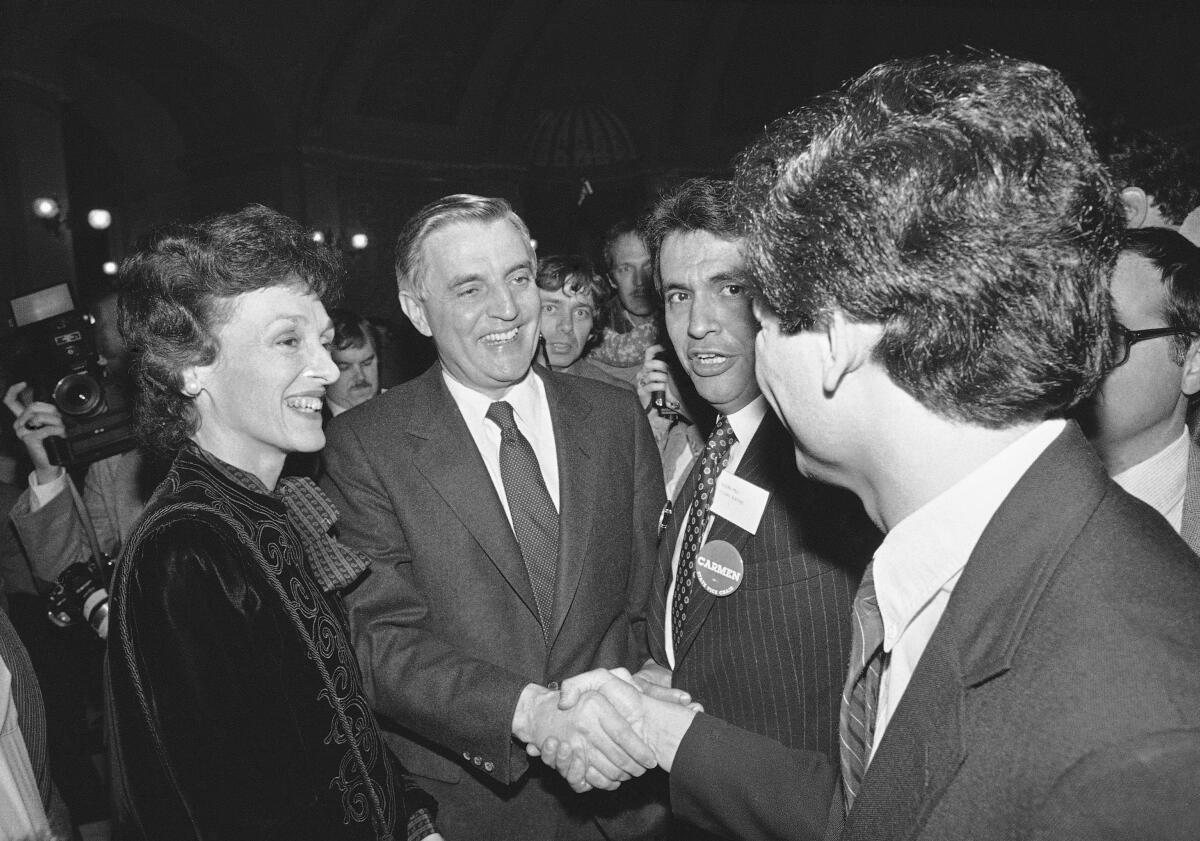
Former Vice President Walter Mondale, center, with his wife Joan and California Assemblymember Richard Alatorre, are greeted by a well-wisher during at the state Democratic Party Convention in 1983.
(Walt Zeboski / Associated Press)
Alatorre graduated from Cal State L.A., earned a master’s degree from USC and became a staffer for Eastside Assemblymember Walter Karabian. He headed Latino voter outreach for Tom Bradley’s failed 1969 mayoral run, taught civics classes to inmates at Terminal Island and served as Western regional director for the NAACP Legal Defense Fund. As his star rose in mainstream politics, Alatorre maintained his dedication to the Eastside grassroots.
When protesters were jailed and held on $100,000 bail during the 1968 Chicano Blowouts, Alatorre used his connections with the Eugene McCarthy and Robert F. Kennedy presidential campaigns to raise $300,000. He convinced a judge to reduce the protesters’ bail to $15,000, then went to bail bondsmen he knew to cut a deal. He did the same during the 1970 Chicano Moratorium, which he left just before it turned into a deadly melee.
The following year, Alatorre ran for an Eastside Assembly seat in a special election and seemed headed for an easy victory. But in one of the biggest upsets in L.A. County history, Alatorre finished second to Republican Bill Brophy after a third-party candidate, Chicano activist and journalist Raul Ruiz, siphoned off votes.
Six months later, Alatorre ran again and won. He never lost a race again.
The rookie Assembly member initially found himself on the wrong side of Sacramento’s ruling class, clashing with state Senate leader David Roberti and Assembly Speaker Leo McCarthy, San Fernando Valley Assemblymember Howard Berman and Gov. Jerry Brown. Alatorre was nevertheless able to distinguish himself fast with his bare-knuckle style.
When the dean of UC Berkeley School of Law came before a subcommittee chaired by Alatorre to ask for more money, Alatorre told him the school needed to institute affirmative action first. When UC Irvine asked for money to build a medical center, Alatorre made his support contingent on opening health clinics in Santa Ana and setting aside 25% of its enrollment for Black and Latino students.
He was a co-founder of what today is known as the California Latino Legislative Caucus, originally numbering just five members. Alatorre also authored a pair of bills — one mandating bilingual services in communities that needed them, another allowing farmworkers to collectively bargain — that were the first of their kind in the nation. He rose in Sacramento with the support and advice of Willie Brown, a Black Assembly member from San Francisco who proved a kindred spirit.
“He loves clothes and I love clothes,” Alatorre said in his UCLA oral history. “He likes nice things, I like nice things. And we’re the two foulmouthed legislators.”
When Brown became Assembly speaker in 1981, he asked Alatorre to head the committee tasked to redraw the boundaries for state legislative districts.
Alatorre’s job was to ensure that Democrats kept their majority in Sacramento. But he also remembered his dad’s long-ago lament that Latinos didn’t have enough political representation. With the help of computer programs and the input of activists who testified at public hearings, he spread Latino voters over many districts instead of amassing them in a few, anticipating a future in which California’s Latino population would be dramatically bigger.
“It was a critical moment in Latino political history,” said Fernando Guerra, director for the Center for the Study of Los Angeles at Loyola Marymount University. As a graduate student at the University of Michigan in the 1980s, he heard Alatorre speak. “Richard talked about how what he had accomplished in California was doable anywhere.”
Back in his Eastside base, Alatorre was creating a political machine with his friend Art Torres. Torres beat a longtime incumbent for a state Senate seat in 1982, the same year two allies won newly realigned congressional seats. But one governing board eluded Alatorre and Torres: the L.A. City Council, where a Latino hadn’t served since Edward Roybal left for Congress in 1963. Standing in their way was longtime Eastside incumbent Art Snyder, who had survived repeated recall attempts and insurgent candidates.
In 1985, Snyder announced he was resigning in the face of scandals. Alatorre easily won the special election to replace him. Hundreds of people, including Brown, then-Assemblymember Maxine Waters, Reps. Mervyn Dymally and Roybal, and Cesar Chavez, attended Alatorre’s swearing-in at City Hall, along with a serenading mariachi.
Alatorre was soon put in charge of redistricting council seats. His moves not only led to new boundaries that enabled Gloria Molina’s victory in 1987, but he also strengthened three districts held by Black council members since the 1960s so that they would remain Black-led for decades, a reality that remains true today.
“He felt every person in his district had dignity, every kid had a future, and everyone had hope,” said Hilary Norton, Alatorre’s former chief of staff, who remembered toy drives organized by Alatorre in his district. “He believed in God’s power to redeem everybody.”
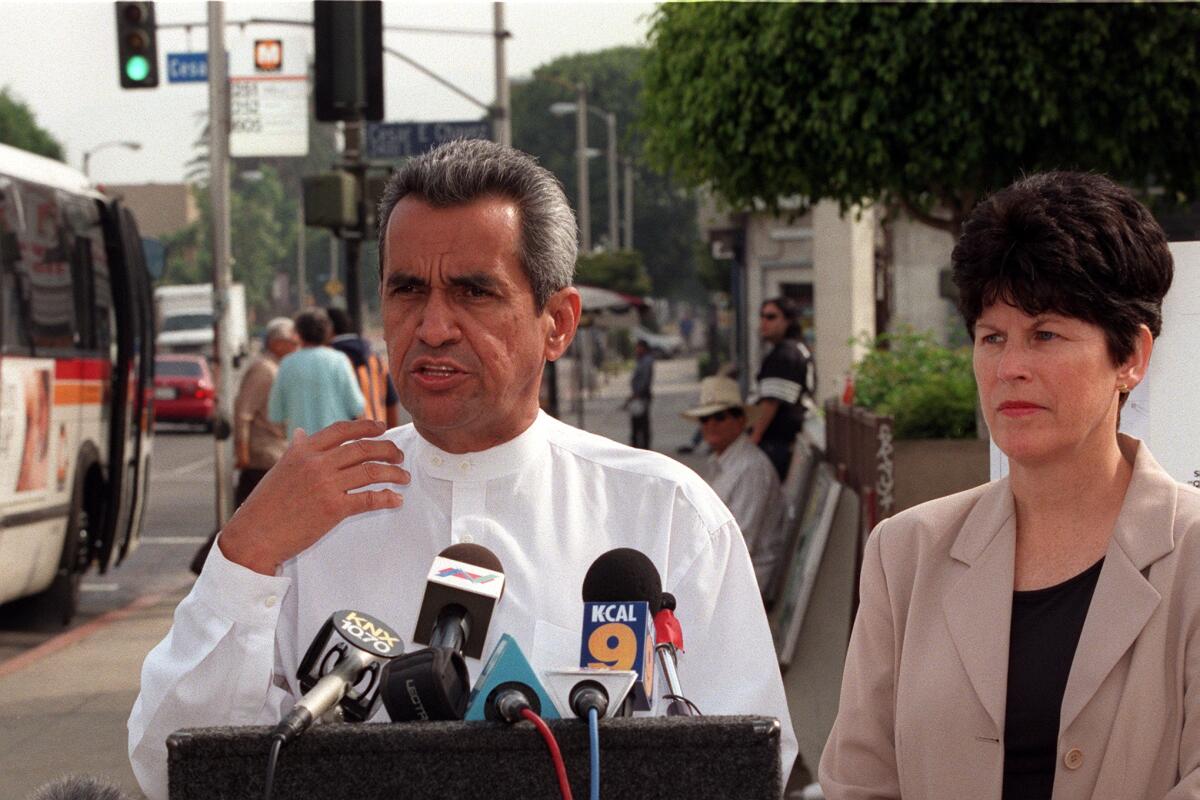
Richard Alatorre at a press conference with Francis Banerjee, then-general manager of the city Department of Transportation, in 1998
(Ken Lubas/Los Angeles Times)
Alatorre’s power continued to grow. He became the inaugural chair of the Metropolitan Transportation Authority board of directors and helped Richard Riordan become mayor in 1993. His former staffer Richard Polanco became the head of the Latino Legislative Caucus and continued his mentor’s goal of getting more Latinos in public office. Critics alleged that Alatorre seemed too eager to direct city contracts to supporters — and he made no apologies for that.
“I didn’t establish the rules of the game. I just learned them well and know how to apply them,” he told The Times in 1999 just before leaving office. “Yet they [the press] write about how sinister that is.”
By then, the controversies that always lapped at Alatorre had subsumed his career.
While he was an Assembly member, the California attorney general’s office investigated him and other Latino politicians for alleged ties to the Mexican Mafia, which proved unfounded. Months after his historic City Council win, Alatorrre paid a then-record penalty for illegally financing the race with funds from his Assembly campaign. He was fined again in 1988 for trying to steer a city contract to the East Los Angeles Community Union, better known as TELACU, which had paid him a $1,000 speaking fee.
None of this tarnished his image among supporters or diluted his influence. But a 1996 lawsuit, filed by a former MTA employee alleging he was fired for opposing a $65-million Eastside subway contract that would partially benefit Alatorre associates, proved more corrosive.
Local and federal investigators began to look at everything from Alatorre’s votes as MTA board chair to charities he promoted to his purchase of a home in Eagle Rock and even who financed the retiling of that house’s roof.
Those investigations resulted in no charges. But the most damaging blow to Alatorre’s reputation happened in 1998, in the midst of a custody battle. The dying sister of Alatorre’s wife had signed over guardianship of her daughter to the Alatorres instead of the girl’s biological father, Henry Lozano, an Eastside political veteran who had helped on Alatorre’s first campaign.
In sworn testimony, Alatorre said he hadn’t used cocaine in years. But a month later, the presiding judge in the case ordered a surprise drug test. It came back positive.
A few months later, Alatorre announced he wouldn’t seek a fourth council term.
“I guess one of my shortcomings was not being able to help people define Richard Alatorre,” he complained to The Times in 1999 on his way out. “Everyone got caught up in my style, in the way I dress, the way I talk, not what I believe in … my enjoyment in helping others.”
Two years later, he pleaded guilty to tax evasion after failing to report nearly $42,000 in alleged bribes. He was sentenced to eight months of house arrest, allowed to leave only for grocery shopping or work.
“For five years, I had to wake up wondering what the next story was coming up,” Alatorre told L.A. CityBeat in 2005. “Because of what happened, I’m the sum of the end of my career, when things were bad. I’ve got that asterisk on my resume that overshadowed 28 years of work.”
By then, however, Alatorre was in the midst of a personal, professional and political comeback that continued for the rest of his life.
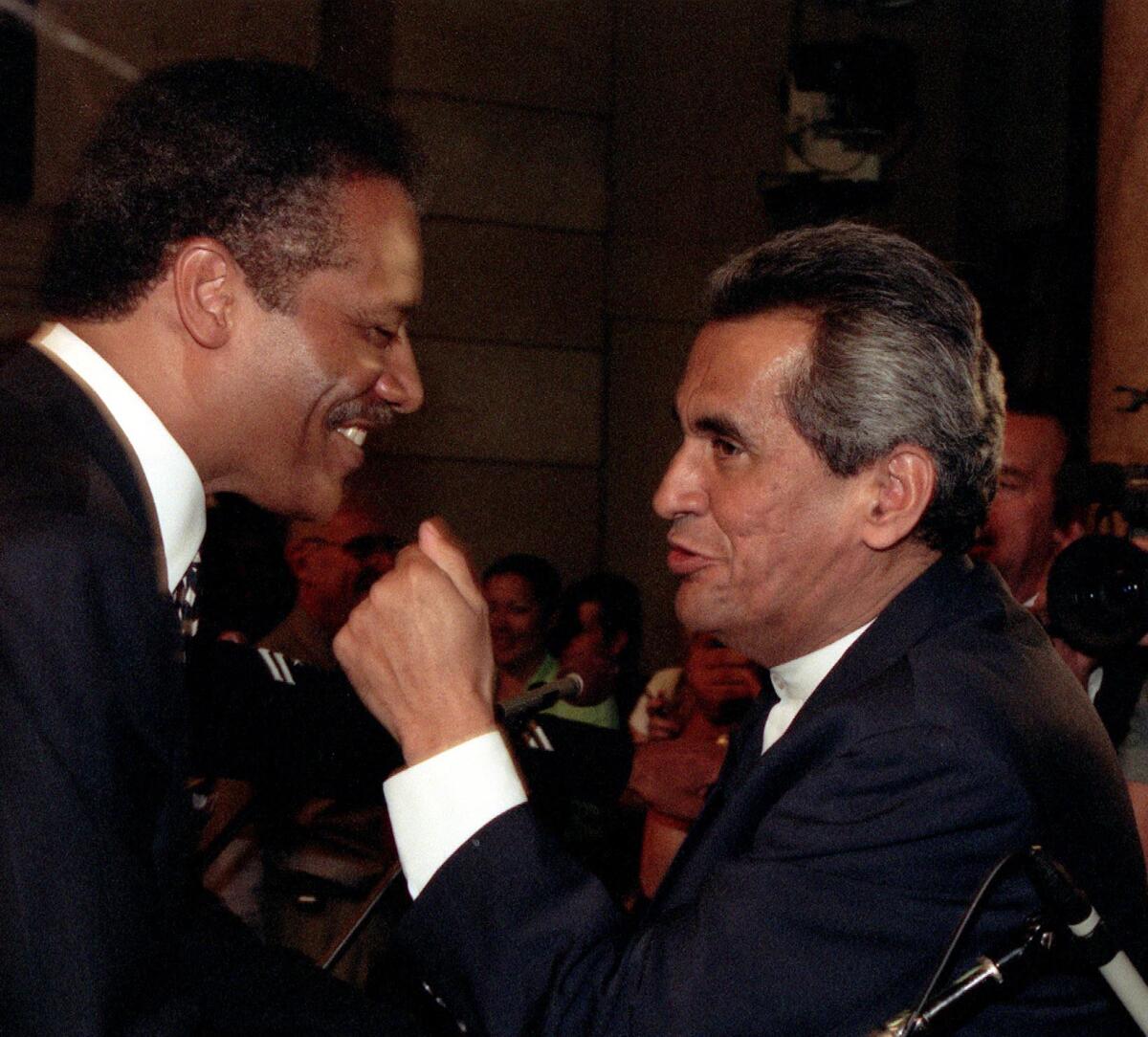
L.A. Councilman Richard Alatorre congratulates Bernard C. Parks after Parks was named to be the new chief of the LAPD in 1997
(Gary Friedman/Los Angeles Times)
He found quick work as a consultant and lobbyist, sparking a 2010 investigation by the L.A. County district attorney’s office that concluded he did lobbying work without registering with City Hall but did not result in any charges. A new generation of Latino political hopefuls sought his advice, none more than Antonio Villaraigosa. The two had frequently clashed on the MTA board during the 1990s, when Alatorre was chair and Villaraigosa was Molina’s representative. By the time of Villaraigosa’s successful 2005 mayoral run, Alatorre was a key advisor and remained one until the end.
“He forgot more than I ever knew,” said Villaraigosa, who spoke this year along with Mayor Karen Bass at a banquet at the Bonaventure Hotel in honor of Alatorre, who was too ill to attend. “Richard knew what needed to be done, and how to do it. He was never afraid to kick the door open when it needed to be.”
And while Alatorre’s failed cocaine test in 1998 sparked embarrassing headlines, he also credited the humiliation with “saving” him in his 2016 autobiography, “Change From the Inside.”
“With help from those I love the most,” he concluded in the 429-page book, with a photo of him surrounded by his beaming family on the opposite page, “I discover[ed] the power within me to find redemption and in the process for the first time in my life, I also [found] peace and grace.”
Alatorre is survived by his wife, Angie; their daughter, Melinda; two sons from a previous marriage, Derrick and Darrell; and granddaughters Gabriela, Mariela, Daniela and Kaycee.

Politics
Warren tells Trump to ‘sign the damn bill’ as bipartisan housing package remains stalled in Washington

NEWYou can now listen to Fox News articles!
Sen. Elizabeth Warren, D-Mass., lashed out at President Donald Trump during a recent local television interview, labeling him a “man-child” throwing a “tantrum” over his refusal to sign a sweeping bipartisan housing package.
Appearing on WCVB’s “On the Record,” the left-wing senator did not hold back her frustration over the stalled legislation, delivering a blunt message to the president: “Sign the damn bill.”
“If he cared about the American people, he’d have already signed the damn thing,” Warren said during the interview, arguing that Trump “does not care about the economic survival of America’s working families.”
FILE – The Senate previously advanced the massive housing package geared toward lowering the costs of homes and supercharging the housing supply. Sen. Elizabeth Warren, D-Mass., pitched it as legislation to prevent America from becoming a “nation of renters.” (Jemal Countess/Getty Images for Protect Borrowers ; Anna Moneymaker/Getty Images)
TRUMP-BACKED HOUSING BILL CLEARS HOUSE AFTER GOP DEFIES SENATE PRESSURE CAMPAIGN
The 21st Century ROAD to Housing Act is an expansive bipartisan package that she said contains nearly 50 provisions designed to address the nationwide housing emergency.
Warren noted that decades of under-building have driven prices up, leaving the U.S. in need of millions of new units.
The primary focus of the bill is to lower the costs of construction and make it easier to build new homes.
FILE – President Donald Trump previously said lawmakers must first approve the SAVE America Act before he moves forward with the housing package. (Yuri Gripas/Abaca/Bloomberg)
BIPARTISAN HOUSING PUSH ADVANCES, BUT TRUMP-BACKED INVESTOR BAN FACES RESISTANCE
The bill, which was co-sponsored by Sen. Tim Scott, R-S.C., also includes a secondary focus aimed at blocking corporate consolidation of the housing market.
Warren explained that the legislation is designed to keep private equity firms from buying up local neighborhoods and turning America “into a nation of renters.”
According to Warren, the legislation had widespread support from both sides of the aisle before it was stalled.
TRUMP VOWS BLOCK ON SIGNING NEW LAWS UNTIL SAVE AMERICA ACT PASSES SENATE
She claimed the bill was “handed to the president on a silver platter” and that lawmakers from both parties were eagerly taking credit for the legislation.
“Republicans were all going online, saying, ‘well, I helped write that bill. This bill is terrific,’” Warren said. “So everybody’s out there saying, ‘my bill, I helped make this happen,’ right up until the man-child has a tantrum and announces he will not be signing it.”
FILE – Sen. Elizabeth Warren called President Donald Trump a “man-child” during the interview, describing his refusal to sign the bill as a “tantrum.” (Chip Somodevilla/Getty Images)
CLICK HERE TO DOWNLOAD THE FOX NEWS APP
Critics of the legislation claim it does not allocate fresh federal funding, directly address rising costs of homeownership, or go far enough to address permitting issues.
The president previously canceled a scheduled signing event, insisting lawmakers must first approve the unrelated SAVE America Act, a voting-focused measure, before he moves forward.
The White House did not immediately respond to Fox News Digital’s request for comment.
Fox News Digital’s Alex Miller contributed to this report.

Veteran MS NOW anchor Alex Witt is leaving the news network, which is moving away from live evening programming on weekends.
The new weekend programming strategy announced Friday is a cost-saving measure that will give parent company Versant more resources for a new direct-to-consumer streaming offering that makes MS NOW available to consumers without a pay-TV subscription. The company is also looking to expand its live event business.
According to a memo from MS NOW President Rebecca Kutler, “The Weekend: Primetime,” a live discussion program launched last year, will have its final airing Saturday.
One of the program’s co-hosts, Antonia Hylton, will take over Witt’s midday shifts later this year. Hylton’s co-hosts Ayman Mohyeldin, Catherine Rampell and Elise Jordan will remain with MS NOW and continue to appear on other programs.
Kutler said job losses from the moves are minimal and encouraged staffers who lose their current roles to apply for 40 current job openings at the company with more on the way. MS NOW has been staffing up its news operation since separating from NBC News last year.
MS NOW changed its name from MSNBC in November. The network, along with other Comcast-owned cable channels, were spun off into Versant in January.
Weekends have long been a ratings weak spot for MS NOW, which while a distant second to Fox News, has seen audience growth in 2026 and remains ahead of CNN. The network has started to rely on podcasts such as “Pod Save America,” from Crooked Media, to fill some hours. The episodes have performed strongly enough for MS NOW to try similar deals with outside podcast producers.
“Throughout the summer, we will expand our taped strategy and announce new content partnerships,” Kutler said in her memo.
With the changes, MS NOW will still have 20 hours of live programming each weekend and will be staffed to handle breaking news.
Witt joined the network formerly known as MSNBC in 1999, long before it began its strong tilt toward progressive political commentary. Over the years, Witt’s weekend newscast became one of the few programs on the network that delivered straight news without opinion.
Kutler called Witt “a beloved longtime member of our MS NOW family” and “a continued, trusted, and steady presence for our audiences.”
While Witt works through the summer, Hylton will anchor the 11 a.m. weekday time period, which will eventually be handled by former NBC News White House correspondent Peter Alexander.
Politics
McCarthy says Trump will use ‘everything he can’ to force Senate action on SAVE America Act

NEWYou can now listen to Fox News articles!
As infighting over the SAVE America Act throws congressional Republicans into disarray, President Donald Trump’s bid to get the stalled election bill across the finish line gained one notable ally.
Former House Speaker Kevin McCarthy, R-Calif., told Fox News Digital that he supports the election integrity measure and indicated that Trump should continue to use every available tool to pressure the Senate to pass it.
“He’s going to try everything he can to make sure he passes that through,” McCarthy said in a brief interview outside the U.S. Capitol.
The ex-speaker’s comments came after Trump abruptly called off a signing ceremony Wednesday for a bipartisan housing bill to pressure the Republican-controlled Senate to act on the SAVE America Act.
President Donald Trump boards Air Force One as he departs Reading Regional Airport in Reading, Pa., on June 23, 2026. (Evelyn Hockstein/Reuters)
IRATE REPUBLICANS ACCUSE TRUMP OF HANDING DEMOCRATS A WIN AFTER BLOWING UP HOUSING PACKAGE
The move surprised Republican lawmakers, some of whom were praising the bill’s passage at a press conference when Trump’s Truth Social post broke.
But Trump has repeatedly cast the election measure — requiring proof of citizenship to vote in federal elections and voter identification requirements — as his top legislative priority.
The legislation’s momentum, however, has slowed in the upper chamber, where Republican leadership insists the votes aren’t there amid widespread Democratic opposition. Senate Republicans have also been unwilling to eliminate the legislative filibuster, which requires a 60-vote threshold to pass the legislation.
Former Speaker of the House Kevin McCarthy speaks during a ceremony honoring President Ronald Reagan on the 115th anniversary of his birthday at the Ronald Reagan Presidential Library in Simi Valley, Calif., on Feb. 6, 2026. (Hans Gutknecht/MediaNews Group)
TRUMP CALLS MAIL IN VOTING CORRUPT AS SENATE BEGINS DEBATE ON SAVE ACT REQUIRING VOTER ID
Amid the SAVE standoff, a group of conservative lawmakers effectively shut down the House floor in an effort to force Senate action on the election bill.
But the Senate recessed Wednesday for two weeks over the July 4 holiday, leaving the measure in limbo until lawmakers return.
The conservative-led blockade sparked fierce backlash, with several members inside the GOP conference telling Fox News Digital the move risked torpedoing their own legislative agenda.
Meanwhile, the House has also yet to pass a version of the legislation incorporating several of the president’s priorities, including a mail-in voting crackdown and provisions banning men from competing in women’s sports and child sex change procedures.
Trump has not indicated whether he will sign the 21st Century ROAD to Housing Act, despite the likely existence of a veto-proof majority.
House Speaker Mike Johnson, R-La., told reporters Thursday that the housing bill had been transmitted to the White House for Trump’s signature following a meeting with the president.
Speaker of the House Mike Johnson, R-La., talks with reporters in the U.S. Capitol on June 10, 2026. (Tom Williams/CQ-Roll Call, Inc via Getty Images)
CLICK HERE TO DOWNLOAD THE FOX NEWS APP
Trump now has 10 days to sign the package or veto it. If he does nothing, the legislation automatically becomes law at the end of the 10-day period.
-

 Delaware1 minute ago
Annual Delaware River Sojourn honors the nation’s 250th anniversary
-

 Florida6 minutes ago
Florida Lottery Mega Millions, Jackpot Triple Play results for June 26, 2026
-
Georgia13 minutes ago
Georgia Lottery Mega Millions, Cash 3 results for June 26, 2026
-

 Hawaii16 minutes ago
Police recover 19 gaming machines, $7K in Kakaako gambling bust
-

 Idaho21 minutes ago
The reactor race has begun
-

 Illinois28 minutes ago
New Illinois bill aims to overhaul public defense system | The Chicago Report
-

 Indiana31 minutes ago
Driver airlifted after NW Indiana police chase ends with crash into tree
-

 Iowa36 minutes ago
Vote: Class 1A Iowa High School Softball Midseason Player Of The Year

