Politics
Potential Supreme Court candidates during a second President Biden term


WASHINGTON — A continuing focus on diversity appears to be the political strategy for how President Biden would approach filling any Supreme Court vacancies in a second term.
Sources close to the White House and his re-election campaign say the president would use the successful nomination of Justice Ketanji Brown Jackson as a template for navigating any future high court opening.
For now, officials say he plans to more prominently tout Jackson’s confirmation to various key constituencies as the presidential campaign intensifies, especially to Black voters who will be key to his re-election.
After Justice Stephen Breyer announced his 2022 retirement, Biden committed early on to naming the first Black woman as his replacement and gathered a number of qualified jurists for initial vetting. That internal list then expanded before three finalists were ultimately reached — Jackson and judges Leondra Kruger and J. Michelle Childs. Kruger and Childs remain top contenders for the Supreme Court, sources say.
BIDEN ADMIN WEIGHS GOING AROUND ISRAEL TO NEGOTIATE RELEASE OF US HOSTAGES DIRECTLY WITH HAMAS: REPORT
President Biden arrives at Omaha Beach to commemorate “D-Day” in France. (Miguel Medina/AFP via Getty Images)
The president, in public remarks, has made much of the diversity of his judicial nominees for the courts. Almost two-thirds are women, more than twice those named by President Trump in his single term (Biden 127; 64% as of May 22, versus Trump 55 total; 24%). Biden has also named an equal percentage of members of a racial or ethnic minority group to the federal bench — about 64%.
Biden could make history with the first justice who identifies as Asian American or Pacific Islander and would have more than 30 AAPI judges he has named to the lower federal courts to choose from.
But any retirement by Justice Clarence Thomas, who turns 75 June 23, or Justice Sonia Sotomayor, who turns 70 two days later, would put political pressure on the next president to name a Black or Latino to the Supreme Court.
BIDEN’S CRUSADE AGAINST US ENERGY HARMS AMERICA AND OUR ALLIES
Overall, Biden has been actively finding qualified federal candidates to fill bench vacancies. His 200th federal judge was confirmed by the Senate last month, slightly outpacing the number by his predecessor at this point in his presidency.
The following is an unofficial list of potential candidates for the Supreme Court by Biden. It was compiled from a number of sources, including officials within his inner circle, his political campaign and Democratic political and legal circles.
The current White House administration, like those before, quickly began compiling an informal list of possible high court nominees to consider in the event of a sudden vacancy. But serious vetting only begins when such a vacancy occurs or is announced in advance by a retiring justice.
Justice Leondra R. Kruger at a session at the California Supreme Court in Los Angeles. (Irfan Khan/Los Angeles Times via Getty Images)
- Leondra Kruger, California Supreme Court Justice
Born in 1976, Kruger is a former Obama Justice Department lawyer and argued 12 cases before the Supreme Court. She also clerked for Justice John Paul Stevens and was a finalist for the 2022 court seat that went to Brown Jackson. Her sterling resume and relatively young age could continue to make Kruger a strong favorite for a Supreme Court seat, especially if Thomas retires. She’s considered something of a moderate on the state high court and often a “swing” or deciding vote in close cases. But state judges rarely receive serious consideration for the U.S. Supreme Court. The last was Justice Sandra Day O’Connor in 1981. Kruger’s parents were both pediatricians. Her mother is Jamaican. Her late father was the son of Jewish immigrants. She gave birth to a daughter in March 2016.
- Sri Srinivasan, D.C. Circuit U.S. Court of Appeals Judge, Washington
Born in 1967 in India, Srinivasan was later named to the court in 2013 (97-0 vote), months before colleague Patricia Millett joined him. He is now chief judge on that bench. He was a finalist for the seat that Garland was nominated for. The son of Indian immigrants and raised in Kansas. Padmanabhan Srikanth Srinivasan was the principal deputy solicitor general at the Justice Department and argued more than two dozen cases before the Supreme Court. He would be the high court’s first Asian American. He clerked for Republican-nominated federal judges Harvie Wilkinson and Day O’Connor. Obama called him “a trailblazer who personifies the best of America.” Known as low-key, practical and non-ideological, he may not excite many progressives, nor give conservatives much to dislike.
Fun fact: Justice Elena Kagan has praised him (both worked together in the Obama SG’s office), saying Srinivasan “cools it down” with his calm manner during oral arguments.
BIDEN WANTS TO ‘BASTARDIZE’ HIS FAMILY STORIES TO GET ‘WEIRD POLITICAL POINTS WITH CERTAIN DEMOGRAPHICS’
- Elizabeth Prelogar, U.S. Solicitor General (pronounced: PRE’-low-guhr)
Born in 1980, Prelogar became the 40th solicitor general in October 2021, after serving for months in an acting role. The Idaho native clerked for justices Ginsburg and Kagan, a former solicitor general, and for then-Judge Merrick Garland on the D.C. Circuit appeals court. Besides Kagan, former solicitors general to later become a justice include William Howard Taft, Robert Jackson, Stanley Reed and Thurgood Marshall.
Fun facts: She was a beauty pageant contestant named Miss Idaho in 2004 and appeared last fall on the NPR quiz show, “Wait, Wait… Don’t Tell Me” (her topic was vacuum cleaner salespeople).
- Lisa Monaco, Deputy Attorney General
Born in 1968, Monaco was a former federal prosecutor and national security adviser under Obama from 2013-2017. She worked as a researcher under then-Senate Judiciary Committee Chairman Joe Biden starting in 1992. Monaco would also be a favorite for attorney general in a second Biden term if Garland retires.
Candace Jackson-Akiwumi testifying at a Senate Judiciary Committee confirmation hearing in Washington, D.C. (Tom Williams-Pool/Getty Images)
- Candace Jackson-Akiwumi, 7th Circuit U.S. Court of Appeals Judge, Chicago
Born in 1979 in Norfolk, Virginia, both her parents are judges, U.S. District Judge Raymond Alvin Jackson and former Norfolk General District Court Judge Gwendolyn Jackson. A former federal defender in Chicago and, before that, a partner in a D.C. law firm, Jackson-Akiwumi was nominated by Biden in March 2021, one of three Black women named to appeals court seats in the administration’s first months.
- J. Michelle Childs, D.C. Circuit U.S. Court of Appeals Judge, Washington
Born in 1966, Childs was nominated in December 2021 to serve on the high-profile D.C. Circuit appeals court, replacing the retiring Judge David Tatel. She was Biden’s second Black woman on the D.C. Circuit, after now-Justice Jackson. Sources say Rep. Clyburn (D-S.C.) strongly pushed the White House to name the South Carolina-based Childs to this seat. The D.C. Circuit is seen as something of a professional stepping stone to the Supreme Court. Besides Jackson, recent justices who earlier served on that appellate bench include John Roberts, Clarence Thomas, Brett Kavanaugh and the late Ruth Bader Ginsburg and Antonin Scalia. Childs had previously been a federal district court judge since 2010. The Detroit native went to law school at the University of South Carolina.
Born in 1974, Pérez was a 2021 appointee to her current seat. She previously served at the progressive Brennan Center for Justice at the New York University School of Law as director of its Voting Rights and Elections Program. A native of San Antonio, she would be given serious consideration, especially if Sotomayor retired.
- Nancy Maldonado, U.S. District Court for the Northern District of Illinois Judge, Chicago
Born in 1975, Maldonado was nominated for a seat on the 7th Circuit. She would be the first Hispanic judge on that federal appeals bench. Her nomination to the high court would have a strong backer in her home state of Illinois.
- Patricia Millett, D.C. Circuit U.S. Court of Appeals Judge, Washington
Born in 1963, Millett was named in 2013 to a bench considered a stepping stone to the high court, where four current justices once served (so did Justice Scalia). Formerly a private Washington-based appellate attorney — Obama called her “one of the nation’s finest” — who also had more than a decade experience in the U.S. Solicitor General’s office. Millett argued 32 cases before the Supreme Court, second-most ever for a female lawyer. Sources from both ideological stripes call her fair-minded, no-nonsense and non-ideological. Age may be a drawback for any future high court vacancies.
Fun fact: Her husband is U.S. Navy reservist Robert King, and the two met at a Methodist Church singles event.
BIDEN’S INNER CIRCLE DEEPLY INVOLVED WITH FAMILY’S BUSINESS DEALINGS: REPORT
President Biden gives a speech at the White House. (Al Drago/Bloomberg via Getty Images)
- Cindy Kyounga Chung, 3rd Circuit U.S. Court of Appeals Judge, Pittsburgh
Born in 1975, Chung, a Korean-American native, is a Biden appointee to her current seat and a former U.S. attorney in Pittsburgh.
- Roopali Desai, 9th Circuit U.S. Court of Appeals Judge, Phoenix, Arizona
Desai was born in 1978 in Toronto, Canada, to parents of Indian descent. After law school in Arizona, Desai, as a private attorney, worked successfully with the Arizona Secretary of State’s office to throw out challenges to the state’s 2020 presidential election results. She was then appointed by Biden to the largest federal appeals court.
- Lucy Haeran Koh, 9th Circuit U.S. Court of Appeals Judge, San Francisco
Born in 1968, Koh was renominated in 2021 by Biden to the federal appeals court. Her 2016 nomination expired with the end of the 114th Congress, and then-President Trump subsequently named someone else to the seat. The Oklahoma native is of Korean descent. Koh had been overseeing separate multidistrict litigation involving such tech giants as Samsung and Apple, Inc. She is married to state Justice Mariano-Florentino Cuéllar (see below).
BIDEN’S ‘PERPETUAL STATE OF CONFUSION’ ON DISPLAY IN NORMANDY AMID RISING COGNITIVE QUESTIONS
- Jacqueline Hong-Ngoc Nguyen, 9th Circuit U.S. Court of Appeals Judge, Pasadena, California
Born in 1965 in Dalat, Vietnam, and named to the court in 2012 after two years as a federal district court judge, Hong-Ngoc Nguyen could make history as the high court’s first Asian American justice. She is already the first Asian American woman to sit on a federal appeals court. A former state judge, federal prosecutor and private attorney, he moved with her family to the U.S. when she was 10, just after the fall of South Vietnam to the communists. Her parents eventually set up a doughnut shop in North Hollywood, California.
- Michelle Friedland, 9th Circuit U.S. Court of Appeals Judge, San Jose, California
Born in 1972 and named to the appeals court seat in 2014, Friedland was sworn in by former Justice O’Connor, for whom she once served as a law clerk.
- Arianna Freeman, 3rd Circuit U.S. Court of Appeals Judge, Philadelphia
Born in 1978, Freeman is a Biden appointee and the first Black woman on the 3rd Circuit U.S. Court of Appeals in Philadelphia. Her service as a former federal public defender in the City of Brotherly Love was criticized by Senate Republicans during her judicial confirmation.
Tamika Montgomery-Reeves testifying at her confirmation hearing in Washington, D.C. (Bill Clark/CQ-Roll Call, Inc via Getty Images)
- Tamika Montgomery-Reeves, 3rd Circuit U.S. Court of Appeals Judge, Wilmington, Delaware
Born in 1981 in Jackson, Mississippi, Montgomery-Reeves was named by Biden in 2022 to her current seat after her service on the Delaware Supreme Court. Her home state professional roots would be an obvious selling point to the president.
- Paul Watford, private attorney in Los Angeles and former judge
Born in 1967, Watford’s age and background until recently made him a favorite among some liberal court watchers. Named to the 9th Circuit U.S. Court of Appeals in 2012, he resigned in May 2023 to go into private practice. He was a finalist for the seat that went to Garland in 2017, although that nomination ultimately failed. He clerked for conservative-libertarian former federal Judge Alex Kozinski on the 9th Circuit and later for Bader Ginsburg. He is also a former federal prosecutor and law firm partner. Supporters call the Orange County, California, native an ideological moderate, which may not sit well with progressives seeking a stronger liberal voice. But his rulings limiting police discretion in search and seizure cases have been applauded by left-leaning advocates.
Born in 1970 and of Taiwanese descent, Liu is a former Justice Ginsburg law clerk who helped draft her dissent in Bush v. Gore. Liu joined the state high court after twice being rejected in 2011 by Senate Republicans for a seat on a San Francisco-based federal appeals court. He was eventually filibustered after conservatives said he was “outside the mainstream,” expressing concerns over his past statements on a variety of hot-button topics such as same-sex marriage and health care reform. A Liu nomination would be among the most contentious made by a Democratic president.
- Mariano-Florentino Cuéllar, former California Supreme Court Justice
Born in 1972 in Mexico, Cuéllar was named in 2021 as president of the D.C.-based Carnegie Endowment for International Peace. Nicknamed “Tino,” Cuellar served in the Obama and Clinton administrations and is a former academic specializing in administrative law. He is married to federal Judge Lucy Koh (see above).
- Jane Kelly, 8th Circuit U.S. Court of Appeals Judge, Cedar Rapids, Iowa
Born in 1964, Kelly is only the second woman to serve on the St. Louis-based court, appointed in 2013 (96-0 vote). She spent most of her legal career as a federal public defender in Iowa. One of her biggest fans is fellow Iowan Republican Sen. Charles Grassley, ranking member on the Judiciary Committee.
Fun fact: Kelly graduated in 1991 from the same Harvard Law School class as Obama.
- David Barron, 1st Circuit U.S. Court of Appeals Judge, Boston
Born in 1967, Barron was confirmed to the bench in May 2014. He formerly served as acting assistant attorney general in the Obama administration, then went to Harvard Law School as a professor. He also clerked for Justice John Paul Stevens. Being a white male may hurt his chances if President Biden feels political pressure to replace Justice Ginsburg with another woman.
- Robert Wilkins, D.C. Circuit U.S. Court of Appeals Judge, Washington
Born in 1963, Wilkins is an Indiana native and was raised by a single mother. He graduated from Harvard Law School in 1989. He filed a civil rights lawsuit in 1992 against the Maryland State Police after being pulled over for speeding after officers were instructed to focus on young Black males when making lawful traffic stops.
- Cheryl Ann Krause, 3rd Circuit U.S. Court of Appeals Judge, Philadelphia
Born in 1968, Krause was a law clerk for two Republican-appointed court judges, including Justice Anthony Kennedy. She was named to her current seat in 2014 by Obama.
- Senators Cory Booker (D-N.J.) and Amy Klobuchar (D-Minn.)
A few members of Congress typically get mentioned on these lists, often as a political courtesy, especially to those senators who would vote on any nomination. Frequently mentioned are two members of the Senate Judiciary Committee (and former 2020 presidential candidates) who gained national prominence during the Justice Kavanaugh confirmation hearings.
Booker, born in 1969, is the former mayor of Newark and one of four Black senators. Klobuchar, born in 1960, was a county prosecutor and adviser to former Vice President Walter Mondale. She was mentioned as a possible vice presidential candidate for Biden and has frequently been mentioned as a high court candidate, dating back to 2009.


James Gagliano on anti-ICE protests and threats against agents
Retired FBI Special Agent James Gagliano discusses anti-ICE protests and threats against agents in Newark, New Jersey. A new curfew has curbed chaos after violent clashes, with one Brooklyn man arrested for threatening to kill an ICE agent. DHS Secretary Markwayne Mullin vows ‘zero tolerance’ for attacks, while Sen. Cory Booker, D- N.J., calls ICE ‘out-of-control.’ Gagliano warns against allowing these protests to continue.
NEWYou can now listen to Fox News articles!
A Canadian national accused of slapping a teen wearing political clothing at the Jersey Shore has been turned over to Immigration and Customs Enforcement, a representative for the local jail told Fox News Digital on Wednesday.
Over the Fourth of July weekend, Kaitlyn Tracey, 33, was reportedly seen on surveillance video confronting a group of teens in Point Pleasant Beach, some of whom were wearing pants with the words “Trump” and “ICE” on them, local media reported.
Tracey, a Canadian national who entered the U.S. on a passport in 2024, then allegedly struck one of the girls and recorded the confrontation, according to court documents reported by NJ.com.
An official who picked up the phone at the Ocean County Jail in Toms River confirmed to Fox News Digital that Tracey had been released into ICE custody as of Monday.
ICE CLASHES WITH AGITATORS INTENSIFY OUTSIDE DELANEY HALL
She was reportedly taken to Delaney Hall in Newark – the site of months-long clashes between left-wing agitators and ICE.
NEW JERSEY GOVERNOR, DEMOCRATIC SENATOR SPEND MEMORIAL DAY PROTESTING ICE FACILITY
Billboard at Trump rally in Wildwood declaring historical blue New Jersey is “Trump Country.” (The Image Direct for Fox News Digital)
Tracey’s criminal charges include endangering the welfare of a child and simple assault, according to reports.
The alleged victim was reportedly uninjured.
NJ TAXPAYERS ON THE HOOK FOR $12M MORE AS DEM GOVERNOR PROTECTS ILLEGAL ALIENS BATTLING DEPORTATION
CLICK HERE TO DOWNLOAD THE FOX NEWS APP
While New Jersey at a state level has adopted sanctuary-type policies, Ocean County is known as one of the few Republican strongholds remaining, and retains the state’s longest-serving lawmaker of any party: Rep. Chris Smith, R-N.J., in office since 1981.
People enjoy the Jersey Shore in Seaside Heights, N.J., as businesses prepare for the holiday weekend on May 23, 2025. (Asbury Park Press via IMAGN)
SIGN UP TO GET THE POLITICS NEWSLETTER
It was not immediately clear on what immigration basis ICE initiated proceedings against Tracey. Fox News Digital reached out to DHS for clarification and comment.
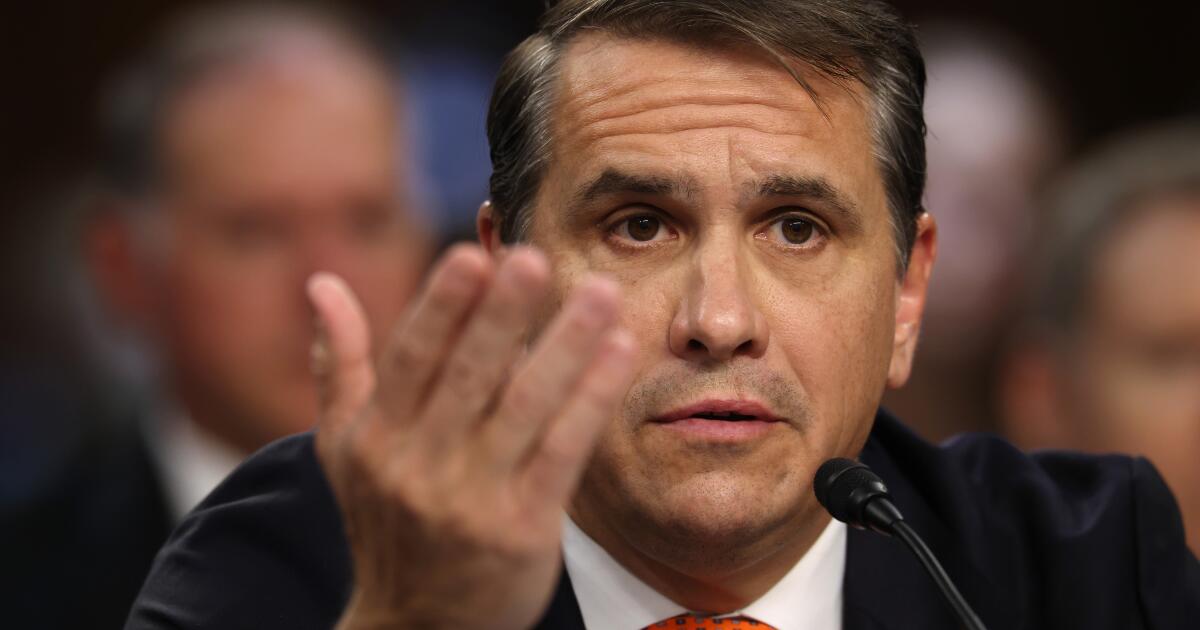
WASHINGTON — The Senate confirmation hearing Wednesday for Todd Blanche, President Trump’s pick for attorney general, will be a referendum on far more than his individual merits.
Blanche, the acting attorney general, served as Trump’s defense attorney before taking office and has been closely linked to many of the most consequential — and controversial — issues that have dominated the first two years of Trump’s second term.
Blanche is set to appear before the Senate Judiciary Committee, which will decide whether to approve his nomination and send it to the full Senate for a confirmation vote. The committee hearing will continue Thursday.
“I would expect committee Democrats to treat Mr. Blanche’s hearing as an opportunity to conduct oversight of the Department of Justice,” said Phil Brest, president of the American Constitution Society, a progressive legal nonprofit and a former top Democratic staffer on the committee. “It’s a test of the Senate’s willingness to probe the department’s operations and to actually serve as a check on the department and the administration more broadly.”
Democrats on the committee are expected to push Blanche on a host of topics, including the $1.8-billion “anti-weaponization fund” that critics derided as a slush fund for the president’s allies, the Justice Department’s rollout of the so-called Epstein files, and the department’s prosecution of several perceived enemies of Trump, notably former FBI Director James Comey.
“While deploying the Justice Department as a shield for the president and his cronies, Blanche has also used our top law-enforcement agency as a sword against Trump’s political opponents,” said Sen. Dick Durbin (D-Ill.), the ranking Democrat on the committee last month. “The independence of DOJ has been decimated under Blanche’s authority.”
Blanche was confirmed by the Senate as deputy attorney general in March, 2025, and was elevated to his current role after Atty. Gen. Pam Bondi was fired in April.
More critical to the success of Blanche’s nomination will be whether he can win the support of two lame-duck Republican senators, Thom Tillis of North Carolina and John Cornyn of Texas, who expressed some reservations about Blanche soon after his nomination was announced.
Cornyn raised concern about Blanche’s independence from Trump, while Tillis said Blanche’s stance on protesters who violently stormed the U.S. Capitol on Jan. 6, 2021, would be critical to his consideration.
Some of those Jan. 6 protesters were expected to be the beneficiaries of the $1.8-billion fund announced as part of a settlement to a lawsuit Trump and his sons and business brought against the IRS.
In a scathing ruling this week, the federal judge wrote that the lawsuit was improper and recommended sanctions against two Justice Department attorneys who worked on the case, though not Blanche himself.
Cornyn told Semafor on Tuesday that the ruling raised a number of issues, including “the potentially collusive nature of the lawsuit.”
He has said previously that he will hold off on making a decision about whether to approve Blanche until after the hearing.
Tillis, meanwhile, told CNN’s Manu Raju on Tuesday that the weaponization fund would need to be completely off the table for him to support Blanche’s nomination.
Trump touted Blanche’s record ahead of the hearing.
“Todd Blanche is doing a PHENOMENAL job as Acting Attorney General of the United States,” the president wrote on Truth Social. “He is a great lawyer, always very fair, and every Republican Senator should vote to CONFIRM Todd Blanche, ASAP!”
Sen. Lindsey Graham’s death means that Republicans currently only enjoy a one-seat majority, but a replacement for Graham on the committee could be in place before it votes on whether to move his nomination to the Senate floor, which will likely come two weeks after the hearing.
Blanche, 51, spent 12 years working for the U.S. attorney’s office for the Southern District of New York, working largely on drug and violent crime cases, and rose to the level of co-chief of the district’s White Plains division.
He left the office in 2014 for private practice and joined the prominent law firm Cadwalader, Wickersham & Taft in 2017 as a partner. He left the firm in 2023 and went independent after other partners expressed concern when he took Trump on as a client.
Blanche went on to represent Trump in several criminal matters, including the New York case about hush money payments to porn star Stormy Daniels, and cases brought by Special Counsel Jack Smith about Trump’s alleged efforts to block the transfer of power after the 2020 presidential election and his alleged retention of classified documents.
He listed all three as among the 10 most significant cases of his career in the questionnaire he completed ahead of the hearing, along with his work at the Justice Department on a lawsuit challenging the construction of a new White House ballroom.
A group of more than 1,200 former Justice Department attorneys wrote a letter opposing Blanche’s nomination, asserting that his leadership has resulted in mass departures of career staff. That has “meant that much of the department’s vital work isn’t being done, or isn’t being done as well – leaving communities less safe, Americans’ rights less protected, and our national security more vulnerable,” the lawyers wrote.
Former Justice Department pardon attorney Liz Oyer is scheduled to testify as a witness for Democrats on Thursday. She has said she was fired for refusing to recommend the restoration of actor Mel Gibson’s gun rights.
Oyer will be joined Thursday by Dani Bensky, one of many victims of the deceased sex abuser Jeffrey Epstein who has criticized Blanche’s handling of the release of the so-called Epstein files — millions of pages of records detailing the Justice Department’s investigations into Epstein’s crimes.
Numerous victims have said that their names and other sensitive information were not properly redacted in the files and criticized Blanche and the department for failing to investigate Epstein’s potential co-conspirators.
Blanche has also come under criticism from survivors of Epstein’s abuse for the interview he conducted in July, 2025, with Epstein accomplice Ghislaine Maxwell, who is serving a 20-year prison sentence for her role in facilitating and participating in Epstein’s abuse.
Days after their interview, Maxwell was moved from her prison in Florida to a minimum-security prison in Texas.
Politics
Biden special counsel’s ‘runaway train’ scooped up sensitive lawmaker info: ‘Abuse of power’

NEWYou can now listen to Fox News articles!
Former special counsel Jack Smith’s investigation into President Donald Trump swept up text messages from nearly 50 members of Congress, bypassing a required review process in what one victim alleged is a direct constitutional violation.
Senate Judiciary Committee Chairman Charles Grassley, R-Iowa, said the situation is more proof Smith’s probe was a “runaway train” of abuses of power, and the elder statesman and Senate Investigations Subcommittee Chairman Ron Johnson, R-Wis., jointly released their filings Tuesday evening.
Grassley and Johnson’s findings were from a full-scale probe of Operation Arctic Frost, the code name for Smith’s endeavor to investigate Trump for alleged corruption and election malfeasance, an operation top Senate Republicans call “worse than Watergate.”
LEGAL WAR ON TRUMP’S AGENDA GAINS FIREPOWER AS FEDERAL LAWYERS DEFECT TO DEMOCRATS
Jack Smith, former U.S. special counsel, arrives for a closed-door deposition before the House Judiciary Committee in Washington, D.C., Dec. 17, 2025. (Getty Images)
Forty-four members of Congress had the contents of their text messages obtained and reviewed by Smith’s team in a way that bypassed protocol. A “filter team” was tasked with reviewing millions of documents in the case and should have had first crack at determining whether such messages were relevant or potentially violated statute or ethics.
Rep. Elise Stefanik, R-N.Y., one of the lawmakers whose texts were swept up in this way, said Tuesday such reviews amounted to clear violations of the Constitution’s speech and debate clause that protects lawmakers from being questioned in “any other place” than the Capitol for legislative acts.
Internal communications have been historically included in that clause in the courts as technology has advanced.
SUPREME COURT JUSTICES HEAD TO CAPITOL HILL FOR FIRST CONGRESSIONAL APPEARANCE SINCE 2019
Stefanik said in a statement that the new records prove Smith’s team “unlawfully and unconstitutionally accessed my private text messages, along with 43 other Members of Congress, in clear violation of the Constitution.”
She said she long suspected there had been “unconstitutional spy[ing] on members of Congress.”
The records were provided by the Trump Justice Department to Grassley and Johnson, which the chairmen said indicated Smith’s team had “circumvented its own filter review process.” The process is additionally meant to protect attorney-client privilege, they said in a statement.
OBAMA-APPOINTED JUDGE TORCHES TRUMP ADMIN IN LATEST COURTROOM SHOWDOWN, REFERS ATTORNEY FOR BAR REVIEW
Former special counsel Jack Smith says the Pledge of Allegiance before he prepares to testify during a hearing before the House Judiciary Committee in the Rayburn House Office Building on Capitol Hill Jan. 22, 2026, in Washington, D.C. (Al Drago/Getty Images)
The news also complicated some of Smith’s prior depositions under oath, including an excerpt in which he answered “no” to a question from a congressional counsel whether records he requested from congresspeople included text messages.
Johnson called the situation a “grotesque example” of Biden-era “weaponization” of the executive branch.
“Jack Smith’s criminal investigation of President Trump was a runaway train that had no brakes,” Grassley added Tuesday.
“Based on the information that’s been produced to me and Senator Johnson, Biden DOJ and FBI investigators apparently ignored their own routine investigative protocols to obtain and review work-related messages from me and dozens of my Republican and Democrat colleagues who were outside the scope of the government’s investigation.”
Grassley added that he hopes Democrats caught up in the otherwise bipartisan text tranche will finally discard their partisanship and recognize the severity of the alleged violations by Smith.
He also indicated he planned to recall Smith before Congress to “hold him accountable.”
Of the 44 members swept up in the text reviews, several were Democrats, including Los Angeles Mayor Karen Bass, Rep. Josh Gottheimer, D-N.J., Sen. Cory Booker, D-N.J., and the top Democrat on the House Armed Services Committee, Rep. Adam Smith of Washington.
Grassley, Johnson and Stefanik were also swept up in the situation, along with top figures like senators Mike Lee, R-Utah; Josh Hawley, R-Mo.; Dan Sullivan, R-Alaska; Rand Paul, R-Ky., former Senate Republican Conference Chairman Lamar Alexander, R-Tenn.; and the late Lindsey Graham, R-S.C.
SIGN UP TO GET THE POLITICS NEWSLETTER
Former House Intelligence Chairman Devin Nunes, R-Calif., was one of the victims, along with current House Judiciary Committee Chairman Jim Jordan, R-Ohio, as well as House Freedom Caucus member Scott Perry of Pennsylvania, EPA Administrator Lee Zeldin of New York, Veterans Affairs Secretary Doug Collins of Georgi, and prominent Trump critic Rep. Thomas Massie of Kentucky.
CLICK HERE TO DOWNLOAD THE FOX NEWS APP
Several lawmakers sounded off on the news soon after Grassley announced his findings, including Hawley, who called for “everyone involved [to] be prosecuted.”
“Joe Biden’s DOJ not only tapped my phone; I just learned they illegally obtained my texts with members of President Trump’s administration,” the Missourian fumed.
Paul called the allegations a “blatant abuse of power and exactly what our Founders warned about,” while citing Smith’s past denial under oath.
Fox News Digital reached out to a representative for Smith for comment.
-

 Nebraska5 minutes ago
Roanoke County teen heads to national rodeo finals in Nebraska
-

 Nevada11 minutes ago
Nevada’s modern boomtowns are these fast-growing cities, study said
-

 New Hampshire17 minutes ago
NH Forests: A Story of Revival and the Challenges Ahead: Business NH Magazine
-

 New Jersey23 minutes ago
NJ Spine Doctor, Daughter, Granddaughter Killed In Plane Crash, Police Say
-

 New Mexico29 minutes ago
McCauley Springs Fire Reaches 100% Containment
-

 North Carolina35 minutes ago
Massive great white shark spotted off NC coast. See where its headed
-

 North Dakota41 minutes ago
Neighbors, not competitors
-

 Ohio47 minutes ago
Former Powell residents indicted in $9.3M Ohio Medicaid fraud scheme

