Politics
Pete Hegseth to Face Democratic Questioning in Confirmation Hearing


Pete Hegseth, President-elect Donald J. Trump’s pick to head the Pentagon, is scheduled to appear before the Senate Armed Services Committee on Tuesday to answer questions on a range of issues, including a sexual assault allegation, his lack of management experience and his comments against women serving in combat.
Mr. Hegseth, a former Fox News host, has a slew of commentary, opinions and allegations to explain, as Democratic lawmakers get their chance to question him about his qualifications to lead the Defense Department, an $849 billion enterprise with nearly three million employees.
Eyes will also be on Senator Joni Ernst, Republican of Iowa, who is an Army Reserve and National Guard veteran and a sexual assault survivor. Ms. Ernst received a barrage of criticism from Trump supporters last month after she said that Mr. Hegseth needed to address issues including the role of women in the military and sexual assault prevention. Her support is viewed as critical to Mr. Hegseth’s confirmation chances.
Whether Mr. Hegseth has the votes to be confirmed remains an open question. After the committee hearing, the full Senate must vote on the confirmation. If all Democrats oppose him, he can afford to lose the support of just three Republican senators.
A former Army major who served in Iraq and Afghanistan and a member of the National Guard until 2021, Mr. Hegseth will presumably need a congressional waiver that is required for any Pentagon chief who has been retired from active-duty military service less than seven years.
The waivers became big issues during the confirmation hearings for the current defense secretary, Lloyd J. Austin III, and for Jim Mattis, who served as defense secretary during the first Trump administration.
But it has rarely been mentioned ahead of Mr. Hegseth’s hearing because there have been so many other issues to discuss.
The top members of the Senate Armed Services Committee were briefed late Friday on the findings from the F.B.I.’s background check of Mr. Hegseth. Other members of the committee expressed concern that they might not have relevant information for Mr. Hegseth’s confirmation hearing.
“I need to see his F.B.I. background check. We need to see his financial disclosures,” said Senator Tammy Duckworth, Democrat of Illinois. “And we need to know about any other potential lawsuits he might be facing, any other allegations he might be facing.”
Democrats and Mr. Hegseth’s backers have both complained that the other side has been unresponsive to attempts to arrange meetings with Mr. Hegseth.
Senator Jack Reed, the ranking Democrat on the committee, is the one Democrat who as of last week had met with Mr. Hegseth. Mr. Reed said in a statement after the two talked on Wednesday that the meeting “raised more questions than answers.”
In addition to the sexual assault allegation against Mr. Hegseth, accusations have also emerged detailing episodes of public drunkenness, workplace sexual improprieties and mismanagement of the veterans nonprofits he ran. Mr. Hegseth has said the sexual assault allegation arose from a consensual encounter. He also told reporters last month that he was “a different man than I was years ago.”
The allegations against Mr. Hegseth have failed to sway most Republican senators, many of whom have argued that senators should discount such claims unless the accusers are willing to come forward publicly.
Mr. Hegseth, who has been married three times, has also acknowledged having extramarital affairs. The New York Times reported last month that his mother, Penelope Hegseth, wrote him an email in 2018 saying he had routinely mistreated women for years and displayed a lack of character.
Mrs. Hegseth later said that she had written the email “in anger, with emotion,” at a time when he and his wife were going through a difficult divorce, and that she apologized for what she had written.
Extramarital affairs and public intoxication can leave officers and troops in the military subject to disciplinary action. Some senior military leaders have questioned privately whether Mr. Hegseth’s confirmation could send conflicting messages to troops about discipline.
Mr. Hegseth’s commentary and writings on a number of issues are also likely to provide fodder for the hearing. In his book “The War on Warriors: Behind the Betrayal of the Men Who Keep Us Free,” Mr. Hegseth complained about “woke” generals who he said had made the military “effeminate” by pushing diversity policies.
He said that Gen. Charles Q. Brown, the chairman of the Joint Chiefs of Staff, a position that usually works closely with the defense secretary, should be fired for being too “woke.” General Brown is African American.
“America’s white sons and daughters are walking away” from the military, he wrote, “and who can blame them.”
Before he was nominated by Mr. Trump to be defense secretary, Mr. Hegseth said that he did not believe that women should be in combat. “I’m straight up just saying we should not have women in combat roles,” he said in a podcast hosted by Shawn Ryan on Nov. 7. Having women in combat, he said, “hasn’t made us more effective, hasn’t made us more lethal, has made fighting more complicated.”
A month later, he offered some clarification. Asked about the issue on the podcast “The Megyn Kelly Show” in early December, Mr. Hegseth said that “if we have the right standard and women meet that standard, roger — let’s go.” But, he added: “If they can’t, and that’s a product of physical differences because the standard is high, then that’s just the reality.”



new video loaded: Eric Swalwell Suspends Campaign for California Governor
transcript
transcript
Eric Swalwell Suspends Campaign for California Governor
In a social media post, Representative Eric Swalwell announced that he was suspending his campaign for California governor after two news outlets published accusations of sexual assault and misconduct against him.
-
I do not suggest to you in any way that I’m perfect or that I’m a saint. I have certainly made mistakes in judgment in my past, but those mistakes are between me and my wife, and to her, I apologize deeply for putting her in this position. I also apologize to you if in any way you have doubted your support for me.
By Monika Cvorak
April 13, 2026

NEWYou can now listen to Fox News articles!
First Lady Melania Trump’s call for public hearings for Jeffrey Epstein’s victims is piling fresh pressure on Acting Attorney General Todd Blanche, who only days earlier signaled the administration wanted to move past the saga even as bipartisan lawmakers and survivors continue demanding more files, testimony and prosecutions.
While the first lady called on Congress to take additional steps to let Epstein “survivors” tell their stories, Epstein victims and members of Congress themselves argued that the onus is with the Trump administration, not Congress.
“First Lady asks Congress to bring Epstein survivors in for testimony. With all due respect, that’s Acting U.S. Attorney General Todd Blanche’s job!” Rep. Thomas Massie, R-Ky., who has been at odds with the president and his administration over how it has handled the Epstein case, said after the First Lady’s remarks. “Rep. Ro Khanna, D-Calif., and I already gave brave survivors a chance to tell their horrific stories on Capitol Hill. Pam Bondi wouldn’t even acknowledge them. PROSECUTE!”
“Actually, Congress did act,” added Rep. Ted Lieu, D-Calif., in response to the First Lady’s Thursday night remarks calling on Congress to do more. “But Acting U.S. Attorney General Todd Blanche is violating the law and refusing to release the Epstein files as required by law.”
WHY MELANIA TRUMP IS DENYING ALLEGED SMEARS RELATED TO JEFFREY EPSTEIN–AND WANTS VICTIMS TO TESTIFY
President Donald Trump reportedly called the Palm Beach, Florida, Police Department in 2006 to thank them for investigating Jeffrey Epstein. (Davidoff Studios/Getty Images)
Meanwhile, in a letter released by over a dozen alleged Epstein victims, survivors also put pressure on the Justice Department to do more.
“First Lady Melania Trump is now shifting the burden onto survivors under politicized conditions that protect those with power: the Department of Justice, law enforcement, prosecutors, and the Trump administration, which has still not fully complied with the Epstein Files Transparency Act,” a letter allegedly signed by 15 Epstein victims, posted to social media by Rep. Melanie Stansbury, D-N.M., stated. “It also diverts attention from Pam Bondi, who must answer for withheld files and the exposure of survivors’ identities. Those failures continue to put lives at risk while shielding enablers.”
“Survivors have done their part. Now it’s time for those in power to do theirs,” the letter concluded.
MELANIA TRUMP’S FORCEFUL EPSTEIN DENIAL DRAWS BIPARTISAN SUPPORT FROM LAWMAKERS
Fox News Digital reached out to the Department of Justice and White House for comment on the First Lady’s remarks and remarks from victims and members of Congress calling on the Trump administration to do more, but did not hear back.
However, in a statement to NPR following the First Lady’s remarks, the Department of Justice said: “As we have always stated, we encourage any victims of Jeffrey Epstein — who wish to speak — to contact the FBI. Any survivor who has information on an abuser is encouraged to contact federal law enforcement.”
Not long after taking the reins from former U.S. Attorney General Pam Bondi, Blanche insisted it was time for the Justice Department to move on from the Epstein case.
“I think that to the extent that the Epstein files was a part of the past year of this Justice Department, it … should not be a part of anything going forward,” Blanche said Thursday in an interview with Fox News host Jesse Watters. He added that the DOJ “has now released all the files with respect to the Epstein saga.”
The Justice Department charged three individuals in connection with an alleged scheme to illegally export U.S. AI technology to China, officials said on March 19. (BRENDAN SMIALOWSKI/AFP via Getty Images)
Still, several members of Congress think there is more to be done on the matter.
Following the first lady’s remarks, Rep. Anna Paulina Luna, R-Fla., indicated that House Oversight chairman, Rep. James Comer, R-Ky., agreed to call four named co-conspirators to testify.
“And they won’t be the only ones,” the congresswoman added in a post on X.
“There are a number of doctors we also have questions for, and the list continues to grow,” the Florida congresswoman continued. “I am calling on the DOJ to prosecute individuals who took plea deals under civil rights violations, and to consider additional charges where appropriate. If you traffic a young girl(s), you don’t get to pretend to be a victim. There is a massive difference.”
First Lady Melania Trump (left) pictured next to Acting U.S. Attorney General Todd Blanche (right) (Getty Images)
CLICK HERE TO DOWNLOAD THE FOX NEWS APP
Meanwhile, Khanna also demanded the first lady come testify in front of Congress, arguing her remarks show she is privy to “relevant” information, while Rep. Robert Garcia, D-Calif., said following the first lady’s Thursday night remarks that he and his colleagues still want to see Bondi testify to Congress.
“Pam Bondi knows more about this cover-up and why the botched release of the files happened the way they did in doxxing survivors and putting their information out there, not protecting their identities. Pam Bondi must testify, that is her legal obligation.”
“I think there’s enough Republicans that also agree — she has been subpoenaed — they had a legal subpoena,” Garcia told CNN. “The DOJ and Todd Blanche continue to cover up for Donald Trump, continue to want this to go away, but we are going to continue to push every single day.”
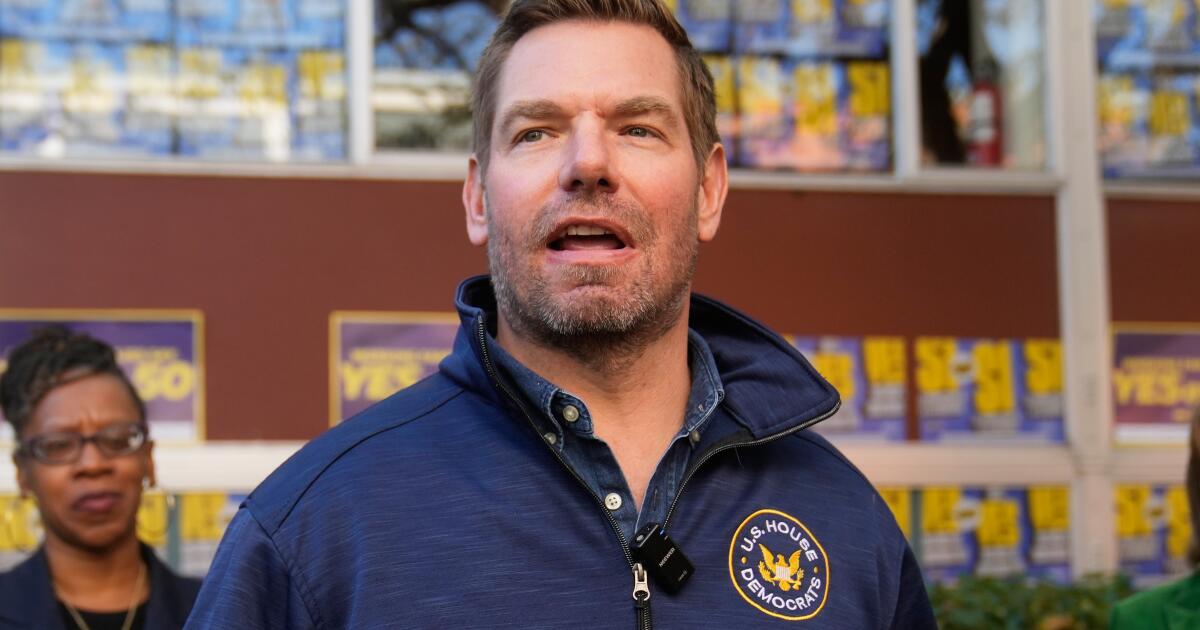
SACRAMENTO — Embattled Rep. Eric Swalwell suspended his campaign for California governor on Sunday but continued to deny accusations that he sexually assaulted a former staff member.
His campaign to succeed Gov. Gavin Newsom had all but collapsed as key Democratic supporters, including Rep. Nancy Pelosi and Sen. Adam Schiff, abandon him.
“To my family, staff, friends, and supporters, I am deeply sorry for mistakes in judgment I’ve made in my past,” Swalwell wrote Sunday on social media.
“I will fight the serious, false allegations that have been made — but that’s my fight, not a campaign’s.”
Swalwell’s gubernatorial campaign had been gaining momentum up until the scandal, with recent polls showing him in the top of the crowded Democratic field of candidates. His abrupt departure throws the race into chaos less than two months before the June 2 primary.
Two reports published Friday allege that Swalwell forced himself on a young, onetime staffer, while other women described the congressman sending them photos of his penis and sexually inappropriate messages.
Swalwell has remained defiant and threatened to sue some of those making the accusations.
House ethics rules bar members from having sex with a subordinate, and House Democratic leader Rep. Hakeem Jeffries of New York is seeking an investigation into the allegations.
More fallout could come: Rep. Anna Paulina Luna (R-Fla.) announced plans to force a House vote to expel Swalwell, a motion supported by some House Democrats, including Reps. Teresa Leger Fernández of New Mexico and Pramila Jayapal of Washington.
Rep. Jared Huffman, a Democrat representing Northern California, also called on Swalwell to resign.
NBC News reported Sunday that there was growing “bipartisan steam” to remove Swalwell, along with Rep. Tony Gonzales (R-Texas), who has admitted to having an affair with a staffer who later killed herself. The expulsions could take place as soon as this week.
At the same time, the Manhattan district attorney’s office has opened an investigation into sexual assault allegations against Swalwell by the former staffer. A representative for the Alameda County district attorney’s office on Saturday said it was in the process of evaluating “whether any alleged criminal conduct occurred” in the agency’s Bay Area jurisdiction.
A former senior advisor to Swalwell’s campaign said the congressman held a Zoom call with his staff Friday morning after reporters contacted them about allegations of sexual impropriety.
Swalwell became emotionless and “dead in the face” when asked about the allegations. He assured staff the accusations were false and asked them to “fight” for him, said the advisor, who asked not to be named so they could speak candidly.
“It’s so disconnected from reality,” the advisor said.
The advisor and others quit immediately after learning later Friday about the details of sexual assault allegations.
The 45-year-old Democratic candidate established himself as a front-runner in the governor’s race despite not having a broad base of supporters in California.
A onetime member of the House Intelligence Committee and a savvy social media user and frequent guest on cable news shows, Swalwell relished his role as a foil to President Trump, using his many platforms to attack and taunt the twice-impeached, criminally convicted president.
He previously worked as a criminal prosecutor and was elected to Congress in 2012 after he defeated Rep. Pete Stark, a fellow Democrat.
He cast himself as a centrist middle-class guy and featured his wife and three young children prominently in his campaign for governor. In an interview with The Times last year, he talked about his decision to continue in politics despite the toll on his family.
Reports in the San Francisco Chronicle and CNN offered a stark contrast to Swalwell’s wholesome image, alleging that he forced himself on a young staffer.
CNN also reported on another woman’s account of an alleged sexual encounter with Swalwell that involved fending off his advances over drinks, and then waking up in his hotel room with no memory of how she got there.
Swalwell and his team threatened legal action against several individuals, the lawmaker’s attorney Elias Dabaie confirmed to The Times.
Swalwell took to social media on Friday night and called the allegations “lies” intended to hurt him in the race.
His close friend, real estate developer Stephen Cloobeck, told The Times on Sunday that Swalwell spent part of the weekend with him at his Beverly Hills home.
“I had a very serious talk with him, and I told him how disappointed I am,” Cloobeck said, adding that the lawmaker apologized.
Cloobeck was among the many Democrats running for California governor. In November he dropped out of the race and endorsed Swalwell. Cloobeck said he had contributed about $1 million to an independent political committee backing Swalwell’s campaign, donations he now deeply regrets.
“I’m literally disgusted and disturbed that my money was taken and other people’s money,” he said.
Since the news reports, campaign staffers have resigned, his fundraising website has gone offline and even his self-described “best friend” in Congress, Sen. Ruben Gallego of Arizona, has withdrawn his endorsement.
Powerful labor groups, including the California Labor Federation, Service Employees International Union California and the California Police Chiefs Assn., withdrew their support.
That union support, along with endorsements from Schiff and other prominent California Democrats, had helped propel Swalwell’s campaign in a race devoid of a clear front-runner. The race to lead the nation’s largest state remains up for grabs, with seven prominent Democrats and two Republicans jockeying to finish in first or second place in the primary and advance to the November election.
Swalwell was among the leading Democrats with the support of 13% of likely voters in a recent UC Berkeley poll co-sponsored by the Los Angeles Times. He was tied for first place among Democrats with former Orange County Rep. Katie Porter, with billionaire Tom Steyer not far behind.
Other Democrats in the race include state Supt. of Public Instruction Tony Thurmond, former U.S. Health and Human Services Secretary Xavier Becerra, San José Mayor Matt Mahan, former Los Angeles Mayor Antonio Villaraigosa, and former state Controller Betty Yee.
The GOP gubernatorial candidates are Steve Hilton, a former Fox News commentator, and Riverside County Sheriff Chad Bianco.

DOJ fires at least 4 prosecutors involved in FACE Act cases during Biden administration

How a Geologist Lives on $200,000 in Bushwick, Brooklyn

Detroit Evening Report: Hamtramck student kidnapped at bus stop – WDET 101.9 FM

Breakfast Burritos, Galbi Patty Melts, and More Dishes Chef Nyesha Arrington Tried in San Francisco

NFL Draft Rumor Reveals 5 Teams Cowboys Can Trade Up With But 1 Isn’t Realistic

Florida High School Football Rankings: Top 25 teams – Oct. 21

How old is Bo Nix? What to know about Oregon quarterback ahead of 2024 NFL Draft

Cleary's 21 help Le Moyne down Central Connecticut State 69-64 in OT

99th annual Pony Swim held in Virginia

Indiana Members Credit Union announced as new anchor tenant at Bottleworks District
DOJ fires at least 4 prosecutors involved in FACE Act cases during Biden administration

Melania Trump’s Epstein remarks turn up the heat on DOJ, Acting AG Todd Blanche to do more
Newsletter: Cautious optimism in Brussels as Orbán ousted in landslide Hungarian opposition win

More than a quarter of private colleges are at risk of closing, a new projection shows

NYC mayor cites $180K racial wealth gap to justify taxes, police cuts
-

 Atlanta, GA1 week ago
1 teenage girl killed, another injured in shooting at Piedmont Park, police say
-

 Georgia6 days ago
Georgia House Special Runoff Election 2026 Live Results
-

 Arkansas3 days ago
Arkansas TV meteorologist Melinda Mayo retires after nearly four decades on air
-

 Pennsylvania7 days ago
Parents charged after toddler injured by wolf at Pennsylvania zoo
-
 Milwaukee, WI1 week ago
Potawatomi Casino Hotel evacuated after fire breaks out in rooftop HVAC system
-

 Technology1 week ago
Anthropic essentially bans OpenClaw from Claude by making subscribers pay extra
-

 Austin, TX6 days ago
ABC Kite Fest Returns to Austin for Annual Celebration – Austin Today
-

 World1 week ago
Zelenskyy warns US-Iran war could divert critical aid from Ukraine