Politics
Opinion: Are the campus protesters angry enough with Biden to vote for Trump?

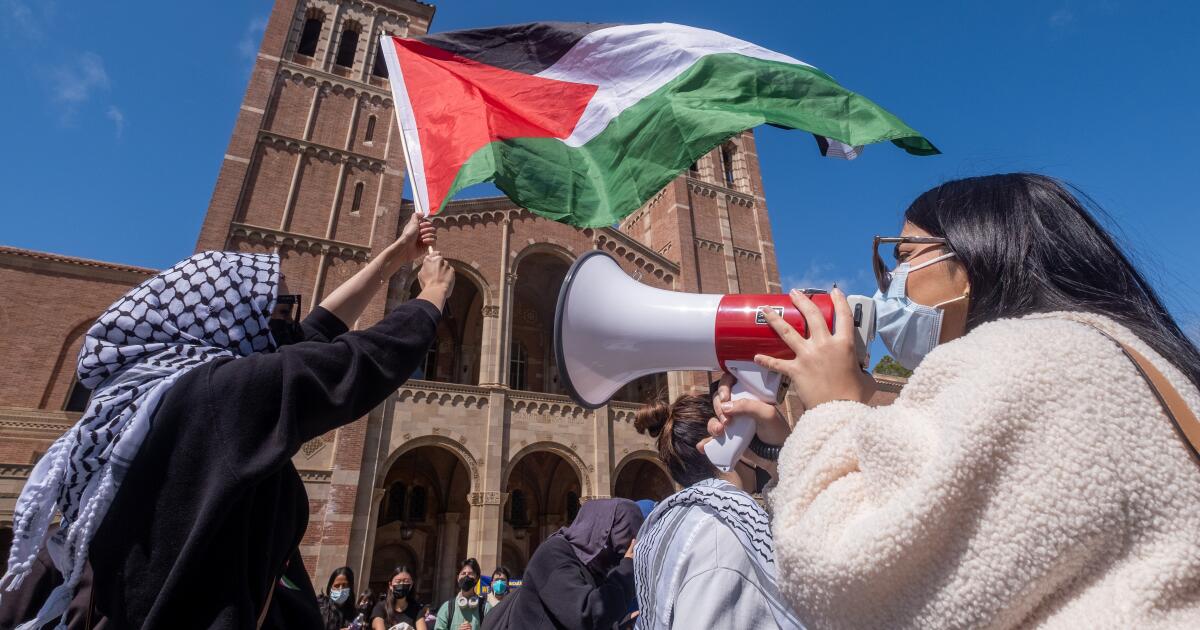
The first time Americans younger than 21 years old could vote in a presidential election was when George McGovern challenged President Nixon in 1972, and conventional wisdom gave McGovern the edge with this new segment of the electorate. After all, McGovern was a Democrat who opposed the Vietnam War when college campuses were seething with protest, the military draft was still in effect and youthful rebellion was having a moment.
And yet on election day, Nixon drew surprising support from nearly half of first-time voters on his way to a landslide victory. Antiwar sentiment might have been widespread, but it wasn’t electorally consequential.
Today, as campus activism continues against U.S. support for Israel in its fight with Hamas in Gaza, young voters — who usually support Democrats — are threatening to withhold their votes from President Biden in protest. History may repeat itself. Their activism may amount to little when votes are counted in November. But if the conflict drives key votes, it could not only put Biden’s reelection at risk but also herald a turning point. This generation and this issue may greatly widen the perception of what matters most for emerging voters.
“Unlike some other foreign policy issues, young people may be viewing this conflict through a different lens that is informed by their generational experiences and, especially, their concerns about racial justice,” Alberto Medina wrote in a report for CIRCLE, the Center for Information and Research on Civic Learning and Engagement at Tufts University.
Although foreign affairs rarely sway voters in this country, young people may not be considering domestic and foreign issues in distinct silos but rather viewing them as deeply interconnected.
Polls already indicate a significant generation gap in how Americans view the Israeli-Hamas conflict; a Pew Research Center survey published in March shows 18- to 29-year-olds were far more critical of Israel and its government, and far more sympathetic to Hamas, than were their elders. Here’s just one data point, of many: Only 38% of the younger cohort said that Israel’s reason to fight Hamas was valid. Among those 65 and older, it was 78%.
That same survey showed that more than a third of the voters under 30 believed that Biden is favoring the Israelis too much in this conflict, far more than any other age group and a number that polls show is rising over time.
Those who argue, or perhaps wish, that this antipathy will not meaningfully affect electoral behavior in November can point to plenty of evidence beyond the historical anomaly it would represent. Polls show that fewer young people are closely following the conflict and as a result are less knowledgeable about it than their elders. And while the campus protesters, especially at elite universities, have dominated media coverage, they still represent a fraction of potential voters under 30. That was true in the Vietnam era as well — one 1969 study found that only 22% of college freshmen participated in a protest against the U.S. government in the previous year.
“There’s a very slim percentage of young people who identify as activist in a deep and sustained fashion,” Jerusha Conner, a professor of education at Villanova University who studies student engagement, told me.
Nonetheless, fueled by the ubiquity of social media, the focus on identity politics and the consequences of globalization, many younger people clearly view the Israel-Hamas war not as a distant problem but rather an outrage felt personally.
This wider perspective may in part reflect the way they have come to understand other issues as clearly both local and global. There’s a solid argument that policies dealing with climate change, for example, cannot be seen simply as domestic issues for those who are inheriting a hotter, more dangerous, less hospitable world. In an April poll, Pew found that 59% of voters under 30 in the U.S. ranked climate change as their top international priority — placing it far above more conventional foreign issues such as relations with China, Russia, NATO or North Korea.
The framing of the Israel-Hamas conflict in moral terms related to identity also brings it close to home. Many American Jews have long viewed the welfare of Israel as central to their identity; in growing numbers, other Americans, especially young Americans of color, connect what they consider oppressive Palestinian suffering with the racial injustice they observe and experience in this country.
Noting these trends, Conner is still not sure how or even whether this wider framing will directly affect voting behavior in November, even among voters active in campus protests. In 2020, she points out, “many activists were not enthused about Biden, but they held their nose and voted for him as a strategic choice. We could see some of the same this time. They are sorely disappointed by him but are savvy enough to understand the stakes.”
Even so, she sees an underlying challenge to the conventional wisdom about the way foreign ramifications of issues and foreign affairs could affect a U.S. election. In their broadest iteration, climate, immigration, reproductive rights, human rights — and the war in Gaza — represent “existential threats to this generation,” she said. “They see the connections. It’s all of a piece.”
Jane Eisner is the former editor in chief of the Forward, a national Jewish news outlet, and the former director of academic affairs at Columbia Journalism School.





NEWYou can now listen to Fox News articles!
President Donald Trump on Monday sent an official notification to Congress about the U.S. strikes against Iran, in which he attempted to justify the military action in the now expanding conflict in the Middle East.
In a letter obtained by FOX News, Trump told Senate President Pro Tempore Chuck Grassley, R-Iowa, that “no U.S. ground forces were used in these strikes” and that the mission “was planned and executed in a manner designed to minimize civilian casualties, deter future attacks, and neutralize Iran’s malign activities.”
This comes after joint U.S.-Israeli strikes against Iran on Saturday as part of Operation Epic Fury, triggering a response from Tehran and a wider conflict in the region. The strikes killed the Islamic Republic’s Supreme Leader Ali Khamenei and other military leaders.
President Donald Trump on Monday sent an official notification to Congress about the U.S. strikes against Iran. (AP Photo/Alex Brandon)
Trump wrote that it is not yet possible to know the full scope of military operations against Iran and that U.S. forces are prepared to take potential further action.
“Although the United States desires a quick and enduring peace, not possible at this time to know the full scope and duration of military operations that may be necessary,” Trump wrote. “As such, United States forces remain postured to take further action, as necessary and appropriate, to address further threats and attacks upon the United States or its allies and partners, and ensure the Government of the Islamic Republic of Iran ceases being a threat to the United States, its allies, and the international community.”
“I directed this military action consistent with my responsibility to protect Americans and United States interests both at home and abroad and in furtherance of United States national security and foreign policy interests,” he added. “I acted pursuant to my constitutional authority as Commander in Chief and Chief Executive to conduct United States foreign relations.”
A general view of Tehran with smoke visible in the distance after explosions were reported in the city, on March 2, 2026, in Tehran, Iran. (Contributor/Getty Images)
Trump said he was “providing this report as part of my efforts to keep the Congress fully informed, consistent with the War Powers Resolution,” as some Republican and Democrat lawmakers attempt to restrain the president’s military action, which they affirm is unconstitutional without congressional approval.
The president also accused Iran of being among the largest state sponsors of terrorism in the world and purported that the “Iranian regime continues to seek the means to possess and employ nuclear weapons,” even after the White House said in June that precision strikes at the time “obliterated” Iran’s nuclear enrichment facilities.
US SURGES FORCES TO MIDDLE EAST AS PENTAGON WARNS IRAN FIGHT ‘WILL TAKE SOME TIME’
A person holds an image of Iran’s Supreme Leader Ayatollah Ali Khamenei as Iranian demonstrators protest against the U.S.-Israeli strikes, in Tehran, Iran, Feb. 28, 2026. (Majid Asgaripour/WANA (West Asia News Agency) via Reuters)
CLICK HERE TO DOWNLOAD THE FOX NEWS APP
“As I previously communicated to the Congress, Iran remains one of the largest, if not the largest, state-sponsors of terrorism in the world,” Trump said in the letter on Monday. “Despite the success of Operation MIDNIGHT HAMMER, the Iranian regime continues to seek the means to possess and employ nuclear weapons. Its array of ballistic, cruise, anti-ship, and other missiles pose a direct threat to and are attacking United States forces, commercial vessels, and civilians, as well as those of our allies and partners.”
“Despite my Administration’s repeated efforts to achieve a diplomatic solution to Iran’s malign behavior, the threat to the United States and its allies and partners became untenable,” he continued.
Fox News’ Tyler Olson contributed to this report.
Related Article


Northern California Rep. Kevin Kiley (R-Rocklin), whose congressional district was carved up in the redistricting ballot measures approved by voters last year, announced Monday that he would not challenge fellow Republican Rep. Tom McClintock of Elk Grove. Instead, he plans to run in the Democratic-leaning district where he resides.
“It’s true that I was fully prepared to run in [McClintock’s district], having tested the waters and with polls showing a favorable outlook in a ‘safe’ district. But doing what’s easy and what’s right are often not the same,” Kiley posted on the social media site X. “And at the end of the day, as much as I love the communities in [that] District that I represent now – and as excited as I was about the new ones – seeking office in a district that doesn’t include my hometown didn’t feel right.”
Kiley, 41, currently represents a congressional district that spans Lake Tahoe to Sacramento. He did not respond to requests for comment.
But after California voters in November passed Proposition 50 — a ballot measure to redraw the state’s congressional districts in an effort to counter Trump’s moves to increase the numbers of Republicans in Congress — Kiley’s district was sliced up into other districts.
As the filing deadline approaches, Kiley pondered his path forward in a decision that was compared by political insiders to the reality television show “The Bachelor.” Who would receive the final rose? McClintock’s new sprawling congressional district includes swaths of gold country, the Central Valley and Death Valley. The district Kiley opted to run in includes the city of Sacramento and the suburbs of Roseville and Rocklin in Placer County.
Kiley was facing headwinds because of the Republican institutional support that lined up behind McClintock, 69, who has been in Congress since 2009 and served in the state Legislature for 26 years previously. President Trump, the California Republican Party and the Club for Growth’s political action committee are among the people and groups who have endorsed McClintock.
Conservative strategist Jon Fleischman, a former executive director of the state GOP, said he was thrilled by Kiley’s decision, which avoids a divisive intraparty battle.
“If you open up the dictionary and look for the word conservative, it’s a photo of Tom McClintock. He is the ideological leader of conservatives, not only in California but in Congress for many, many years,” Fleischman said, adding that the endorsements for McClintock purposefully came because Kiley was considering challenging him.
Kiley, who grew up near Sacramento, attended Harvard University and Yale Law School. A former Teach for America member, he served in the state Assembly for six years before being elected to Congress in 2022 with Trump’s backing. But he has bucked the president, notably on tariffs. He also unsuccessfully ran to replace Gov. Gavin Newsom during the 2021 recall, and has been a constant critic of the governor.
Kiley is now running in a Sacramento-area district represented by Rep. Ami Bera (D-Elk Grove). Democrats in the newly drawn district had a nearly 9-point voter registration edge in 2024. Bera is now running in the new version of Kiley’s district.
In Kiley’s new race, his top rival is Dr. Richard Pan of Sacramento, a former state senator and staunch supporter of vaccinations.
“Kevin Kiley can try to rebrand himself, but voters know his extreme record,” Pan said in a statement. “He has stood with Donald Trump 98% of the time and was named a ‘MAGA Champion.’ The people of this district deserve better than political opportunism disguised as moderation. This race is about who will actually fight for healthcare, public health, and working families. I’ve done that my entire career. Kevin Kiley has not.”

new video loaded: Defense Officials Give No Timeline for War in Iran as U.S. Boosts Forces
transcript
transcript
Defense Officials Give No Timeline for War in Iran as U.S. Boosts Forces
At a Pentagon news conference, top defense officials said that the U.S. military was sending more forces to the Middle East and expects to “take additional losses.” Earlier, President Trump said that the U.S. could continue striking Iran for the next four to five weeks.
-
“We didn’t start this war, but under President Trump, we are finishing it. This operation is a clear, devastating, decisive mission. Destroy the missile threat. Destroy the navy. No nukes. President Trump has all the latitude in the world to talk about how long it may or may not take. Four weeks. Two weeks, six weeks. It could move up. It could move back. We’re going to execute at his command the objectives we’ve set out to achieve.” “We expect to take additional losses. And as always, we will work to minimize U.S. losses. But as the secretary said, this is major combat operations.” Reporter: “Are there currently any American boots on the ground in Iran?” “No, but we’re not going to go into the exercise of what we will or will not do. I think — it’s one of those fallacies for a long time that this department or presidents or others should tell the American people. This — and our enemies by the way — here’s exactly what we’ll do. Why in the world would we tell you, you, the enemy, anybody, what we will or will not do in pursuit of an objective?”
By Christina Kelso
March 2, 2026

Trump sends official notification to Congress on strikes against Iran

Punch the monkey, viral star, experiences dramatic breakthrough among zoo mates

NBA player calls for Hawks to cancel their ‘Magic City’ strip club promotional night out of respect for women

Why the Microsoft 365 Copilot bug matters for data security

California gas is pricey already. The Iran war could cost you even more

Florida High School Football Rankings: Top 25 teams – Oct. 21

Cleary's 21 help Le Moyne down Central Connecticut State 69-64 in OT

How old is Bo Nix? What to know about Oregon quarterback ahead of 2024 NFL Draft

99th annual Pony Swim held in Virginia

Indiana Members Credit Union announced as new anchor tenant at Bottleworks District
Trump sends official notification to Congress on strikes against Iran

Unexpected birth brings hope to near-extinct Amazon tribe

Supreme Court blocks redrawing of New York congressional map, dealing a win for GOP

Map: Earthquake Shakes Central California

Gas prices could jump as Middle East tensions threaten global oil supply
-

 World5 days ago
Exclusive: DeepSeek withholds latest AI model from US chipmakers including Nvidia, sources say
-

 Massachusetts5 days ago
Mother and daughter injured in Taunton house explosion
-

 Denver, CO5 days ago
10 acres charred, 5 injured in Thornton grass fire, evacuation orders lifted
-

 Louisiana1 week ago
Wildfire near Gum Swamp Road in Livingston Parish now under control; more than 200 acres burned
-

 Technology1 week ago
YouTube TV billing scam emails are hitting inboxes
-

 Politics1 week ago
OpenAI didn’t contact police despite employees flagging mass shooter’s concerning chatbot interactions: REPORT
-

 Technology1 week ago
Stellantis is in a crisis of its own making
-

 News1 week ago
World reacts as US top court limits Trump’s tariff powers