Politics
Louisiana Gov. Landry signals push for state to resume death row executions


- Louisiana hasn’t executed anyone on death row since 2010, but Gov. Jeff Landry said he is willing to explore execution methods to fulfill commitments to victims’ families.
- Approximately 60 inmates are currently on death row in Louisiana, but executions have stalled due to legal challenges and drug shortages.
- Alabama recently executed a convict using nitrogen gas, the first such execution in the US since the introduction of lethal injection in 1982.
Louisiana hasn’t carried out a death row execution since 2010, but between a new conservative governor who is in favor of capital punishment and other states implementing alternative methods to lethal injections, the Deep South state could soon look at ways to resume.
During a news conference Wednesday, Louisiana Gov. Jeff Landry hinted at a willingness to explore expanding execution methods, saying he is committed to upholding “contractual obligations” between the state and victims’ families after a death sentence has been handed down in court.
“I have committed myself to those (victims’) families because I have sat in front of those families. I have listened to those families from all over the state,” Landry said. “They deserve their day of justice. That is what the jury has granted them.”
ALABAMA DEATH ROW INMATE EXECUTED WITH NITROGEN GAS, NATION’S FIRST BY A NEW METHOD IN 42 YEARS
“I and the Legislature… are going to fulfill our commitments,” he added.
A sign hangs at the Death Row building at the Louisiana State Penitentiary in Angola, LA. Louisiana Gov. Jeff Landry on Jan 31, 2024, hinted at his willingness to explore expanding the state’s methods of executing those on death row, saying that he is committed to upholding “contractual obligations” between the state and victims’ families. (AP Photo/Judi Bottoni, File)
Around 60 people currently sit on Louisiana’s death row, according to the Louisiana Department of Public Safety & Corrections. However, amid legal battles and a lethal injection drug shortage, executions in the state have stalled, with none currently scheduled.
Over the past few years, a handful of states have sought to reinstate other execution methods, such as firing squads.
Most recently, Alabama carried out the nation’s first execution using nitrogen gas. When that state put Kenneth Eugene Smith, a convicted murderer, to death on Jan. 25, it was also the first time a new execution method had been used in the United States since lethal injection, now the most common one, was introduced in 1982.
“States around us are finding ways and methods in order to execute those who have been tried, and convicted, and sentenced to death,” Landry said.
The idea of using nitrogen gas for executions is gaining traction elsewhere in the country. The state of Oklahoma already has a law authorizing the use of nitrogen gas, as does Missouri, and some others, including Nebraska, have introduced measures this year to add it as an option.
ALABAMA DEATH ROW INMATE SERVED STEAK AS LAST MEAL HOURS BEFORE NOVEL EXECUTION IN MURDER-FOR-HIRE KILLING
Last year there were 24 executions carried out in five states, according to the Washington, D.C.-based Death Penalty Information Center. Twenty-nine states have either abolished the death penalty or paused executions.
Last year, nearly every death row inmate in Louisiana asked for clemency — the commutation of a death sentence to life in prison — from then-Gov. John Bel Edwards, a Democrat who favored eliminating capital punishment. The handful of applicants who were granted a hearing were denied clemency.
During Wednesday’s news conference, Landry said he still plans to call a special legislative session in February during which lawmakers will focus on addressing crime. Capital punishment could also on the table.
Landry said he would be meeting with legislative leaders in the afternoon to discuss what would be on the special session’s agenda.





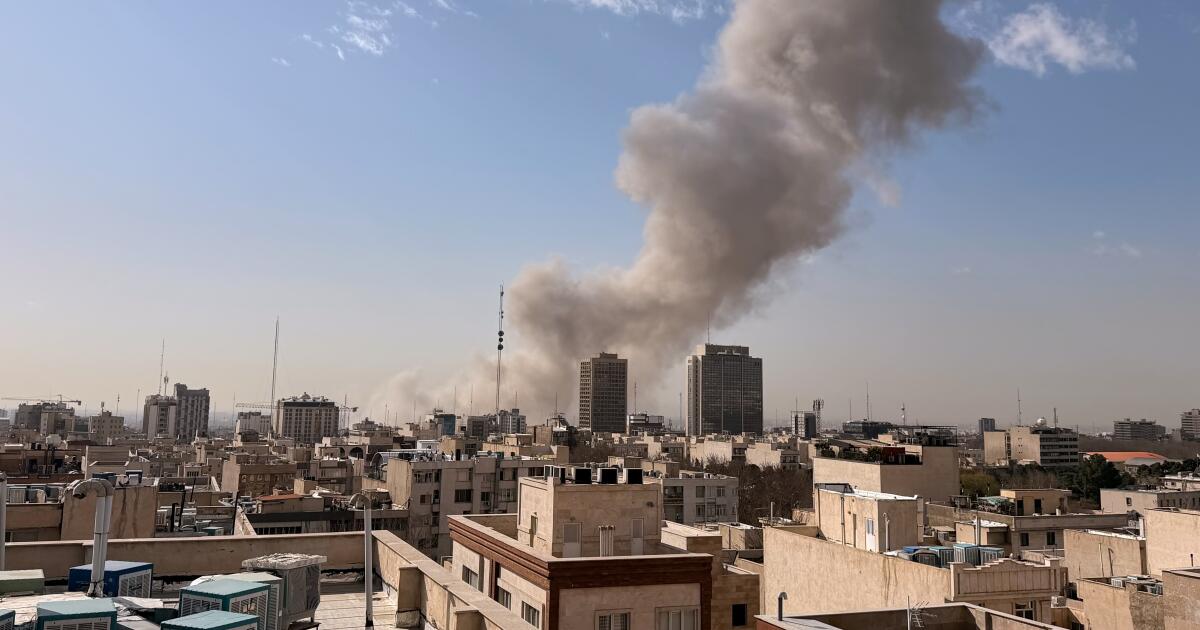
TEHRAN — The U.S. and Israel pummeled Iran early Saturday in an attack aimed at razing the Islamic Republic’s nuclear ambitions and thwarting its efforts to influence the Middle East though proxies such as Hezbollah and Hamas.
Iran’s Supreme Leader Ayatollah Ali Khamenei was killed in the attack, according to President Trump, who in a post on Truth Social wrote that “one of the most evil people in History, is dead. This is not only Justice for the people of Iran, but for all Great Americans.”
More than 200 people were killed in Iran and hundreds more injured, according to Iran’s Red Crescent.
The attacks spurred a furious Iranian retaliation, with multiple barrages striking Israel, a number of Gulf nations and Jordan; and fulfilled long-standing fears that a confrontation with Iran would plunge the entire region into war.
Reports of Khamenei’s death prompted diverse reactions worldwide: In portions of Tehran and Los Angeles, home to a large Persian population, people took to the streets to celebrate. In New York, protesters gathered at Times Square to denounce the attack.
The attack came eight weeks after U.S. forces deployed by Trump toppled Venezuelan President Nicolás Maduro, and Trump said Saturday’s operation also presented a chance for regime change.
Addressing the Iranian people, Trump said, “When we are finished, take over your government. It will be yours to take.”
Trump made the comments in an eight-minute prerecorded video. “This will be probably your only chance for generations,” Trump said, adding, “For many years, you have asked for America’s help, but you never got it. No president was willing to do what I am willing to do tonight.”
The Iranian government confirmed Khamenei’s death.
The attacks began with Israeli strikes Saturday morning — a workday in Iran — on Tehran, the capital, with residents speaking of attacks near Khamenei’s compound, the presidential palace, Iran’s National Security Council, the ministries of defense and intelligence, the Atomic Energy Organization and a military complex.
-
Share via
In Tehran there were scenes of panic, with residents racing to stock up on supplies, leaving shelves bare in grocery stores across the city. Others, heeding warnings from authorities of further strikes, decided to leave the capital. Images on social media showed highways leading out of Tehran choked with traffic.
“It’s going to take 10 hours at least, but it doesn’t matter,” said Zainab, who was loading her car with whatever she could stuff inside for the drive to her sister’s home in Iran’s northeast.
By the end of the day, the streets of Tehran appeared all but abandoned, with residents hunkering down for a night punctuated by the sounds of blasts reverberating across the capital.
Israeli Prime Minister Benjamin Netanyahu, a vociferous advocate for attacking Iran — and who has spent years urging Washington to do so — said the campaign would continue “as long as needed.”
Trump, who long insisted Iran cannot have nuclear weapons, also addressed Iran’s efforts in the Middle East in his video message.
“We are going to ensure that the region’s terrorist proxies can no longer destabilize the region or the world, and attack our forces,” he said. “And we will ensure that Iran does not obtain a nuclear weapon.”
Trump also said U.S. military forces “may have casualties,” adding, “That often happens in war.”
The Iranian Foreign Ministry, in a statement, said that “Iranians have never surrendered to aggression.”
Iranian Foreign Minister Abbas Araghchi, who was leading Iran’s delegation in Oman-brokered negotiations, said the war on Iran was “wholly unprovoked, illegal and illegitimate.”
“Our powerful armed forces are prepared for this day and will teach the aggressors the lesson they deserve,” he wrote on X.

Iranians protest on Saturday in Tehran against attacks on Iran by Israel and the United States.
(Majid Saeedi / Getty Images)
Israel’s military said its attacks were the largest military flyover in its history, with some 200 warplanes dropping hundreds of munitions on about 500 objectives.
Outside of Tehran, explosions could be heard in other cities, including Isfahan, Karaj, Kermanshah, Qom and Urmia, according to Iranian state media. An attack on the city of Minab struck a girls’ school, killing at least 85 students and injuring dozens of others, state-run media said.
Iran’s Red Crescent later said 201 people were killed in attacks across the country, and that 24 out of Iran’s 32 provinces were hit. More than 700 people were injured.
Cellphone and internet communications were disrupted shortly after the attacks began but have since been restored.
Iran struck back across the Middle East, with barrages reported on U.S. bases in the United Arab Emirates, Qatar, Bahrain, Kuwait, Iraq, Saudi Arabia and Jordan. Debris from one of those missiles killed one person in the UAE; another struck a hotel in Dubai. A Kuwaiti airport was hit, but no injuries were reported.
Iran also dispatched multiple waves of missiles to Israel, with residents in Jordan, Syria and Lebanon seeing vapor trails crisscrossing the skies above and the explosive sounds of interceptions.
The waves of ordnance spurred airspace closures across the region, with many airlines suspending service to affected countries and leaving tens of thousands of people stranded.
Araghchi informed his Iraqi counterpart, Fuad Hussein, on Saturday that Tehran will limit its response to U.S. military bases in the region, and that Iran was acting in self-defense.
But the attacks nevertheless infuriated Arab governments. Many came out with statements excoriating Iran for what they described as an unprovoked attack on their sovereignty.
Russia, whose ties with Iran have deepened in recent years, demanded Israel and the U.S. halt military operations. According to the Associated Press, U.N. Ambassador Vassily Nebenzia said, “We insist on the immediate resumption of political and diplomatic settlement efforts … based on international law, mutual respect and a balance of interests.”
In a sign of the rapidly expanding impact of the war, messages purporting to be from Iran’s Islamic Revolutionary Guard Corps were sent to ships ordering them to stay away from the Strait of Hormuz with “immediate effect.”
Shutting the strait, a strategic passageway through which one-fifth of global oil supplies pass, would probably lead to an immediate spike in energy prices and disrupt other shipping.
The opening salvos of what promises to be a lengthy campaign come two days after the U.S. and Iran concluded a third round of Oman-brokered negotiations in Geneva aimed at reducing tensions and stopping the prospect of war.
On Friday, Trump expressed displeasure with the pace of the talks, saying the Iranian side was not negotiating in “good faith” or giving in to U.S. demands. But Oman’s Foreign Minister Badr Albusaidi said a deal was “within reach.”
On Saturday, Albusaidi expressed dismay that “active and serious negotiations have yet again been undermined.”
“Neither the interests of the United States nor the cause of global peace are well served by this. And I pray for the innocents who will suffer,” he said in a statement on X.
The American strikes on Iran drew immediate reaction on Capitol Hill as Democrats and a small bloc of Republicans accused the White House of sidelining Congress on actions they fear will trigger a broader conflict in the Middle East.
“By the president’s own words, ‘American heroes may be lost.’ That alone should have demanded the highest level of scrutiny, deliberation, and accountability, yet the president moved forward without seeking congressional authorization,” Sen. Mark Warner (D-Va.), the vice chair of the Senate Intelligence Committee, said in a statement.
Rep. Ro Khanna (D-Fremont) called on lawmakers to back a measure he is co-sponsoring with Rep. Thomas Massie (R-Ky.) that would compel the administration to seek congressional approval before engaging in any further activity in Iran.
“The American people are tired of regime change wars that cost us billions of dollars and risk our lives,” Khanna said in a video posted on X.
As Democrats warned of constitutional overreach, other lawmakers rallied behind the president.
Sen. Roger Wicker (R-Miss.), the Senate Armed Services Committee chairman, said in a statement that Trump had taken “decisive action against the threat posed by the world’s leading proliferator of terrorism, the Iranian regime.”
“This is a pivotal and necessary operation to protect Americans and American interests,” Wicker said.
Secretary of State Marco Rubio notified some members of Congress’ Gang of Eight, which are the top four leaders in the House and Senate and top Democrats and Republicans on the House and Senate intelligence committees, according to CBS News.
Bulos reported from El Obeid, Sudan, Ceballos from Washington, D.C., and special correspondent Mostaghim from Tehran.

NEWYou can now listen to Fox News articles!
Several House Republicans are pushing Speaker Mike Johnson, R-La., to go to war with the Senate GOP over an election security bill that has little chance of passing the upper chamber under current circumstances.
House GOP leaders convened a lawmaker-only call on Sunday in the wake of a massive military operation against Iran launched by the U.S. and Israel.
After leaders briefed House Republicans on how the chamber would respond to the ongoing conflict — including a vote on ending Democrats’ weeks-long government shutdown targeting the Department of Homeland Security (DHS) — Fox News Digital was told that several lawmakers raised concerns about the Senate not yet taking up the Safeguarding American Voter Eligiblity (SAVE America) Act. Among other provisions, the act would require voters in federal elections to produce valid ID and proof of citizenship.
Rep. Derrick Van Orden, R-Wis., was among those pushing the House to reject any bills from the Senate until the measure was taken up, telling Johnson according to multiple sources on the call, “If we don’t get this done, or at least show that we’ve got some backbone, we’re done. The midterms are over.”
Speaker of the House Mike Johnson, R-La., pauses for questions from reporters as he arrives for an early closed-door Republican Conference meeting at the Capitol in Washington, Tuesday, Feb. 3, 2026. (J. Scott Applewhite/AP Photo)
At least three other House Republicans shared similar concerns. Sources on the call said Rep. Brandon Gill, R-Texas, argued that GOP voters were “not enthused” heading into November and that “the single biggest thing” to turn that around would be forcing the Senate to pass the SAVE America Act.
The SAVE America Act passed the House last month with support from all Republicans and just one Democrat, Rep. Henry Cuellar, D-Texas.
JEFFRIES ACCUSES REPUBLICANS OF ‘VOTER SUPPRESSION’ OVER BILL REQUIRING VOTER ID, PROOF OF CITIZENSHIP
Republicans have pointed out on multiple occasions that voter ID measures have bipartisan support across multiple public polls and surveys. But Democrats have dismissed the legislation as an attempt at voter suppression ahead of the 2026 midterms.
Senate Majority Leader John Thune speaks at a press conference with other members of Senate Republican leadership following a policy luncheon in Washington, D.C. on Oct. 28, 2025. (Nathan Posner/Anadolu via Getty Images)
The legislation would require 60 votes in the Senate to break filibuster, which it’s likely not to get given Democrats’ near-uniform opposition. But House Republicans have pressured Senate Majority Leader John Thune to use a mechanism known as a standing filibuster to circumvent that — which Thune has signaled opposition to, given the vast amount of time it would take up in the Senate and potential unintended consequences in the amendment process.
It also comes as Congress grapples with the fallout from the strikes on Iran and the need to ensure safety for the U.S. domestically and for service members abroad, both of which will require close coordination between the two chambers.
Johnson told Republicans several times on the Sunday call that he was privately pressuring Thune on the bill but was wary of creating a public rift with his fellow GOP leader, sources said.
HARDLINE CONSERVATIVES DOUBLE DOWN TO SAVE THE SAVE ACT
“If we’re going to go to war against our own party in the Senate, there may be implications to that,” Johnson said at one point, according to people on the call. “So we want to be thoughtful and careful.”
Sen. Mike Lee, R-Utah, talks with a guest during a “Only Citizens Vote Bus Tour” rally in Upper Senate Park to urge Congress to pass the Safeguard American Voter Eligibility (SAVE) Act on Wednesday, Sept. 10, 2025. (Tom Williams/CQ-Roll Call, Inc via Getty Images)
At another point in the call, sources said Rep. Andrew Clyde, R-Ga., suggested pairing a coming vote on DHS funding with the SAVE America Act in order to force the Senate to take it up.
CLICK HERE TO DOWNLOAD THE FOX NEWS APP
But both Johnson and House Homeland Security Committee Chairman Andrew Garbarino, R-N.Y., were hesitant about such a move given the enhanced threat environment in the wake of the U.S. operation in Iran.
Both spoke out in favor of the SAVE America Act, people told Fox News Digital, but warned the current situation merited leaving the DHS funding bill on its own in a bid to end the partial shutdown, so the department could fully function as a national security shield.
Related Article


According to President Trump, the United States attacked Iran because the Islamic Republic posed “imminent threats” to the U.S. and its allies, including through its use of terrorist proxies and continued pursuit of nuclear weapons.
“Its menacing activities directly endanger the United States, our troops, our bases overseas and our allies throughout the world,” he said in a recorded statement Saturday.
According to leading Democrats in Congress, Trump’s justification is questionable, especially given his claims of having “completely obliterated” Iran’s nuclear capabilities in separate U.S. bombings last June.
“Everything I have heard from the administration before and after these strikes on Iran confirms this is a war of choice with no strategic endgame,” said Rep. Jim Himes (D-Conn.), ranking Democrat on the House Intelligence Committee and part of a small group of congressional leaders — the Gang of Eight — who were briefed on the operation by Secretary of State Marco Rubio.
That divide is bound to remain an issue politically heading into this year’s midterm elections, and could be a liability for Republicans — especially considering that some in the “America First” wing of the MAGA base were raising their own objections, citing Trump’s 2024 campaign pledges to extricate the U.S. from foreign wars, not start new ones.
The debate echoed a similar if less immediate one around President George W. Bush’s decision to go to war in Iraq following the Sept. 11, 2001, attacks, also based on claims that “weapons of mass destruction” posed an immediate threat. Those claims were later disproved by multiple findings that Iraq had no such arsenal, fueling recriminations from both political parties for years.
The latest divide also intensified unease over Congress ceding its wartime powers to the White House, which for years has assumed sweeping authority to attack foreign adversaries without direct congressional input in the name of addressing terrorism or preventing immediate harm to the nation or its troops.
Even prior to the weekend bombings, Democrats including Sen. Adam Schiff of California were pushing Congress to pass a resolution barring the Trump administration from attacking Iran without explicit congressional authorization.
“President Trump must come to Congress before using military force unless absolutely necessary to defend the United States from an imminent attack,” Sen. Tim Kaine (D-Va.), a member of the armed services and foreign relations committees, said in a statement Thursday.
In justifying the daylight strikes that killed Supreme Leader Ayatollah Ali Khamenei just two days later, Trump accused the Iranian government of having “waged an unending campaign of bloodshed and mass murder” for nearly half a century — including through attacks on U.S. military assets and commercial shipping vessels abroad — and of having “armed, trained and funded terrorist militias” in multiple countries, including Hezbollah and Hamas.
Trump said that after the U.S. bombed Iran last summer, it had warned Tehran “never to resume” its pursuit of nuclear weapons. “Instead, they attempted to rebuild their nuclear program and to continue developing long-range missiles that can now threaten our very good friends and allies in Europe, our troops stationed overseas, and could soon reach the American homeland,” he said.
Other Republican leaders largely backed the president.
“The United States did not start this conflict, but we will finish it. If you kill or threaten Americans anywhere in the world — as Iran has — then we will hunt you down, and we will kill you,” said Defense Secretary Pete Hegseth.
“Every president has talked about the threat posed by the Iranian regime. President Trump is the one with the courage to take bold, decisive action,” said Atty. Gen. Pam Bondi.
While Iran’s coordination with and sponsorship of groups such as Hezbollah and Hamas are well known, Trump’s claims about Tehran’s ongoing development of nuclear weapons systems are less established — and the administration has provided little evidence to back them up.
Democrats seized on that lack of fresh intelligence in their responses to the attacks, contrasting Trump’s latest statements about imminent threats with his assertion after last year’s bombings that the U.S. had all but eliminated Iran’s nuclear aspirations.
“Let’s be clear: The Iranian regime is horrible. But I have seen no imminent threat to the United States that would justify putting American troops in harm’s way,” said Sen. Mark Warner (D-Va.), vice chairman of the Senate Intelligence Committee and a member of the Gang of Eight. “What is the motivation here? Is it Iran’s nuclear program? Their missiles? Regime change?”
Senate Minority Leader Chuck Schumer (D-N.Y.) said in a statement that the Trump administration “has not provided Congress and the American people with critical details about the scope and immediacy of the threat,” and must do so.
House Minority Leader Hakeem Jeffries (D-N.Y.) said the Trump administration needs congressional authority to wage such attacks barring “exigent circumstances,” and didn’t have it.
“The Trump administration must explain itself to the American people and Congress immediately, provide an ironclad justification for this act of war, clearly define the national security objective and articulate a plan to avoid another costly, prolonged military quagmire in the Middle East,” he said.
After the U.S. military announced Sunday that three U.S. service personnel were killed and five others seriously wounded in the attacks, the demands for a clearer justification and new constraints on Trump only increased.
Rep. Ro Khanna (D-Fremont) said Sunday he is optimistic that Democrats will be unified in trying to pass the war powers resolution, and also that some Republicans will join them, given that the strikes have been unpopular among a portion of the MAGA base.
Rep. Thomas Massie (R-Ky.), who partnered with Khanna to force the release of the Jeffrey Epstein files, has said he will work with him again to push a congressional vote on war with Iran, which he said was “not ‘America First.’”
Benjamin Radd, a political scientist and senior fellow at the UCLA Burkle Center for International Relations, said that whether or not Iran represented an “imminent” threat to the U.S. depends not just on its nuclear capabilities, but on its broader desire and ability to inflict pain on the U.S. and its allies — as was made clear to both the U.S. and Israel after the Hamas attacks on Israel on Oct. 7, 2023, which Iran praised.
“If you are Israel or the United States, that’s imminent,” he said.
What happens next, Radd said, will largely depend on whether remaining Iranian leaders stick to Khamenei’s hard-line policies, or decide to negotiate anew with the U.S. He expects they might do the latter, because “it’s a fundamentalist regime, it’s not a suicidal regime,” and it’s now clear that the U.S. and Israel have the capabilities to take out Iranian leaders, Iran has little ability to defend itself, and China and Russia are not rushing to its aid.
How the strikes are viewed moving forward may also depend on what those leaders decide to do next, said Kevan Harris, an associate professor of sociology who teaches courses on Iran and Middle East politics at the UCLA International Institute.
If the conflict remains relatively contained, it could become a political win for Trump, with questions about the justification falling away. But if it spirals out of control, such questions are likely to only grow, as occurred in Iraq when things started to deteriorate there, he said.
Israel and the U.S. are betting that the conflict will remain manageable, which could turn out to be true, Harris said, but “the problem with war is you never really know what might happen.”
On Sunday, Iran launched retaliatory attacks on Israel and the wider Gulf region. Trump said the campaign against Iran continued “unabated,” though he may be willing to negotiate with the nation’s new leaders. It was unclear when Congress might take up the war powers measure.

Smoke a joint and get deep with flowers at this guided floral design workshop in DTLA
Iran’s supreme leader killed in U.S.-Israeli attack, Trump says

Prep talk: Birmingham’s Slava Shahbazyan celebrates winning state wrestling title

Pakistan calls troops, orders 3-day curfew as 24 killed in pro-Iran rallies

US says Kuwait accidentally shot down 3 American jets

Florida High School Football Rankings: Top 25 teams – Oct. 21

Cleary's 21 help Le Moyne down Central Connecticut State 69-64 in OT

How old is Bo Nix? What to know about Oregon quarterback ahead of 2024 NFL Draft

99th annual Pony Swim held in Virginia

Indiana Members Credit Union announced as new anchor tenant at Bottleworks District
Pakistan calls troops, orders 3-day curfew as 24 killed in pro-Iran rallies
US says Kuwait accidentally shot down 3 American jets

House Republicans push Johnson to go to war with Senate over SAVE Act

Israel FM says Europe too divided, slams Spanish PM

Satellite images provide view inside Iran at war
-

 World4 days ago
Exclusive: DeepSeek withholds latest AI model from US chipmakers including Nvidia, sources say
-

 Massachusetts5 days ago
Mother and daughter injured in Taunton house explosion
-

 Denver, CO5 days ago
10 acres charred, 5 injured in Thornton grass fire, evacuation orders lifted
-

 Louisiana1 week ago
Wildfire near Gum Swamp Road in Livingston Parish now under control; more than 200 acres burned
-

 Technology1 week ago
YouTube TV billing scam emails are hitting inboxes
-

 Politics1 week ago
OpenAI didn’t contact police despite employees flagging mass shooter’s concerning chatbot interactions: REPORT
-

 Technology1 week ago
Stellantis is in a crisis of its own making
-

 News1 week ago
World reacts as US top court limits Trump’s tariff powers