Politics
'I got a job, I got class': Why Cal State L.A. isn't roiling with protest

On a recent Wednesday afternoon, the Cal State L.A. student union buzzed with people eating lunch. Outside, students took graduation photos wearing caps and gowns beside a yellow sign that read, “We are L.A.”
Not far away, a small group of student protesters continued their weeks-long encampment in solidarity with the people of Gaza.
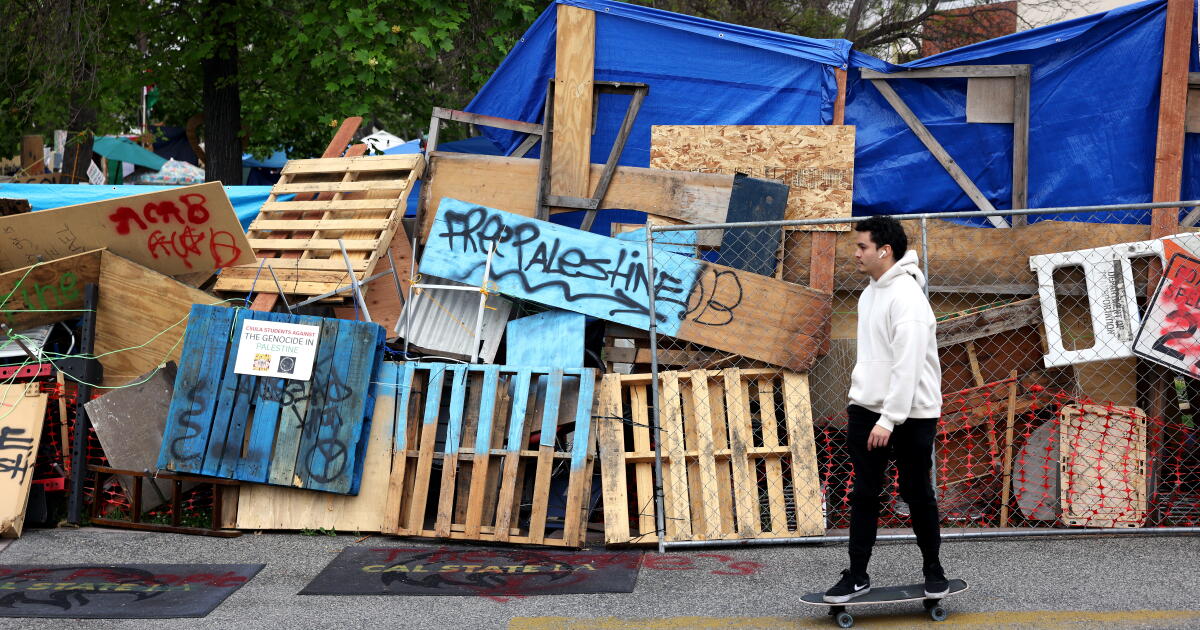
On May 1, organizers established a Gaza Solidarity Encampment on a patch of grass beneath the “Olympic Fantasy” tile mural near the heart of campus. The encampment barrier, fortified with blue tarps and plywood, displays artwork decrying the bloodshed as Israel continues its military offensive in Gaza. Graffiti on a campus building behind the encampment trumpets “Free Gaza” in bold, colorful letters.
The campers’ demands on university leaders are much the same as those from protest organizers at USC, UCLA, Pomona College and other campuses across the country. They are asking the university to disclose its financial investments in companies that supply weapons to Israel and to divest from those funds. They want the Cal State L.A. president to issue a statement supporting a cease-fire in Gaza.
But there are also notable differences in the protest scenes as the encampment enters its fourth week.
The vibe here has been much quieter than the raucous events that unfolded at UCLA and USC, where police in riot gear moved in to clear encampments. Cal State L.A.’s president has said she would let the peaceful demonstration continue without law enforcement intervention. While some encampments have drawn many hundreds of students, the members of Cal State L.A.’s encampment could be counted in the dozens.
Part of that difference is sheer size: Cal State L.A. enrolls 23,000 students, about half the enrollment of UCLA and USC. And unlike those schools, Cal State L.A. is a commuter school. Only 1,000 to 2,000 students live on campus.
The demographics at Cal State are also markedly different from schools such as UCLA and USC. About 75% of Cal State’s student body is Latino, and many of the students are working-class and older than traditional college populations. Just more than 2% of students come from other countries.
By contrast, Asians and whites make up more than 60% of the undergraduate student body at UCLA, where 9% of undergraduates and 17% of graduate students hail from other nations. At USC, a private school, 27% of students are international.
But perhaps the greatest distinction involves free time: Most students at Cal State L.A. are juggling schoolwork with jobs and pressing responsibilities at home.
Shawna Andrews, a nursing student at Cal State L.A., said she hadn’t heard much about the Israel-Hamas war until she saw the encampment. The 29-year-old appreciates the message the protesters are sending. But Andrews, who is graduating, said she simply hasn’t had the bandwidth to pay close attention to the Gaza war between being a full-time student and caring for a family member in the early stages of dementia.
“There are other things that just grab my focus that are here, that are next to me, surrounding me, versus something that’s going on overseas,” Andrews said.
Brian Hernandez, an information systems major, echoed those sentiments. “You do need a little bit of privilege to actually protest … that type of way. To sit in a random place and just hang out,” the 25-year-old said. “I can’t spend days sleeping on a campus. … I got a job, I got class.”
While their numbers are relatively small, the students occupying the pro-Palestinian encampment at Cal State L.A. are ardent about their cause.
(Christina House / Los Angeles Times)
Though their numbers may be smaller than at some other Los Angeles-area schools, the students who raised the Cal State L.A. encampment are ardent about their cause. They vowed this week to stay until their demands were met, even as the semester wound down and commencement ceremonies took place.
“In terms of demographics, the people who are in there, they may not be related to the Palestinians in that way, but we deeply, deeply care because it’s the most devastating thing ever,” said one organizer, who provided only her first name, Sarah, for fear of being harassed online. “We’re students and we’re community, and we still care. Those are the values that our families have instilled in us.”
Last week, Cal State L.A. President Berenecea Johnson Eanes and other administrative leaders met inside the encampment with the protesters to discuss their demands. Eanes reaffirmed her commitment to allowing the students to continue their encampment as a form of free speech. She agreed to disclose Cal State L.A.’s foundation and auxiliary investments, which campus leaders have control over, and to recommend revisions to its investment policies “by adding a human rights-based approach” and reviewing current investments to align with that policy.
Eanes did not agree to issue a statement supporting a cease-fire in Gaza.
“I want to emphasize and I understand, again, that this has been a traumatic experience for many people and many people are suffering pain. It is not lost on me at all,” Eanes said. “I hope that you see my conversation with you as my ongoing commitment to staying in collaboration and staying in communication.”
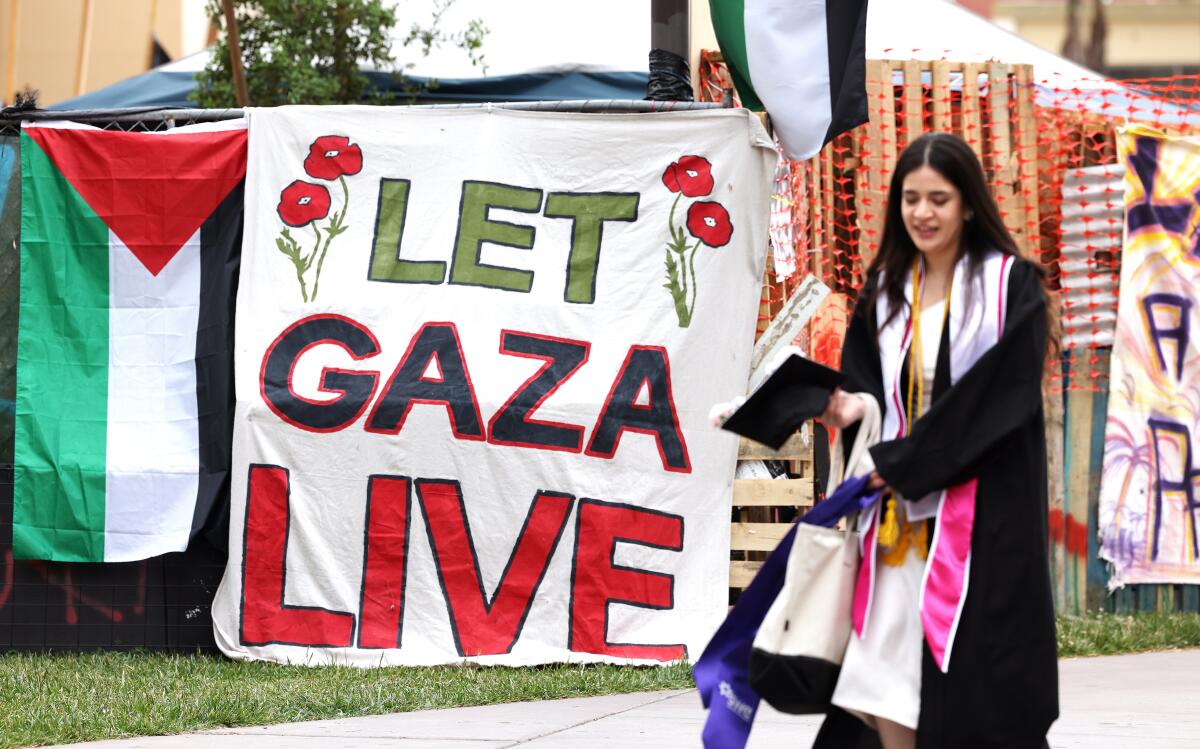
Many Cal State L.A. students live off campus and hold jobs. “I can’t spend days sleeping on a campus,” says one student not involved in the Gaza war protests.
(Christina House / Los Angeles Times)
Leda Ramos, a professor of Chicana(o) and Latina(o) Studies, was also at the encampment last week, helping students monitor who entered. They welcomed passersby to stop in and ask questions, which some did. Ramos’ two daughters are also participating in the encampment, she said.
“This is a demographic that — it’s amazing — that commutes for the most part and really struggles with economic security, and … [there is a] huge number of first-generation students,” Ramos said. “So we’re aware of how this is such a sacrifice.”
One student organizer said she was maintaining a work and class schedule while also staying at the encampment.
“We’re not only working-class students going to work, having jobs, but we also know what’s going on the world and we’ve taken it upon ourselves to be here,” said Red, who like many of the protesters declined to give her full name for fear of harassment. “It’s not that we’re unaware. I think the system has made it so that we don’t focus on those things.”
The community, Ramos noted, has been supportive with donations of food and other items. As Ramos spoke, a woman stopped by to hand one of the organizers a $20 bill. Moments later, a student appeared with a donation of two large jugs of water and offered two thumbs up.
Another student, wearing cap and gown, took a break from graduation photos to chat with the protesters. “Thank you for standing up,” the student told them. The photographer, also a student, shared her gratitude as well.
“I’m Lebanese; this has been my reality for my entire life,” the student said. She promised to stop by later.




At a time when so many forces seem to be dividing us as a nation, it is tragic that President Trump seeks to co-opt or destroy whatever remaining threads unite us.
I refer, of course, to the U.S. men’s Olympic hockey team winning gold: the kind of victory that normally causes Americans to forget their differences and instead focus on something wholesome, like chanting “USA” while mispronouncing the names of the European players we defeated before taking on Canada.
This should have been pure civic oxygen. Instead, we got video of Kash Patel pounding beers with the players — which is not illegal, but does make you wonder whether the head of the Federal Bureau of Investigation has a desk somewhere with neglected paperwork that might hold the answers to the D.B. Cooper mystery.
Then came the presidential phone call to the men’s team, during which Trump joked about having to invite the women’s team to the State of the Union, too, or risk impeachment — the sort of sexist humor that lands best if you’re a 79-year-old billionaire and not a 23-year-old athlete wondering whether C-SPAN is recording. (The U.S. women’s hockey team also brought home the gold this year, also after beating Canada. The White House invited the women to the State of the Union, and they declined.)
It’s hard to blame the players on the men’s team who were subjected to Trump’s joke. They didn’t invite this. They’re not Muhammad Ali taking a principled stand against Vietnam, or Tommie Smith and John Carlos raising fists for Black power at the Olympics in 1968, or even Colin Kaepernick protesting police brutality by kneeling during the national anthem. They’re just hockey bros who survived a brutal game and were suddenly confronted with two of the most powerful figures in the federal government — and a cooler full of beer.
When the FBI director wants to hang, you don’t say, “Sorry, sir, we have a team curfew.” And when the president calls, you definitely don’t say, “Can you hold? We’re trying to remain serious, bipartisan and chivalrous.” Under those circumstances, most agreeable young men would salute, smile and try to skate past it.
But symbolism matters. If the team becomes perceived as a partisan mascot, then the victory stops belonging to the country and starts belonging to a faction. That would be bad for everyone, including the team, because politics is the fastest way to turn something fun into something divisive.
And Trump’s meddling with the medal winners didn’t end after his call. It continued during Tuesday night’s State of the Union address, when Trump spent six minutes honoring the team, going so far as to announce that he would award the Presidential Medal of Freedom to goalie Connor Hellebuyck.
To be sure, presidents have always tried to bask in reflected glory. The main difference with Trump, as always, is scale. He doesn’t just associate himself with popular institutions; he absorbs them in the popular mind.
We’ve seen this dynamic play out with evangelical Christianity, law enforcement, the nation of Israel and various cultural symbols. Once something gets labeled as “Trump-adjacent,” millions of Americans are drawn to it. However, millions of other Americans recoil from it, which is not healthy for institutions that are supposed to serve everyone. (And what happens to those institutions when Trump is replaced by someone from the opposing party?)
Meanwhile, our culture keeps splitting into niche markets. Heck, this year’s Super Bowl necessitated two separate halftime shows to accommodate our divided political and cultural worldviews. In the past, this would have been deemed both unnecessary and logistically impossible.
But today, absent a common culture, entertainment companies micro-target via demographics. Many shows code either right or left — rural or urban. The success of the western drama “Yellowstone,” which spawned imitators such as “Ransom Canyon” on Netflix, demonstrates the success of appealing to MAGA-leaning viewers. Meanwhile, most “prestige” TV shows skew leftward. The same cultural divides now exist among comedians and musicians and in almost every aspect of American life.
None of this was caused by Trump — technology (cable news, the internet, the iPhone) made narrowcasting possible — but he weaponized it for politics. And whereas most modern politicians tried to build broad majorities the way broadcast TV once chased ratings — by offending as few people as possible — Trump came not to bring peace but division.
Now, unity isn’t automatically virtuous. North Korea is unified. So is a cult. Americans are supposed to disagree — it’s practically written into the Constitution. Disagreement is baked into our national identity like free speech and complaining about taxes.
But a functioning republic needs a few shared experiences that aren’t immediately sorted into red and blue bins. And when Olympic gold medals get drafted into the culture wars, that’s when you know we’re running out of common ground.
You might think conservatives — traditionally worried about social cohesion and anomie — would lament this erosion of a mainstream national identity. Instead, they keep supporting the political equivalent of a lawn mower aimed at the delicate fabric of our nation.
So here we are. The state of the union is divided. But how long can a house divided against itself stand?
We are, as they say, skating on thin ice.
Matt K. Lewis is the author of “Filthy Rich Politicians” and “Too Dumb to Fail.”

new video loaded: Hillary Clinton Denies Ever Meeting Jeffrey Epstein
transcript
transcript
Hillary Clinton Denies Ever Meeting Jeffrey Epstein
The former first lady, senator and secretary of state, Hillary Clinton, told congressional members in a closed-door deposition that she had no dealings with Jeffrey Epstein.
-
“I don’t know how many times I had to say I did not know Jeffrey Epstein. I never went to his island. I never went to his homes. I never went to his offices. So it’s on the record numerous times.” “This isn’t a partisan witch hunt. To my knowledge, the Clintons haven’t answered very many questions about everything.” “You’re sitting through an incredibly unserious clown show of a deposition, where members of Congress and the Republican Party are more concerned about getting their photo op of Secretary Clinton than actually getting to the truth and holding anyone accountable.” “What is not acceptable is Oversight Republicans breaking their own committee rules that they established with the secretary and her team.” “As we had agreed upon rules based on the fact that it was going to be a closed hearing at their demand, and one of the members violated that rule, which was very upsetting because it suggested that they might violate other of our agreements.”

By Jackeline Luna
February 26, 2026
Politics
Vulnerable House Dem lashes out at Trump’s ‘racist’ SOTU challenge: ‘That was uncomfortable’

NEWYou can now listen to Fox News articles!
Rep. Janelle Bynum, D-Ore., called a challenge from President Donald Trump at the 2026 State of the Union “racist” when he asked listeners to stand if they agreed the U.S. should prioritize the safety of its own citizens over illegal aliens.
“If you agree with this statement, then stand up and show your support,” Trump said.
“The first duty of the American government is to protect American citizens, not illegal aliens.”
Democrats remained seated for over a minute and a half as the Republican side of the chamber burst into prolonged applause.
President Donald Trump pictured ahead of his 2026 State of the Union Address on Feb. 24, 2026. (Kenny Holston-Pool/Getty Images)
After the address, Bynum, who is on the National Republican Congressional Committee’s list of vulnerable Dem incumbents, said the moment made her uneasy.
“I think you can agree with the ‘what’ — like standing up for American citizens,” Bynum said. “But I disagree with the ‘how.’”
“There’s thinly veiled racist language, anti-immigrant language in what he was asking, and that was uncomfortable,” Bynum said.
Bynum’s office did not immediately respond to a request for comment on how Trump’s challenge had asked lawmakers to discriminate on the basis of race.
TRUMP SHAMES DEMOCRATS IN VIRAL STATE OF THE UNION CHALLENGE ON MIGRANT CRIME: ‘FIRST DUTY’
Trump’s remarks to Democrats on Tuesday came as a partial government shutdown drags on over demands Democrats have made to reform the agency at the heart of Trump’s immigration crackdown.
Rep. Janelle Bynum, D-Ore., left, pictured alongside President Donald Trump, right. (Bill Clark/CQ-Roll Call, Inc via Getty Images; Craig Hudson For The Washington Post via Getty Images)
Democrats are demanding a set of 10 enforcement reforms for Immigration and Customs Enforcement (ICE) and won’t vote to fund the Department of Homeland Security (DHS) until Republicans meet their demands.
DHS, which oversees ICE, went into a shutdown on Feb. 14.
DHS SHUTDOWN DRAGS INTO WEEK TWO AS IRAN THREAT, SOTU CLASH COMPLICATE HILL TALKS
Among other changes, Democrats are looking for a ban on masks, an end to roaming patrols, visible identification and stiffer warrant requirements for arresting illegal aliens in public.
Republicans have dismissed those demands, arguing that Democrats must first pass legislation to restrict “sanctuary cities” — local communities that have instructed their law enforcement not to cooperate with federal agents on immigration apprehensions and deportations.
DHS Agents in Charlotte, North Carolina on a mission. (Ryan Murphy/Getty Images)
CLICK HERE TO DOWNLOAD THE FOX NEWS APP
In a press release after the State of the Union, Bynum, who voted against DHS earlier this year, listed Trump’s framing of his immigration crackdown among her many critiques of the address.
“Tonight, I watched President Trump spend the majority of his speech lying about the state of our economy, demonizing immigrants and spewing more of the same divisive BS. I can’t say I’m surprised,” she wrote.
Related Article


Heart disease threat projected to climb sharply for key demographic

Anthony Richardson free to seek trade after injury setbacks amid Colts’ shift to Daniel Jones

300,000 Chrome users hit by fake AI extensions
Commentary: How Trump helped foreign markets outperform U.S. stocks during his first year in office
Philip Glass canceled a Kennedy Center show, but this conductor brings his work center stage at L.A. Opera

Florida High School Football Rankings: Top 25 teams – Oct. 21

Cleary's 21 help Le Moyne down Central Connecticut State 69-64 in OT

How old is Bo Nix? What to know about Oregon quarterback ahead of 2024 NFL Draft

99th annual Pony Swim held in Virginia

Indiana Members Credit Union announced as new anchor tenant at Bottleworks District

Has India’s influence in Afghanistan grown under the Taliban?

Bill Clinton to testify before House committee investigating Epstein links

Read Judge Schiltz’s Order

Vulnerable House Dem lashes out at Trump’s ‘racist’ SOTU challenge: ‘That was uncomfortable’

Italy calls for suspension of EU carbon market
-

 World1 day ago
Exclusive: DeepSeek withholds latest AI model from US chipmakers including Nvidia, sources say
-

 Massachusetts2 days ago
Mother and daughter injured in Taunton house explosion
-

 Montana1 week ago
2026 MHSA Montana Wrestling State Championship Brackets And Results – FloWrestling
-

 Oklahoma1 week ago
Wildfires rage in Oklahoma as thousands urged to evacuate a small city
-

 Louisiana4 days ago
Wildfire near Gum Swamp Road in Livingston Parish now under control; more than 200 acres burned
-

 Technology6 days ago
YouTube TV billing scam emails are hitting inboxes
-

 Denver, CO2 days ago
10 acres charred, 5 injured in Thornton grass fire, evacuation orders lifted
-

 Technology6 days ago
Stellantis is in a crisis of its own making