Politics
How a ‘game-changer’ child tax credit for families became a priority for Harris, Vance

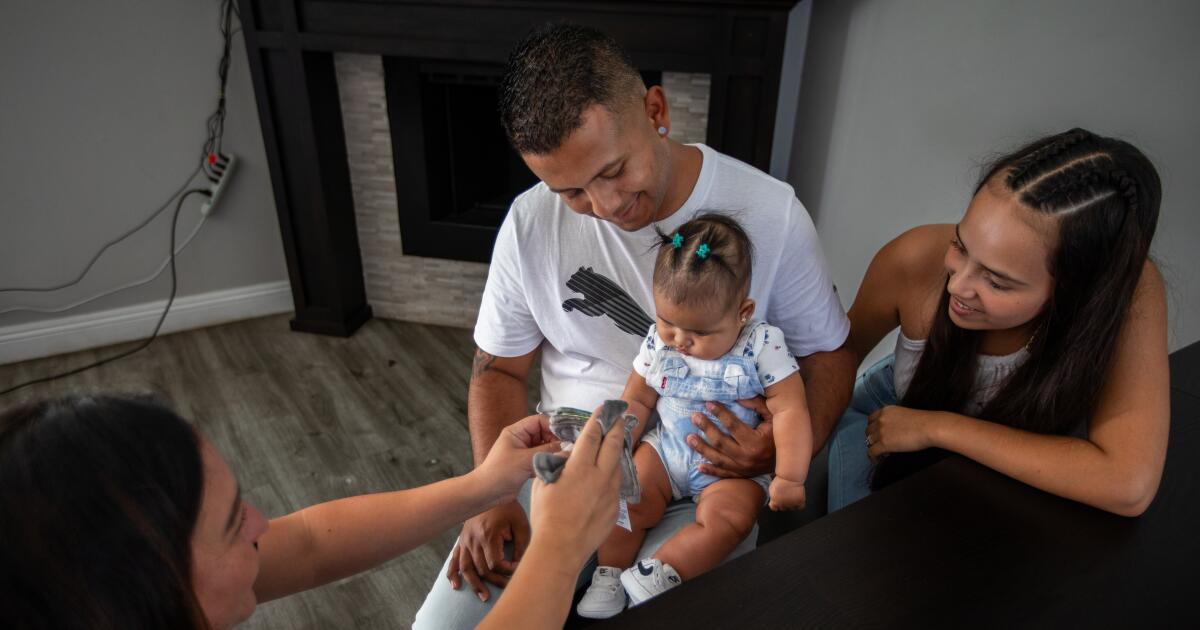
A child tax credit is quickly emerging as a major family-friendly issue and a possible bipartisan point of agreement in this year’s presidential campaign, touted by both Vice President Kamala Harris and Republican vice presidential nominee JD Vance.
During a speech Friday in the battleground state of North Carolina, Harris proposed restoring the popular pandemic-era child tax credit of up to $3,600, and offering an additional $6,000 credit to families with newborn babies.
“That is a vital, vital year of critical development of a child, and the cost can really add up, especially for young parents who need to buy diapers and clothes and a car seat and so much else, and we will do this while reducing the deficit,” Harris said.
And in an appearance on CBS’ “Face the Nation” last Sunday, Vance said he supported an increase to the child tax credit.
“Look, I’d love to see a child tax credit that’s $5,000 per child,” he said. “But you, of course, have to work with Congress to see how possible and viable that is.”
Engage with our community-funded journalism as we delve into child care, transitional kindergarten, health and other issues affecting children from birth through age 5.
What is the child tax credit?
The child tax credit was first enacted in 1997 as a way to give middle- and upper-income families an extra $500 nonrefundable tax credit per year for each of their children. The credit has been expanded several times under both Republican and Democratic administrations.
In 2017, President Trump signed into law an increase that raised the credit up to a maximum of $2,000 per child. The lowest-income families received a smaller credit than middle-class families — currently, up to $1,600 per child.
Then in 2021, during the height of the pandemic, President Biden signed into law a temporary, fully refundable increase that expanded the child tax credit to $3,600 per child under 6, and $3,000 for older children. This expansion allowed all families — even those earning the lowest incomes — to receive the full amount and have it deposited in monthly allotments directly into their bank accounts. The one-year expansion cost an additional $105 billion.
A historic drop in child poverty
This regular, monthly payment of $250 to $300 each month was a “game-changer” for families, said Christy Felling, director of communications for the nonprofit First Five Years Fund. “That’s really what had a dramatic impact on child poverty.”
The policy had an immediate and enormous impact. In 2021, the child poverty rate dropped by nearly half compared with the year before, from 9.7% down to 5.2% — a historic low.
“We know this works and has a direct impact on so many issues, including child poverty,” Harris said Friday.
Elyssa Schmier, a vice president at the advocacy group MomsRising, described the credit as “life-changing for a lot of people” and “wildly popular.”
Research has found that families spent the money on food and housing, as well as children’s clothing, books and toys. Some stay-at-home parents were able to afford the child care they needed to return to work. The biggest impacts were seen felt Black and Latino families, said Christopher Wimer, director of the Center on Poverty and Social Policy at Columbia University. “Its hard for me to pinpoint another policy that would be as effective at lifting kids out of poverty,” he said.
But when the expansion of the child tax credit expired at the end of the year, Congress did not extend it, and the child poverty rate skyrocketed to 12.4% — even higher than pre-pandemic levels.
At least 15 states, including California, have child tax credits of their own, in addition to the federal credit. Gov. Tim Walz of Minnesota, Harris’s running mate, signed into law a credit of $1,750 per eligible child, among the most generous state policies.

Are you a SoCal mom?
The L.A. Times early childhood team wants to connect with you! Find us in The Mamahood’s mom group on Facebook.
Share your perspective and ask us questions.
Where does the child tax credit stand today?
The current child tax credit of up to $2,000 per child is set to expire in 2025. Because it is not fully refundable, 24 million low-income children receive a smaller credit than middle-class families.
Legislation to increase the credit again has recently garnered bipartisan support in Congress. In January, the House passed a smaller version of an expansion, but the legislation ran up against Republican opposition in the Senate earlier this month and failed. Despite his stated support for an expanded child tax credit, Vance did not show up for the vote.
“It’s really, really hard to get legislation passed right now. It got swept up into the chaos,” said Felling, of The First 5 Years Fund.
So far, Trump has not mentioned the child tax credit during his speeches and rallies.
Harris’ focus on raising the child tax credit is among her first economic policy proposals of the campaign — and has advocates optimistic about another expansion.
“There are so many hot-button issues facing the United States right now, that just to get the spotlight and attention on child-related issues from both sides is half the battle,” said Felling.
Wimer said Harris’ proposal to provide an extra $6,000 to infants in the first year of life was particularly exciting.
“Our research that the birth of a child is quite often like a poverty-inducing event,” he said.
All of the costs of a newborn — including a crib, diapers, formula — add up quickly and can cause real economic stress for a struggling new family. An influx of money during one of the most developmentally sensitive moments of a child’s life has the potential to make a real difference, he said.
This article is part of The Times’ early childhood education initiative, focusing on the learning and development of California children from birth to age 5. For more information about the initiative and its philanthropic funders, go to latimes.com/earlyed.

Politics
Jeffries welcomes Democratic Socialists into the fold as critics warn party is revealing ‘exactly who it is’

NEWYou can now listen to Fox News articles!
House Minority Leader Hakeem Jeffries publicly embraced a new crop of congressional nominees Saturday, including three Democratic Socialists of America-backed candidates whose primary victories have fueled fresh debate over the Democratic Party’s leftward shift ahead of the 2026 midterms.
The powerful New York lawmaker’s post highlights the challenge facing the top House Democrat as he works to unite his party ahead of the general election. If Democrats take back the House in November, Jeffries is expected to become the next speaker. That means he’ll likely be leading a Democratic caucus with more self-described Democratic Socialists than ever before. So far, more than a dozen Democratic Socialists of America-backed candidates have won or advanced in primaries across the country this election cycle.
In a post on X, Jeffries wrote, “Congratulations to our Democratic nominees,” before listing the party’s congressional candidates from across New York. Among those recognized were Brad Lander, Claire Valdez and Darializa Avila Chevalier, all of whom are affiliated with or backed by the Democratic Socialists of America and secured victories in closely watched Democratic primaries last week.
House Minority Leader Hakeem Jeffries has called Trump official Bill Pulte a “malignant clown.” (Aaron Schwartz/Bloomberg)
“From public servants to union organizers to community activists, the path is different but the work is the same,” Jeffries wrote. “We must decisively address the affordability crisis and crush far-right extremism!”
RISING SOCIALIST STARS ON TRACK TO CONGRESS: WHO ARE DARIALIZA AVILA CHEVALIER, BRAD LANDER AND CLAIRE VALDEZ?
Lander, Chevalier and Valdez all received backing from New York City Mayor Zohran Mamdani, whose endorsements helped cement the growing influence of the Democratic Party’s progressive wing in New York politics. Lander and Chevalier defeated Jeffries-endorsed incumbents Reps. Dan Goldman and Adriano Espaillat in their respective Democratic primaries. Jeffries did not endorse in the race won by Claire Valdez, which was an open seat.
Now, as Democrats turn their attention to the general election, he appears to be rallying behind the party’s nominees as they try to win back the House in November.
The socialist candidates have also faced scrutiny over resurfaced social media posts, support for defunding the police and anti-Israel rhetoric, positions that have put them at odds with many in the Democratic Party.
Socialist New York congressional nominees Darializa Avila Chevalier (L), Claire Valdez (C) and Brad Lander. (Michael M. Santiago/Getty Images; Michael Nagle/Bloomberg via Getty Images; Adam Gray/Bloomberg via Getty Images)
Chevalier has faced scrutiny over resurfaced social media posts, including one in which she called to “literally abolish the border.”
She has also faced renewed scrutiny over past social media posts targeting leading Democrats, including calling former President Joe Biden a “war criminal,” attacking former Vice President Kamala Harris and rebuking Sen. Bernie Sanders over Israel.
Like Chevalier, Valdez and Lander, who is Jewish, share her sentiment that Israel is committing “genocide” in Gaza.
LIBERAL MS NOW WRITER CALLS MAMDANI PRIMARY SWEEP A ‘GENUINELY SCARY NIGHT FOR NEW YORK CITY JEWS’
Jeffries’ decision to publicly congratulate the three nominees quickly drew criticism.
The Republican Jewish Coalition blasted Jeffries’ congratulatory message, warning Jewish voters that these candidates are not the Democrat “fringe” but the new faces of the party.
“To Jewish Democrats: your party is telling you EXACTLY who it is,” the Coalition wrote. “These future members of Congress, who @hakeemjeffries is welcoming with open arms, want to: Abolish prisons and borders. Defund the police. Downplay 9/11,” rattling off other serious controversies stemming from the candidates.
Jamie Metzl, a former National Security Council and State Department official and lifelong Democrat, blasted Jeffries for congratulating the nominees.
New York City Mayor Mayor Zohran Mamdani speaks at a news conference Thursday in Manhattan. (Spencer Platt/Getty Images)
“When I first read this post, I assumed it was from a spoof account. I am deeply concerned that it appears to be all too real,” Metzl wrote. “To welcome these nominees without acknowledging and criticizing their self-declared sympathies for U.S.-designated terrorist organizations, their calls to abolish the police, their stated desire to dismantle Western civilization, and their blatant anti-Americanism is to sacrifice the core principles of the Democratic Party.”
Metzl accused Jeffries of putting his bid to become House speaker ahead of the Democratic Party’s principles.
“I understand your ambition to become Speaker should Democrats retake the House, but you should not sacrifice the principles of our party to advance your own political aspirations,” Metzl wrote.
Democratic leadership has been in the hot seat this week facing questions from the media about how to reconcile support for the New York slate of socialist candidates, particularly after Valdez’s supporters were seen shouting “you’re next” at a television screen showing Jeffries on Tuesday night.
“They’re gonna eat you next Congressman – and replace you with one of their own,” conservative commentator Meghan McCain posted on X.
“This is funny,” conservative commentator Robby Starbuck posted on X. “Hakeem still doesn’t realize that the communists are going to eat him alive. Clearly not a student of history. Bless his heart.”
CLICK HERE TO DOWNLOAD THE FOX NEWS APP
In a CNN appearance on Friday, Jeffries said, “I think that what happens in a handful of primaries in one of the bluest cities in the country is not in any way indicative of what needs to happen in November, where we need to reelect every single frontline Member, common sense Democrats, authentically committed to making life better for the American people, opposing these extreme Republicans who have been nothing but a reckless rubber stamp for Donald Trump’s agenda.”
“And at the same period of time, make sure that we flip red seats blue, including in New York-17, where we have a combat veteran, incredibly patriotic American Cait Conley, who came out of a primary on Tuesday as well and is an incredibly strong candidate. She will defeat Mike Lawler in New York in November.”

Twenty-four days after the polls closed on election day, Los Angeles County officials have certified the results from the 2,227,461 ballots cast. Despite questions raised about the pace of the vote count, a Times analysis found ballots this June were tallied faster than in previous cycles.
California is known to have a slow vote count, partially because of the state’s grace period for mail-in ballots. This year, counties were required to report most of the ballots by June 15, with some exceptions, including for mail-in ballots received within seven days of election day and ballots requiring additional verification such as signature curing. The process has spurred baseless claims of fraud from President Trump and others, leading the U.S. Supreme Court to take up a case on whether mail-in ballots must be received by election day to count.
The state has reported 9.4 million processed ballots. Officials estimate about 5 ballots remain to be counted and 17,650 are waiting to cure a missing or mismatched signature.
Compared with the last time both governor and Los Angeles mayor were on the ballot, county election officials counted more ballots, and tallied them faster than in 2022, The Times found.
In Los Angeles County, turnout jumped from 28% of eligible voters in the 2022 primary to 38% this June, according to the county registrar. Meanwhile, the share of vote-by-mail ballots dropped about 3 percentage points to 82%, indicating a rise in in-person voting.
Statewide, early results show 41% of registered voters turned up for the June election, up from 33% in 2022, according to the secretary of state. County elections officials must report their final results by July 3, giving state officials a week to certify all election results.
The Los Angeles Times reports election results from the county clerk as well as from the Associated Press. The AP provides ballot counts, a calculation of the expected vote and race calls for statewide and national races.
The expected vote percentage, or EEVP, is an estimate of the total number of votes that will eventually be certified. That number can be adjusted based on new information over time.
“Before counting begins in California, our estimates are primarily informed by turnout in past similar elections plus pre-election data on ballot returns, with projections based on what percentage of ballots had already been received at the same point in past elections,” AP director of election analytics Emily Swanson said in an email.
In the gubernatorial and mayoral races, more than half of the votes were counted by the end of election day, EEVP data show.

Swanson’s team also observed a faster vote count this year than in the 2022 and 2024 primaries.
In January 2024, L.A. County consolidated its election operations into a new ballot processing center in the City of Industry. Dean Logan, head of the L.A. County registrar-recorder/county clerk’s office, told The Times earlier this month that the facility, which is open to observers, is designed for transparency, security and efficiency.
“It doesn’t take long to count. The counting process is very fast,” Logan said ahead of election day. “What extends the time period is those options that are provided under California law for voters — to allow everyone the opportunity to vote up until election day, and then allowing us the time to process those with the same level of security and integrity that we did the ballots that were received two weeks before the election.”
Despite the faster count, the Associated Press took longer to call winners, suggesting these races were more competitive. The AP makes such declarations by determining whether there is an opportunity for a trailing candidate to catch up to the race leader. It has been calling races for nearly 180 years.
Both the gubernatorial and Los Angeles mayoral race saw a 30% increase in votes from 2022. The governor’s race received more than 9.2 million votes compared with 7 million in 2022. The Los Angeles mayor’s race received more than 850,000 votes, an increase from nearly 650,000 in 2022.


The vote counting process for California, Washington, Oregon, Nevada and Alaska may change for the November midterm election, depending on which way the U.S. Supreme Court rules.
Data and graphics assistant editor Sean Greene contributed to this report.

NEWYou can now listen to Fox News articles!
The attorney who helped persuade the Supreme Court to strike down Hawaii’s private-property concealed-carry restriction on Thursday criticized the state’s reliance on a Reconstruction-era Black Code to defend the law.
In a 6-3 decision in Wolford v. Lopez, the Court held that Hawaii cannot require licensed gun owners to obtain express permission before carrying firearms onto private property open to the public. Gun-rights challengers dubbed the policy the “vampire rule” because lawful gun owners had to be “invited in” before entering businesses while armed.
“It is disgraceful that any state would rely on a law specifically aimed at taking away the Second Amendment rights or any constitutional right of Black Americans as it was at that time,” attorney Kevin O’Grady, who represented the plaintiffs, told Fox News Digital.
“And it’s not surprising, however, that Hawaii would rely on it as they are diametrically opposed to the Second Amendment. We fully expected that the Supreme Court would identify that as the kind of law that one absolutely should not look to determine whether or not something is constitutional because this is the perfect example of something which is not constitutional.”
SUPREME COURT HANDS SECOND AMENDMENT WIN TO CONCEALED CARRY HOLDERS IN BLUE STATE GUN CONTROL CASE
Justice Ketanji Brown Jackson speaks on stage during the “Ketanji Brown Jackson on Lovely One: A Memoir” panel at The Atlantic Festival in Washington, D.C., on Sept. 20, 2024. (Tasos Katopodis/Getty Images for The Atlantic)
A major flashpoint was Hawaii’s effort to justify the law under the Supreme Court’s 2022 decision in New York State Rifle & Pistol Association v. Bruen. Since Bruen, courts evaluating firearm regulations have generally asked whether modern gun restrictions are consistent with the nation’s historical tradition of firearm regulation.
Hawaii cited several historical laws, including an 1865 Louisiana statute enacted as part of the post-Civil War Black Codes. The law made it unlawful to carry firearms onto another person’s property without the owner’s consent.
Justice Samuel Alito, writing for the majority, rejected that argument outright, calling the Louisiana statute a “tainted artifact” that was enacted to disarm newly freed Black Americans and leave them defenseless after the Civil War. He concluded the law “cannot be taken seriously” as evidence of the Second Amendment’s original public meaning.
Justice Ketanji Brown Jackson, however, argued in her dissent the Court skipped an important constitutional question.
Jackson did not defend the Black Codes, which she acknowledged were racist and used to oppress newly freed Black Americans. But she argued the Court should have first decided whether the Louisiana law itself violated the Second Amendment, or whether the real constitutional problem was that it was enforced in a racially discriminatory way.
SUPREME COURT TAKES SECOND AMENDMENT CASE CHALLENGING HAWAII GUN LAW
Todd Settergren handles pistols inside his display case at Setterarms gun shop in Walnut Creek, Calif., on Jan. 13, 2017. (Michael Macor/The San Francisco Chronicle via Getty Images)
“It might well be that the Black Codes are invalid inputs for Bruen’s test,” Jackson wrote, “but only if they violated the Second Amendment — which may or may not be the case.”
Instead, she argued that under the Supreme Court’s Bruen framework, the Court could not simply dismiss those laws without first explaining why they should not count as historical evidence.
She outlined two possibilities: either the firearm restrictions in the Black Codes were constitutional but enforced in a racially discriminatory manner — making the constitutional defect an equal-protection problem — or the restrictions independently violated the Second Amendment. The Court, she argued, never resolved that question before excluding the Louisiana law from consideration.
US APPEALS COURT STRIKES DOWN CALIFORNIA’S OPEN-CARRY BAN IN MAJOR SECOND AMENDMENT RULING
“Either history does matter, and if so, all potentially relevant historical experiences must be thoroughly examined,” she wrote. “Or, it does not, and the Court should just admit that the test it has created is boundless.”
Her reasoning immediately drew pushback from critics, who argued the Fourteenth Amendment was passed in response to laws like the Black Codes that denied newly freed Black Americans their constitutional rights, like the right to bear arms.
Rain clouds roll over the United States Supreme Court building in Washington, D.C., on June 18, 2026. (Chip Somodevilla/Getty Images)
“I would simply point her to what Justice Alito pointed out in the majority ruling — it was in response to these types of laws that the Fourteenth Amendment was enacted in the first place,” Hannah Hill, vice president of the National Association of Gun Rights, told Fox News Digital.
US JUDGE TOSSES ILLINOIS’ BAN ON SEMIAUTOMATIC WEAPONS, GOVERNOR PLEDGES SWIFT APPEAL
“That right there is your answer,” Hill continued. “Yes, there was a historical tradition — they enacted a constitutional amendment to fix that deprivation of rights, and that is also in the Constitution now, so I think she should probably go back to law school.”
Tyler Yzaguirre, president of Second Amendment Institute, echoed O’Grady and Hill’s criticism.
“Those laws were not legitimate expressions of our Nation’s constitutional tradition; they were examples of government using its power to deprive Americans of a fundamental right,” Yzaguirre told Fox News Digital. “The Court was right to reject the notion that such laws could define the historical limits of the Second Amendment.”
CLICK HERE TO DOWNLOAD THE FOX NEWS APP
Businesses may still ban guns by posting or enforcing a “no firearms” policy. But what Hawaii can’t do, the Court said, is treat every business as off-limits to licensed gun owners unless the owner specifically says guns are allowed.
-

 Cleveland, OH5 minutes ago
Timofey Mozgov Reveals Sadness, Regret Over Viral 2016 Cleveland Cavaliers Reunion
-

 Austin, TX12 minutes ago
Texas Game Wardens warn of dangers as they respond to emergencies across Texas
-

 Alabama15 minutes ago
Two ejected after boat crash on Alabama lake
-

 Alaska20 minutes ago
Alaska Sen. Dan Sullivan’s primary challenger who has the same name is eligible for ballot, judge rules
-

 Arizona27 minutes ago
Where People Are Moving To In Arizona In 2026
-

 Arkansas30 minutes ago
Fourth of July 2026: Where to celebrate across Northwest Arkansas | Northwest Arkansas Democrat-Gazette
-

 California30 minutes ago
Long Beach officials confirm first California case of human West Nile virus in 2026
-

 Colorado42 minutes ago
Colorado State Patrol investigating after pedestrian struck on Highway 36

