Politics
Hold the 'blue wall,' or light up the Sun Belt? Harris eyes path through U.S. battlegrounds

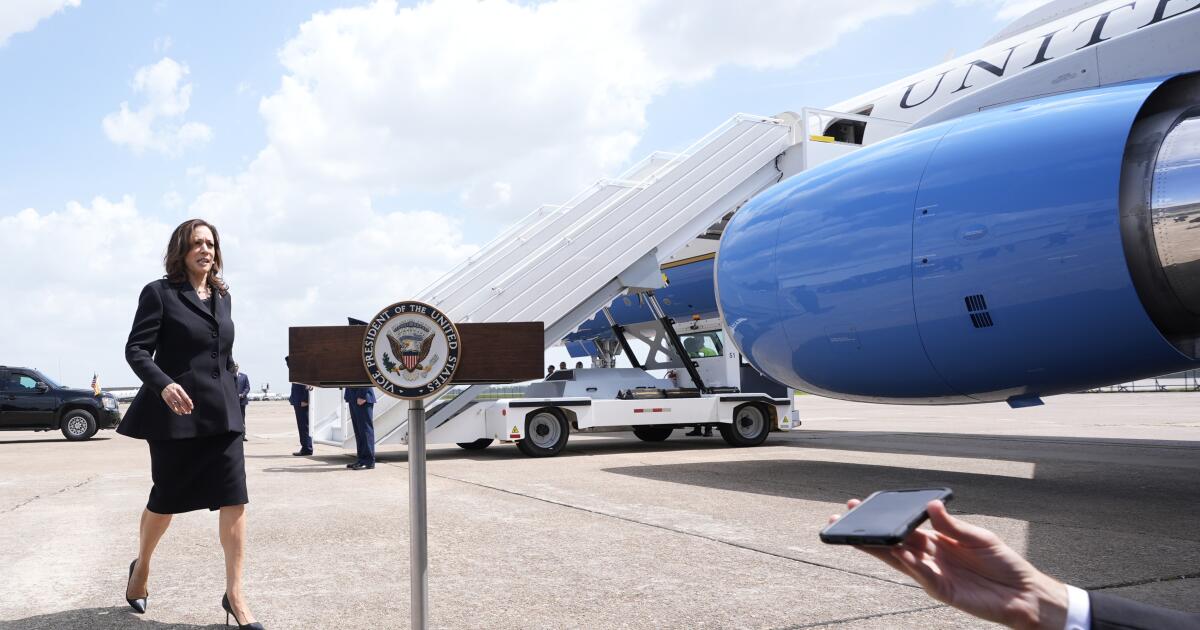
Vice President Kamala Harris’ late entry into the presidential race against former President Trump reset the political playing field in important ways, giving Democrats a promising boost in polling and a huge infusion of cash and volunteers. But it didn’t change everything.
In a nation of more than 330 million people, the 2024 election — just like the 2016 and 2020 elections before it — will almost certainly be decided by a relatively small number of voters in a handful of battleground states, political experts said.
When Hillary Clinton lost to Trump in 2016, it was by fewer than 80,000 votes across Wisconsin, Michigan and Pennsylvania combined. When President Biden beat Trump in 2020, it was by fewer than 50,000 votes across Wisconsin, Arizona and Georgia.
Now, Harris is in a high-speed race to start executing her own path to victory through the nation’s battlegrounds, which include Pennsylvania, Michigan and Wisconsin — three of the “blue wall” of states that lean Democratic — and Georgia, North Carolina and Arizona, in the nation’s Sun Belt. This week, she is expected to pick her running mate — possibly from one of those states — and begin holding major rallies in places such as Philadelphia, Detroit, Raleigh, N.C., and Savannah, Ga.
Amid the high-stakes number-crunching that campaigns always do to determine their best path to victory, the Harris campaign is citing polls showing her closing the gap with Trump in nearly every battleground, and seeming more bullish than Biden’s campaign ever did. On the question of whether Harris might focus on the blue wall or the Sun Belt, her campaign’s answer has been both.
Harris speaks at a Black sorority gathering in Houston last week. One expert believes her campaign will also invest in voter turnout in the South to put Donald Trump on the defensive even in red states.
(LM Otero / Associated Press)
In a call with reporters last week, the campaign’s battleground states director, Dan Kanninen, said the flood of support for Harris across the country included 360,000 new volunteers and $200 million in donations during the first week of her candidacy — two-thirds of which was from new donors.
On Friday, the Harris campaign said that it had $377 million in cash on hand — compared with $327 million for Trump — and that it would be spending hard and fast to ramp up the fight.
Kanninen said the campaign is rapidly expanding an already large network of Biden-Harris field offices and volunteers across the battleground states. He said that there were 600 staffers “on the ground in the blue wall,” and that 150 more would be added by mid-August. Aides also planned to double the size of the campaign’s teams in Arizona and North Carolina, and were opening new field offices in Georgia.
Volunteers were fanning out to knock on doors, and being trained on how best to spur pro-Harris conversations online.
“We’re making these investments across the entire map because the data is clear: We have multiple pathways to 270 electoral votes,” Kanninen said. “The vice president is strong in both the blue wall and in the Sun Belt, and we are running hard in both.”
The Trump campaign did not respond to a request for comment on its strategy for battleground states.
In the American electoral system, voters cast ballots to elect the president, but the candidate who receives the most votes nationally is not necessarily the winner. Clinton, for example, received about 2.9 million more votes than Trump, and still lost.
That’s because the candidate who wins the most individual votes in a state receives all of that state’s electoral votes, in what’s known as the electoral college. The number of electoral votes per state is determined by population, with the most populous states — such as California — receiving the most.
In order to win an election today, a presidential candidate must secure 270 electoral votes, and different presidents have gotten there through different pathways. Barack Obama famously pulled together a broad coalition of voters, flipping nine previously red states to blue in 2008.
Clinton was confident going into the 2016 election, riding polls that appeared strongly in her favor, only to have her campaign’s swing-state strategy — she never campaigned in Wisconsin — ridiculed by some political analysts after her stunning defeat. In 2020, Biden managed to undo some of the damage to the Democratic Party, taking back several key battleground states while flipping Arizona and Georgia — but by closer margins and via a narrower path to victory than Obama‘s in 2008 and 2012.
Political experts, pollsters and other veterans of presidential races said that given Harris’ resources, it makes sense for the campaign to cast a wide net and fight in as many swing states as possible. But they have different takes on how she might get to 270 — or fall short.
Robert Alexander, a professor of political science at Bowling Green State University in Ohio and author of “Representation and the Electoral College,” has long studied presidential paths to victory on the electoral map.
“Harris’ entry has changed the complexion of states up for grabs, I would say, from where Biden was — and it’s made it more amenable for Democrats. Certain states seemed to be slipping away [under Biden], and some of the early polling would say that they are now back in grasp for a Harris-led ticket,” Alexander said. “That’s a pretty significant shift in a pretty quick time period.”
He said that Pennsylvania — with 19 electoral votes, which Clinton lost and Biden won — is a “pretty key state in all of this right now,” and that there will no doubt be “money dumped” into campaigning there.
But he also expects Harris, buoyed by new energy and enthusiasm, to invest in driving up turnout in the South, in part to force Trump — who had been preparing to “run up the scoreboard” on Biden — back into a defensive posture.
Kyle Kondik, a political analyst at the Center for Politics at the University of Virginia, said both Harris and Trump appear focused, correctly, on the seven states that were decided by 3 percentage points or less in the last election: Pennsylvania, Michigan and Wisconsin in the blue wall; Georgia, North Carolina and Arizona in the Sun Belt; and Nevada.
In 2020, Biden won six out of the seven, while Trump took North Carolina — and all of them are up for grabs in 2024, Kondik said.
Before Biden dropped out, Kondik had been watching the president’s numbers falling fast in the blue wall swing states, and considered the decline a deadly sign for the Biden campaign. “If he lost in any of them, he wasn’t going to win,” Kondik said.
He said the same probably holds true for Harris, but that may change if her numbers keep going up in North Carolina and Georgia.
“The jury’s out on that,” he said.
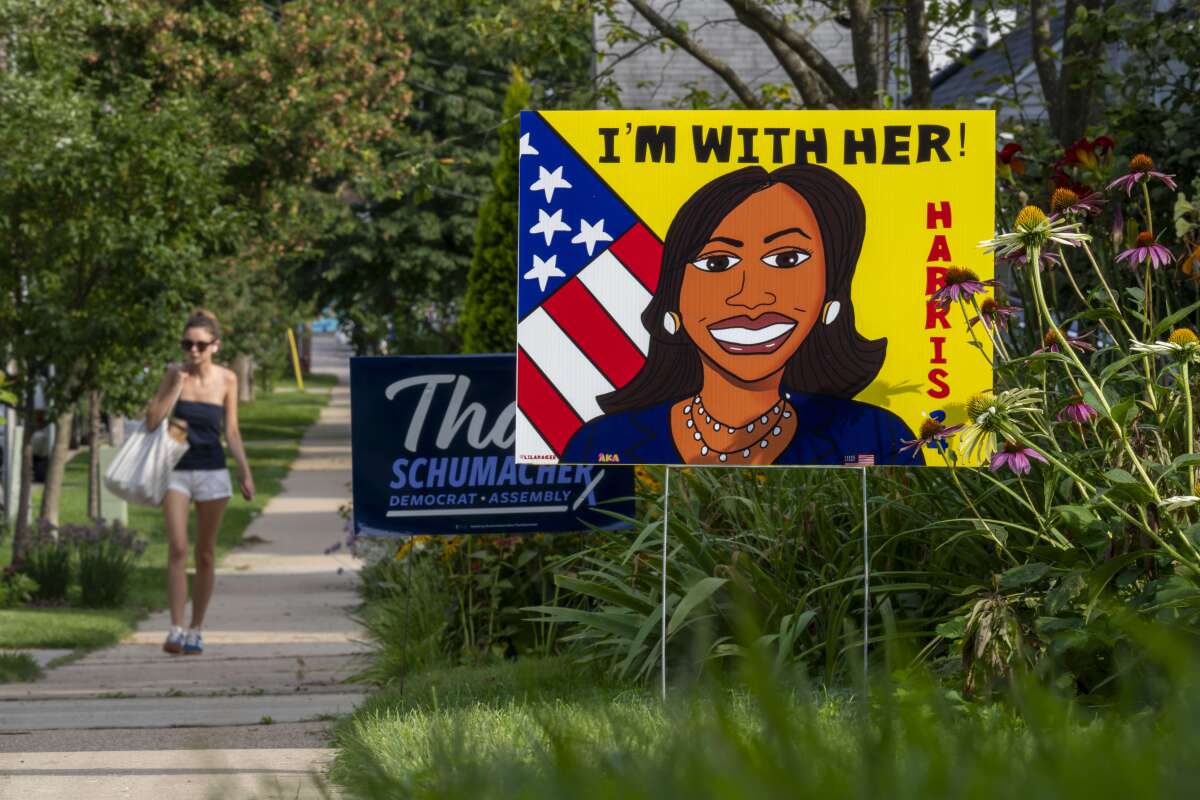
This colorful endorsement of Harris went up recently in Madison, the capital of Wisconsin. The crucial swing state helped Trump win the presidency in 2016 — and lose it in 2020.
(Kayla Wolf / Associated Press)
Cornell Belcher, a pollster who worked for both Obama campaigns, said Harris may not be able to restore Obama’s broad coalition. But it “makes all the sense in the world” for her to follow Obama’s strategy of “pressing for expansion” on the electoral map, he said — “going more places and making Republicans play defense more.”
Harris has to “secure the blue wall, hard stop,” Belcher said, and will definitely be paying attention to — and spending time in — Wisconsin, Michigan and Pennsylvania.
But given her brimming campaign coffers, he said, she also has the “opportunity to go on the offensive” in other vulnerable places.
North Carolina, which Obama had flipped blue, more recently elected a Democratic governor in Roy Cooper, and may see diminished Republican turnout given GOP primary voters’ selection of far-right candidates in down-ballot races, Belcher said.
“It’s absolutely an opportunity if you have the resources,” he said of the Harris campaign. “And again, they have the resources.”
Georgia, he said, is also in play, with a “well-educated, upwardly mobile population and a growing segment of minority voters” who flipped both of the state’s U.S. Senate seats blue in the last election.
“For Democrats to not tap in to these changing dynamics within these states,” Belcher said, “would be malpractice.”
Harris doesn’t have a lot of time, but Belcher and others said it’s unclear how relevant that is. This race has been moving at lightning speed, the trajectory of polling in several states turned on a dime in the last couple of weeks, and Harris’ favorability ratings shot up in record time after Biden endorsed her.
“We’re in uncharted waters,” Belcher said. “There are no road maps for all of this.”
Alexander, of Bowling Green, said he still believes that Harris has a “tougher path” to winning than Trump due to the nature of the electoral college system — and he worries 2024 could be another “misfire election,” with Trump winning the electoral college despite Harris winning the popular vote.
“In a different time,” Alexander said, “it would be seen as a constitutional crisis.”

Politics
Fetterman unleashes on ‘dirtbag’ wing of Dems after far-left victories: ‘Orgy of socialism’

NEWYou can now listen to Fox News articles!
Sen. John Fetterman, D-Pa., unloaded on his own party on Sunday evening, blasting a series of victories for progressives he called “anti-America.”
“Big night for the dirtbag left,” Fetterman said, referring to New York’s recent primaries, where two members of the Democratic Socialists of America (DSA) won primaries.
“I’ve said the party is becoming an orgy of socialism. Clearly anti-America, anti-Western Civilization,” Fetterman said.
Fetterman’s striking calls give a rare look at how some moderates may view the developments on their far-left flank that have dominated the party’s momentum in recent months, sparking concern that their high visibility is dragging the party further and further left.
FETTERMAN WARNS DEMOCRATS ‘DRIFTING FIRMLY INTO COMMUNISM’ AFTER SOCIALIST PRIMARY WINS
Sen. John Fetterman, D-Pa., speaks to reporters outside the Senate Chamber during votes on Nov. 10, 2025, on Capitol Hill in Washington, D.C. (Andrew Harnik/Getty Images)
His comments come on the heels of a handful of key progressive victories.
In Maine, Graham Platner, a controversial Democratic candidate for U.S. Senate, has attracted controversy for denying knowledge of the meaning behind a Nazi-linked tattoo, for off-color comments about race and calling himself a “communist” in a deleted Reddit post.
In New York, one DSA member, Claire Valdez, won a primary on a platform of abolishing ICE and a Green New Deal-style approach to climate change. Similarly, Darializa Avila-Chevalier, another DSA candidate, beat out incumbent Rep. Adriano Espillat, D-N.Y., a high-ranking Democrat and the chair of the Congressional Hispanic Caucus.
WINNERS AND LOSERS EMERGE AFTER SOCIALIST EARTHQUAKE ROCKS NYC PRIMARIES
Graham Platner, Democratic Senate candidate for Maine, speaks at a primary election night event at the Blue Hill YMCA in Blue Hill, Maine, on June 9, 2026. Platner won the party’s Senate primary after a campaign marked by accusations of past misbehavior and voter concerns. (Graeme Sloan/Bloomberg via Getty Images)
Both Chevalier and Valdez had the backing of New York Mayor Zohran Mamdani, himself a socialist.
The wins have captured national attention and drawn criticisms from Republicans who have pointed to their success as emblematic of the direction of the Democratic Party.
Fetterman, who has not shied away from confrontations, has been one of the few Democrats to express alarm about the kind of candidates carrying the party’s banner.
“I mean, you look at some of the things that people have said. Abolish prison, abolish the border, abolish ICE, I mean these crazy people — I have colleagues in my caucus that refuse to even call this out,” Fetterman said.
FETTERMAN REACTS TO MAMDANI’S REFUSAL TO ACCEPT SUPREME COURT’S IMMIGRATION RULING
U.S. Sen. John Fetterman, D-Pa., walks through the Senate Subway during the Senate War Powers vote on April 22, 2026, in Washington, D.C. (Heather Diehl/Getty Images)
CLICK HERE TO DOWNLOAD THE FOX NEWS APP
“Between P-hustle in Maine and some of the other winners in New York, they should form their own party and run on all the things that they’ve had to delete on social media,” Fetterman said, referring to Platner.
“That’s where our party has moved,” he added.
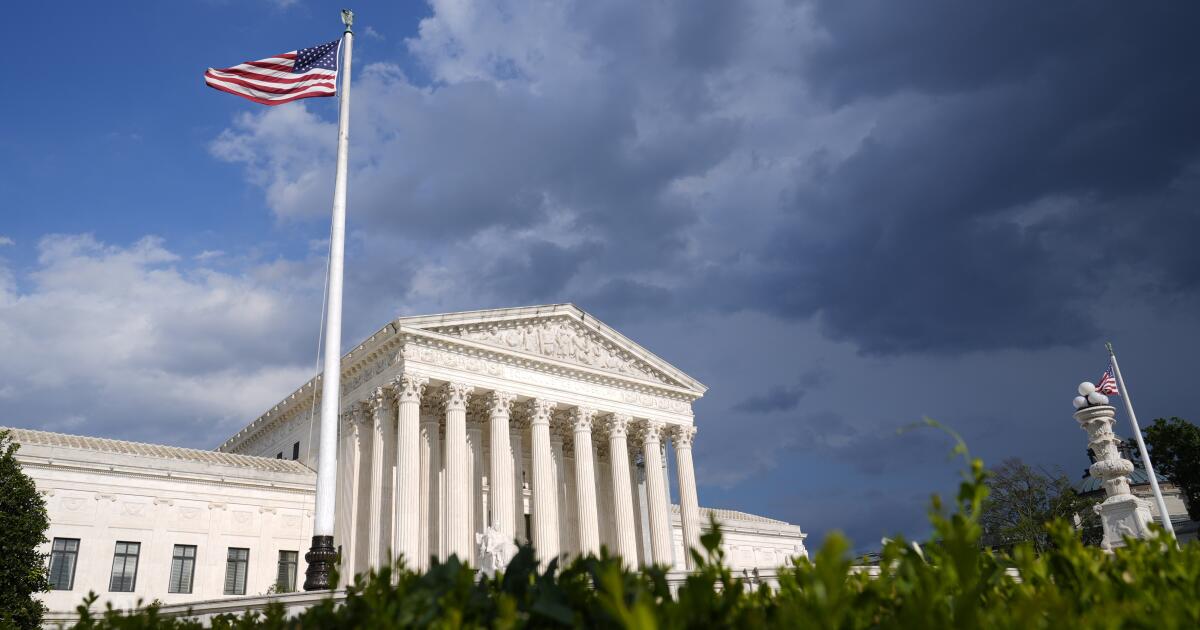
WASHINGTON — The Supreme Court cast doubt Monday on whether police may obtain cellphone data to find crime suspects.
In a 6-3 decision, the justices said this location information showing where a cellphone user has traveled is personal and private and subject to the protection of the 4th Amendment’s ban on unreasonable searches.
Justice Elena Kagan said these “records serve as a personal journal of a user’s movements.”
She said the information “resembles other private materials — think of emails, documents, photographs, or calendars—that even if stored on Google’s servers, a user reasonably views as his own…and reasonably expects to be shielded from the inquisitive eyes of the government.”
Because an “individual has a legitimate expectation of privacy in his cellphone location data,” she said police investigators need a valid search warrant from a magistrate.
The court stopped short of deciding the proper basis for a search warrant in such cases. Instead, the justices sent the case back to judges in Virginia.
But the outcome casts doubt on “geofence warrants.”
In recent years, police have gone to Google and cellphone companies seeking tracking data on cellphones that were at a crime scene. Sometimes, they have had a warrant from a magistrate.
Civil libertarians say the use of this tracking data raises the specter of mass surveillance on innocent people.
Police and government lawyers say no one has a reasonable right to privacy when they are walking on a sidewalk or driving down the street.
The case before the court arose from the armed robbery conviction of a Virginia man who stole $195,000 from a credit union in a small town near Richmond.
By the time police arrived, the robber had fled. But surveillance cameras showed he was carrying a gun and a cellphone.
Lacking other leads, detective Joshua Hilton asked a judge to issue a special type of warrant seeking information from Google.
Referred to as a “geofence warrant,” it seeks data from phones in a particular area at a particular time.
The detective sought data on phones that were within 150 yards of the credit union within one hour of the late afternoon robbery.
After examining and paring down the data, the detective asked for the phone records of Okello Chatrie. Then, with a search warrant of his home, investigators found two robbery-style demand notes, a semi-automatic pistol and about $100,000 in cash.
A judge refused to suppress the evidence from an allegedly unconstitutional search, and Chatrie entered a conditional guilty plea.
The full 4th Circuit Court of Appeals split evenly on the legality of the geofence warrant, and the Supreme Court agreed to decide the issue in Chatrie vs. U.S.
Usually investigators obtain warrants to search the home or vehicle of a known crime suspect.
The new and disputed geofence warrants seek to find a suspect by examining data on the cellphones that were at the scene of a crime.
The FBI used this cellphone data in 2021 to identify suspects who broke through police barricades on Jan. 6, 2021, and pushed their way into the Capitol to disrupt the official counting of electoral votes.
Chief Justice John G. Roberts Jr. and Justices Sonia Sotomayor, Neil M. Gorsuch, Brett M. Kavanaugh and Ketanji Brown Jackson agreed on the outcome in Chatrie vs. U.S.
In a 21-page dissent, Justice Samuel A. Alito Jr. said the court had “carefully set the stage for its planned performance: striking a pose as a great champion of privacy in the digital age. I cannot support this irresponsible escapade.”
Justice Clarence Thomas agreed.
Justice Amy Coney Barrett agreed in a one-paragraph dissent. “Chatrie had no reasonable expectation of privacy in data about his public movements that he voluntarily disclosed to Google,” she said.
The Supreme Court ruled 6-3 that President Trump could fire independent regulators for any reason. But the justices carved out an exception for the Federal Reserve, preventing the immediate removal of Lisa D. Cook, a Federal Reserve governor.
-
 Cleveland, OH3 minutes ago
No idling: Why it’s against the law in Cleveland
-

 Austin, TX10 minutes ago
Home Automation Austin Brings Personalized, Full-Service Home Automation to Homeowners in Austin
-

 Alabama13 minutes ago
Former Alabama Inmate Arrested After Allegedly Flying Drone with Contraband Toward Prison
-

 Alaska18 minutes ago
As war stalls, Putin concedes he never cut a deal with Trump in Alaska
-

 Arizona25 minutes ago
Flags are at half-staff today in Arizona. Here’s who is being honored
-

 Arkansas28 minutes ago
What Is The Arkansas Razorbacks Toughest Stretch of the 2026 Season?
-

 California33 minutes ago
Southern California residents say HOA made them take down American flags
-

 Colorado40 minutes ago
Colorado’s Most Beautiful State Parks, Ranked By A Colorado Local

